---
title: Demeter
author: Mark Cartwright
source: https://www.worldhistory.org/demeter/
format: machine-readable-alternate
license: Creative Commons Attribution-NonCommercial-ShareAlike (https://creativecommons.org/licenses/by-nc-sa/4.0/)
updated: 2023-08-28
---
# Demeter
_Authored by [Mark Cartwright](https://www.worldhistory.org/user/markzcartwright/)_
Demeter was one of the oldest gods in the ancient [Greek](https://www.worldhistory.org/disambiguation/greek/) [pantheon](https://www.worldhistory.org/Pantheon/). Demeter was a goddess of [agriculture](https://www.worldhistory.org/disambiguation/Agriculture/) and guaranteed the fertility of the earth. She protected both farming and vegetation. The close connection with the earth was inherited from Demeter's mother [Rhea](https://www.worldhistory.org/Rhea/). Demeter was probably a reincarnation of local mother Earth goddesses worshipped in rural communities in [Bronze Age](https://www.worldhistory.org/disambiguation/Bronze_Age/) [Greece](https://www.worldhistory.org/greece/).
The sanctuary at [Eleusis](https://www.worldhistory.org/Eleusis/) is dedicated to both the goddess and her daughter [Persephone](https://www.worldhistory.org/persephone/). This was the location of the famous Eleusinian Mysteries. From Eleusis, the idea spread across the [Archaic](https://www.worldhistory.org/disambiguation/Archaic/) and Classical Greek worlds that Demeter would protect her worshippers in the afterlife. To the Romans, the goddess remained popular and was known as [Ceres](https://www.worldhistory.org/Ceres/).
### Demeter's Family
Daughter of Kronos and Rhea, sister of [Zeus](https://www.worldhistory.org/zeus/), [Poseidon](https://www.worldhistory.org/poseidon/), [Hades](https://www.worldhistory.org/Hades/), [Hera](https://www.worldhistory.org/Hera/), and [Hestia](https://www.worldhistory.org/Hestia/), Demeter was the mother of Persephone and Iacchus (both with Zeus) and [Plutus](https://www.worldhistory.org/disambiguation/Plutus/), the [god](https://www.worldhistory.org/God/) of wealth (with the mortal Cretan Iasion, who was subsequently killed by a thunderbolt from a jealous Zeus). She also adopted Demophon, the Eleusinian prince, who gave the human race the gifts of the plough and knowledge of agriculture. Demeter was also pursued by Poseidon, and to escape his attentions, she changed into a mare; however, Poseidon too changed into a horse and their resulting offspring was Arion, the winged horse ridden by [Hercules](https://www.worldhistory.org/hercules/). Demeter and Persephone were very often paired together and sometimes even referred to as a single goddess with a dual aspect. The duo was often referred to as 'the Two Goddesses' and the *Demeteres* (two Demeters).
### Demeter & Persephone
The most important [mythology](https://www.worldhistory.org/mythology/) surrounding Demeter was the story of the rape of her daughter Persephone (also known as Kore in Greek and Proserpina by the Romans) by Hades, the god of the Underworld. One day Hades fell in love with Persephone as soon as he saw her and so carried her off in his [chariot](https://www.worldhistory.org/chariot/) to live with him in Hades, the Greek underworld. In some accounts, Zeus had given his consent to the abduction, the location of the crime being traditionally placed in either [Sicily](https://www.worldhistory.org/sicily/) (famed for its fertility) or Asia. Distraught, Demeter searched the earth for her lost daughter and though [Helios](https://www.worldhistory.org/Helios/) (or [Hermes](https://www.worldhistory.org/Hermes/)) told her of her daughter's fate, she, nevertheless, continued her wanderings until she finally arrived at Eleusis. It was here, disguised as an old woman, that the goddess cared for Demophon (or Triptolemus), the only son of Metaneira, the wife of Keleos (or Celeus), king of Eleusis. To reward the family for their kindness, Demeter set about making Demophon immortal by placing him on a fire every night. However, when Metaneira saw this she raised an alarm. In response, Demeter revealed her true identity and demanded a [temple](https://www.worldhistory.org/temple/) be built in her honour. This was the beginning of the celebrated sanctuary of Eleusis in Attica (see below).
[  Demeter & Persephone Osama Shukir Muhammed Amin (Copyright) ](https://www.worldhistory.org/image/5080/demeter--persephone/ "Demeter & Persephone")Once the temple was completed, Demeter withdrew from the world and lived inside it; at the same time, she created a great drought to convince the other gods to release Persephone from Hades. As the drought claimed ever more victims, crops withered (illustrating Persephone's mastery over agriculture), and there was so little food that mortals could not even offer their sacrifices to the gods, Zeus finally persuaded Hades to release his ill-gotten bride. Before giving her up though, the wily Hades put a pomegranate kernel in the girl's mouth, knowing its divine taste would compel her to return to him. In other versions of the myth, Persephone could have been released if she had not eaten anything in the underworld during her captivity, but at the last moment, Hades gave her a pomegranate seed. Finally, as a compromise, it was decided that Persephone would be released but that she would have to return to Hades for one-third of the year (or in other accounts one half). In gratitude for the return of her daughter, Demeter was said to have sent the prince Demophon to teach humanity the cultivation of grain and other tricks useful for agriculture.
### Demeter & the Eleusinian Mysteries
The story of Demeter and Persephone was perhaps symbolic of the changing seasons and the perennial change from life to death, to life once more, or, in other words, the changes from summer to winter and the return of life in spring. An alternative view of more modern historians is that the disappearance of Peresphone is symbolic of the practice of burying seeds in the summer so that they did not dry out before they could be sown in the autumn. The cycle became one of the rituals of the sacred Eleusinian Mysteries; indeed the symbols of the cult were ears of grain and a torch - symbolic of Demeter's search for Persephone and a reminder that the rituals at Eleusis were carried out at night.
[ 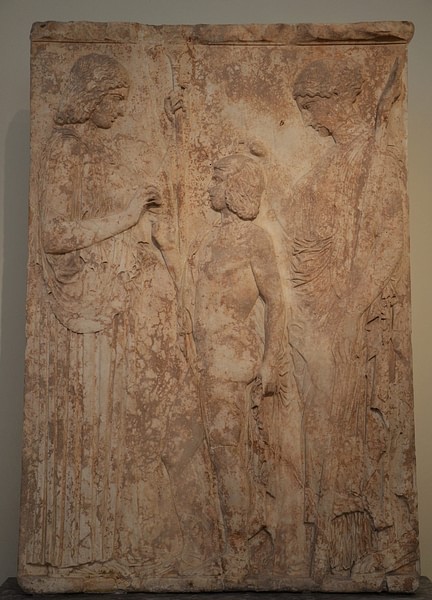 Eleusinian votive relief Carole Raddato (CC BY-SA) ](https://www.worldhistory.org/image/3511/eleusinian-votive-relief/ "Eleusinian votive relief")Eleusis became the most important sanctuary to Demeter, and the site has a religious connection and related monuments dating back to the [Mycenaean civilization](https://www.worldhistory.org/Mycenaean_Civilization/) of the 15th century BCE. From c. 600 BCE the Eleusinian Mysteries became an official ceremony in the [Athenian calendar](https://www.worldhistory.org/article/833/the-athenian-calendar/), and Eleusis became a truly [pan](https://www.worldhistory.org/Pan/)-[Hellenic](https://www.worldhistory.org/greece/) site under the Athenian dictator [Peisistratus](https://www.worldhistory.org/Pisistratus/) (r. 550-510 BCE). In the 5th century BCE [Pericles](https://www.worldhistory.org/pericles/), the Athenian statesman (l. 495-429 BCE), oversaw the construction of a new Telesterion (Initiation Hall and temple), then the largest building in Greece. The site continued to attract pilgrims and worshippers well into [Roman](https://www.worldhistory.org/disambiguation/Roman/) times with emperors [Hadrian](https://www.worldhistory.org/hadrian/) (r. 117-138 CE) and [Marcus Aurelius](https://www.worldhistory.org/Marcus_Aurelius/) (r. 161-180 CE) aggrandising Eleusis. The sanctuary's fortunes declined significantly following the decree of Theodosius I (r. 379-395 CE) to close down all pagan sites in 379 CE, and Eleusis was destroyed around 395 CE following the invasion of the [Visigoths](https://www.worldhistory.org/visigoth/).
Unfortunately for us today, because all initiates were bound by a sacred oath not to reveal details of the Eleusinian Mysteries, they have to this day remained just that, a mystery. We do know that, from the 6th century BCE, the ceremonies were held twice a year. The first step in the initiation process was known as the "Lesser Mysteries" and held every spring. The more important "Great Mysteries" were held in the autumn over nine days. Only Greeks could be initiated, although this was later expanded to include Roman citizens. We also know details of some of the outdoor activities, and there was a procession led by the priestess of Demeter along the Sacred Way from Eleusis to the [agora](https://www.worldhistory.org/agora/) of [Athens](https://www.worldhistory.org/Athens/) and another return procession led by a symbolic chariot of Iacchus. There were ritual and communal cleansing and purification ceremonies carried out in the sea at Phaleron, the representation or re-enactment of the myths involving the two goddesses, animal sacrifices (pigs), and the interpretation of sacred texts by priests, the *mystagōgoi*. There was also probably drinking, [music](https://www.worldhistory.org/disambiguation/Music/), dancing, and general revelry involved, as attested by [Greek pottery](https://www.worldhistory.org/Greek_Pottery/) scenes of the rites which show initiates holding the "*[bacchus](https://www.worldhistory.org/Bacchus/)*" or sacred rod. Closely associated with fertility and agriculture, the mysteries probably brought worshippers good fortune and, perhaps most important for most participants, the promise of a better afterlife.
### Other Places of Demeter Worship
Demeter had sanctuaries across the Greek world in most [city](https://www.worldhistory.org/city/)-states. [Homer](https://www.worldhistory.org/homer/) mentions that the goddess had a precinct named after her at Pyrasos. From the 8th century BCE there was a particularly noted sanctuary and temple to Demeter on [Naxos](https://www.worldhistory.org/Naxos/). In the 4th century BCE, a temple was constructed in her honour at Dion. Other notable sites of worship included Andania in Messenia, Lykosoura in Arcadia, and, perhaps most curiously, at Phigaleia, also in Arcadia, where a cult statue of the goddess was placed in a cave which had a horse's head, probably in reference to Demeter's amorous encounter with Poseidon. Many southern Italian city-states, especially in Sicily, had important cults to Demeter where she was often associated with civic duties, a link also seen in her worship at [Thebes](https://www.worldhistory.org/disambiguation/Thebes/).
[  Persephone, Demeter, & Pluto Marble Plaque, Tegea. Dan Diffendale (CC BY-NC-SA) ](https://www.worldhistory.org/image/5694/persephone-demeter--pluto-marble-plaque-tegea/ "Persephone, Demeter, & Pluto Marble Plaque, Tegea.")Besides the mystery cult, at Eleusis during the Archaic and Classical periods there was the Eleusinia, an important biannual games where the prizes were sacred grain. The Thesmophoria, meanwhile, was an all-female autumn festival in Attica to honour Demeter. Designed to generally promote fertility, the festival saw pigs thrown into pits or caves and left to putrefy; their remains were then mixed with seeds before sowing. Although not particularly informative about the festival itself, [Aristophanes](https://www.worldhistory.org/Aristophanes/) (c. 460 - c. 380 BCE), the master of [Greek comedy](https://www.worldhistory.org/Greek_Comedy/), wrote the play *[Thesmophoriazusae](https://www.worldhistory.org/Thesmophoriazusae/)* (411 BCE) where, during the festival, [women](https://www.worldhistory.org/disambiguation/women/) take advantage of the traditional exclusion of men and debate the elimination of [Euripides](https://www.worldhistory.org/Euripides/) (c. 484-407 BCE), one of the great writers of [Greek tragedy](https://www.worldhistory.org/Greek_Tragedy/). There was, too, the Haloa, another largely all-female winter festival in honour of Demeter and [Dionysos](https://www.worldhistory.org/Dionysos/), the Kalamaia, and the Proerosia festivals.
### How is Demeter Represented in Art?
In ancient [literature](https://www.worldhistory.org/literature/), Homer in *The [Iliad](https://www.worldhistory.org/iliad/)* describes the goddess as 'golden-haired', and [Hesiod](https://www.worldhistory.org/hesiod/) in his *[Theogony](https://www.worldhistory.org/Theogony/)* and *Works & Days*, describes her as 'bounteous Demeter', 'well-garlanded', 'hallowed', and 'reverend'. Demeter rarely appears in the visual arts before the 6th century BCE and then she is usually shown with Persephone. In Archaic and Classical art she is often seated, wears a crown of grain and holds a torch (signifying her search for her lost daughter) or a sceptre, a poppy (the flower that grows so abundantly in untended wheat fields) or simply stalks of grain. In her role as a goddess of fertility, Demeter is also sometimes present in scenes depicting the birth of [Athena](https://www.worldhistory.org/athena/). From Eleusis, there are surviving relief panels showing both Demeter and Persephone which once adorned the sacred buildings at this her most important sacred site.
#### Editorial Review
This human-authored definition has been reviewed by our editorial team before publication to ensure accuracy, reliability and adherence to academic standards in accordance with our [editorial policy](https://www.worldhistory.org/static/editorial-policy/).
## Bibliography
- Anonymous. *Ancient Greece Temples And Sanctuaries.* Toubis, Athens, 2010
- Bagnall, R. (ed). *The Encyclopedia of Ancient History.* Wiley-Blackwell, 2012
- Carabatea, M. *Greek Mythology.* Pergamos, Peania, 2007
- [Carpenter, T.H. *Art and Myth in Ancient Greece.* Thames & Hudson, 1991.](https://www.worldhistory.org/books/0500202362/)
- [Graves, R. *The Greek Myths.* Penguin Classics, 2012.](https://www.worldhistory.org/books/0143106716/)
- [Graziosi, B. *The Gods of Olympus.* Picador Paper, 2015.](https://www.worldhistory.org/books/1250062349/)
- [Hesiod. *Hesiod.* Loeb Classical Library, 2007.](https://www.worldhistory.org/books/0674996224/)
- [Homer. *The Iliad.* Penguin Classics, 1998.](https://www.worldhistory.org/books/0140275363/)
- Hope Moncrieff, A.R. *Classical Mythology.* Senate, London, 1994
- [Hornblower, S. *The Oxford Classical Dictionary.* Oxford University Press, 2012.](https://www.worldhistory.org/books/0199545561/)
- [National Geographic. *National Geographic Essential Visual History of World Mythology.* National Geographic, 2008.](https://www.worldhistory.org/books/142620373X/)
## About the Author
Mark is WHE’s Publishing Director and has an MA in Political Philosophy (University of York). He is a full-time researcher, writer, historian and editor. Special interests include art, architecture and discovering the ideas that all civilizations share.
## Timeline
- **c. 1500 BCE**: First [temple](https://www.worldhistory.org/temple/) to [Demeter](https://www.worldhistory.org/demeter/) & [Persephone](https://www.worldhistory.org/persephone/) is built at [Eleusis](https://www.worldhistory.org/Eleusis/).
- **c. 700 BCE**: [Greek](https://www.worldhistory.org/disambiguation/greek/) poet [Hesiod](https://www.worldhistory.org/hesiod/) writes his *[Theogony](https://www.worldhistory.org/Theogony/)* and *[Works and Days](https://www.worldhistory.org/Works_and_Days/)*.
- **700 BCE - 600 BCE**: Temples are built in honour of [Apollo](https://www.worldhistory.org/apollo/), [Demeter](https://www.worldhistory.org/demeter/) and [Dionysos](https://www.worldhistory.org/Dionysos/) on the island of [Naxos](https://www.worldhistory.org/Naxos/).
- **c. 600 BCE**: The Eleusinian Mysteries become part of the official Athenian religious calendar.
## Questions & Answers
### Who was Demeter to Hades?
Demeter's daughter Persephone was abducted by Hades, the Greek god of the Underworld.
### Did Zeus and Demeter have a child?
Zeus and Demeter had two children: Persephone and Iacchus.
### Why did Zeus leave Demeter?
Zeus left Demeter because she had an affair with the mortal Cretan Iasion and had a son, Plutus, the god of wealth. Zeus killed Iasion with a thunderbolt.
## External Links
- [Persephone, The Greek Goddess Of The Underworld And Spring](https://allthatsinteresting.com/persephone)
## Cite This Work
### APA
Cartwright, M. (2019, November 12). Demeter. *World History Encyclopedia*.
### Chicago
Cartwright, Mark. "Demeter." *World History Encyclopedia*, November 12, 2019. .
### MLA
Cartwright, Mark. "Demeter." *World History Encyclopedia*, 12 Nov 2019, .
## License & Copyright
Submitted by [Mark Cartwright](https://www.worldhistory.org/user/markzcartwright/ "User Page: Mark Cartwright"), published on 12 November 2019. The copyright holder has published this content under the following license: [Creative Commons Attribution-NonCommercial-ShareAlike](https://creativecommons.org/licenses/by-nc-sa/4.0/deed.en). This license lets others remix, tweak, and build upon this content non-commercially, as long as they credit the author and license their new creations under the identical terms. When republishing on the web a hyperlink back to the original content source URL must be included. Please note that content linked from this page may have different licensing terms.