---
title: Delphi
author: Mark Cartwright
source: https://www.worldhistory.org/delphi/
format: machine-readable-alternate
license: Creative Commons Attribution-NonCommercial-ShareAlike (https://creativecommons.org/licenses/by-nc-sa/4.0/)
updated: 1970-01-01
---
# Delphi
_Authored by [Mark Cartwright](https://www.worldhistory.org/user/markzcartwright/)_
Delphi was an important ancient [Greek](https://www.worldhistory.org/disambiguation/greek/) religious sanctuary sacred to the [god](https://www.worldhistory.org/God/) [Apollo](https://www.worldhistory.org/apollo/). Located on Mt. Parnassus near the Gulf of [Corinth](https://www.worldhistory.org/corinth/), it was home to the famous oracle of Apollo which gave cryptic predictions and guidance to both [city](https://www.worldhistory.org/city/)-states and individuals. In addition, Delphi was also home to the panhellenic Pythian Games. Delphi is a UNESCO World Heritage Site.
### [Mythology](https://www.worldhistory.org/mythology/) & Origins
The site was first settled in [Mycenaean](https://www.worldhistory.org/Mycenaean_Civilization/) times in the late [Bronze Age](https://www.worldhistory.org/disambiguation/Bronze_Age/) (1500-1100 BCE) but took on its religious significance from around 800 BCE. The original name of the sanctuary was Pytho after the snake which Apollo was believed to have killed there. Votive offerings at the site from this period include small clay statues (the earliest), [bronze](https://www.worldhistory.org/disambiguation/bronze/) figurines, and richly decorated bronze tripods.
Delphi was also considered the centre of the world, for in [Greek mythology](https://www.worldhistory.org/Greek_Mythology/) [Zeus](https://www.worldhistory.org/zeus/) released two eagles, one to the east and another to the west, and Delphi was the point at which they met after encircling the world. This fact was represented by the *omphalos* (or navel), a dome-shaped stone which stood outside Apollo's [temple](https://www.worldhistory.org/temple/) and which also marked the spot where Apollo killed the Python.
### Apollo's Oracle
The oracle of Apollo at Delphi was famed throughout the Greek world and even beyond. The oracle - the [Pythia](https://www.worldhistory.org/Pythia/) or priestess - would answer questions put to her by visitors wishing to be guided in their future actions. The whole process was a lengthy one, usually taking up a whole day and only carried out on specific days of the year. First the priestess would perform various actions of purification such as washing in the nearby Castalian Spring, burning laurel leaves, and drinking holy water. Next an animal - usually a goat - was sacrificed. The party seeking advice would then offer a *pelanos* - a sort of pie - before being allowed into the inner temple where the priestess resided and gave her pronouncements, possibly in a drug or natural gas-induced state of ecstasy.
[  The Oracle at Delphi (Artist's Impression) Mateusz Przeklasa (Copyright) ](https://www.worldhistory.org/image/15380/the-oracle-at-delphi-artists-impression/ "The Oracle at Delphi (Artist's Impression)")Perhaps the most famous consultant of the Delphic oracle was [Croesus](https://www.worldhistory.org/croesus/), the fabulously rich King of [Lydia](https://www.worldhistory.org/lydia/) who, faced with a [war](https://www.worldhistory.org/disambiguation/War/) against the Persians, asked the oracle's advice. The oracle stated that if Croesus went to war then a great [empire](https://www.worldhistory.org/empire/) would surely fall. Reassured by this, the Lydian king took on the mighty [Cyrus](https://www.worldhistory.org/disambiguation/Cyrus/). However, the Lydians were routed at [Sardis](https://www.worldhistory.org/sardis/) and it was the Lydian empire which fell, a lesson that the oracle could easily be misinterpreted by the unwise or over-confident.
### Panhellenic Games
Delphi, as with the other major religious sites of [Olympia](https://www.worldhistory.org/Olympia/), [Nemea](https://www.worldhistory.org/nemea/), and [Isthmia](https://www.worldhistory.org/Isthmia/), held games to honour various gods of the [Greek religion](https://www.worldhistory.org/Greek_Religion/). The Pythian Games of Delphi began sometime between 591 and 585 BCE and were initially held every eight years, with the only event being a musical competition where solo singers accompanied themselves on a [kithara](https://www.worldhistory.org/Kithara/) to sing a hymn to Apollo. Later, more musical contests and athletic events were added to the programme, and the games were held every four years with only the [Olympic Games](https://www.worldhistory.org/Olympic_Games/) being more important. The principal prize for victors in the Games was a crown of laurel or bay leaves.
The site and games were managed by the independent Delphic *amphictiony* - a council with representatives from various nearby city-states - which levied taxes, collected offerings, invested in construction programmes, and even organised military campaigns in the Four Sacred Wars, fought to redress sacrilegious acts against Apollo perpetrated by the states of Crisa, Phocis, and Amphissa.
[ 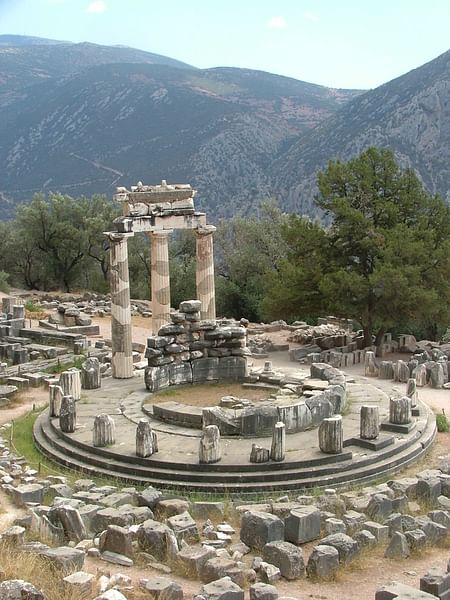 Tholos of Delphi Kufoleto (CC BY-SA) ](https://www.worldhistory.org/image/1315/tholos-of-delphi/ "Tholos of Delphi")### [Architecture](https://www.worldhistory.org/disambiguation/architecture/)
The first temple in the area was built in the 7th century BCE and was itself a replacement for less substantial buildings of worship which had stood before it. The focal point of the sanctuary, the Doric temple of Apollo, was unfortunately destroyed by fire in 548 BCE. A second temple, again Doric in style, was completed in c. 510 BCE with the help of the exiled Athenian family, the Alcmeonids. Measuring some 60 by 24 metres, the facade had six columns whilst the sides had 15. This temple was destroyed by [earthquake](https://www.worldhistory.org/disambiguation/earthquake/) in 373 BCE and was replaced by a similarly proportioned temple in 330 BCE. This was constructed with poros stone coated in stucco. Marble [sculpture](https://www.worldhistory.org/disambiguation/Sculpture/) was also added as decoration along with Persian shields taken at the [Battle](https://www.worldhistory.org/disambiguation/battle/) of [Marathon](https://www.worldhistory.org/marathon/). This is the temple which survives, albeit only partially, today.
Other notable constructions at the site were the [theatre](https://www.worldhistory.org/disambiguation/theatre/) (with capacity for 5,000 spectators), temples to [Athena](https://www.worldhistory.org/athena/) (4th century BCE), a tholos with 13 Doric columns (c. 580 BCE), stoas, [stadium](https://www.worldhistory.org/Stadium/) (with capacity for 7,000 spectators), and around 20 treasuries, which were constructed to house the votive offerings and dedications from city-states all over [Greece](https://www.worldhistory.org/greece/). Notable amongst these mini-temples are the Athenian Treasury and the Siphnian Treasury.
Similarly, monuments were also erected to commemorate military victories and other important events. For example, the Spartan general [Lysander](https://www.worldhistory.org/Lysander/) erected a monument to celebrate his victory over [Athens](https://www.worldhistory.org/Athens/) at Aegospotami. Other notable monuments were the great bronze Bull of [Corcyra](https://www.worldhistory.org/corcyra/) (580 BCE), the ten statues of the kings of [Argos](https://www.worldhistory.org/argos/) (c. 369 BCE), a [gold](https://www.worldhistory.org/gold/) four-horse [chariot](https://www.worldhistory.org/chariot/) offered by [Rhodes](https://www.worldhistory.org/Rhodes/), and a huge bronze statue of the Trojan Horse offered by the Argives (c.413 BCE). Lining the sacred way, which wound from the sanctuary gate up to the temple of Apollo, the visitor must have been greatly impressed by the artistic and literal wealth on display. Alas, in most cases, only the monumental pedestals survive of these great statues, silent witnesses to a lost grandeur.
[  Gigantomachy, Treasury of the Siphians, Delphi Mark Cartwright (CC BY-NC-SA) ](https://www.worldhistory.org/image/417/gigantomachy-treasury-of-the-siphians-delphi/ "Gigantomachy, Treasury of the Siphians, Delphi")### Demise
In 480 BCE the Persians attacked the sanctuary and in 279 BCE the sanctuary was again attacked, this time by the Gauls. It was during the 3rd century BCE that the site came under the control of the Aitolian League. In 191 BCE Delphi passed into [Roman](https://www.worldhistory.org/disambiguation/Roman/) hands; however, the sanctuary and the games continued to be culturally important in Roman times, in particular under [Hadrian](https://www.worldhistory.org/hadrian/). The decree by Theodosius in 393 CE to close all pagan sanctuaries resulted in Delphi's gradual decline. A Christian community dwelt at the site for several centuries until its final abandonment in the 7th century CE.
The site was 're-discovered' with the first modern excavations being carried out in 1880 CE by a team of French archaeologists. Notable finds were splendid metope sculptures from the treasury of the Athenians (c. 490 BCE) and the Siphnians (c. 525 BCE) depicting scenes from Greek mythology. In addition, a bronze charioteer in the severe style (480-460 BCE), the marble [Sphinx](https://www.worldhistory.org/sphinx/) of the Naxians (c. 560 BCE), the twin marble [archaic](https://www.worldhistory.org/disambiguation/Archaic/) statues - the *kouroi* of Argos (c. 580 BCE) and the richly decorated *omphalos* stone (c. 330 BCE) - all survive as testimony to the cultural and artistic wealth that Delphi had once enjoyed.
#### Editorial Review
This human-authored definition has been reviewed by our editorial team before publication to ensure accuracy, reliability and adherence to academic standards in accordance with our [editorial policy](https://www.worldhistory.org/static/editorial-policy/).
## Bibliography
- Ananiades, D. *Ancient Greece: Temples & Sanctuaries.* Toubis, Athens, 2010
- Hornblower, S. *The Oxford Classical Dictionary.* OUP, Oxford, 2012
- Kolonia, R. *Delphi Archaeological Museum.* MOCARF, Athens
## About the Author
Mark is WHE’s Publishing Director and has an MA in Political Philosophy (University of York). He is a full-time researcher, writer, historian and editor. Special interests include art, architecture and discovering the ideas that all civilizations share.
## Timeline
- **1500 BCE**: The site of [Delphi](https://www.worldhistory.org/delphi/) is first settled.
- **c. 800 BCE**: The site of [Delphi](https://www.worldhistory.org/delphi/) first acquires a religious significance.
- **c. 650 BCE**: The first [temple](https://www.worldhistory.org/temple/) in honour of [Apollo](https://www.worldhistory.org/apollo/) is built at [Delphi](https://www.worldhistory.org/delphi/).
- **c. 580 BCE**: The kouroi of [Argos](https://www.worldhistory.org/argos/), thought to represent Cleobis & Biton, are sculpted.
- **560 BCE**: The oracles of [Delphi](https://www.worldhistory.org/delphi/) and [Thebes](https://www.worldhistory.org/disambiguation/Thebes/) both tell King [Croesus](https://www.worldhistory.org/croesus/) of [Lydia](https://www.worldhistory.org/lydia/) that if he attacks the [Medes](https://www.worldhistory.org/Medes/), he will destroy a great [empire](https://www.worldhistory.org/empire/). Seeing this as a good omen, he goes to [war](https://www.worldhistory.org/disambiguation/War/), loses, and the Lydian Empire is destroyed.
- **c. 560 BCE**: [Naxos](https://www.worldhistory.org/Naxos/) dedicates a large [column](https://www.worldhistory.org/column/) and [sphinx](https://www.worldhistory.org/sphinx/) to the oracle of [Apollo](https://www.worldhistory.org/apollo/) at [Delphi](https://www.worldhistory.org/delphi/).
- **c. 525 BCE**: The Treasury of the Siphnians is built at [Delphi](https://www.worldhistory.org/delphi/) which included [Caryatid](https://www.worldhistory.org/Caryatid/) [architecture](https://www.worldhistory.org/disambiguation/architecture/).
- **c. 510 BCE**: The second [temple](https://www.worldhistory.org/temple/) to [Apollo](https://www.worldhistory.org/apollo/) is constructed at [Delphi](https://www.worldhistory.org/delphi/), replacing the first temple destroyed by fire.
- **490 BCE**: [Athens](https://www.worldhistory.org/Athens/) builds a treasury at [Delphi](https://www.worldhistory.org/delphi/) following their victory at [Marathon](https://www.worldhistory.org/marathon/) against [Persia](https://www.worldhistory.org/Persia/).
- **480 BCE**: Persian forces attack the sanctuary of [Delphi](https://www.worldhistory.org/delphi/).
- **480 BCE - 460 BCE**: The [bronze](https://www.worldhistory.org/disambiguation/bronze/) charioteer of [Delphi](https://www.worldhistory.org/delphi/) is sculpted.
- **448 BCE**: [Pericles](https://www.worldhistory.org/pericles/) leads the Athenian forces in the [Battle](https://www.worldhistory.org/disambiguation/battle/) of [Delphi](https://www.worldhistory.org/delphi/).
- **373 BCE**: An [earthquake](https://www.worldhistory.org/disambiguation/earthquake/) destroys the [temple](https://www.worldhistory.org/temple/) of [Apollo](https://www.worldhistory.org/apollo/) at [Delphi](https://www.worldhistory.org/delphi/).
- **c. 330 BCE**: The third [temple](https://www.worldhistory.org/temple/) to [Apollo](https://www.worldhistory.org/apollo/) is constructed at [Delphi](https://www.worldhistory.org/delphi/), replacing the earlier temple damaged by [earthquake](https://www.worldhistory.org/disambiguation/earthquake/).
- **279 BCE**: Gauls attack the sanctuary of [Delphi](https://www.worldhistory.org/delphi/).
- **191 BCE**: [Delphi](https://www.worldhistory.org/delphi/) comes under [Roman](https://www.worldhistory.org/disambiguation/Roman/) control.
- **c. 67 CE**: Emperor [Nero](https://www.worldhistory.org/Nero/) competes at the panhellenic Games of [Olympia](https://www.worldhistory.org/Olympia/) and [Delphi](https://www.worldhistory.org/delphi/).
- **393 CE**: [Roman Emperor](https://www.worldhistory.org/Roman_Emperor/) Theodosius definitively ends all pagan Games in [Greece](https://www.worldhistory.org/greece/).
- **c. 591 CE - 585 CE**: The Pythian Games of [Delphi](https://www.worldhistory.org/delphi/) began.
## External Links
- [Oracles & Offerings - Ancient Greek World 04](https://ed.ted.com/on/kO96wl00)
- [In Our Time, The Delphic Oracle](https://www.bbc.co.uk/programmes/b00txj8d)
## Cite This Work
### APA
Cartwright, M. (2013, February 22). Delphi. *World History Encyclopedia*.
### Chicago
Cartwright, Mark. "Delphi." *World History Encyclopedia*, February 22, 2013. .
### MLA
Cartwright, Mark. "Delphi." *World History Encyclopedia*, 22 Feb 2013, .
## License & Copyright
Submitted by [Mark Cartwright](https://www.worldhistory.org/user/markzcartwright/ "User Page: Mark Cartwright"), published on 22 February 2013. The copyright holder has published this content under the following license: [Creative Commons Attribution-NonCommercial-ShareAlike](https://creativecommons.org/licenses/by-nc-sa/4.0/deed.en). This license lets others remix, tweak, and build upon this content non-commercially, as long as they credit the author and license their new creations under the identical terms. When republishing on the web a hyperlink back to the original content source URL must be included. Please note that content linked from this page may have different licensing terms.