---
title: Delos
author: Mark Cartwright
source: https://www.worldhistory.org/delos/
format: machine-readable-alternate
license: Creative Commons Attribution-NonCommercial-ShareAlike (https://creativecommons.org/licenses/by-nc-sa/4.0/)
updated: 1970-01-01
---
# Delos
_Authored by [Mark Cartwright](https://www.worldhistory.org/user/markzcartwright/)_
Delos is a [Greek](https://www.worldhistory.org/disambiguation/greek/) island in the [Cyclades](https://www.worldhistory.org/Cyclades/) archipelago which was both an influential political force and, with its sanctuary to the [god](https://www.worldhistory.org/God/) [Apollo](https://www.worldhistory.org/apollo/), an important religious centre in the [Archaic](https://www.worldhistory.org/disambiguation/Archaic/) and Classical periods. The island was also a major commercial and trading centre in the 2nd and 1st centuries BCE. Delos is listed by UNESCO as a World Heritage Site.
### Delos in [Mythology](https://www.worldhistory.org/mythology/)
Delos, measuring a mere 3 km², is a small island without any particular advantages for habitation due to its barrenness and lack of water. In [Greek mythology](https://www.worldhistory.org/Greek_Mythology/), this is precisely why [Leto](https://www.worldhistory.org/Leto/), escaping the wrath of [Hera](https://www.worldhistory.org/Hera/), was able to find sanctuary here in order to give birth to Apollo and [Artemis](https://www.worldhistory.org/artemis/). In some versions of the myth, [Zeus](https://www.worldhistory.org/zeus/) (Leto's lover) called on his brother [Poseidon](https://www.worldhistory.org/poseidon/) to create the island with a thrust of his trident, hence the name Delos, which signifies 'appearance' or 'apparent' in ancient Greek. The ancient Greeks also considered the island the centre of the Cycladic group and as the last resting place of the Hyperboreans - a legendary northern race of Apollo-worshippers.
### Historical Overview
The island was first inhabited in the early [Bronze Age](https://www.worldhistory.org/disambiguation/Bronze_Age/), and [Mycenaean](https://www.worldhistory.org/Mycenaean_Civilization/) tombs have been excavated dating from the late [Bronze](https://www.worldhistory.org/disambiguation/bronze/) Age. Colonised from [Ionia](https://www.worldhistory.org/ionia/) in the mid-10th century BCE, it was not, however, until the 8th century BCE that the site began to take on a religious significance in the wider Greek world. [Athens](https://www.worldhistory.org/Athens/), under [Pisistratus](https://www.worldhistory.org/Pisistratus/), took a greater interest in the island in the 6th century BCE and attempted to purify the island by a 'catharsis' - removing and prohibiting burials on the island from c. 540 BCE.
Delos further increased its importance when it was chosen as the meeting place and treasury for the [Delian League](https://www.worldhistory.org/Delian_League/) in 478 BCE. In 454 BCE the treasury was moved to Athens and the Athenians also took over administration of the site. Administration changed hands when [Antigonus](https://www.worldhistory.org/disambiguation/Antigonus/) established the League of Islanders in 314 BCE, which included Delos.
Following the Chremonidean [War](https://www.worldhistory.org/disambiguation/War/) (c. 266-261 BCE), Delos became an independent [polis](https://www.worldhistory.org/Polis/) for the next 150 years or so and was administered by a religious council of *hieropoioi*. In this period, the island enjoyed the generous patronage of various [Hellenistic](https://www.worldhistory.org/Hellenic_World/) kings. The island's independence came to an end in 166 BCE when the Romans gave control of Delos back to Athens, also making it a free [trade](https://www.worldhistory.org/disambiguation/trade/) port. This brought another period of prosperity, and the island became an important centre for the slave trade whilst its population greatly increased in size and ethnic diversity, a fact reflected in the adoption of diverse religious cults on the island, such as those to Sarapis and [Isis](https://www.worldhistory.org/isis/). Things took a turn for the worse, however, when the island was sacked first by [Mithradates VI](https://www.worldhistory.org/Mithridates_VI/)'s general, [Archelaus](https://www.worldhistory.org/disambiguation/Archelaus/), in 88 BCE and then again by pirates in 69 BCE, events which brought about the island's gradual and permanent decline.
[  Delos Panorama Mark Cartwright (CC BY-NC-SA) ](https://www.worldhistory.org/image/1385/delos-panorama/ "Delos Panorama")### The Sanctuary of Delos
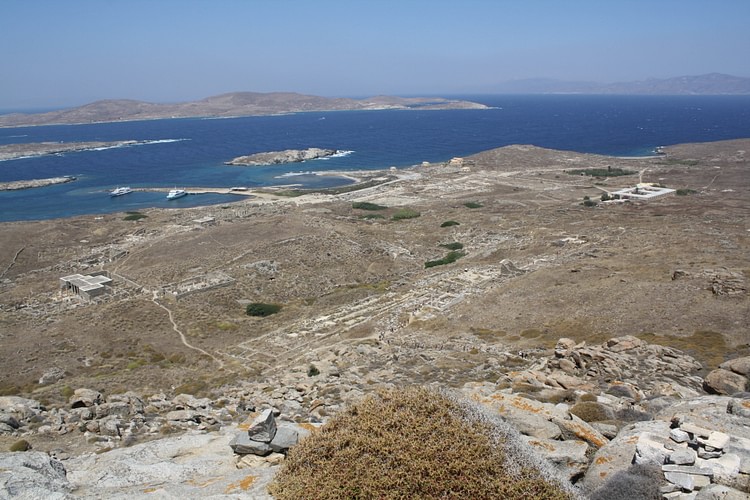
The island was first excavated by a team of French archaeologists from 1873 CE, revealing the true extent of the religious site. The island once had temples dedicated to Apollo, Leto (the Letoon), Artemis, (the Artemision) Hera (the Heraion), Zeus, [Athena](https://www.worldhistory.org/athena/), [Hercules](https://www.worldhistory.org/hercules/), and [Asclepius](https://www.worldhistory.org/Asclepius/). The [Temple](https://www.worldhistory.org/temple/) of Apollo housed, from the 6th century BCE, an 8 m high cult statue of the god made of wood and covered in [gold](https://www.worldhistory.org/gold/). There was also a temple dedicated to the twelve Olympian gods (the Dodekatheon). Several other sacred buildings have also been identified but their exact purpose is unclear.
The *Panēgyris*, an Ionian festival in honour of Apollo, was held every year on the island and in the late 5th century BCE, a spectacular (Athenian inspired) festival - the *Delia* - was held every five years. The accompanying athletic games and musical and dancing contests attracted visitors from across the [Aegean](https://www.worldhistory.org/aegean/). Victors in the Delian games climbed the island's Mt. Kynthos in order to be crowned.
As with other major sanctuaries, Delos had a diverse complex of buildings, including a monumental gateway entrance ([propylaea](https://www.worldhistory.org/Propylaea/)) to the site, a [theatre](https://www.worldhistory.org/disambiguation/theatre/) (c. 300 BCE, capacity: 5,000 spectators), [stadium](https://www.worldhistory.org/Stadium/), several stoas (for example, of Antigonus), [gymnasium](https://www.worldhistory.org/Gymnasium/), hippodrome, palaestras (3rd and 2nd centuries BCE), a hypostyle hall (constructed in the 3rd century BCE) an [agora](https://www.worldhistory.org/agora/) (built under Theophrastus in the 2nd century BCE), and even a sacred lake, guarded by marble lions.
[ 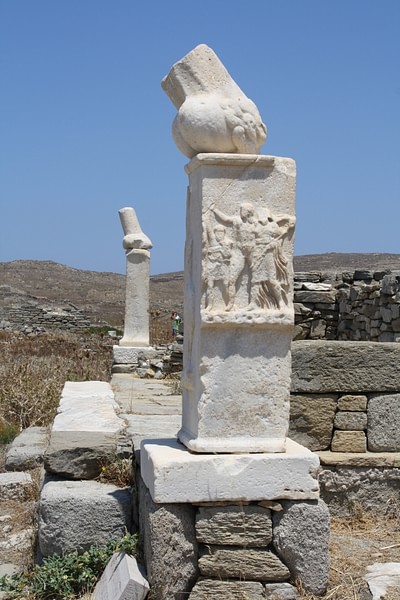 Column Phallus, Delos Mark Cartwright (CC BY-NC-SA) ](https://www.worldhistory.org/image/2054/column-phallus-delos/ "Column Phallus, Delos")Beyond the sanctuary of Apollo, there were also sanctuaries testimony to the [city](https://www.worldhistory.org/city/)'s one-time cosmopolitan make-up, with temples to Isis, [Serapis](https://www.worldhistory.org/Serapis/) and Cabeiri. Commercial buildings on the island included markets and warehouses, and the residential area dating from the 2nd century BCE displays grid street plans and large houses, which, with their mosaics, [wall](https://www.worldhistory.org/wall/) paintings, and colonnades, are testimony to the islands one-time prosperity.
Notable archaeological finds at the site are the famous marble lions, much weather-worn but still retaining a regal air. Of these, five lions survive from the original nine dedicated by the Naxians in the 7th century BCE. In addition, several fine mosaics have been uncovered, including one depicting [Dionysos](https://www.worldhistory.org/Dionysos/) seated on a panther.
#### Editorial Review
This human-authored definition has been reviewed by our editorial team before publication to ensure accuracy, reliability and adherence to academic standards in accordance with our [editorial policy](https://www.worldhistory.org/static/editorial-policy/).
## Bibliography
- Ananiades D. *Ancient Greece: Temples & Sanctuaries.* Toubis, Athens, 2010
- Hornblower, S. (ed). *The Oxford Classical Dictionary.* OUP, Oxford, 2012
- Kinzl, K.H. (ed). *A Companion to the Classical Greek World.* Wiley-Blackwell, London, 2012
- Tsakos, K. *Delos-Mykonos A Guide to the History & Archaeology.* Hesperos, Athens, 1998
- [Zaphiropoulou, P. *Delos.* Krene Editions, 1983.](https://www.worldhistory.org/books/B000GWE4UY/)
## About the Author
Mark is WHE’s Publishing Director and has an MA in Political Philosophy (University of York). He is a full-time researcher, writer, historian and editor. Special interests include art, architecture and discovering the ideas that all civilizations share.
## Timeline
- **c. 5000 BCE**: The [Cyclades](https://www.worldhistory.org/Cyclades/) are first inhabited by settlers from Asia Mnior.
- **3000 BCE - 2200 BCE**: The first archaeological evidence of organised communities in the [Cyclades](https://www.worldhistory.org/Cyclades/).
- **3000 BCE - 2000 BCE**: Distinctive minimalistic standing marble figurines are produced in the [Cyclades](https://www.worldhistory.org/Cyclades/).
- **2200 BCE - 1700 BCE**: Evidence of town planning and more sophisticated [architecture](https://www.worldhistory.org/disambiguation/architecture/) in the Cylades.
- **1700 BCE - 1400 BCE**: The [culture](https://www.worldhistory.org/disambiguation/culture/) in the [Cyclades](https://www.worldhistory.org/Cyclades/) is increasingly influenced by [Minoan](https://www.worldhistory.org/disambiguation/Minoan/) [Crete](https://www.worldhistory.org/crete/).
- **1400 BCE - 1100 BCE**: [Culture](https://www.worldhistory.org/disambiguation/culture/) in the [Cyclades](https://www.worldhistory.org/Cyclades/) is increasingly influenced by the [Mycenaean civilization](https://www.worldhistory.org/Mycenaean_Civilization/) of mainland [Greece](https://www.worldhistory.org/greece/).
- **c. 700 BCE**: The [temple](https://www.worldhistory.org/temple/) of [Apollo](https://www.worldhistory.org/apollo/) is built on the island of [Delos](https://www.worldhistory.org/delos/).
- **c. 550 BCE**: The [silver](https://www.worldhistory.org/Silver/) drachma of [Delos](https://www.worldhistory.org/delos/) depicts a [lyre](https://www.worldhistory.org/Lyre/) - symbolic of [Apollo](https://www.worldhistory.org/apollo/) - on its reverse side.
- **c. 550 BCE**: Oldest surviving [sculpture](https://www.worldhistory.org/disambiguation/Sculpture/) of a winged [Nike](https://www.worldhistory.org/nike/) found on [Delos](https://www.worldhistory.org/delos/).
- **c. 540 BCE**: [Athens](https://www.worldhistory.org/Athens/) removes and prohibits further burials on [Delos](https://www.worldhistory.org/delos/) to purify the sacred island.
- **478 BCE**: Many Cycladic states join the Athenian led [Delian League](https://www.worldhistory.org/Delian_League/) as a defence against Persian agression.
- **478 BCE - 454 BCE**: The treasury of the [Delian League](https://www.worldhistory.org/Delian_League/) is kept on [Delos](https://www.worldhistory.org/delos/) until its removal to [Athens](https://www.worldhistory.org/Athens/).
- **431 BCE - 404 BCE**: The Cycladic [city](https://www.worldhistory.org/city/) states side with [Athens](https://www.worldhistory.org/Athens/) in the [Peloponnesian war](https://www.worldhistory.org/Peloponnesian_War/) against [Sparta](https://www.worldhistory.org/sparta/) and her allies.
- **377 BCE - 355 BCE**: The Cycladic [city](https://www.worldhistory.org/city/) states join [Athens](https://www.worldhistory.org/Athens/) in the Second Athenian League against [Sparta](https://www.worldhistory.org/sparta/) .
- **314 BCE**: [Antigonus I](https://www.worldhistory.org/Antigonus_I/) establishes the League of Islanders which includes [Delos](https://www.worldhistory.org/delos/).
- **c. 300 BCE**: The [theatre](https://www.worldhistory.org/disambiguation/theatre/) of [Delos](https://www.worldhistory.org/delos/) is built.
- **166 BCE**: [Rome](https://www.worldhistory.org/Rome/) puts [Delos](https://www.worldhistory.org/delos/) under the jurisdiction of [Athens](https://www.worldhistory.org/Athens/) and makes the island a free port.
- **166 BCE**: [Rome](https://www.worldhistory.org/Rome/) gives dominion over the [Cyclades](https://www.worldhistory.org/Cyclades/) to [Athens](https://www.worldhistory.org/Athens/).
- **88 BCE**: Mithridates attacks and detroys the island of [Delos](https://www.worldhistory.org/delos/).
- **69 BCE**: [Delos](https://www.worldhistory.org/delos/) is sacked by pirates.
## External Links
- [the sacred island](https://www.visit-ancient-greece.com/delos.html)
## Cite This Work
### APA
Cartwright, M. (2013, February 26). Delos. *World History Encyclopedia*.
### Chicago
Cartwright, Mark. "Delos." *World History Encyclopedia*, February 26, 2013. .
### MLA
Cartwright, Mark. "Delos." *World History Encyclopedia*, 26 Feb 2013, .
## License & Copyright
Submitted by [Mark Cartwright](https://www.worldhistory.org/user/markzcartwright/ "User Page: Mark Cartwright"), published on 26 February 2013. The copyright holder has published this content under the following license: [Creative Commons Attribution-NonCommercial-ShareAlike](https://creativecommons.org/licenses/by-nc-sa/4.0/deed.en). This license lets others remix, tweak, and build upon this content non-commercially, as long as they credit the author and license their new creations under the identical terms. When republishing on the web a hyperlink back to the original content source URL must be included. Please note that content linked from this page may have different licensing terms.