---
title: Dacia
author: Adrian Dumitru
source: https://www.worldhistory.org/dacia/
format: machine-readable-alternate
license: Creative Commons Attribution-NonCommercial-ShareAlike (https://creativecommons.org/licenses/by-nc-sa/4.0/)
updated: 1970-01-01
---
# Dacia
_Authored by [Adrian Dumitru](https://www.worldhistory.org/user/ariarathes/)_
Dacia was a region inhabited by the Dacians in the north of the Danube (modern Romania). The kingdom of Dacia was the creation of Burebistas (c. 80-44 BCE), who conquered and united several other Dacian principalities. Burebistas practically destroyed the [Celtic](https://www.worldhistory.org/celt/) tribes of the Scordiscii and subjected, or allied with, the [Greek](https://www.worldhistory.org/disambiguation/greek/) [cities](https://www.worldhistory.org/city/) of the Western Black Sea coast, from Odessus (today's Varna) to Olbia (near today's Odessa). During the [Roman](https://www.worldhistory.org/disambiguation/Roman/) Civil [War](https://www.worldhistory.org/disambiguation/War/), the Dacians would probably have come to support [Pompey](https://www.worldhistory.org/pompey/). Burebistas was eventually killed in the same year as [Julius Caesar](https://www.worldhistory.org/Julius_Caesar/), who allegedly was preparing an expedition against the Dacians and the Parthians.
The Dacian kingdom crumbled into four (or five) principalities, only to re-emerge under [Decebalus](https://www.worldhistory.org/Decebalus/) (c. 87-106 CE). He fought victoriously against [Domitian](https://www.worldhistory.org/domitian/)'s general Cornelius Fuscus, but he was eventually defeated and forced to sign a peace treaty which made the Dacian kingdom a client of [Rome](https://www.worldhistory.org/Rome/) receive Roman money and technical support in return. The situation lasted until [Trajan](https://www.worldhistory.org/trajan/) waged two extensive wars (101-102 CE and 105-106 CE) in order to crush the Dacian kingdom and raze all the strongholds.
Dacia Traiana was a Roman province for nearly 170 years, until the reigns of [Gallienus](https://www.worldhistory.org/Gallienus/) and [Aurelian](https://www.worldhistory.org/Aurelian/) when it was abandoned (c. 271 CE) ,and gradual reduction in the presence of imperial legions eventuated in the withdrawal of the local Roman administration in favour of creating Dacia Aureliana to the south of the Danube in what is now modern Serbia.
This was done, in part, to give the illusion that Roman imperial power persevered in the region, even though signs of sociopolitical stress were very apparent. Later, Dacia Aureliana was divided further into two separate provinces: Dacia Mediterranea with its capital at Serdica, and Dacia Ripensis, with its capital at Ratiaria. After 275 CE, Dacia north of the Danube was overrun by various hoards of [Goths](https://www.worldhistory.org/Goths/), [Huns](https://www.worldhistory.org/Huns/), and [Avars](https://www.worldhistory.org/Avars/) during the barbarian invasions of the so-called '[Migration Age](https://www.worldhistory.org/Migration_Age/)'. However, Dacia was briefly 'reconquered' by Rome during the reign of [Constantine the Great](https://www.worldhistory.org/Constantine_I/).
Interestingly, post-Roman Dacian material culture continued to reveal a strong sense of 'Romanness'. For example, a 5th century CE Dacian [burial](https://www.worldhistory.org/burial/) contained a Roman type brooch which would have belonged to a well-placed member of society. And at Napoca, cross-dating using [pottery](https://www.worldhistory.org/pottery/) remains infers a post-Roman date for the construction of a Roman styled porticus. Similarly, at Porolissum, red-slipped ware (terra sigillata Porolissensis) has been found in a post-Roman (re)construction phase of the forum. If the ceramic dates are substantiated, it may be argued that the Dacians continued utilizing spatial foci and certain architectural designs that were characteristic of Rome. Regardless, collectively the material evidence underscores the centralization of Roman life within post-Roman Dacia.
Regarding post-Roman period Dacian religious identity, at Porolissum, a Constantinian styled Chi-Rho (symbolizing [Jesus](https://www.worldhistory.org/Jesus_Christ/) Chris) was found inscribed on a vessel. This, in addition to a [bronze](https://www.worldhistory.org/disambiguation/bronze/) dove — the symbol of the Holy Spirit — were randomly excavated from unknown contexts (*See Gospel of Luke* 3:22; *[Gospel of John](https://www.worldhistory.org/Gospel_of_John/)* 1:32). Interestingly, a cruciform was also found in the forum of Porolissum. The presence of Christian artifacts from post-Roman contexts suggests a parallel Christianization of the province corresponding to contemporary events taking place within the greater Roman world.
[ 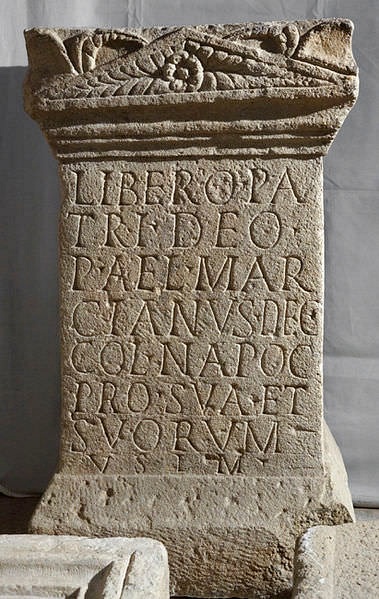 Dacian Altar Piece UBB Contrib (CC BY-SA) ](https://www.worldhistory.org/image/2798/dacian-altar-piece/ "Dacian Altar Piece")Additionally, 4th and 5th century CE burials also showcase more affluence and cultural diversity in post-Roman Dacia Porolissensis compared to the Roman period, suggesting a change in the urban status of the local community. For example, in Potaissa, burials containing iron buckles, flint-steel, [gold](https://www.worldhistory.org/gold/) and [silver](https://www.worldhistory.org/Silver/) jewelry, [amber](https://www.worldhistory.org/Amber/) and embroidery beads have been excavated. It should be noted that proportionately 'rich' burials only represent a small segment of Daco-Roman society. Then, as now, most people in society were not wealthy.
Perhaps the notion of 'urban prosperity' during a 'Dark Age' appears counterintuitive to more traditional early medieval models for the period. However, this may be explained by the continuous [trade](https://www.worldhistory.org/disambiguation/trade/) between the Eastern [Empire](https://www.worldhistory.org/empire/) and Potaissa. For example, numismatic evidence reveals that during the late 3rd and early 4th centuries CE Western Imperial minted [coinage](https://www.worldhistory.org/coinage/) ceased to be used in transactions (by 262 CE in Porolissum), and was subsequently replaced by [Byzantine](https://www.worldhistory.org/disambiguation/Byzantine/) minted coinage. In addition, burial evidence from Moigrad and Napoca suggest a cultural transition within social hierarchies, possibly related to the ascension of Ostrogothic nobility, much of which may be attributed to the post-Constantinian Romano-Gothic integration.
Furthermore, declining population estimates in Napoca — based in large part on ceramic evidence — suggest a moderate catastrophe immediately followed the withdrawal of Legio V Macedonica from Dacia. Perhaps this is nascent evidence of the eventual fragmentation of the Western [Mediterranean](https://www.worldhistory.org/disambiguation/mediterranean/) trade network? Chronologically, examining the material culture in total, it is clear that some crisis impacted portions of Dacian society immediately after Rome's withdrawal, followed by increasing socioeconomic activity in later periods. In any case, post-Roman Dacia Traiana continued to maintain its urban hierarchical status in the region in a manner that consistently interested the imperial and merchant classes of the Mediterranean.
#### Editorial Review
This human-authored definition has been reviewed by our editorial team before publication to ensure accuracy, reliability and adherence to academic standards in accordance with our [editorial policy](https://www.worldhistory.org/static/editorial-policy/).
## Timeline
- **106 BCE**: The governor of the [Roman](https://www.worldhistory.org/disambiguation/Roman/) province of Macedonia, M. Minucius Rufus, celebrates his victory over a raid of the Dacians allied with the [Celtic](https://www.worldhistory.org/celt/) tribe of the Scordiscii in the Balkans.
- **c. 70 BCE - 44 BCE**: The reign of Burebistas, styled in a [Greek](https://www.worldhistory.org/disambiguation/greek/) inscription as "the first and the greatest king". He attacked and destroyed the [Celtic](https://www.worldhistory.org/celt/) tribes on the central Danube, and the Greek [cities](https://www.worldhistory.org/city/) on the western coast Black Sea became his allies and clients.
- **c. 60 BCE**: Boii in eastern [Europe](https://www.worldhistory.org/europe/) crushed by the Dacians.
- **49 BCE - 48 BCE**: Burebistas sends Acornion of Dionysopolis as ambassador to negotiate an alliance with [Pompey](https://www.worldhistory.org/pompey/).
- **44 BCE**: Burebistas is killed in the same year as his enemy [Julius Caesar](https://www.worldhistory.org/Julius_Caesar/).
- **85 CE - 86 CE**: Dacians invade Moesia and defeat the Romans.
- **86 CE**: The [Roman](https://www.worldhistory.org/disambiguation/Roman/) general Cornelius Fuscus invades [Dacia](https://www.worldhistory.org/dacia/). He is ambushed and his army is annihilated.
- **87 CE - 106 CE**: Reign of the last Dacian king, [Decebalus](https://www.worldhistory.org/Decebalus/).
- **88 CE**: Resolved to avenge Fuscus' defeat, [Domitian](https://www.worldhistory.org/domitian/) sends another army to [Dacia](https://www.worldhistory.org/dacia/) under Tettius Iulianus. This general is victorious on the mountainous pass of Tapae, in the south-west of modern Romania.
- **101 CE - 106 CE**: [Trajan](https://www.worldhistory.org/trajan/) conquers [Dacia](https://www.worldhistory.org/dacia/).
## Cite This Work
### APA
Dumitru, A. (2011, April 28). Dacia. *World History Encyclopedia*.
### Chicago
Dumitru, Adrian. "Dacia." *World History Encyclopedia*, April 28, 2011. .
### MLA
Dumitru, Adrian. "Dacia." *World History Encyclopedia*, 28 Apr 2011, .
## License & Copyright
Submitted by [Adrian Dumitru](https://www.worldhistory.org/user/ariarathes/ "User Page: Adrian Dumitru"), published on 28 April 2011. The copyright holder has published this content under the following license: [Creative Commons Attribution-NonCommercial-ShareAlike](https://creativecommons.org/licenses/by-nc-sa/4.0/deed.en). This license lets others remix, tweak, and build upon this content non-commercially, as long as they credit the author and license their new creations under the identical terms. When republishing on the web a hyperlink back to the original content source URL must be included. Please note that content linked from this page may have different licensing terms.