---
title: Ancient Crete
author: Mark Cartwright
source: https://www.worldhistory.org/crete/
format: machine-readable-alternate
license: Creative Commons Attribution-NonCommercial-ShareAlike (https://creativecommons.org/licenses/by-nc-sa/4.0/)
updated: 1970-01-01
---
# Ancient Crete
_Authored by [Mark Cartwright](https://www.worldhistory.org/user/markzcartwright/)_
Crete is an island in the eastern [Mediterranean](https://www.worldhistory.org/disambiguation/mediterranean/) which during the [Bronze Age](https://www.worldhistory.org/disambiguation/Bronze_Age/) produced the influential [Minoan civilization](https://www.worldhistory.org/Minoan_Civilization/) with its distinctive [architecture](https://www.worldhistory.org/disambiguation/architecture/) and art. An important member of the [Greek](https://www.worldhistory.org/disambiguation/greek/) world in the [Archaic period](https://www.worldhistory.org/Archaic_Period/), Crete dipped a little in significance during the Classical period but was again a major cultural centre in [Roman](https://www.worldhistory.org/disambiguation/Roman/) times when it was a province within the [Roman empire](https://www.worldhistory.org/Roman_Empire/) and centre of [early Christianity](https://www.worldhistory.org/article/1205/early-christianity/). The island today has many archaeological sites of note which include [Knossos](https://www.worldhistory.org/knossos/), [Phaistos](https://www.worldhistory.org/Phaistos/), and [Gortyn](https://www.worldhistory.org/Gortyn/), all with significant architectural remains as compelling evidence of Crete's long and varied history.
### [Minoan](https://www.worldhistory.org/disambiguation/Minoan/) Crete
The earliest evidence of habitation on the island goes back to at least 7,000 BCE when settlers from [Anatolia](https://www.worldhistory.org/Asia_Minor/) arrived but its first recognisable [culture](https://www.worldhistory.org/disambiguation/culture/) was the Minoans who would provide some of antiquity's most recognisable legends, architecture and artworks, as well as going on to influence many subsequent Mediterranean civilizations. The Minoans rose to prominence from around 2000 BCE, and they would be one of the most successful Mediterranean trading cultures of the [Bronze](https://www.worldhistory.org/disambiguation/bronze/) Age. [Agriculture](https://www.worldhistory.org/disambiguation/Agriculture/) and [trade](https://www.worldhistory.org/disambiguation/trade/) allowed the formation of large centralised centres at Knossos, Phaistos, [Malia](https://www.worldhistory.org/Malia/), [Zakros](https://www.worldhistory.org/Zakros/), and other sites where grand palatial buildings were constructed and local trade was centralised. These structures were two or three stories high, spread over several thousand square metres, and decorated with fine frescoes. It seems likely that some sort of central administration organised the gathering and storage of materials such as wine, oil, grain, precious metals, and ceramics. The [Linear A script](https://www.worldhistory.org/Linear_A_Script/), as yet undeciphered, is another indicator of a sophisticated political and trading culture. A relatively peaceful relationship between centres is suggested by the lack of fortification walls, although finds of arrow heads, armour and helmets point to some preoccupation with martial affairs.
The Minoan palaces show evidence of destruction by [earthquake](https://www.worldhistory.org/disambiguation/earthquake/) c. 1700 BCE, after which they were rebuilt. The palaces were well-appointed, monumental structures with large courts, colonnades, staircases, religious crypts, light-wells, drainage systems, extensive storage magazines for large ceramic *pithoi* containers, and even '[theatre](https://www.worldhistory.org/disambiguation/theatre/)' areas for public spectacles. The complexity of these palaces, the sport of bull-leaping, the worship of bulls as indicated by the presence throughout of sacred bulls' horns and depictions of double axes (or *labrys*) all probably gave rise to the legend from [Greek mythology](https://www.worldhistory.org/Greek_Mythology/) of King Minos, ruler of Knossos, and the Athenian hero [Theseus](https://www.worldhistory.org/Theseus/) who killed the [minotaur](https://www.worldhistory.org/Minotaur/) which dwelt in the [labyrinth](https://www.worldhistory.org/Labyrinth/) of the same [city](https://www.worldhistory.org/city/). Other features of the Minoan [religion](https://www.worldhistory.org/religion/) besides bulls include the prominence of Nature and fertility goddesses, best seen in voluptuous [faience](https://www.worldhistory.org/disambiguation/Faience/) figurines holding snakes.
[ 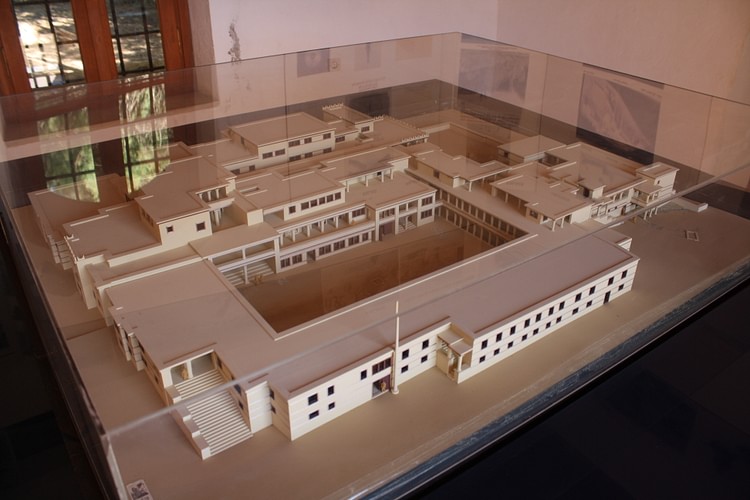 Palace of Malia Mark Cartwright (CC BY-NC-SA) ](https://www.worldhistory.org/image/650/palace-of-malia/ "Palace of Malia")The Athenian Theseus myth and others, such as [Rhea](https://www.worldhistory.org/Rhea/) hiding a young [Zeus](https://www.worldhistory.org/zeus/) in a cave on Crete, point, as do archaeological finds across the [Aegean](https://www.worldhistory.org/aegean/), to Crete's influence on the wider world. The island's prosperity based on sea trade is attested not only by its monumental architecture but also a flourishing of the arts as best seen in [Minoan frescoes](https://www.worldhistory.org/article/390/minoan-frescoes/), ceramics, jewellery, and figurines. Trade relations are known with [Thera](https://www.worldhistory.org/thera/), [Rhodes](https://www.worldhistory.org/Rhodes/), [Egypt](https://www.worldhistory.org/egypt/), the [Near East](https://www.worldhistory.org/Near_East/), [Cyprus](https://www.worldhistory.org/cyprus/), and the [Cyclades](https://www.worldhistory.org/Cyclades/), amongst others.
A second wave of earthquakes and destructive fires occurred between 1500 BCE and 1450 BCE which seems to have definitively ended the Minoan presence on Crete. The island may also have suffered a tsunami following the eruption of Thera, although the date of this event is uncertain. The collapse of the Minoan centres, perhaps not coincidentally, was contemporary with the rise of the [Mycenaean civilization](https://www.worldhistory.org/Mycenaean_Civilization/) on mainland [Greece](https://www.worldhistory.org/greece/). There is evidence that the Mycenaeans ruled at Minoan sites between 1450 and 1380 BCE. Knossos was again destroyed c. 1380 BCE and never rebuilt. By 1200 BCE many of the Minoan settlements had been abandoned.
[  Griffin Fresco, Knossos, Crete Mark Cartwright (CC BY-NC-SA) ](https://www.worldhistory.org/image/392/griffin-fresco-knossos-crete/ "Griffin Fresco, Knossos, Crete")### [Archaic](https://www.worldhistory.org/disambiguation/Archaic/) & Classical Crete
There are no surviving written records of activities on the island between 1200 and 800 BCE but it is known that Dorian-speaking immigrants settled on Crete in that period. Kommos became an important port with evidence of contact with the Greek mainland, [Phoenicia](https://www.worldhistory.org/phoenicia/), and the Near East, an influence also seen in language and art. New settlements prospered so that by 650 BCE the island boasted, according to Greek tradition, 100 *[poleis](https://www.worldhistory.org/Polis/)* or city-states, many with temples, markets and urban planning. The number was more likely nearer 60 but, nevertheless, Crete was firmly established as an important region of the Greek world, albeit one more disconnected than most others.
Legal texts, the most famous and longest being the [law](https://www.worldhistory.org/disambiguation/law/) code of Gortyn (c. 450 BCE), show that Cretan [cities](https://www.worldhistory.org/city/) were composed of various classes of peoples including slaves and foreigners, and had a concern for justice, especially in the fields of family and property law. As with the classic *[polis](https://www.worldhistory.org/Polis/)* model of the Greek mainland, a landed citizenry made up an armed force of hoplites when required and the population as a whole was ruled by an aristocracy which presided over a popular assembly of government. Traditional tribal leaders and noble families would have monopolised public positions, including those related to religious activities which followed the polytheistic [pantheon](https://www.worldhistory.org/Pantheon/) and practices of the Greek mainland.
[  The Law Code of Gortyn, Crete Mark Cartwright (CC BY-NC-SA) ](https://www.worldhistory.org/image/397/the-law-code-of-gortyn-crete/ "The Law Code of Gortyn, Crete")The very fact that Crete is an island limited its role in Greek regional affairs during the Classical period (600-450 BCE), but Cretan towns did provide warriors – Cretan mercenary slingers and archers being especially highly esteemed – for such conflicts as the Peloponnesian Wars and the campaigns of [Alexander the Great](https://www.worldhistory.org/Alexander_the_Great/) and his successors. From the 3rd to 1st century BCE, the formation of a Cretan Federation seems to have done little in arresting the island's general decline into relative obscurity. Many people emigrated to the Greek mainland while Crete now earned a reputation for [piracy](https://www.worldhistory.org/Piracy/), a practice which eventually brought about two wars with that other Mediterranean island built on trade: Rhodes (206-204 BCE and 155-153 BCE).
A civil [war](https://www.worldhistory.org/disambiguation/War/) erupted between the island's three main cities - Gortyn, Knossos, and Lyttos - between c. 222 and 219 BCE. Philip V of [Macedon](https://www.worldhistory.org/macedon/) was courted as an ally, but taking advantage of the political weaknesses of the Cretan cities, it was [Ptolemy](https://www.worldhistory.org/disambiguation/Ptolemy/) VI who established a garrison in eastern Crete. However, this did not stop the continued civil war between rival cities which rumbled on throughout the 2nd century BCE. A peace was finally established in 110 BCE when the Mediterranean's new superpower [Rome](https://www.worldhistory.org/Rome/) stepped into local affairs.
### Roman Crete
In the Roman period Cretan piracy was still rife, and it would take two wars in 71 and 69-67 BCE before the ever-determined Romans could finally stamp it out. Crete, thereafter, became something of a pawn in wider Roman regional politics as the Republic went through its [death](https://www.worldhistory.org/disambiguation/Death/) throes. In 36 BCE, for example, [Mark Antony](https://www.worldhistory.org/Mark_Antony/) gave the island to [Cleopatra](https://www.worldhistory.org/disambiguation/cleopatra/) as a gift. With the succession of [Augustus](https://www.worldhistory.org/augustus/), though, Crete was officially incorporated into the Roman [empire](https://www.worldhistory.org/empire/). The emperor created a colony at Knossos, and the city, along with the island in general, benefitted from an influx of immigrants which brought a prosperity Crete had not seen for centuries. Prominent settlers included veterans from the legions, traders, and Jews in what became a thriving Roman province with its governor residing at Gortyn. At least 15 cities prospered in this period, oil and wine production increased massively, amphitheatres, temples, [Roman baths](https://www.worldhistory.org/Roman_Baths/) and [aqueducts](https://www.worldhistory.org/aqueduct/) were built, and the island minted its own [coinage](https://www.worldhistory.org/coinage/). The famed Cretan archers became an important fixture in the [Roman army](https://www.worldhistory.org/Roman_Army/) across the empire, but no Roman troops were stationed on Crete itself.
[  Gortyn, Crete Mark Cartwright (CC BY-NC-SA) ](https://www.worldhistory.org/image/377/gortyn-crete/ "Gortyn, Crete")An early Christian community was established at Gortyn c. 60 CE whose first bishop was [Titus](https://www.worldhistory.org/disambiguation/Titus/), a disciple of [Saint Paul](https://www.worldhistory.org/Paul_the_Apostle/). Gortyn, in particular, thrived with a population reaching 300,000 and its status confirmed as a major Roman town when the future emperor [Trajan](https://www.worldhistory.org/trajan/) was appointed [quaestor](https://www.worldhistory.org/Quaestor/) there in 81 CE. The 3rd century CE saw several infamous persecutions of Christians including ten martyrs during a wild animal hunt in Gortyn's [amphitheatre](https://www.worldhistory.org/amphitheatre/) in 249 CE. When the Roman Empire split into two, Crete was made part of the Eastern empire although the Christian church was under the jurisdiction of the Pope at [Thessaloniki](https://www.worldhistory.org/Thessalonica/). The island continued to prosper throughout this period until the [Byzantine](https://www.worldhistory.org/disambiguation/Byzantine/) era when it faced repeated Arab raids and, ultimately, full [conquest](https://www.worldhistory.org/warfare/) c. 827 CE.
#### Editorial Review
This human-authored definition has been reviewed by our editorial team before publication to ensure accuracy, reliability and adherence to academic standards in accordance with our [editorial policy](https://www.worldhistory.org/static/editorial-policy/).
## Bibliography
- Bagnall, R.S. *The Encyclopedia of Ancient History.* Wiley-Blackwell, 2012
- [Cline, E.H. *The Oxford Handbook of the Bronze Age Aegean.* Oxford University Press, 2012.](https://www.worldhistory.org/books/0199873607/)
- Davaras, C. *East Crete.* Hannibal Editions, Athens
- Davaras, C. *Malia.* Hannibal Editions, Athens
- Davaras, C. *Phaistos.* Hannibal Editions, Athens.
- Davaras, C. *The Palace of Knossos.* Hannibal Editions, Athens, 2010
- [Davaras, C:. *Phaistos Hagia Triada Gortyne.* Editions Hannibal, 1981.](https://www.worldhistory.org/books/B00FEJYDCS/)
- [Higgins, R:. *Minoan and Mycenaean Art.* Thames & Hudson, 1997.](https://www.worldhistory.org/books/0500203032/)
- [Hornblower, S. *The Oxford Classical Dictionary.* Oxford University Press, 2012.](https://www.worldhistory.org/books/0199545561/)
- [Hutchinson, R.W. *Prehistoric Crete.* Penguin Books, 1962.](https://www.worldhistory.org/books/B0000CLF3U/)
- [Stylianos, A. *Minoan Civilization. Translated from the Greek by Cressida Ridley.* Heraklion, Crete: V. Kouvidis - V. Manouras Co. c1969, 1969.](https://www.worldhistory.org/books/B007PV5OWQ/)
## About the Author
Mark is WHE’s Publishing Director and has an MA in Political Philosophy (University of York). He is a full-time researcher, writer, historian and editor. Special interests include art, architecture and discovering the ideas that all civilizations share.
## Timeline
- **7000 BCE**: First habitation on [Crete](https://www.worldhistory.org/crete/).
- **6000 BCE**: First habitation at [Malia](https://www.worldhistory.org/Malia/).
- **3600 BCE - 3000 BCE**: First inhabitation of [Phaistos](https://www.worldhistory.org/Phaistos/).
- **3000 BCE**: Stone tombs on [Crete](https://www.worldhistory.org/crete/).
- **c. 2700 BCE**: Olive trees are grown and harvested in [Crete](https://www.worldhistory.org/crete/). Olive oil is exported.
- **2200 BCE**: First monumental [architecture](https://www.worldhistory.org/disambiguation/architecture/) at [Malia](https://www.worldhistory.org/Malia/).
- **2200 BCE - 1500 BCE**: The [Minoan Civilization](https://www.worldhistory.org/Minoan_Civilization/) flourishes on [Crete](https://www.worldhistory.org/crete/), [Greece](https://www.worldhistory.org/greece/). King Minos establishes the first navy in the region.
- **c. 2000 BCE**: [Pottery](https://www.worldhistory.org/pottery/) wheel introduced to [Minoan civilization](https://www.worldhistory.org/Minoan_Civilization/) on [Crete](https://www.worldhistory.org/crete/).
- **2000 BCE - 1700 BCE**: First [Minoan](https://www.worldhistory.org/disambiguation/Minoan/) [palace](https://www.worldhistory.org/disambiguation/palace/) at [Phaistos](https://www.worldhistory.org/Phaistos/).
- **c. 2000 BCE - c. 1650 BCE**: Cretan Hieroglyphic [script](https://www.worldhistory.org/script/) is in use.
- **2000 BCE - 1450 BCE**: [Minoan civilization](https://www.worldhistory.org/Minoan_Civilization/) in [Crete](https://www.worldhistory.org/crete/) and the [Aegean](https://www.worldhistory.org/aegean/).
- **2000 BCE - 1400 BCE**: [Phaistos](https://www.worldhistory.org/Phaistos/)' greatest cultural height.
- **1900 BCE**: First [Minoan](https://www.worldhistory.org/disambiguation/Minoan/) [palace](https://www.worldhistory.org/disambiguation/palace/) at [Knossos](https://www.worldhistory.org/knossos/).
- **1850 BCE - 1550 BCE**: [Phaistos disk](https://www.worldhistory.org/Phaistos_Disk/) manufactured on [Crete](https://www.worldhistory.org/crete/).
- **c. 1850 BCE - c. 1450 BCE**: The [Linear A script](https://www.worldhistory.org/Linear_A_Script/) of the [Minoan civilization](https://www.worldhistory.org/Minoan_Civilization/) is in use.
- **1700 BCE**: Second [Palace](https://www.worldhistory.org/disambiguation/palace/) of [Knossos](https://www.worldhistory.org/knossos/) on [Crete](https://www.worldhistory.org/crete/).
- **1700 BCE - 1600 BCE**: Second [palace](https://www.worldhistory.org/disambiguation/palace/) at [Phaistos](https://www.worldhistory.org/Phaistos/).
- **1700 BCE - 1400 BCE**: The [culture](https://www.worldhistory.org/disambiguation/culture/) in the [Cyclades](https://www.worldhistory.org/Cyclades/) is increasingly influenced by [Minoan](https://www.worldhistory.org/disambiguation/Minoan/) [Crete](https://www.worldhistory.org/crete/).
- **1675 BCE - 1450 BCE**: Second [Minoan](https://www.worldhistory.org/disambiguation/Minoan/) [palace](https://www.worldhistory.org/disambiguation/palace/) at [Malia](https://www.worldhistory.org/Malia/).
- **1650 BCE - 1550 BCE**: [Knossos](https://www.worldhistory.org/knossos/) survives [Thera](https://www.worldhistory.org/thera/) eruption.
- **c. 1600 BCE**: [Phaistos disk](https://www.worldhistory.org/Phaistos_Disk/) manufactured.
- **c. 1600 BCE**: [Rhodes](https://www.worldhistory.org/Rhodes/) has significant contact with [Minoan](https://www.worldhistory.org/disambiguation/Minoan/) [Crete](https://www.worldhistory.org/crete/).
- **1500 BCE - 1450 BCE**: The 'Harvester Vase' of [Minoan](https://www.worldhistory.org/disambiguation/Minoan/) origin depicts a [sistrum](https://www.worldhistory.org/Sistrum/) player.
- **c. 1450 BCE**: [Earthquake](https://www.worldhistory.org/disambiguation/earthquake/) and fire ends the [Minoan](https://www.worldhistory.org/disambiguation/Minoan/) period at [Malia](https://www.worldhistory.org/Malia/).
- **c. 1450 BCE**: Destruction of [Minoan](https://www.worldhistory.org/disambiguation/Minoan/) [palace](https://www.worldhistory.org/disambiguation/palace/) at [Zakros](https://www.worldhistory.org/Zakros/).
- **c. 1450 BCE**: Mycenaen influence extended to [Knossos](https://www.worldhistory.org/knossos/), [Crete](https://www.worldhistory.org/crete/).
- **c. 1330 BCE**: Abandonment of [Zakros](https://www.worldhistory.org/Zakros/) settlement.
- **c. 750 BCE**: The earliest depiction of the [tympanon](https://www.worldhistory.org/Tympanon/) on a [bronze](https://www.worldhistory.org/disambiguation/bronze/) disc found in the Idaean Cave in [Crete](https://www.worldhistory.org/crete/).
- **700 BCE - 600 BCE**: Brief resurgence in [Phaistos](https://www.worldhistory.org/Phaistos/) settlement.
- **c. 689 BCE**: [Rhodes](https://www.worldhistory.org/Rhodes/) and Cretans found [Gela](https://www.worldhistory.org/Gela/) in [Sicily](https://www.worldhistory.org/sicily/).
- **c. 580 BCE**: [Agrigento](https://www.worldhistory.org/agrigento/) in [Sicily](https://www.worldhistory.org/sicily/) is founded by colonists from [Gela](https://www.worldhistory.org/Gela/), [Crete](https://www.worldhistory.org/crete/) and [Rhodes](https://www.worldhistory.org/Rhodes/).
- **470 BCE**: [Gortyn](https://www.worldhistory.org/Gortyn/) on [Crete](https://www.worldhistory.org/crete/) begins to mint its own [coinage](https://www.worldhistory.org/coinage/).
- **c. 450 BCE**: The [Law](https://www.worldhistory.org/disambiguation/law/) Code of [Gortyn](https://www.worldhistory.org/Gortyn/) is written.
- **c. 220 BCE**: [Gortyn](https://www.worldhistory.org/Gortyn/) allies with [Knossos](https://www.worldhistory.org/knossos/) to defeat Lyttos on [Crete](https://www.worldhistory.org/crete/).
- **206 BCE - 204 BCE**: [Crete](https://www.worldhistory.org/crete/) is at [war](https://www.worldhistory.org/disambiguation/War/) with [Rhodes](https://www.worldhistory.org/Rhodes/).
- **189 BCE**: [Gortyn](https://www.worldhistory.org/Gortyn/) gives sanctuary to [Hannibal](https://www.worldhistory.org/hannibal/).
- **c. 180 BCE**: [Phaistos](https://www.worldhistory.org/Phaistos/) conquered by [Gortyn](https://www.worldhistory.org/Gortyn/).
- **155 BCE - 153 BCE**: [Crete](https://www.worldhistory.org/crete/) is at [war](https://www.worldhistory.org/disambiguation/War/) with [Rhodes](https://www.worldhistory.org/Rhodes/) for a second time.
- **110 BCE**: [Rome](https://www.worldhistory.org/Rome/) establishes peace between the warring Cretan [cities](https://www.worldhistory.org/city/).
- **71 BCE**: [Rome](https://www.worldhistory.org/Rome/) wages [war](https://www.worldhistory.org/disambiguation/War/) on the Cretan pirates.
- **69 BCE - 67 BCE**: [Rome](https://www.worldhistory.org/Rome/) wages a second [war](https://www.worldhistory.org/disambiguation/War/) against the Cretan pirates.
- **36 BCE**: [Mark Antony](https://www.worldhistory.org/Mark_Antony/) gives [Crete](https://www.worldhistory.org/crete/) as a gift to [Cleopatra](https://www.worldhistory.org/disambiguation/cleopatra/).
- **c. 27 BCE**: [Augustus](https://www.worldhistory.org/augustus/) makes [Gortyn](https://www.worldhistory.org/Gortyn/) the capital of the [Roman](https://www.worldhistory.org/disambiguation/Roman/) province of [Crete](https://www.worldhistory.org/crete/) & [Cyrene](https://www.worldhistory.org/cyrene/).
- **60 CE**: An early Christian community is established at [Gortyn](https://www.worldhistory.org/Gortyn/), [Crete](https://www.worldhistory.org/crete/).
- **81 CE**: [Trajan](https://www.worldhistory.org/trajan/) serves as [quaestor](https://www.worldhistory.org/Quaestor/) at [Gortyn](https://www.worldhistory.org/Gortyn/), [Crete](https://www.worldhistory.org/crete/).
- **365 CE**: [Gortyn](https://www.worldhistory.org/Gortyn/) is destroyed by a devastating [earthquake](https://www.worldhistory.org/disambiguation/earthquake/).
- **670 CE**: [Gortyn](https://www.worldhistory.org/Gortyn/) is destroyed by [earthquake](https://www.worldhistory.org/disambiguation/earthquake/).
- **c. 827 CE**: [Crete](https://www.worldhistory.org/crete/) is conquered by the Arabs.
- **961 CE**: The [Byzantine Empire](https://www.worldhistory.org/Byzantine_Empire/) reconquers [Crete](https://www.worldhistory.org/crete/) from the Arabs under Nikephoros Phokas, the future Emperor Nikephoros II.
## External Links
- [The scientific origins of the Minotaur - Matt Kaplan](http://ed.ted.com/lessons/the-scientific-origins-of-the-minotaur-matt-kaplan)
- [Minoan Crete | Essay | The Metropolitan Museum of Art | Heilbrunn Timeline of Art History](https://www.metmuseum.org/toah/hd/mino/hd_mino.htm)
## Cite This Work
### APA
Cartwright, M. (2017, February 02). Ancient Crete. *World History Encyclopedia*.
### Chicago
Cartwright, Mark. "Ancient Crete." *World History Encyclopedia*, February 02, 2017. .
### MLA
Cartwright, Mark. "Ancient Crete." *World History Encyclopedia*, 02 Feb 2017, .
## License & Copyright
Submitted by [Mark Cartwright](https://www.worldhistory.org/user/markzcartwright/ "User Page: Mark Cartwright"), published on 02 February 2017. The copyright holder has published this content under the following license: [Creative Commons Attribution-NonCommercial-ShareAlike](https://creativecommons.org/licenses/by-nc-sa/4.0/deed.en). This license lets others remix, tweak, and build upon this content non-commercially, as long as they credit the author and license their new creations under the identical terms. When republishing on the web a hyperlink back to the original content source URL must be included. Please note that content linked from this page may have different licensing terms.