---
title: Crafts
author: Joshua J. Mark
source: https://www.worldhistory.org/crafts/
format: machine-readable-alternate
license: Creative Commons Attribution-NonCommercial-ShareAlike (https://creativecommons.org/licenses/by-nc-sa/4.0/)
updated: 1970-01-01
---
# Crafts
_Authored by [Joshua J. Mark](https://www.worldhistory.org/user/JPryst/)_
The word 'Craft' comes from the Middle English word for 'strength' or 'skill' derived from the Old English word *craeft* which comes from Old High German *kraft,* for strength, and means “skill in planning, making, executing” and, by extension, “an occupation or [trade](https://www.worldhistory.org/disambiguation/trade/) requiring skill” and crafts, then, being those objects resulting from the application of that skill (*Merriam-Webster Dictionary*). Every [civilization](https://www.worldhistory.org/civilization/) has developed their own crafts and the term can be applied to numerous aspects of each of them. Within the scope of this article the term is applied only to hand-crafts including ceramics and [metal](https://www.worldhistory.org/disambiguation/metal/)-working but it should be understood that the term is equally applicable to [writing](https://www.worldhistory.org/writing/) and other forms of expression.
Crafts in the ancient world, both in their purpose and how they were manufactured, were as varied as the cultures which produced them. In ancient [Mesopotamia](https://www.worldhistory.org/Mesopotamia/), crafts were produced both by order of the state and privately. As early as 6500 BCE flax textiles were in use in the region known as Tepe Sabz (modern day Iran) and flax was woven both privately and by state workers prior to the rise of wool. From the [city](https://www.worldhistory.org/city/) of [Ur](https://www.worldhistory.org/ur/) we have the [Sumerian](https://www.worldhistory.org/Sumerians/) Standard of [War](https://www.worldhistory.org/disambiguation/War/) and the Standard of Peace, both commissioned by the State and wrought by those whom, today, would be known as government employees.
At the same time, however, there were many private artists producing their own, more personal, works (also as early as 6500 BCE, from which time [pottery](https://www.worldhistory.org/pottery/) has been found) such as the statue Ram Caught In A Thicket from Ur c. 2800 BCE, an elaborate piece composed of shells, lapis lazuli and [gold](https://www.worldhistory.org/gold/) depicting a ram (or goat) struggling to free itself from a bush. While the Sumerian standards are utilitarian works, providing a narrative of the [culture](https://www.worldhistory.org/disambiguation/culture/) at peace or at war, pieces like Ram Caught In A Thicket often depicted scenes from daily life or symbolic representations of the gods as it has been speculated that the Ram statue symbolized the male energy principle of the [god](https://www.worldhistory.org/God/) Tammuz caught in the "thicket" of the female deity [Inanna](https://www.worldhistory.org/Inanna/)/[Ishtar](https://www.worldhistory.org/ishtar/). Inanna/Ishtar is regularly depicted as a difficult character who often ensnared her lovers in webs of difficulty.
As early as 6200 BCE [copper](https://www.worldhistory.org/copper/) was being smelted in [Anatolia](https://www.worldhistory.org/Asia_Minor/) in the south of the Mesopotamian region and copper grew in importance as it became more readily available. It would eventually prove to be an increasingly valuable commodity in trade as well as for domestic use.
In ancient [Egypt](https://www.worldhistory.org/egypt/) the most important artisans were the metalsmiths who produced the bowls, vases, cups, statues and figurines, even the swords and daggers, one sees today in museums around the world. The metalsmiths worked primarily in copper mined from the Sinai peninsula until the [Middle Kingdom](https://www.worldhistory.org/disambiguation/Middle_Kingdom/) (2040-1782 BCE) when [bronze](https://www.worldhistory.org/disambiguation/bronze/) (a mixture of copper and tin) was introduced, the tin coming from the hills of [Elam](https://www.worldhistory.org/elam/) southeast of [Babylon](https://www.worldhistory.org/babylon/).
Without a doubt, however, the most widely used metal in ancient Egypt was gold which was mined in plenty from the quartz-bearing rock in the eastern desert and south of Egypt in Nubia and the Sudan. The famous [tomb](https://www.worldhistory.org/tomb/) of [Tutankhamun](https://www.worldhistory.org/Tutankhamun/), discovered by Howard Carter in the early 1920's CE is the best testament to the many uses the metalsmiths could put gold to, as they fashioned the substance into everything from the ornate [death](https://www.worldhistory.org/disambiguation/Death/) mask to the coffin to the cups, bracelets and jewelery found in the tomb. According to the historian [Herodotus](https://www.worldhistory.org/herodotus/), the [Egyptian](https://www.worldhistory.org/disambiguation/Egyptian/) metalsmiths were known as the most skilled artisans in the world and their surviving works bear witness to the truth of Herodotus' claim.
[ 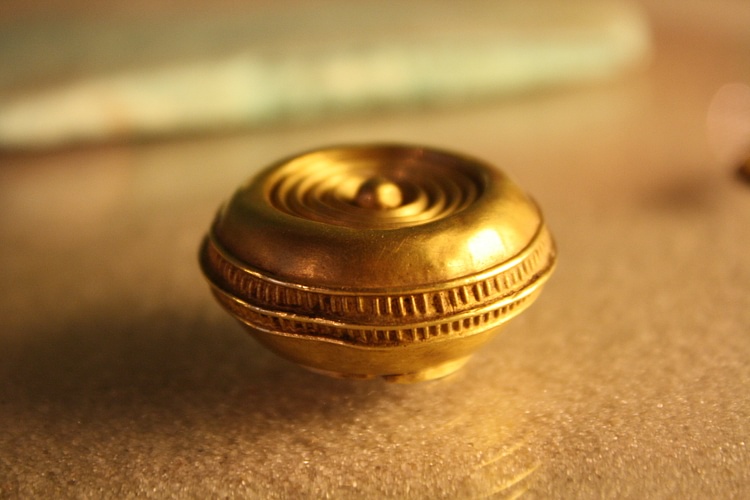 Neolithic Gold Bead Mark Cartwright (CC BY-NC-SA) ](https://www.worldhistory.org/image/2951/neolithic-gold-bead/ "Neolithic Gold Bead")
Crafts in ancient [Greece](https://www.worldhistory.org/greece/) reached their height in the production of ceramics (from the [Greek](https://www.worldhistory.org/disambiguation/greek/) word *ceramos* for 'wet clay') which was one of Greece's main state industries as well as a work produced privately by individual artists. The production of Greek ceramics began on the island kingdom of [Crete](https://www.worldhistory.org/crete/) around 2500 BCE as evidenced by archaelogical finds at [Knossos](https://www.worldhistory.org/knossos/) and [Gortyn](https://www.worldhistory.org/Gortyn/). The most famous style of pottery was the Black-Figure Style where figures in black were drawn against an earthen-red background (or *vice versa* in the Red-Figure Style) to tell a story in linear form.
These stories could range from mythological tales to personal family narratives and were most famously admired by the English poet John Keats in his *Ode on A Grecian Urn* in which he extols the virtues of the “still unravished bride of quietness” and longs for the eternal youth and beauty depicted on the urn. Other ceramic vessels were the [amphora](https://www.worldhistory.org/Amphora/) used primarily for wine and found in abundance in the wrecks of the Phoenican vessels Tanit and [Elissa](https://www.worldhistory.org/Dido/) discovered in 1999 CE by Bob Ballard. The *hydria* (used primarily for water) and the *crater* were two other types of ceramic products. The *crater* was a broad rimmed ceramic supported by a short cylinder on a base; both forms are still in use today as vases and mixing bowls.
[ 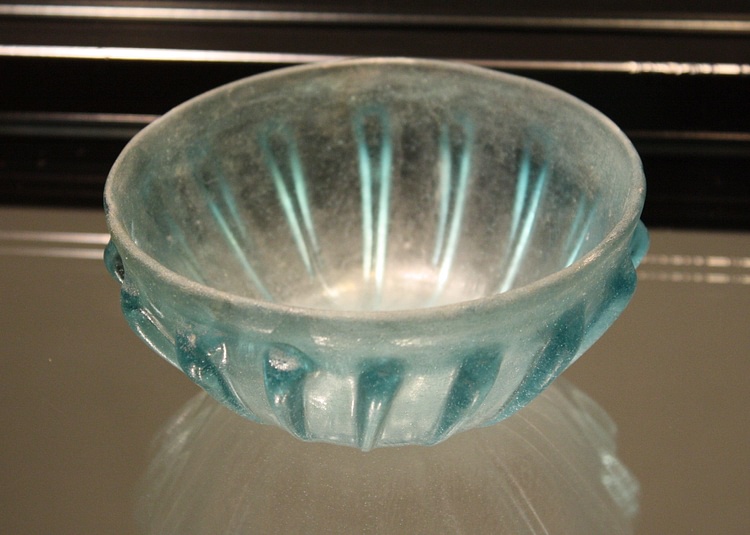 Roman Glass Bowl, Aosta Mark Cartwright (CC BY-NC-SA) ](https://www.worldhistory.org/image/2167/roman-glass-bowl-aosta/ "Roman Glass Bowl, Aosta")
The Romans drew upon the cultures which had gone before in their production of crafts (as they did in every other aspect of their culture) to create fine works of art but, as befitting their pragmatic nature, they excelled in crafts which were more utilitarian than asthetic. The greatest craftsmen of ancient [Rome](https://www.worldhistory.org/Rome/) were the plumbers (from the Latin *plumium* for lead) who wrought the great pipes which brought water into, and out of, the city of Rome and nearby [Ostia](https://www.worldhistory.org/Ostia/) and the masons who shaped the stones which went to create the roads, buildings and temples. From Galicia, Spain down to Trier, across Germany and all the way to Egypt, the craftsmanship of the [Roman](https://www.worldhistory.org/disambiguation/Roman/) builders can still be seen today in roads still useable and the aquaducts which stretch across [Europe](https://www.worldhistory.org/europe/).
In the first milennium BCE, the Phonecians would send their ships up across the Atlantic to what would become the English isles to load on great quantities of tin to mix with the plentiful copper of the [Mediterranean](https://www.worldhistory.org/disambiguation/mediterranean/) to create bronze. Why the [Phoenicians](https://www.worldhistory.org/phoenicia/) did not also mine from the Elam hills, as the Egyptians did, is unclear. In 200 BCE iron manufacturing in the [Celtic](https://www.worldhistory.org/celt/) world, starting around the area now known as Cornwall, underwent a significant boom and the [iron age](https://www.worldhistory.org/disambiguation/Iron_Age/) would change every aspect of the lives of those who lived in the Celtic lands and beyond.
Crafts were an integral part of the lives of the people who created and used them. More importantly, perhaps, they were an expression of the culture and of the lives of the people at a given time. Archaeologists regularly report that they value ceramics in their finds above gold, [silver](https://www.worldhistory.org/Silver/), or other precious treasure because ceramics tell the most accurate and honest story about daily life at a site. The people of the past, just like those of today, did not always lead lives of grand adventure or excitement but still had stories to tell of great passion and enduring fascination. These stories were told through the crafts they created and today, many thousands of years later, one may read these stories still and admire the works of the early artists.
#### Editorial Review
This human-authored definition has been reviewed by our editorial team before publication to ensure accuracy, reliability and adherence to academic standards in accordance with our [editorial policy](https://www.worldhistory.org/static/editorial-policy/).
## Bibliography
- [Durant, W. *Our Oriental Heritage.* Simon & Schuster, 1954.](https://www.worldhistory.org/books/B00005WJGO/)
- [Durant, W. *The Life of Greece.* Simon & Schuster, 1956.](https://www.worldhistory.org/books/B0006DFJPW/)
- [Herodotus. *Herodotus.* University of Chicago Press, 1988.](https://www.worldhistory.org/books/0226327728/)
- [Nardo, D. *Exploring Cultural History - Living in Ancient Egypt.* Thomson, 2007.](https://www.worldhistory.org/books/B003U1H2A2/)
- [Nardo, D. *Exploring Cultural History - Living in Ancient Rome.* Greenhaven Press, 2007.](https://www.worldhistory.org/books/0737714565/)
## About the Author
Joshua J. Mark is World History Encyclopedia's co-founder and Content Director. He was previously a professor at Marist College (NY) where he taught history, philosophy, literature, and writing. He has traveled extensively and lived in Greece and Germany.
- [Linkedin Profile](https://www.linkedin.com/pub/joshua-j-mark/38/614/339)
## Timeline
- **8000 BCE**: Ovens in use in the [Near East](https://www.worldhistory.org/Near_East/) are applied to [pottery](https://www.worldhistory.org/pottery/) production.
- **6500 BCE**: Textiles of flax.
- **c. 6200 BCE**: First [copper](https://www.worldhistory.org/copper/) smelting in [Anatolia](https://www.worldhistory.org/Asia_Minor/).
- **5500 BCE**: Oldest [faience](https://www.worldhistory.org/disambiguation/Faience/) workshop in [Egypt](https://www.worldhistory.org/egypt/) founded at Abydos.
- **c. 1380 BCE**: First instances of iron working in the [Hittite](https://www.worldhistory.org/hittite/) [Empire](https://www.worldhistory.org/empire/).
- **c. 200 BCE**: Iron in the [Celtic](https://www.worldhistory.org/celt/) world experiences a significant boom. Iron manufacturing increase in all facets of life such as weapon construction and [agriculture](https://www.worldhistory.org/disambiguation/Agriculture/) items.
- **50 BCE**: Invention of glassblowing.
## Cite This Work
### APA
Mark, J. J. (2011, April 28). Crafts. *World History Encyclopedia*.
### Chicago
Mark, Joshua J.. "Crafts." *World History Encyclopedia*, April 28, 2011. .
### MLA
Mark, Joshua J.. "Crafts." *World History Encyclopedia*, 28 Apr 2011, .
## License & Copyright
Submitted by [Joshua J. Mark](https://www.worldhistory.org/user/JPryst/ "User Page: Joshua J. Mark"), published on 28 April 2011. The copyright holder has published this content under the following license: [Creative Commons Attribution-NonCommercial-ShareAlike](https://creativecommons.org/licenses/by-nc-sa/4.0/deed.en). This license lets others remix, tweak, and build upon this content non-commercially, as long as they credit the author and license their new creations under the identical terms. When republishing on the web a hyperlink back to the original content source URL must be included. Please note that content linked from this page may have different licensing terms.