---
title: Corinth
author: Mark Cartwright
source: https://www.worldhistory.org/corinth/
format: machine-readable-alternate
license: Creative Commons Attribution-NonCommercial-ShareAlike (https://creativecommons.org/licenses/by-nc-sa/4.0/)
updated: 2022-12-15
---
# Corinth
_Authored by [Mark Cartwright](https://www.worldhistory.org/user/markzcartwright/)_
Corinth was a [Greek](https://www.worldhistory.org/disambiguation/greek/), [Hellenistic](https://www.worldhistory.org/Hellenic_World/) and [Roman](https://www.worldhistory.org/disambiguation/Roman/) [city](https://www.worldhistory.org/city/) located on the isthmus which connects mainland [Greece](https://www.worldhistory.org/greece/) with the [Peloponnese](https://www.worldhistory.org/Peloponnese/). Surrounded by fertile plains and blessed with natural springs, ancient Corinth was a centre of [trade](https://www.worldhistory.org/disambiguation/trade/), had a naval fleet and participated in various Greek wars.
In the Roman period, Corinth was a major colony and for over a millennium, it was rarely out of the limelight. The city was famously visited by the Apostle [Paul](https://www.worldhistory.org/disambiguation/Paul/) c. 51 CE. Today, the ancient city lies in ruins but there still stands an impressive [temple](https://www.worldhistory.org/temple/) dedicated to [Apollo](https://www.worldhistory.org/apollo/).
### Corinth in [Mythology](https://www.worldhistory.org/mythology/)
Not being a major [Mycenaean](https://www.worldhistory.org/Mycenaean_Civilization/) centre, Corinth lacks the mythological heritage of other Greek city-states. Nevertheless, the mythical founder of the city was believed to have been King [Sisyphus](https://www.worldhistory.org/sisyphus/), famed for his punishment in [Hades](https://www.worldhistory.org/Hades/) where he was made to forever roll a large boulder up a hill. Sisyphus was succeeded by his son Glaucus and his grandson [Bellerophon](https://www.worldhistory.org/Bellerophon/), whose winged-horse [Pegasus](https://www.worldhistory.org/Pegasus/) became a symbol of the city and a feature of Corinthian coins. Corinth is also the setting for several other episodes from [Greek mythology](https://www.worldhistory.org/Greek_Mythology/) such as [Theseus](https://www.worldhistory.org/Theseus/)' hunt for the wild boar, Jason settled there with [Medea](https://www.worldhistory.org/Medea/) after his adventures looking for the [Golden Fleece](https://www.worldhistory.org/Golden_Fleece/), and there is the myth of Arion - the real-life and gifted [kithara](https://www.worldhistory.org/Kithara/) player and resident of Corinth - who was rescued by dolphins after being abducted by pirates.
### Historical Overview
First inhabited in the [Neolithic period](https://www.worldhistory.org/Neolithic/) (c. 5000 BCE), the site became more densely populated from the 10th century BCE. The historical founders of the city were the aristocratic descendants of King Bacchis, the Bacchiadae, in c. 750 BCE. These replaced the long line of kings which stretched back in time before historical records. The Bacchiadae ruled as a body of 200 until in c. 657 BCE the popular tyrant Cypselus took control of the city, to be succeeded by his son [Periander](https://www.worldhistory.org/Periander/) (re. c. 627-587 BCE). Cypselus funded the building of a treasury at [Delphi](https://www.worldhistory.org/delphi/) and founded colonies which included Ambracia, Anactorium, and Leucas. These added to the existing Corinthian colonies of [Corcyra](https://www.worldhistory.org/corcyra/) ([Corfu](https://www.worldhistory.org/corcyra/)) and [Syracuse](https://www.worldhistory.org/syracuse/) in [Sicily](https://www.worldhistory.org/sicily/) which had been founded in 734 BCE (traditional date).
[  Corinthian Vessel with Protome Mary Harrsch (Photographed at the Getty Villa, Malibu) (CC BY-NC-SA) ](https://www.worldhistory.org/image/1229/corinthian-vessel-with-protome/ "Corinthian Vessel with Protome")From the 8th century BCE, the high quality of Corinthian [pottery](https://www.worldhistory.org/pottery/) led to its export across Greece. Indeed, Corinthian pottery, with its innovative figure decoration, would dominate the [Greek pottery](https://www.worldhistory.org/Greek_Pottery/) market until the 6th century BCE when Attic [black-figure pottery](https://www.worldhistory.org/Black_Figure_Pottery/) took over as the dominant style. Other significant exports were Corinthian stone and bronzewares. Corinth also became the hub of trade through the *diolkos*. This was a stone track with carved grooves for wheeled wagons which offered a land short-cut between the harbours of Lechaion on the Corinthian Gulf and Kenchreai on the Saronic Gulf and probably dates to the reign of Periander. In the [Peloponnesian War](https://www.worldhistory.org/Peloponnesian_War/) the *diolkos* was even used to transport triremes from one sea to the other and it continued to be used until the 9th century CE. Although the idea for a canal across the isthmus was first considered in the 7th century BCE and various Roman Emperors from [Julius Caesar](https://www.worldhistory.org/Julius_Caesar/) to [Hadrian](https://www.worldhistory.org/hadrian/) began preliminary feasibility studies, it was [Nero](https://www.worldhistory.org/Nero/) who actually began the project in 67 CE. However, on the emperor's [death](https://www.worldhistory.org/disambiguation/Death/), the project was abandoned after three months, not to be resumed until 1881 CE.
From the early 6th century BCE, Corinth administered the Panhellenic games at nearby [Isthmia](https://www.worldhistory.org/Isthmia/), held every two years in the spring. These games were established in honour of [Poseidon](https://www.worldhistory.org/poseidon/) and were particularly famous for their horse and [chariot](https://www.worldhistory.org/chariot/) races.
An oligarchy, consisting of a council of 80, gained power in Corinth in c. 585 BCE. Concerned with local rival [Argos](https://www.worldhistory.org/argos/), from c. 550 BCE Corinth became an ally of [Sparta](https://www.worldhistory.org/sparta/). Together, an expedition was launched against [Polycrates](https://www.worldhistory.org/Polycrates/) of [Samos](https://www.worldhistory.org/samos/) in c. 525 BCE but was ultimately unsuccessful. During Cleomenes' reign though, the city became wary of the growing power of Sparta and opposed Spartan intervention in [Athens](https://www.worldhistory.org/Athens/). Corinth also fought in the [Persian Wars](https://www.worldhistory.org/Persian_Wars/) against the invading forces of [Xerxes](https://www.worldhistory.org/Xerxes_I/) which threatened the autonomy of all of Greece.
Corinth suffered badly in the First Peloponnesian [War](https://www.worldhistory.org/disambiguation/War/), for which it was responsible after attacking [Megara](https://www.worldhistory.org/disambiguation/Megara/). The Corinthians were also instrumental in causing the Second Peloponnesian War, when they felt their regional interests centred in Corcyra were threatened by Athens in 433 BCE. Once again though, the Corinthians, mainly as Sparta's naval ally, had a disastrous war. The city did, however, successfully defend its colony of Syracuse when it was attacked by Athenian forces. Disillusioned with Sparta's reluctance to completely destroy Athens after their victory in the war in 404 BCE and concerned over Spartan expansion in Greece and [Asia Minor](https://www.worldhistory.org/Asia_Minor/), Corinth formed an alliance in the 4th century with Argos, Boeotia, [Thebes](https://www.worldhistory.org/disambiguation/Thebes/), and Athens to fight Sparta in the Corinthian Wars (395-386 BCE). The conflict was largely fought at sea and on Corinthian territory and was yet another costly endeavour for the citizens of Corinth.
One final conflict, this time against the invading [Philip II of Macedon](https://www.worldhistory.org/Philip_II_of_Macedon/), was once again lost at Chaeronea in 338 BCE. Corinth did become the seat of the Corinthian League, but an unfortunate consequence of this dubious honour was a Macedonian garrison being stationed on the Acrocorinth [acropolis](https://www.worldhistory.org/Acropolis/) overlooking the city. A succession of Hellenistic kings took control of the city - starting with [Ptolemy I](https://www.worldhistory.org/Ptolemy_I/) and ending with Aratus in 243 BCE, when Corinth joined the [Achaean League](https://www.worldhistory.org/Achaean_League/). Worse was to follow, however, when the Roman commander Lucius Mummius sacked the city in 146 BCE.
A brighter period returned to the city when [Julius](https://www.worldhistory.org/disambiguation/Julius/) [Caesar](https://www.worldhistory.org/disambiguation/caesar/) founded his colony at the site in 44 BCE and organised the agricultural land into organised plots (*centuriation*) for distribution to Roman settlers. The city was once more flourishing by the 1st century CE and became an important administrative and trade centre. In addition, following St. Paul's visit between 51 and 52 CE, Corinth became the centre of [early Christianity](https://www.worldhistory.org/article/1205/early-christianity/) in Greece. In a public hearing, the saint had to defend himself against accusations from the city's Hebrews that his preaching undermined the Mosiac [Law](https://www.worldhistory.org/disambiguation/law/). The pro-[consul](https://www.worldhistory.org/Consul/) Lucius Julius Gallio judged that Paul had not broken any [Roman Law](https://www.worldhistory.org/Roman_Law/) and so was permitted to continue his teachings. From the 3rd century CE the city began to decline and the Germanic Heruli and [Alaric](https://www.worldhistory.org/Alaric/) tribes attacked the city in 267 CE and 396 CE respectively.
[ 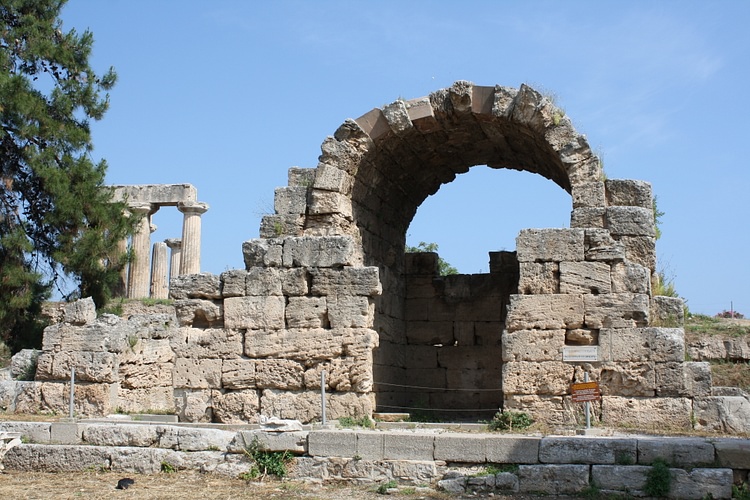 Ruined Shop, Corinth Agora Mark Cartwright (CC BY-NC-SA) ](https://www.worldhistory.org/image/534/ruined-shop-corinth-agora/ "Ruined Shop, Corinth Agora")### The Archaeological Site
In ancient Corinth there were cults to [Aphrodite](https://www.worldhistory.org/Aphrodite/) (protectress of the city), Apollo, [Demeter](https://www.worldhistory.org/demeter/) Thesmophoros, [Hera](https://www.worldhistory.org/Hera/), Poseidon, and [Helios](https://www.worldhistory.org/Helios/) and various buildings to cult heroes, the founders of the city. In addition, there were several sacred springs, the most famous being Peirene. Unfortunately, the destruction in 146 BCE obliterated much of this religious past. In Roman Corinth, Aphrodite, Poseidon, and Demeter did continue to be worshipped along with the Roman gods.
The site today, first excavated in 1892 CE by the Greek Archaeological Service, is dominated by the Doric peripteral Temple of Apollo (c. 550-530 BCE), originally with 6 columns on the façades and fifteen on the long sides. A particular feature of the temple is the use of monolithic columns rather than the more commonly used [column](https://www.worldhistory.org/column/) drums. Seven columns remain standing today.
The majority of the other surviving buildings date from the 1st century CE in the Roman era and include a large forum, a temple to [Octavia](https://www.worldhistory.org/disambiguation/Octavia/), baths, the Bema where St. Paul addressed the Corinthians, the Asklepeion temple to [Asclepius](https://www.worldhistory.org/Asclepius/), and a centre of healing, fountains - including the monumental Peirine fountain complex (2nd century CE) - a [propylaea](https://www.worldhistory.org/Propylaea/), [theatre](https://www.worldhistory.org/disambiguation/theatre/), odeion, [gymnasium](https://www.worldhistory.org/Gymnasium/), and stoas. There are also the remains of three basilicas.
Archaeological finds at the site include many fine mosaics - notably the [Dionysos](https://www.worldhistory.org/Dionysos/) [mosaic](https://www.worldhistory.org/Mosaic/) - Greek and [Roman sculpture](https://www.worldhistory.org/Roman_Sculpture/) - including an impressive number of busts of Roman rulers - and outstanding examples of all the styles of Greek pottery, the first source of the city's fame in the ancient world.
#### Editorial Review
This human-authored definition has been reviewed by our editorial team before publication to ensure accuracy, reliability and adherence to academic standards in accordance with our [editorial policy](https://www.worldhistory.org/static/editorial-policy/).
## Bibliography
- Ananiades, D. *Ancient Greece: Temples & Sanctuaries.* Toubis, Athens, 2010
- [Hornblower, S. *The Oxford Classical Dictionary.* Oxford University Press, USA, 2012.](https://www.worldhistory.org/books/0199545561/)
- [Kinzl, K.H. (ed). *A Companion to the Classical Greek World.* Wiley-Blackwell, 2010.](https://www.worldhistory.org/books/1444334123/)
- [Papahatzis, N. *Ancient Corinth.* Ekdotike Athenon, 1981.](https://www.worldhistory.org/books/9602131438/)
## About the Author
Mark is WHE’s Publishing Director and has an MA in Political Philosophy (University of York). He is a full-time researcher, writer, historian and editor. Special interests include art, architecture and discovering the ideas that all civilizations share.
## Timeline
- **c. 5000 BCE**: Earliest [Neolithic](https://www.worldhistory.org/Neolithic/) finds in the [Corinth](https://www.worldhistory.org/corinth/) area.
- **1074 BCE**: Aletes, the last Dorian king of Late [Bronze Age](https://www.worldhistory.org/disambiguation/Bronze_Age/) [Corinth](https://www.worldhistory.org/corinth/), is deposed.
- **926 BCE - 891 BCE**: Bacchis, a descendent of Aletes, becomes king of [Corinth](https://www.worldhistory.org/corinth/).
- **c. 750 BCE**: The Bacchiadae take power in [Corinth](https://www.worldhistory.org/corinth/).
- **c. 733 BCE**: Traditional date when [Corinth](https://www.worldhistory.org/corinth/) founds a colony on [Corcyra](https://www.worldhistory.org/corcyra/).
- **733 BCE**: [Corinth](https://www.worldhistory.org/corinth/) founds the colony of [Syracuse](https://www.worldhistory.org/syracuse/) in [Sicily](https://www.worldhistory.org/sicily/).
- **c. 700 BCE**: Corinthians adopt the [trireme](https://www.worldhistory.org/trireme/) from the [Phoenicians](https://www.worldhistory.org/phoenicia/).
- **660 BCE**: [Corcyra](https://www.worldhistory.org/corcyra/) wins a naval [battle](https://www.worldhistory.org/disambiguation/battle/) against their founding [city](https://www.worldhistory.org/city/) of [Corinth](https://www.worldhistory.org/corinth/).
- **c. 657 BCE - 585 BCE**: The Kypselidai are tyrants of [Corinth](https://www.worldhistory.org/corinth/).
- **c. 627 BCE - c. 587 BCE**: [Periander](https://www.worldhistory.org/Periander/) is tyrant at [Corinth](https://www.worldhistory.org/corinth/).
- **c. 625 BCE**: [Black-figure pottery](https://www.worldhistory.org/Black_Figure_Pottery/) created in [Corinth](https://www.worldhistory.org/corinth/).
- **c. 625 BCE - 600 BCE**: The orientalizing style of [Greek pottery](https://www.worldhistory.org/Greek_Pottery/) becomes popular in [Corinth](https://www.worldhistory.org/corinth/).
- **c. 620 BCE - 600 BCE**: Proto-corinthian reaches its zenith in artistic quality producing the best [pottery](https://www.worldhistory.org/pottery/) in [Greece](https://www.worldhistory.org/greece/).
- **585 BCE**: An oligarchy of 80 takes power at [Corinth](https://www.worldhistory.org/corinth/).
- **580 BCE**: First athletic games at [Isthmia](https://www.worldhistory.org/Isthmia/).
- **c. 550 BCE**: The [temple](https://www.worldhistory.org/temple/) of [Apollo](https://www.worldhistory.org/apollo/) is constructed at [Corinth](https://www.worldhistory.org/corinth/).
- **c. 550 BCE - c. 366 BCE**: [Peloponnesian League](https://www.worldhistory.org/Peloponnesian_League/) alliance between [Sparta](https://www.worldhistory.org/sparta/), [Corinth](https://www.worldhistory.org/corinth/), Elis and [Tegea](https://www.worldhistory.org/Tegea/) which establishes Spartan hegemony over the [Peloponnese](https://www.worldhistory.org/Peloponnese/).
- **525 BCE**: [Sparta](https://www.worldhistory.org/sparta/) and [Corinth](https://www.worldhistory.org/corinth/) unsuccessfully attack [Polycrates](https://www.worldhistory.org/Polycrates/) of [Samos](https://www.worldhistory.org/samos/).
- **433 BCE**: A naval [battle](https://www.worldhistory.org/disambiguation/battle/) between the victorious combined forces of [Corcyra](https://www.worldhistory.org/corcyra/) and [Athens](https://www.worldhistory.org/Athens/) against [Corinth](https://www.worldhistory.org/corinth/).
- **429 BCE**: [Athens](https://www.worldhistory.org/Athens/) successfully campaigns in the Corinthian Gulf regions during the [Peloponnesian War](https://www.worldhistory.org/Peloponnesian_War/).
- **c. 411 BCE - c. 337 BCE**: Life of Corinthian general [Timoleon](https://www.worldhistory.org/Timoleon/).
- **395 BCE - 386 BCE**: The Corinthian Wars between [Sparta](https://www.worldhistory.org/sparta/) and an alliance of [Athens](https://www.worldhistory.org/Athens/), [Corinth](https://www.worldhistory.org/corinth/), [Argos](https://www.worldhistory.org/argos/), Boeotia and [Thebes](https://www.worldhistory.org/disambiguation/Thebes/).
- **c. 354 BCE**: [Xenophon](https://www.worldhistory.org/xenophon/) dies at [Corinth](https://www.worldhistory.org/corinth/).
- **338 BCE**: Philip of Macedonia defeats the [Greek](https://www.worldhistory.org/disambiguation/greek/) allied forces of [Athens](https://www.worldhistory.org/Athens/), [Thebes](https://www.worldhistory.org/disambiguation/Thebes/) and [Corinth](https://www.worldhistory.org/corinth/) in the [Battle](https://www.worldhistory.org/disambiguation/battle/) of Chaironeia.
- **243 BCE**: [Corinth](https://www.worldhistory.org/corinth/) joins the Archaean League.
- **243 BCE**: [Corinth](https://www.worldhistory.org/corinth/) is attacked and brought into the [Achaean League](https://www.worldhistory.org/Achaean_League/).
- **225 BCE**: Macedonians bring an army across the Isthmus to face another Achaian force trying to take [Corinth](https://www.worldhistory.org/corinth/).
- **146 BCE**: [Rome](https://www.worldhistory.org/Rome/) sacks [Corinth](https://www.worldhistory.org/corinth/) and dissolves the [Achaean league](https://www.worldhistory.org/Achaean_League/). [Greece](https://www.worldhistory.org/greece/) is ruled by Rome.
- **44 BCE**: [Julius Caesar](https://www.worldhistory.org/Julius_Caesar/) founds the [Roman](https://www.worldhistory.org/disambiguation/Roman/) colony of [Corinth](https://www.worldhistory.org/corinth/).
- **67 CE**: Under [Nero](https://www.worldhistory.org/Nero/) excavation of the [Corinth](https://www.worldhistory.org/corinth/) Canal begins but is abandoned after three months.
- **267 CE**: The [Goths](https://www.worldhistory.org/Goths/) sack [Athens](https://www.worldhistory.org/Athens/), [Corinth](https://www.worldhistory.org/corinth/), [Sparta](https://www.worldhistory.org/sparta/), and [Argos](https://www.worldhistory.org/argos/).
- **c. 396 CE**: [Corinth](https://www.worldhistory.org/corinth/) burned by the [Visigoths](https://www.worldhistory.org/visigoth/) under [Alaric](https://www.worldhistory.org/Alaric/).
## Cite This Work
### APA
Cartwright, M. (2009, September 02). Corinth. *World History Encyclopedia*.
### Chicago
Cartwright, Mark. "Corinth." *World History Encyclopedia*, September 02, 2009. .
### MLA
Cartwright, Mark. "Corinth." *World History Encyclopedia*, 02 Sep 2009, .
## License & Copyright
Submitted by [Mark Cartwright](https://www.worldhistory.org/user/markzcartwright/ "User Page: Mark Cartwright"), published on 02 September 2009. The copyright holder has published this content under the following license: [Creative Commons Attribution-NonCommercial-ShareAlike](https://creativecommons.org/licenses/by-nc-sa/4.0/deed.en). This license lets others remix, tweak, and build upon this content non-commercially, as long as they credit the author and license their new creations under the identical terms. When republishing on the web a hyperlink back to the original content source URL must be included. Please note that content linked from this page may have different licensing terms.