---
title: Corcyra: The Ancient City-State of Corfu
author: Mark Cartwright
source: https://www.worldhistory.org/corcyra/
format: machine-readable-alternate
license: Creative Commons Attribution-NonCommercial-ShareAlike (https://creativecommons.org/licenses/by-nc-sa/4.0/)
updated: 2025-04-18
---
# Corcyra: The Ancient City-State of Corfu
_Authored by [Mark Cartwright](https://www.worldhistory.org/user/markzcartwright/)_
Corcyra (modern Corfu and also known as Kerkyra) located in the Ionian sea is one of the northern most [Greek](https://www.worldhistory.org/disambiguation/greek/) islands and was an important *[polis](https://www.worldhistory.org/Polis/)* or [city-state](https://www.worldhistory.org/Polis/) in the [Archaic](https://www.worldhistory.org/disambiguation/Archaic/) and Classical periods. Possessing a significant naval fleet and controlling access to the Adriatic, the island was often fought over by larger [city](https://www.worldhistory.org/city/)-states such as [Corinth](https://www.worldhistory.org/corinth/) and [Athens](https://www.worldhistory.org/Athens/) in the Classical Period and was a [Roman](https://www.worldhistory.org/disambiguation/Roman/) naval base in the 1st century BCE.
### Archaic & Classical Periods
The island was first inhabited in the [Neolithic age](https://www.worldhistory.org/Neolithic/) and early [Bronze Age](https://www.worldhistory.org/disambiguation/Bronze_Age/) archaeological remains show similarities with finds in Campania and Apulia (central and southern [Italy](https://www.worldhistory.org/italy/)). Strategically positioned to control the early sea routes between [Greece](https://www.worldhistory.org/greece/), Italy and the wider Adriatic, the island became a significant port. In the 8th century BCE, by driving out the Eretrians a colony was established by Corinth on a rocky peninsula on the east side of the island; the traditional date for this historic founding was 734 BCE. The city gained the name of Corcyra and thanks to its three harbours prospered as a trading centre. The name Corcyra may be a corruption of 'Gorgon' - after the mythical creature known as [Medusa](https://www.worldhistory.org/Medusa/) who was killed by the Corinthian hero [Bellerophon](https://www.worldhistory.org/Bellerophon/).
Relations between the native population and the colonising Corinthians were initially cooperative with colonies at Epidamnus and [Apollonia](https://www.worldhistory.org/disambiguation/Apollonia/) being co-founded between the two but Corinth would have its hands full to contain the island in the longer term. According to [Thucydides](https://www.worldhistory.org/Thucydides/), in c. 660 BCE the two fought in a sea [battle](https://www.worldhistory.org/disambiguation/battle/) with Corcyra victorious. The Corinthian tyrant [Periander](https://www.worldhistory.org/Periander/) brought the island once again in line with the mother city but on his [death](https://www.worldhistory.org/disambiguation/Death/) the island once again fought for independence. Corcyra then followed an isolationist policy, rarely interfering in wider Mediterranean affairs and, significantly, refrained from participating in the [Persian Wars](https://www.worldhistory.org/Persian_Wars/) of the early 5th century BCE which involved most of Greece. The island was helped in this independent stance by its high degree of self-sufficiency. The favourable climate of the island (having one of the highest rainfalls in Greece) allowed [agriculture](https://www.worldhistory.org/disambiguation/Agriculture/) to prosper so that even the export of surplus goods, particularly wine, was possible.
However, a civil [war](https://www.worldhistory.org/disambiguation/War/) at Epidamnus once again brought a head-on conflict with Corinth and the island allied itself with Athens, who was eager to protect her [trade](https://www.worldhistory.org/disambiguation/trade/) routes. In 433 BCE the Athenians sent a small fleet in assistance against Corinthian naval interference, a force which was reinforced in 427 and 425 BCE. The civil war (*stasis*) of 427 BCE in Corcyra was particularly bitter, with two main factions - democratic and oligarchic - committing atrocities and the citizens of Corcyra, thereafter, gained a reputation for being quarrelsome independents. In 410 BCE the democratic faction sought support once again from Athens whilst the oligarchy looked to [Sparta](https://www.worldhistory.org/sparta/) for aid, embroiling the island with the two protagonists of the damaging [Peloponnesian War](https://www.worldhistory.org/Peloponnesian_War/).
[ 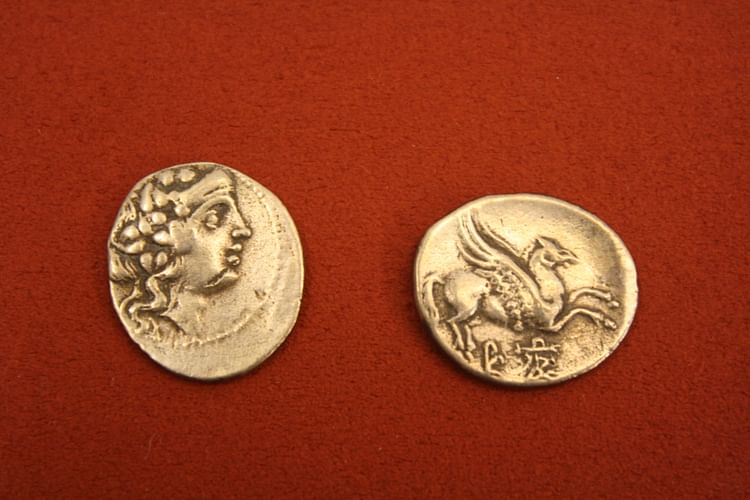 Corcyra Silver Didrachm Mark Cartwright (CC BY-NC-SA) ](https://www.worldhistory.org/image/853/corcyra-silver-didrachm/ "Corcyra Silver Didrachm")### [Hellenistic](https://www.worldhistory.org/Hellenic_World/) & Roman Periods
In the 4th century BCE Corcyra became more involved in regional politics, contributing two ships from her fleet towards [Timoleon](https://www.worldhistory.org/Timoleon/)'s expedition against [Syracuse](https://www.worldhistory.org/syracuse/) in 344 BCE and aiding the Athenians in their attempts to block Macedonia from operating in the Adriatic. [Alexander](https://www.worldhistory.org/disambiguation/Alexander/)'s successors fought for control of the island following the break-up of the Macedonian [empire](https://www.worldhistory.org/empire/) and it was later occupied by Agathocles, tyrant of Syracuse. The Illyrians captured the island in 229 BCE but following intervention from [Rome](https://www.worldhistory.org/Rome/), the island became an important naval base for the next half century, governed by a Rome-nominated prefect. In 148 BCE the island was put under the jurisdiction of the province of Macedonia.
In the 1st century BCE the island backed two losers in succession: [Pompey](https://www.worldhistory.org/pompey/) against [Julius Caesar](https://www.worldhistory.org/Julius_Caesar/) and [Mark Antony](https://www.worldhistory.org/Mark_Antony/) against [Octavian](https://www.worldhistory.org/augustus/), the latter establishing a naval base on Corcyra in 31 BCE. The island was, however, given back some degree of independence under Emperor [Claudius](https://www.worldhistory.org/claudius/) in the 1st century CE.
### [Archaeology](https://www.worldhistory.org/Archaeology/)
The island has several archaeological sites dating from the 7th and 6th centuries BCE on the Palaeopolis peninsula. Indicating the island's status as an important religious sanctuary there were several major temples, one of which was dedicated to [Apollo](https://www.worldhistory.org/apollo/), another to [Poseidon](https://www.worldhistory.org/poseidon/) and two more to [Artemis](https://www.worldhistory.org/artemis/) - of which only the foundations and fragmentary pieces remain.
The famous Doric [temple](https://www.worldhistory.org/temple/) of Artemis, dated to c. 585 BCE, originally had 8x17 exterior columns and a 3-aisled cella, pronaos and opisthodomos with a clay tile roof, replaced with marble in 535-525 BCE. It is the earliest temple in Greece to incorporate major stone decorative [sculpture](https://www.worldhistory.org/disambiguation/Sculpture/). Large pieces of the west pediment survive and depict the mythical Gorgon Medusa flanked by panthers, illustrating her role as Potnia Theron, Mistress of Animals, an epithet often attributed to Artemis. Also depicted are Medusa's offspring Chrysaor (Golden-Sword) and the flying horse [Pegasus](https://www.worldhistory.org/Pegasus/), who also often appeared on the coins of ancient Corcyra. Other archaeological remains on Corfu include parts of the ancient city walls and, from the Roman period, shipyards, harbour installations, workshops and a paved [agora](https://www.worldhistory.org/agora/).
#### Editorial Review
This human-authored definition has been reviewed by our editorial team before publication to ensure accuracy, reliability and adherence to academic standards in accordance with our [editorial policy](https://www.worldhistory.org/static/editorial-policy/).
## Bibliography
- Ananiades, D. *Ancient Greece: Temples & Sanctuaries.* Toubis, Athens, 2010
- [Burn, A.R. *The Penguin History of Greece.* Penguin Books, 1966.](https://www.worldhistory.org/books/0140137513/)
- [Hornblower, S. *The Oxford Classical Dictionary.* Oxford University Press, USA, 2012.](https://www.worldhistory.org/books/0199545561/)
- [Kinzl, K.H. (ed). *A Companion to the Classical Greek World.* Wiley-Blackwell, 2010.](https://www.worldhistory.org/books/1444334123/)
- [Strassler, R.B. Thucydides. *The Landmark Thucydides\[Paperback\] \[1998\] 1 Ed. Thucydides, Robert B. Strassler, Richard..* Free Press, 2013.](https://www.worldhistory.org/books/B00CQ81V5M/)
- [Xenophon. *The Landmark Xenophon's Hellenika by Xenophon unknown Edition \[Paperback\].* Anchor, 2013.](https://www.worldhistory.org/books/B00BR5H4Z6/)
## About the Author
Mark is WHE’s Publishing Director and has an MA in Political Philosophy (University of York). He is a full-time researcher, writer, historian and editor. Special interests include art, architecture and discovering the ideas that all civilizations share.
## Timeline
- **c. 733 BCE**: Traditional date when [Corinth](https://www.worldhistory.org/corinth/) founds a colony on [Corcyra](https://www.worldhistory.org/corcyra/).
- **660 BCE**: [Corcyra](https://www.worldhistory.org/corcyra/) wins a naval [battle](https://www.worldhistory.org/disambiguation/battle/) against their founding [city](https://www.worldhistory.org/city/) of [Corinth](https://www.worldhistory.org/corinth/).
- **c. 580 BCE**: The west pediment of the [temple](https://www.worldhistory.org/temple/) of [Artemis](https://www.worldhistory.org/artemis/) in [Corcyra](https://www.worldhistory.org/corcyra/) depicts [Medusa](https://www.worldhistory.org/Medusa/) and [Pegasus](https://www.worldhistory.org/Pegasus/).
- **490 BCE - 470 BCE**: [Corcyra](https://www.worldhistory.org/corcyra/) does not participate in the [Persian Wars](https://www.worldhistory.org/Persian_Wars/).
- **433 BCE**: A naval [battle](https://www.worldhistory.org/disambiguation/battle/) between the victorious combined forces of [Corcyra](https://www.worldhistory.org/corcyra/) and [Athens](https://www.worldhistory.org/Athens/) against [Corinth](https://www.worldhistory.org/corinth/).
- **433 BCE**: Alliance between [Athens](https://www.worldhistory.org/Athens/) and [Corcyra](https://www.worldhistory.org/corcyra/).
- **427 BCE**: Civil [war](https://www.worldhistory.org/disambiguation/War/) on [Corcyra](https://www.worldhistory.org/corcyra/) between democratic and oligarchic factions.
- **344 BCE**: [Corcyra](https://www.worldhistory.org/corcyra/) contributes two ships to [Timoleon](https://www.worldhistory.org/Timoleon/)'s fleet which attacked [Syracuse](https://www.worldhistory.org/syracuse/).
- **229 BCE**: [Corcyra](https://www.worldhistory.org/corcyra/) is captured by the Illyrians.
- **148 BCE**: [Corcyra](https://www.worldhistory.org/corcyra/) is made part of the [Roman](https://www.worldhistory.org/disambiguation/Roman/) province of Macedonia.
- **31 BCE**: [Octavian](https://www.worldhistory.org/augustus/) uses [Corcyra](https://www.worldhistory.org/corcyra/) as a [Roman](https://www.worldhistory.org/disambiguation/Roman/) naval base.
## Cite This Work
### APA
Cartwright, M. (2013, June 05). Corcyra: The Ancient City-State of Corfu. *World History Encyclopedia*.
### Chicago
Cartwright, Mark. "Corcyra: The Ancient City-State of Corfu." *World History Encyclopedia*, June 05, 2013. .
### MLA
Cartwright, Mark. "Corcyra: The Ancient City-State of Corfu." *World History Encyclopedia*, 05 Jun 2013, .
## License & Copyright
Submitted by [Mark Cartwright](https://www.worldhistory.org/user/markzcartwright/ "User Page: Mark Cartwright"), published on 05 June 2013. The copyright holder has published this content under the following license: [Creative Commons Attribution-NonCommercial-ShareAlike](https://creativecommons.org/licenses/by-nc-sa/4.0/deed.en). This license lets others remix, tweak, and build upon this content non-commercially, as long as they credit the author and license their new creations under the identical terms. When republishing on the web a hyperlink back to the original content source URL must be included. Please note that content linked from this page may have different licensing terms.