---
title: Ancient China
author: Joshua J. Mark
source: https://www.worldhistory.org/china/
format: machine-readable-alternate
license: Creative Commons Attribution-NonCommercial-ShareAlike (https://creativecommons.org/licenses/by-nc-sa/4.0/)
updated: 2022-07-11
---
# Ancient China
_Authored by [Joshua J. Mark](https://www.worldhistory.org/user/JPryst/)_
Ancient China produced what has become the oldest extant [culture](https://www.worldhistory.org/disambiguation/culture/) in the world. The name 'China' comes from the [Sanskrit](https://www.worldhistory.org/Sanskrit/) *Cina* (derived from the name of the Chinese [Qin Dynasty](https://www.worldhistory.org/Qin_Dynasty/), pronounced 'Chin') which was translated as 'Cin' by the Persians and seems to have become popularized through [trade](https://www.worldhistory.org/disambiguation/trade/) along the [Silk Road](https://www.worldhistory.org/Silk_Road/).
The Romans and the Greeks knew the country as 'Seres', “the land where [silk](https://www.worldhistory.org/Silk/) comes from”. The name 'China' does not appear in print in the west until 1516 CE in Barbosa's journals narrating his travels in the east (though the Europeans had long known of China through trade via the Silk Road). [Marco Polo](https://www.worldhistory.org/Marco_Polo/), the famous explorer who familiarized China to [Europe](https://www.worldhistory.org/europe/) in the 13th century CE, referred to the land as 'Cathay. In Mandarin Chinese, the country is known as 'Zhongguo' meaning "central state" or "middle [empire](https://www.worldhistory.org/empire/)".
### Prehistory
Well before the advent of recognizable [civilization](https://www.worldhistory.org/civilization/) in the region, the land was occupied by hominids. Peking Man, a skull fossil discovered in 1927 CE near Beijing, lived in the area between 700,000 to 300,000 years ago, and Yuanmou Man, whose remains were found in Yuanmou in 1965 CE, inhabited the land 1.7 million years ago. Evidence uncovered with these finds shows that these early inhabitants knew how to fashion stone tools and use fire.
While it is commonly accepted that human beings originated in [Africa](https://www.worldhistory.org/disambiguation/africa/) and then migrated to other points around the globe, China's paleoanthropologists "support the theory of 'regional evolution' of the origin of man" (China.org) which claims an independent basis for the birth of human beings. "The Shu Ape, a primate weighing only 100 to 150 grams and being similar to a mouse in size, lived \[in China\] in the Middle Eocene Epoch 4.5 to 4 million years ago. Its discovery posed a great challenge to the theory of African origin of the human race" (China.org). This challenge is considered plausible due to genetic links between the Shu Ape fossil and both advanced and lower primates, standing, then, as a 'missing link' in the evolutionary process.
However one interprets this data (the Chinese conclusions have been disputed by the international community), the solid evidence provided by other finds substantiates a very ancient lineage of hominids and [homo sapiens](https://www.worldhistory.org/Homo_Sapiens/) in China and a high level of sophistication in early culture. One example of this is [Banpo Village](https://www.worldhistory.org/Banpo_Village/), near Xi'an, discovered in 1953 CE. Banpo is a [Neolithic](https://www.worldhistory.org/Neolithic/) village which was inhabited between 4500 and 3750 BCE and comprises 45 houses with floors sunk into the ground for greater stability. A trench encircling the village provided both protection from attack and drainage (while also helping to fence in domestic animals) while man-made caves dug underground were used to store food. The design of the village, and the artifacts discovered there (such as [pottery](https://www.worldhistory.org/pottery/) and tools), argue for a very advanced culture at the time it was constructed.
[  Banpo Village, Xi'an, China Ian Armstrong (CC BY-SA) ](https://www.worldhistory.org/image/4052/banpo-village-xian-china/ "Banpo Village, Xi'an, China")It has generally been accepted that the Chinese 'Cradle of Civilization' is the Yellow River Valley which gave rise to villages sometime around 5000 BCE. While this has been disputed, and arguments have been made for the more widespread development of communities, there is no doubt that the Henan province, in the Yellow River Valley, was the site of many early villages and farming communities.
In 2001 CE, archaeologists uncovered two skeletons "buried in a collapsed house, which was covered with a thick layer of silt deposits from the Yellow River. In the layer of deposits, archaeologists found more than 20 skeletons, an altar, a square, pottery, and stone and jade utensils" (Chinapage.org). This site was only one of many prehistoric villages in the area.
### The First Dynasties
From these small villages and farming communities grew centralized government; the first of which was the prehistoric [Xia Dynasty](https://www.worldhistory.org/Xia_Dynasty/) (c. 2070-1600 BCE). The Xia Dynasty was considered, for many years, more myth than fact until excavations in the 1960s and 1970s CE uncovered sites which argued strongly for its existence. [Bronze](https://www.worldhistory.org/disambiguation/bronze/) works and tombs clearly point to an evolutionary period of development between disparate [Stone Age](https://www.worldhistory.org/Stone_Age/) villages and a recognizable cohesive civilization.
The dynasty was founded by the legendary Yu the Great who worked relentlessly for 13 years to control the flooding of the Yellow River which routinely destroyed the farmer's crops. He was so focused on his work that it was said he did not return home once in all those years, even though he seems to have passed by his house on at least three occasions, and this dedication inspired others to follow him.
After he had controlled the flooding, Yu conquered the Sanmiao tribes and was named successor (by the then-ruler, Shun), reigning until his [death](https://www.worldhistory.org/disambiguation/Death/). Yu established the hereditary system of succession and thereby the concept of dynasty which has become most familiar. The ruling class and the elite lived in urban clusters while the peasant population, which supported the elite's lifestyle, remained largely agrarian, living in rural areas. Yu's son, Qi, ruled after him and power remained in the hands of the family until the last Xia ruler, Jie, was overthrown by [Tang](https://www.worldhistory.org/Tang_Dynasty/) who established the Shang Dynasty (1600-1046 BCE).
Tang was from the kingdom of Shang. The dates popularly assigned to him (1675-1646 BCE) do not in any way correspond to the known events in which he took part and must be considered erroneous. What is known is that he was the ruler, or at least a very important personage, in the kingdom of Shang who, around 1600 BCE, led a revolt against Jie and defeated his forces at the [Battle](https://www.worldhistory.org/disambiguation/battle/) of Mingtiao.
The extravagance of the Xia court and the resultant burden on the populace is thought to have led to this uprising. Tang then assumed leadership of the land, lowered taxes, suspended the grandiose building projects begun by Jie (which were draining the kingdom of resources) and ruled with such wisdom and efficiency that art and culture were allowed to flourish. Writing developed under the Shang Dynasty as well as bronze metallurgy, architecture, and religion.
[  King Tang of Shang Ma Lin (Public Domain) ](https://www.worldhistory.org/image/4501/king-tang-of-shang/ "King Tang of Shang")Prior to the Shang, the people worshipped many gods with one supreme [god](https://www.worldhistory.org/God/), Shangti, as head of the [pantheon](https://www.worldhistory.org/Pantheon/) (the same pattern found in other cultures). Shangti was considered 'the great ancestor' who presided over victory in [war](https://www.worldhistory.org/disambiguation/War/), [agriculture](https://www.worldhistory.org/disambiguation/Agriculture/), the weather, and good government. Because he was so remote and so busy, however, the people seem to have required more immediate intercessors for their needs and so the practice of ancestor worship began.
When someone died, it was thought, they attained divine powers and could be called upon for assistance in times of need (similar to the [Roman](https://www.worldhistory.org/disambiguation/Roman/) belief in the *parentes*). This practice led to highly sophisticated rituals dedicated to appeasing the spirits of the ancestors which eventually included ornate burials in grand tombs filled with all one would need to enjoy a comfortable afterlife.
The king, in addition to his secular duties, served as chief officiate and mediator between the living and the dead and his rule was considered ordained by divine [law](https://www.worldhistory.org/disambiguation/law/). Although the famous [Mandate of Heaven](https://www.worldhistory.org/Mandate_of_Heaven/) was developed by the later [Zhou Dynasty](https://www.worldhistory.org/Zhou_Dynasty/), the idea of linking a just ruler with divine will has its roots in the beliefs fostered by the Shang.
[  Imperial Dynasties of China Visual Timeline Simeon Netchev (CC BY-NC-ND) ](https://www.worldhistory.org/image/16125/imperial-dynasties-of-china-visual-timeline/ "Imperial Dynasties of China Visual Timeline")### The [Zhou](https://www.worldhistory.org/Zhou_Dynasty/) Dynasty
Around the year 1046 BCE, King Wu (r. 1046-1043 BCE), of the province of Zhou, rebelled against King Zhou of Shang and defeated his forces at the Battle of Muye, establishing the Zhou Dynasty (1046- 256 BCE). 1046-771 BCE marks the Western Zhou Period while 771-256 BCE marks the Eastern Zhou Period. Wu rebelled against the ruling Shang after the king of Shang killed his older brother unjustly. The Mandate of Heaven was invoked by Wu and his family to legitimize the revolt as he felt the Shang were no longer acting in the interests of the people and so had forfeited the mandate between the monarchy and the god of law, order, and justice, Shangti.
The Mandate of Heaven was thus defined as the gods' blessing on a just ruler and rule by divine mandate. When the government no longer served the will of the gods, that government would be overthrown. Further, it was stipulated that there could be only one legitimate ruler of China and that his rule should be legitimized by his proper conduct as a steward of the lands entrusted him by heaven. Rule could be passed from father to son but only if the child possessed the necessary virtue to rule. This mandate would later be often manipulated by various rulers entrusting succession to unworthy progeny.
[ 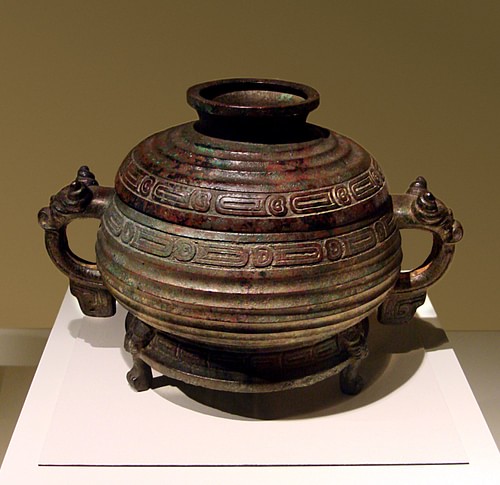 Bronze Zhou Cooking Vessel Editor at Large (CC BY-SA) ](https://www.worldhistory.org/image/3045/bronze-zhou-cooking-vessel/ "Bronze Zhou Cooking Vessel")Under the Zhou, culture flourished and civilization spread. Writing was codified and iron metallurgy became increasingly sophisticated. The greatest and best-known Chinese philosophers and poets, [Confucius](https://www.worldhistory.org/Confucius/), [Mencius](https://www.worldhistory.org/Mencius/), [Mo Ti](https://www.worldhistory.org/Mo_Ti/) (Mot Zu), [Lao-Tzu](https://www.worldhistory.org/Lao-Tzu/), Tao Chien, and the military strategist [Sun-Tzu](https://www.worldhistory.org/Sun-Tzu/) (if he existed as depicted), all come from the Zhou period in China and the time of the Hundred Schools of Thought.
The [chariot](https://www.worldhistory.org/chariot/), which was introduced to the land under the Shang, became more fully developed by the Zhou. It should be noted that these periods and dynasties did not begin nor end as neatly as they seem to in history books and the Zhou Dynasty shared many qualities with the Shang (including language and religion). While historians find it necessary, for clarity's sake, to break events into periods, the Zhou Dynasty remained extant through the following recognized periods known as The Spring and Autumn Period and The [Warring States Period](https://www.worldhistory.org/Warring_States_Period/).
### The Spring & Autumn Period & The Warring States
During the Spring and Autumn Period (c. 772-476 BCE and so called from the *Spring and Autumn Annals*, the official chronicle of the state at the time and an early source mentioning General Sun-Tzu), the Zhou government became decentralized in their move to the new capital at [Luoyang](https://www.worldhistory.org/Luoyang/), marking the end of the 'Western Zhou' period and the beginning of 'Eastern Zhou'. This is the period most noted for advances in [philosophy](https://www.worldhistory.org/philosophy/), poetry, and the arts and saw the rise of Confucian, Taoist, and Mohist thought.
At the same time, however, the different states were breaking away from central rule by Luoyang and proclaiming themselves sovereign. This, then, led to the so-called Warring States Period (c. 481-221 BCE) in which seven states fought with each other for control. The seven states were Chu, [Han](https://www.worldhistory.org/Han_Dynasty/), Qi, Qin, Wei, Yan, and Zhao, all of whom considered themselves sovereign but none of whom felt confident in claiming the Mandate of Heaven still held by the Zhou of Luoyang. All seven of the states used the same tactics and observed the same rules of conduct in battle and so none could gain the advantage over the others.
[  Map of the Warring States of China & Qin Conquest Simeon Netchev (CC BY-NC-ND) ](https://www.worldhistory.org/image/16124/map-of-the-warring-states-of-china--qin-conquest/ "Map of the Warring States of China & Qin Conquest")This situation was exploited by the pacifist philosopher Mo Ti, a skilled engineer, who made it his mission to provide each state with equal knowledge of fortifications and siege ladders in hopes of neutralizing any one state's advantage and so ending the war. His efforts were unsuccessful however and, between 262 and 260 BCE, the state of Qin gained supremacy over Zhao, finally defeating them at The Battle of Changping.
A Qin statesman by the name of Shang [Yang](https://www.worldhistory.org/Yin_and_Yang/) (d. 338 BCE), a great believer in efficiency and law, had recast the Qin understanding of [warfare](https://www.worldhistory.org/warfare/) to focus on victory at any cost. Whether Sun-Tzu or Shang Yang is to be credited with the [reformation](https://www.worldhistory.org/disambiguation/Reformation/) of military protocol and strategy in China depends on one's acceptance of Sun-Tzu's historicity. Whether Sun-Tzu existed as people claim, however, it is very probable that Shang Yang was acquainted with the famous work, *[The Art of War](https://www.worldhistory.org/The_Art_of_War/)*, which bears Sun-Tzu's name as author.
Prior to these reforms, [Chinese warfare](https://www.worldhistory.org/Chinese_Warfare/) was considered a nobleman's game of skill with very set rules dictated by courtesy and the perceived will of heaven. One did not attack the weak or the unprepared and one was expected to delay engagement until an opponent had mobilized and formed ranks on the field. Shang advocated total war in pursuit of victory and counseled taking the enemies' forces by whatever means lay at hand. Shang's principles were known in Qin and made use of at Changping (where over 450,000 captured Zhao soldiers were executed after the battle) giving the Qin the advantage they had been waiting for.
Still, they did not make further effective use of these tactics until the rise of Ying Zheng, King of Qin. Utilizing Shang's directives, and with an army of considerable size using iron weapons and driving chariots, Ying Zheng emerged from the Warring States conflict supreme in 221 BCE, subduing and unifying the other six states under his rule and proclaiming himself Shi Huangdi -`First Emperor' - of China.
### The Qin Dynasty
Shi Huangdi thus established the Qin Dynasty (221-206 BCE), initiating the period known as the Imperial Era in China (221 BCE-1912 CE) when dynasties ruled the land. He ordered the destruction of the walled fortifications which had separated the different states and commissioned the building of a great [wall](https://www.worldhistory.org/wall/) along the northern border of his kingdom. Though little remains today of Shi Huangdi's original wall, The [Great Wall of China](https://www.worldhistory.org/Great_Wall_of_China/) was begun under his rule.
> It stretched for over 5,000 kilometres (3,000 miles) across hill and plain, from the boundaries of [Korea](https://www.worldhistory.org/Korea/) in the east to the troublesome Ordos Desert in the west. It was an enormous logistical undertaking, though for much of its course it incorporated lengths of earlier walls built by the separate Chinese kingdoms to defend their northern frontiers in the fourth and third centuries. (Scarre and Fagan, 382)
Shi Huangdi also strengthened the infrastructure through road building which helped to increase trade through the ease of travel.
> Five trunk roads led from the imperial capital at Xianyang, each provided with police forces and posting stations. Most of these roads were of rammed-earth construction and were 15 metres (50 feet) wide. The longest ran southwest over 7,500 kilometres (4,500 miles) to the frontier region of Yunnan. So precipitous was the countryside that sections of the road had to be built out from vertical cliff faces on projecting timber galleries. (Scarre and Fagan, 382)
Shi Huangdi also expanded the boundaries of his empire, built the Grand Canal in the south, redistributed land and, initially, was a fair and just ruler.
[  Shi Huangdi Dennis Jarvis (CC BY-SA) ](https://www.worldhistory.org/image/988/shi-huangdi/ "Shi Huangdi")While he made great strides in building projects and military campaigns, his rule became increasingly characterized by a heavy hand in domestic policy. Claiming the Mandate from Heaven, he suppressed all philosophies save the [Legalism](https://www.worldhistory.org/Legalism/) which had been developed by Shang Yang and, heeding the counsel of his chief advisor, Li Siu, he ordered the destruction of any history or philosophy books which did not correspond to Legalism, his family line, the state of Qin, or himself.
> Since books were then written on strips of bamboo fastened with swivel pins, and a volume might be of some weight, the scholars who sought to evade the order were put to many difficulties. A number of them were detected; tradition says that many of them were sent to labor on the Great Wall, and that four hundred and sixty were put to death. Nevertheless some of the literati memorized the complete works of Confucius and passed them on by word of mouth to equal memories. (Durant, 697)
This act, along with Shi Huangdi's suppression of general freedoms, including freedom of speech, made him progressively more unpopular. The ancestor worship of the past and the land of the dead began to interest the emperor more than his realm of the living and Shi Huangdi became increasingly engrossed in what this other world consisted of and how he might avoid traveling there. He seems to have developed an obsession with death, became increasingly paranoid regarding his personal safety, and ardently sought after immortality.
[  The Terracotta Army Panorama Bernd Thaller (CC BY-NC-SA) ](https://www.worldhistory.org/image/7542/the-terracotta-army-panorama/ "The Terracotta Army Panorama")His desire to provide for himself an afterlife commensurate with his present one led him to commission a [palace](https://www.worldhistory.org/disambiguation/palace/) built for his [tomb](https://www.worldhistory.org/tomb/) and an army of over 8,000 terracotta warriors created to serve him in eternity. This ceramic army, buried with him, also included terracotta chariots, cavalry, a commander in chief, and assorted birds and animals. He is said to have died in 210 BCE while on a quest for an elixir of immortality and Li Siu, hoping to gain control of the government, kept his death a secret until he could alter his will to name his pliable son, Hu-Hai, as heir.
This plan proved untenable, however, as the young prince showed himself to be quite unstable, executing many, and initiating a widespread rebellion in the land. Shortly after Shi Huangdi' s death, the Qin Dynasty quickly collapsed through the intrigue and ineptitude of people like Hu-Hai, Li Siu, and another advisor, Zhao Gao, and the [Han Dynasty](https://www.worldhistory.org/Han_Dynasty/) (202 BCE-220 CE) began with the accession of Liu-Bang.
### The Chu-Han Contention
With the fall of the Qin Dynasty, China was plunged into the chaos known as the Chu-Han Contention (206-202 BCE). Two generals emerged among the forces which rebelled against the Qin: Liu-Bang of Han (l. c. 256-195 BCE) and General Xiang-Yu of Chu (l. 232-202 BCE), who fought for control of the government. Xiang-Yu, who had proven himself the most formidable opponent of the Qin, awarded Liu-Bang the title of 'King of the Han' in recognition of Liu-Bang's decisive defeat of the Qin forces at their capital of Xianyang.
[  Chu-Han Contention Map SY (CC BY-SA) ](https://www.worldhistory.org/image/9887/chu-han-contention-map/ "Chu-Han Contention Map")The two former allies quickly became antagonists, however, in the power struggle known as the Chu-Han contention until Xiang-Yu negotiated the Treaty of Hong Canal and brought a temporary peace. Xiang-Yu suggested dividing China under the rule of the Chu in the east and the Han in the west, but Liu-Bang wanted a united China under Han rule and, breaking the treaty, resumed hostilities. At the [Battle of Gaixia](https://www.worldhistory.org/Battle_of_Gaixia/) in 202 BCE, Liu-Bang's great general, Han-Xin, trapped and defeated the forces of Chu under Xiang-Yu and Liu-Bang was proclaimed emperor (known to posterity as Emperor Gaozu of Han). Xiang-Yu committed suicide but his family was allowed to live and even serve in government positions.
The new emperor Gaozu treated all of his former adversaries with respect and united the land under his rule. He pushed back the nomadic Xiongnu tribes, who had been making incursions into China, and made peace with the other states which had risen in rebellion against the failing Qin Dynasty. The Han Dynasty (which derives its name from Liu-Bang's home in Hanzhong province) would rule China, with a brief interruption, for the next 400 years, from 202 BCE to 220 CE. The Han is divided into two periods: Western Han - 202 BCE-9 CE and Eastern Han - 25 -220 CE.
### The Han Dynasty
The resultant peace initiated by Gaozu brought the stability necessary for culture to again thrive and grow. Trade with the west began during this time and arts and technology increased in sophistication. The Han are considered the first dynasty to write their history down but, as Shi Huangdi destroyed so many of the written records of those who came before him, this claim is often disputed. There is no doubt, however, that great advances were made under the Han in every area of culture.
The Yellow Emperor's *Canon of [Medicine](https://www.worldhistory.org/disambiguation/medicine/)*, China's earliest written record on medicine was codified during the Han Dynasty. Paper was invented at this time and writing became more sophisticated. Gaozu embraced Confucianism and made it the exclusive philosophy of the government, setting a pattern which would continue on to the present day.
Even so, unlike Shi Huangdi, he did not legislate philosophy for others. He practiced tolerance for all other philosophies and, as a result, [literature](https://www.worldhistory.org/literature/) and education flourished under his reign. He reduced taxes and disbanded his army who, nevertheless, rallied without delay when called upon.
After his death in 195 BCE, his wife, Empress Lu Zhi (l. 241-180 BCE), installed a series of puppet kings, beginning with the crown prince Liu Ying (Emperor Hui, r. 195-188 BCE), who served her interests but still continued his policies. These programmes maintained stability and culture enabling the greatest of the Han emperors, Wu Ti (also known as Wu the Great, r. 141- 87 BCE), to embark on his enterprises of expansion, public works, and cultural initiatives. He sent his emissary Zhang Qian to the west in 138 BCE which resulted in the official opening of the Silk Road in 130 BCE.
Confucianism was further incorporated as the official doctrine of the government and Wu Ti established schools throughout the empire to foster literacy and teach Confucian precepts. He also reformed transportation, roads, and trade and decreed many other public projects, employing millions as state workers in these undertakings. After Wu Ti, his successors, more or less, maintained his vision for China and enjoyed equal success.
[  Han Dynasty Farm Model Mark Cartwright (CC BY-NC-SA) ](https://www.worldhistory.org/image/4040/han-dynasty-farm-model/ "Han Dynasty Farm Model")Increase in wealth led to the rise of large estates and general prosperity but, for the [peasants](https://www.worldhistory.org/disambiguation/Peasants/) who worked the land, life became increasingly difficult. In 9 CE, the acting regent, Wang Mang (l. 45 BCE-23 CE), usurped control of the government claiming the Mandate of Heaven for himself and declaring an end to the Han Dynasty. Wang Mang founded the Xin Dynasty (9-23 CE) on a platform of extensive land reform and redistribution of wealth.
He initially had enormous support from the peasant population and was opposed by the landowners. His programs, however, were poorly conceived and executed resulting in widespread unemployment and resentment. Uprisings, and extensive flooding of the Yellow River, further destabilized Wang Mang's rule and he was assassinated by an angry mob of the peasants on whose behalf he had ostensibly seized the government and initiated his reforms.
### The Fall of Han & Rise of The Xin Dynasty
The rise of the Xin Dynasty ended the period known as Western Han and its demise led to the establishment of the Eastern Han period. Emperor Guangwu (r. 25-57 CE) returned the lands to the wealthy estate owners and restored order in the land, maintaining the policies of the earlier Western Han rulers. Guangwu, in reclaiming lands lost under the Xin Dynasty, was forced to spend much of his time putting down rebellions and re-establishing Chinese rule in the regions of modern-day Korea and Vietnam.
The Trung Sisters Rebellion of 39 CE in Vietnam, led by two sisters, required “ten odd thousands of men” (according to the official state record of Han) and four years to put down. Even so, the emperor consolidated his rule and even expanded his boundaries, providing stability which gave rise to an increase in trade and prosperity. By the time of Emperor Zhang (r. 75-88 CE), China was so prosperous that it was partners in trade with all the major nations of the day and continued in this way after his death. The Romans under [Marcus Aurelius](https://www.worldhistory.org/Marcus_Aurelius/), in 166 CE, considered Chinese silk more precious than [gold](https://www.worldhistory.org/gold/) and paid China whatever price was asked.
Disputes between the landed gentry and the peasants, however, continued to cause problems for the government as exemplified in the Five Pecks of Rice Rebellion (142 CE) and the Yellow Turban Rebellion (184 CE). While the Five Pecks of Rice Rebellion began as a religious movement, it involved a large number of the peasant class at odds with the Confucian ideals of the government and the elite. Both of these revolts were in response to governmental neglect of the people which worsened as the late Han Dynasty became increasingly corrupt and ineffective. The leaders of both rebellions claimed that the Han had forfeited the Mandate of Heaven and should abdicate.
The power of the government to control the people began to disintegrate until full-scale revolt erupted throughout the country as the Yellow Turban Rebellion gained momentum. Han generals were sent to put the rebellion down but, as soon as one enclave was crushed, another would spring up. The revolt was finally put down by the general [Cao Cao](https://www.worldhistory.org/Cao_Cao/) (l. 155- 220 CE). Cao Cao and his former friend and ally Yuan-Shao (d. 202 CE) then fought each other for control of the land with Cao Cao emerging victorious in the north.
Cao attempted a complete unification of China by invading the south but was defeated at the [Battle of Red Cliffs](https://www.worldhistory.org/Battle_of_Red_Cliffs/) in 208 CE, leaving China divided into three separate kingdoms - Cao Wei, Eastern Wu, and Shu Han - each of which claimed the Mandate of Heaven. This era is known as the Period of the Three Kingdoms (220-280 CE), a time of violence, instability, and uncertainty which would later inspire some of the greatest works in [Chinese literature](https://www.worldhistory.org/Chinese_Literature/).
[ 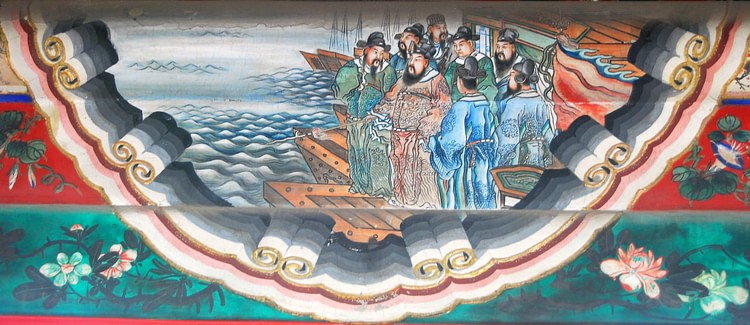 Cao Cao, Battle of Red Cliffs Shizhao (CC BY-SA) ](https://www.worldhistory.org/image/6931/cao-cao-battle-of-red-cliffs/ "Cao Cao, Battle of Red Cliffs")The Han Dynasty was now a memory and other, shorter-lived dynasties (such as the Wei and Jin, the Wu Hu, and the [Sui](https://www.worldhistory.org/Sui_Dynasty/)) assumed control of the government in turn and initiated their own platforms from roughly 208-618 CE. The [Sui Dynasty](https://www.worldhistory.org/Sui_Dynasty/) (589-618 CE) finally succeeded in reuniting China in 589 CE. The importance of the Sui Dynasty is in its implementation of highly efficient bureaucracy which streamlined the operation of government and led to greater ease in maintaining the empire. Under the Emperor Wen, and then his son, Yang, the Grand Canal was completed, the Great Wall was enlarged and portions rebuilt, the army was increased to the largest recorded in the world at that time, and [coinage](https://www.worldhistory.org/coinage/) was standardized across the realm.
Literature flourished and it is thought that the famous *Legend of Hua Mulan*, about a young girl who takes her father's place in the army and saves the country, was developed at this time (though the original poem is thought to have been composed during the Northern Wei Period, 386-535 CE). Unfortunately, both Wen and Yang were not content with domestic stability and organized massive expeditions against the Korean peninsula. Wen had already bankrupted the treasury through his building projects and military campaigns and Yang followed his father's example and failed equally in his attempts at military [conquest](https://www.worldhistory.org/warfare/). Yang was assassinated in 618 CE which then sparked the uprising of Li-Yuan who took control of the government and called himself Emperor Gao-Tzu of Tang (r. 618-626 CE).
### The [Tang Dynasty](https://www.worldhistory.org/Tang_Dynasty/)
The Tang Dynasty (618-907 CE) is considered the 'golden age' of Chinese civilization. Gao-Tzu prudently maintained and improved upon the bureaucracy initiated by the Sui Dynasty while dispensing with extravagant military operations and building projects. With minor modifications, the bureaucratic policies of the Tang Dynasty are still in use in Chinese government in the modern day.
Despite his efficient rule, Gao-Tzu was deposed by his son, Li-Shimin, in 626 CE. Having assassinated his father, Li-Shimin then killed his brothers and others of the noble house and assumed the title Emperor [Taizong](https://www.worldhistory.org/disambiguation/Taizong/) (r. 626-649 CE). After the bloody coup, however, Taizong decreed that [Buddhist](https://www.worldhistory.org/buddhism/) temples be built at the sites of the battles and that the fallen should be memorialized.
Continuing, and building upon, the concepts of ancestor worship and the Mandate of Heaven, Taizong claimed divine will in his actions and intimated that those he had killed were now his counselors in the afterlife. As he proved to be a remarkably efficient ruler, as well as a skilled military strategist and warrior, his coup went unchallenged and he set about the task of governing his vast empire.
Taizong followed his father's precepts in keeping much of what was good from the Sui Dynasty and improving upon it. This can be seen especially in Taizong's legal code which drew heavily on Sui concepts but expanded them for specificity of crime and punishment. He ignored his father's model of foreign policy, however, and embarked on a series of successful military campaigns which extended and secured his empire and also served to spread his legal code and Chinese culture.
Taizong was succeeded by his son Gaozong (r. 649-683 CE) whose wife, [Wu Zetian](https://www.worldhistory.org/Wu_Zetian/), would become China's first - and only - female monarch. Empress Wu Zetian (r. 690-704 CE) initiated a number of policies which improved the living conditions in China and strengthened the position of the emperor. She also made ample use of a secret police force and highly efficient channels of communication to stay always one step ahead of her enemies, both foreign and domestic.
[  Glazed Tang Dynasty Camel James Blake Wiener (CC BY-NC-SA) ](https://www.worldhistory.org/image/4101/glazed-tang-dynasty-camel/ "Glazed Tang Dynasty Camel")Trade flourished within the empire and, along the Silk Road, with the West. [Rome](https://www.worldhistory.org/Rome/) having now fallen, the [Byzantine Empire](https://www.worldhistory.org/Byzantine_Empire/) became a prime buyer of Chinese silk. By the time of the rule of Emperor Xuanzong (r. 712-756 CE) China was the largest, most populous, and most prosperous country in the world. Owing to the large population, armies of many thousands of men could be conscripted into service and military campaigns against Turkish nomads or domestic rebels were swift and successful. Art, technology, and [science](https://www.worldhistory.org/science/) all flourished under the Tang Dynasty (although the high point in the sciences is considered to be the later Sung Dynasty of 960-1234 CE) and some of the most impressive pieces of Chinese [sculpture](https://www.worldhistory.org/disambiguation/Sculpture/) and silverwork come from this period.
### The Fall of Tang & Rise of the [Song Dynasty](https://www.worldhistory.org/Song_Dynasty/)
Still, the central government was not universally admired and regional uprisings were a regular concern. The most important of these was the An Shi Rebellion (also known as the An Lushan Rebellion) of 755 CE. General An Lushan, a favorite of the imperial court, recoiled against what he saw as excessive extravagance in government. With a force of over 100,000 troops, he rebelled and declared himself the new emperor by the precepts of the Mandate of Heaven.
Although his revolt was put down by 763 CE, the underlying causes of the insurrection and further military actions continued to [plague](https://www.worldhistory.org/disambiguation/plague/) the government through 779 CE. The most apparent consequence of An Lushan's rebellion was a dramatic reduction in the population of China. It has been estimated that close to 36 million people died as a direct result of the rebellion, either in battle, in reprisals, or through disease and lack of resources.
Trade suffered, taxes went uncollected, and the government, which had fled [Chang'an](https://www.worldhistory.org/Chang'an/) when the revolt began, was ineffective in maintaining any kind of significant presence. The Tang Dynasty continued to suffer from domestic revolts and, after the Huang Chao Rebellion (874-884 CE) never recovered. The country broke apart into the period known as The Five Dynasties and Ten Kingdoms (907-960 CE), with each regime claiming for itself legitimacy, until the rise of the Song Dynasty (aka Sung).
[ 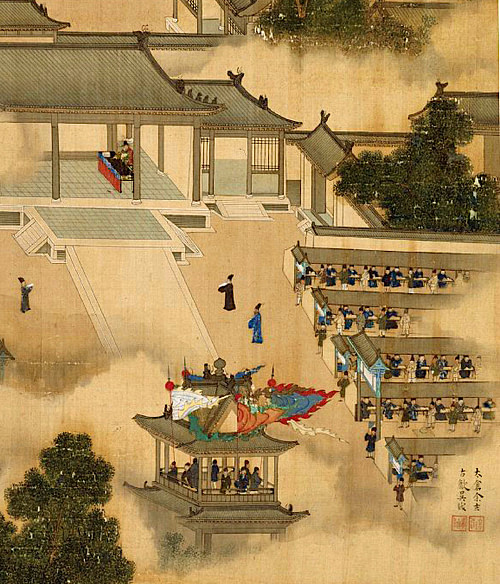 Chinese Students Taking Civil Service Exams Yu Ren, Wu Yue (Public Domain) ](https://www.worldhistory.org/image/10034/chinese-students-taking-civil-service-exams/ "Chinese Students Taking Civil Service Exams")With the Song, China became stable once again and institutions, laws, and customs were further codified and integrated into the culture. Neo-Confucianism became the most popular philosophy of the country, influencing these laws and customs, and shaping the culture of China recognizable in the modern day. Still, in spite of advances in every area of civilization and culture, the age-old strife between wealthy landowners and the peasants who worked that land continued throughout the following centuries.
Periodic peasant revolts were crushed as quickly as possible, but no remedies for the people's grievances were ever offered, and each military action continued to deal with the symptom of the problem instead of the problem itself. In 1949 CE, Mao Tse Tung led the people's revolution in China, toppling the government and instituting the People's Republic of China on the premise that, finally, everyone would be equally affluent.
#### Editorial Review
This human-authored definition has been reviewed by our editorial team before publication to ensure accuracy, reliability and adherence to academic standards in accordance with our [editorial policy](https://www.worldhistory.org/static/editorial-policy/).
## Bibliography
- [Ancient Archeological Sites](http://www.chinapage.org/archeology/ancient-site.html "Ancient Archeological Sites"), accessed 1 Dec 2016.
- [Benn, C. *Daily Life in Traditional China: The Tang Dynasty.* Greenwood, 2001.](https://www.worldhistory.org/books/0313309558/)
- [Chinese Archaeology](http://www.ibiblio.org/chinesehistory/contents/02cul/c03s05.html "Chinese Archaeology"), accessed 1 Dec 2016.
- [Davis, P.K. *100 Decisive Battles.* Oxford University Press, USA, 2001.](https://www.worldhistory.org/books/0195143663/)
- [Durant, W. *Our Oriental Heritage.* Simon & Schuster, 1954.](https://www.worldhistory.org/books/B00005WJGO/)
- [Ebrey, P. B. *The Cambridge Illustrated History of China.* Cambridge University Press, 2010.](https://www.worldhistory.org/books/0521124336/)
- [Formation of the Chinese Civilization](http://www.china.org.cn/e-gudai/index.htm "Formation of the Chinese Civilization"), accessed 1 Dec 2016.
- [Rothschild, N. H. *Wu Zhao: China's Only Woman Emperor.* Pearson-Longman, 2008.](https://www.worldhistory.org/books/B004HP06K8/)
- [Scarre, C. and Fagan, B.F. *Ancient Civilizations \[Paperback\].* Pearson, 2011.](https://www.worldhistory.org/books/B00A08DXY2/)
- [Sima Qian. *Records of the Grand Historian.* Columbia University Press, 1995.](https://www.worldhistory.org/books/0231081693/)
- [Tanner, H. M. *China: A History, From Neolithic Cultures through the Great Qing Empire.* Hackett Publishing Company, Inc., 2010.](https://www.worldhistory.org/books/1603842020/)
- [Treistman, J. M. *The Prehistory of China: An Archaeological Exploration.* Doubleday & Company, 1972.](https://www.worldhistory.org/books/0858850125/)
## About the Author
Joshua J. Mark is World History Encyclopedia's co-founder and Content Director. He was previously a professor at Marist College (NY) where he taught history, philosophy, literature, and writing. He has traveled extensively and lived in Greece and Germany.
- [Linkedin Profile](https://www.linkedin.com/pub/joshua-j-mark/38/614/339)
## Timeline
- **c. 6500 BCE**: Rice cultivation begins in the Yangtze River valley in [China](https://www.worldhistory.org/china/).
- **c. 5000 BCE**: Dead buried with [grave](https://www.worldhistory.org/burial/) goods at [Banpo Village](https://www.worldhistory.org/Banpo_Village/), [China](https://www.worldhistory.org/china/).
- **5000 BCE**: Evidence of the surgical procedure of [trephination](https://www.worldhistory.org/Trephination/) found in [China](https://www.worldhistory.org/china/).
- **5000 BCE**: Villages arise in [China](https://www.worldhistory.org/china/) around the Yellow River. Terraced farming begins and rice is cultivated.
- **c. 4800 BCE**: [Neolithic](https://www.worldhistory.org/Neolithic/) village of Banpo in [China](https://www.worldhistory.org/china/) built.
- **c. 4500 BCE - c. 3750 BCE**: The [Neolithic](https://www.worldhistory.org/Neolithic/) village of Banpo is inhabited.
- **4500 BCE - 3000 BCE**: The Hongshan [culture](https://www.worldhistory.org/disambiguation/culture/) in [China](https://www.worldhistory.org/china/) produces a jade figurine which is the oldest known depiction of a dragon.
- **c. 3600 BCE**: First appearance of [silk](https://www.worldhistory.org/Silk/) in [China](https://www.worldhistory.org/china/).
- **c. 3000 BCE - c. 1700 BCE**: The [Longshan culture](https://www.worldhistory.org/Longshan_Culture/) flourishes in north-east [China](https://www.worldhistory.org/china/).
- **c. 2700 BCE**: The earliest known examples of woven [silk](https://www.worldhistory.org/Silk/) from Qianshanyang, [China](https://www.worldhistory.org/china/).
- **c. 2070 BCE - c. 1600 BCE**: The [Xia Dynasty](https://www.worldhistory.org/Xia_Dynasty/) rules in [China](https://www.worldhistory.org/china/).
- **c. 1789 BCE - 1758 BCE**: Kong Jia of the [Xia Dynasty](https://www.worldhistory.org/Xia_Dynasty/) rules in [China](https://www.worldhistory.org/china/).
- **1728 BCE - 1675 BCE**: Jie is the last ruler of the [Xia Dynasty](https://www.worldhistory.org/Xia_Dynasty/) in [China](https://www.worldhistory.org/china/).
- **1600 BCE - 1046 BCE**: [Writing](https://www.worldhistory.org/writing/) develops in [China](https://www.worldhistory.org/china/) during the [Shang Dynasty](https://www.worldhistory.org/Shang_Dynasty/).
- **1600 BCE - 1046 BCE**: [Shang Dynasty](https://www.worldhistory.org/Shang_Dynasty/) in [China](https://www.worldhistory.org/china/).
- **c. 1300 BCE**: The Chinese [Shang dynasty](https://www.worldhistory.org/Shang_Dynasty/) moves its capital to [Yin](https://www.worldhistory.org/Yin_and_Yang/) (modern Anyang).
- **c. 1300 BCE**: The [chariot](https://www.worldhistory.org/chariot/) is introduced to [China](https://www.worldhistory.org/china/) from the northwest.
- **1250 BCE - 1192 BCE**: Reign of the great Emperor Wu Ding of the [Shang Dynasty](https://www.worldhistory.org/Shang_Dynasty/) in [China](https://www.worldhistory.org/china/).
- **c. 1250 BCE - c. 1150 BCE**: The I-Ching, the Book of Changes, is written.
- **c. 1050 BCE**: King Wen of [Zhou](https://www.worldhistory.org/Zhou_Dynasty/) is the first Chinese ruler to claim a [Mandate of Heaven](https://www.worldhistory.org/Mandate_of_Heaven/).
- **1046 BCE - 771 BCE**: Western [Zhou dynasty](https://www.worldhistory.org/Zhou_Dynasty/) replaces the [Shang Dynasty](https://www.worldhistory.org/Shang_Dynasty/) in [China](https://www.worldhistory.org/china/).
- **772 BCE - 476 BCE**: The Spring and Autumn Period in [China](https://www.worldhistory.org/china/).
- **771 BCE**: Following nomadic attacks in the west, the Chinese [Zhou dynasty](https://www.worldhistory.org/Zhou_Dynasty/) moves its capital east to [Luoyang](https://www.worldhistory.org/Luoyang/). Beginning of Eastern [Zhou](https://www.worldhistory.org/Zhou_Dynasty/) Period.
- **771 BCE - 256 BCE**: Eastern [Zhou Dynasty](https://www.worldhistory.org/Zhou_Dynasty/) in [China](https://www.worldhistory.org/china/).
- **551 BCE - 479 BCE**: Life of [Confucius](https://www.worldhistory.org/Confucius/).
- **512 BCE - 506 BCE**: The Wu Chu wars in [China](https://www.worldhistory.org/china/) between the States of Wu and Chu.
- **506 BCE**: The [Battle](https://www.worldhistory.org/disambiguation/battle/) of Boju at which the Wu forces under [Sun-Tzu](https://www.worldhistory.org/Sun-Tzu/) defeated the Chu.
- **c. 500 BCE**: Life of the Chinese Relativist Philosopher [Teng Shih](https://www.worldhistory.org/Teng_Shih/) (probable date of [death](https://www.worldhistory.org/disambiguation/Death/) 522 or 502 BCE).
- **c. 500 BCE**: Probable life of the Chinese philosopher [Lao-Tzu](https://www.worldhistory.org/Lao-Tzu/), founder of [Taoism](https://www.worldhistory.org/Taoism/) and author of the Tao-Te-Ching.
- **c. 500 BCE**: Probable life of [Sun-Tzu](https://www.worldhistory.org/Sun-Tzu/), Military Strategist, author of [The Art of War](https://www.worldhistory.org/The_Art_of_War/).
- **c. 481 BCE - 221 BCE**: [Warring States Period](https://www.worldhistory.org/Warring_States_Period/) in [China](https://www.worldhistory.org/china/).
- **470 BCE - 391 BCE**: Life of the Chinese pacifist philosopher [Mo Ti](https://www.worldhistory.org/Mo_Ti/), founder of Mohism.
- **440 BCE - 360 BCE**: Life of Chinese Hedonist Philosopher [Yang Zhu](https://www.worldhistory.org/Yang_Zhu/).
- **372 BCE - 289 BCE**: Life of the Confucian philosopher [Mencius](https://www.worldhistory.org/Mencius/) (Mang-Tze).
- **364 BCE**: Duke Xin, ruler of Qin, is awarded the title of Hegemon by the [Zhou](https://www.worldhistory.org/Zhou_Dynasty/) state.
- **343 BCE**: Xiao, ruler of Qin, is awarded the title of Hegemon by the [Zhou](https://www.worldhistory.org/Zhou_Dynasty/) state.
- **328 BCE - 308 BCE**: Rise of the Chinese state of Qin.
- **326 BCE**: Huiwen, ruler of Qin, is awarded royal status by the [Zhou](https://www.worldhistory.org/Zhou_Dynasty/) state.
- **c. 280 BCE - c. 233 BCE**: Life of [Han](https://www.worldhistory.org/Han_Dynasty/) Feizi who developed [Legalism](https://www.worldhistory.org/Legalism/) in [China](https://www.worldhistory.org/china/).
- **278 BCE**: The Qin state captures Ying, the capital of the Chu state.
- **262 BCE - 260 BCE**: The [Battle](https://www.worldhistory.org/disambiguation/battle/) of Changping, one of the most important battles in the [Warring States Period](https://www.worldhistory.org/Warring_States_Period/) in [China](https://www.worldhistory.org/china/) between Zhao and Qin.
- **259 BCE - 210 BCE**: Life of Ying Zheng of Qin, [Shi Huangdi](https://www.worldhistory.org/Shi_Huangdi/), First Emperor of [China](https://www.worldhistory.org/china/).
- **256 BCE**: The army of the state of Qin captures the [city](https://www.worldhistory.org/city/) of Chengzhou and the last [Zhou](https://www.worldhistory.org/Zhou_Dynasty/) ruler, King Nan, is killed. End of the [Zhou Dynasty](https://www.worldhistory.org/Zhou_Dynasty/).
- **256 BCE**: The Qin absorbs the remains of the [Zhou](https://www.worldhistory.org/Zhou_Dynasty/) state.
- **230 BCE**: The Qin state defeats the [Han](https://www.worldhistory.org/Han_Dynasty/) state during the [Warring States Period](https://www.worldhistory.org/Warring_States_Period/).
- **225 BCE**: The Qin state defeats the Wei state during the [Warring States Period](https://www.worldhistory.org/Warring_States_Period/).
- **223 BCE**: The Qin state absorbs the Chu state during the [Warring States Period](https://www.worldhistory.org/Warring_States_Period/).
- **221 BCE**: The Qin state defeats the Yan and Qi states during the [Warring States Period](https://www.worldhistory.org/Warring_States_Period/).
- **221 BCE - 210 BCE**: First emperor of a united [China](https://www.worldhistory.org/china/), [Shi Huangti](https://www.worldhistory.org/Shi_Huangdi/), rules.
- **221 BCE - 206 BCE**: The [Qin Dynasty](https://www.worldhistory.org/Qin_Dynasty/) in [China](https://www.worldhistory.org/china/).
- **220 BCE - 210 BCE**: Emperor [Shi Huangti](https://www.worldhistory.org/Shi_Huangdi/) initiates building the [Great Wall of China](https://www.worldhistory.org/Great_Wall_of_China/) and the Grand Canal.
- **c. 218 BCE**: Construction of the [Great Wall of China](https://www.worldhistory.org/Great_Wall_of_China/) is initiated.
- **213 BCE**: The Burning of the Books and the Burying of Philosophers Period in [China](https://www.worldhistory.org/china/).
- **213 BCE - 206 BCE**: [Qin Dynasty](https://www.worldhistory.org/Qin_Dynasty/) elevates [Legalism](https://www.worldhistory.org/Legalism/) as state [philosophy](https://www.worldhistory.org/philosophy/) and bans all others.
- **210 BCE - 206 BCE**: [China](https://www.worldhistory.org/china/) rises in rebellion against crumbling [Qin Dynasty](https://www.worldhistory.org/Qin_Dynasty/).
- **206 BCE**: Chinese Qin [empire](https://www.worldhistory.org/empire/) collapses following the [death](https://www.worldhistory.org/disambiguation/Death/) of emperor [Shi Huangti](https://www.worldhistory.org/Shi_Huangdi/). Civil [War](https://www.worldhistory.org/disambiguation/War/) begins.
- **206 BCE**: The Emperor [Shi Huangti](https://www.worldhistory.org/Shi_Huangdi/) is buried with a [terracotta army](https://www.worldhistory.org/Terracotta_Army/) of more than 8,000 soldiers in a [palace](https://www.worldhistory.org/disambiguation/palace/) [tomb](https://www.worldhistory.org/tomb/).
- **206 BCE - 9 CE**: The Western [Han dynasty](https://www.worldhistory.org/Han_Dynasty/) rules [China](https://www.worldhistory.org/china/) from their capital in [Chang'an](https://www.worldhistory.org/Chang'an/).
- **202 BCE**: The [Battle of Gaixia](https://www.worldhistory.org/Battle_of_Gaixia/) in which the [Han](https://www.worldhistory.org/Han_Dynasty/) forces defeat the Chu.
- **202 BCE**: Liu-Bang of [Han](https://www.worldhistory.org/Han_Dynasty/) establishes the [Han Dynasty](https://www.worldhistory.org/Han_Dynasty/) in [China](https://www.worldhistory.org/china/).
- **202 BCE**: Liu Bang is proclaimed emperor of [China](https://www.worldhistory.org/china/) after defeating the rival general Xiang Yu.
- **Mar 202 BCE**: Emperor Gaozu (Liu Bang) becomes the first [Han](https://www.worldhistory.org/Han_Dynasty/) ruler.
- **195 BCE**: Liu Bang dies. His empress Lü Zhi (also known as Lü Hou) rules through puppet kings for her own benefit for the next fifteen years.
- **141 BCE - 87 BCE**: [Han](https://www.worldhistory.org/Han_Dynasty/) Emperor Wu abandons [Legalism](https://www.worldhistory.org/Legalism/) in favor of [Confucianism](https://www.worldhistory.org/Confucianism/).
- **141 BCE - 87 BCE**: Reign of Emperor Wu (Wu the Great), the most effective and influential of the [Han](https://www.worldhistory.org/Han_Dynasty/) monarchs.
- **140 BCE - 87 BCE**: [Han](https://www.worldhistory.org/Han_Dynasty/) emperor Wu rules and expands Han territory in [China](https://www.worldhistory.org/china/).
- **138 BCE - 126 BCE**: Zhang Qian, as envoy of Emperor Wu, opens up the '[Silk Road](https://www.worldhistory.org/Silk_Road/)' trading route between [China](https://www.worldhistory.org/china/) and central Asia.
- **117 BCE - 100 BCE**: [Han](https://www.worldhistory.org/Han_Dynasty/) emperors extend the western part of the [Great Wall of China](https://www.worldhistory.org/Great_Wall_of_China/).
- **111 BCE**: Kingdom of Nan-Yueh (northern Vietnam) comes under Chinese administration.
- **109 BCE**: Chinese [Han](https://www.worldhistory.org/Han_Dynasty/) [Empire](https://www.worldhistory.org/empire/) conquers the kingdom of Tien.
- **104 BCE - 101 BCE**: The [War](https://www.worldhistory.org/disambiguation/War/) of the Heavenly Horses, general Li Guangli forces the [city](https://www.worldhistory.org/city/) of Da Yuan ([Alexandria](https://www.worldhistory.org/alexandria/) Eschate) into tributary status.
- **2 CE**: [Chang'an](https://www.worldhistory.org/Chang'an/), the imperial capital of [China](https://www.worldhistory.org/china/), had a population of nearly 250 thousand people.
- **9 CE**: Wang Mang takes control of the [empire](https://www.worldhistory.org/empire/) by usurping the throne and proclaiming his innovative dynasty called Xin ("new").
- **9 CE - 23 CE**: Emperor Wang Mang, known as a reformist, reigns in [China](https://www.worldhistory.org/china/), founds Xin Dynasty.
- **23 CE**: The sack of [Chang'an](https://www.worldhistory.org/Chang'an/), imperial capital of [China](https://www.worldhistory.org/china/).
- **c. 23 CE**: After the sack of [Chang'an](https://www.worldhistory.org/Chang'an/), Liu Xiu led his loyal officials to the [city](https://www.worldhistory.org/city/) of [Luoyang](https://www.worldhistory.org/Luoyang/), where the Chinese imperial capital was relocated.
- **25 CE - 220 CE**: The Eastern [Han dynasty](https://www.worldhistory.org/Han_Dynasty/) rules [China](https://www.worldhistory.org/china/).
- **91 CE**: The [Han dynasty](https://www.worldhistory.org/Han_Dynasty/) of [China](https://www.worldhistory.org/china/) invades Mongolia.
- **c. 155 CE - 220 CE**: Life of [Cao Cao](https://www.worldhistory.org/Cao_Cao/), Chinese military dictator and founder of the Wei state.
- **160 CE**: Chinese [Han](https://www.worldhistory.org/Han_Dynasty/) [empire](https://www.worldhistory.org/empire/) in decline.
- **168 CE - 189 CE**: Ling is emperor in [China](https://www.worldhistory.org/china/).
- **184 CE**: The Yellow Turban rebellion breaks out when local government offices are attacked across [China](https://www.worldhistory.org/china/).
- **184 CE**: A large peasant uprising known as the Yellow Turban Rebellion (sometimes referred to as the Yellow Scarves Rebellion) threatened the [city](https://www.worldhistory.org/city/) of [Luoyang](https://www.worldhistory.org/Luoyang/).
- **184 CE - 192 CE**: The 'Yellow Turban' rebellion is quashed by the [Han](https://www.worldhistory.org/Han_Dynasty/) in [China](https://www.worldhistory.org/china/).
- **189 CE**: [Luoyang](https://www.worldhistory.org/Luoyang/), the [Han](https://www.worldhistory.org/Han_Dynasty/) capital, is sacked by the Chinese warlord Dong Zhuo.
- **190 CE**: [Luoyang](https://www.worldhistory.org/Luoyang/), the [Han](https://www.worldhistory.org/Han_Dynasty/) capital in [China](https://www.worldhistory.org/china/), is burned.
- **190 CE**: Dong [Zhou](https://www.worldhistory.org/Zhou_Dynasty/) seized control of the Chinese imperial capital and placed a child, Liu Xie, as the new ruler.
- **205 CE**: [Cao Cao](https://www.worldhistory.org/Cao_Cao/) takes over the former [Han](https://www.worldhistory.org/Han_Dynasty/) government and appoints himself chancellor, in effect, a military dictator.
- **208 CE**: [China](https://www.worldhistory.org/china/) is divided into three regional kingdoms.
- **215 CE**: [Cao Cao](https://www.worldhistory.org/Cao_Cao/) represses for good the Yellow Turban rebellion in [China](https://www.worldhistory.org/china/).
- **220 CE**: Liu Xie abdicated the throne. Wars between warlords and states continued and [China](https://www.worldhistory.org/china/) would have to wait about 350 years to be unified again.
- **220 CE**: [Death](https://www.worldhistory.org/disambiguation/Death/) of the North [China](https://www.worldhistory.org/china/) military dictator [Cao Cao](https://www.worldhistory.org/Cao_Cao/).
- **304 CE**: The nomadic Xiongu break through the [Great Wall of China](https://www.worldhistory.org/Great_Wall_of_China/).
- **342 CE**: Murong Huang invades [Korea](https://www.worldhistory.org/Korea/) from [China](https://www.worldhistory.org/china/) and sacks the [Goguryeo](https://www.worldhistory.org/Goguryeo/) capital of Gungnae, taking 50,000 inhabitants prisoner.
- **413 CE - 478 CE**: Japanese kings send ambassadors and tribute to [China](https://www.worldhistory.org/china/).
- **c. 494 CE**: The first [Buddhist](https://www.worldhistory.org/buddhism/) caves are carved at [Longmen Grottoes](https://www.worldhistory.org/Longmen_Grottoes/), [China](https://www.worldhistory.org/china/).
- **494 CE**: The Northern Wei select [Luoyang](https://www.worldhistory.org/Luoyang/) as their capital in [China](https://www.worldhistory.org/china/).
- **528 CE**: Steppe hordes attack the Chinese capital [Luoyang](https://www.worldhistory.org/Luoyang/).
- **581 CE - 601 CE**: Reign of Wen (aka Wendi), first [Sui](https://www.worldhistory.org/Sui_Dynasty/) emperor in [China](https://www.worldhistory.org/china/).
- **581 CE - 618 CE**: [Sui Dynasty](https://www.worldhistory.org/Sui_Dynasty/) in [China](https://www.worldhistory.org/china/).
- **604 CE - 618 CE**: Reign of [Yang](https://www.worldhistory.org/Yin_and_Yang/) (aka Yangdi), second and last [Sui](https://www.worldhistory.org/Sui_Dynasty/) emperor in [China](https://www.worldhistory.org/china/).
- **618 CE - 626 CE**: Reign of Gaozu, 1st Emperor of [Tang Dynasty](https://www.worldhistory.org/Tang_Dynasty/) in [China](https://www.worldhistory.org/china/).
- **618 CE - 907 CE**: The [Tang Dynasty](https://www.worldhistory.org/Tang_Dynasty/) in [China](https://www.worldhistory.org/china/).
- **626 CE - 649 CE**: Reign of Emperor [Taizong](https://www.worldhistory.org/disambiguation/Taizong/) in [China](https://www.worldhistory.org/china/).
- **634 CE**: [Taizong](https://www.worldhistory.org/disambiguation/Taizong/) signs peace treaty between Tibet and [China](https://www.worldhistory.org/china/).
- **649 CE - 683 CE**: Reign of Emperor Gaozong in [China](https://www.worldhistory.org/china/).
- **668 CE**: The [Goguryeo](https://www.worldhistory.org/Goguryeo/) kingdom of northern [Korea](https://www.worldhistory.org/Korea/) collapses following an attack by the [Tang Dynasty](https://www.worldhistory.org/Tang_Dynasty/) of [China](https://www.worldhistory.org/china/).
- **683 CE - 704 CE**: Reign of Empress [Wu Zetian](https://www.worldhistory.org/Wu_Zetian/), only female monarch of [China](https://www.worldhistory.org/china/).
- **690 CE - 704 CE**: Reign of Empress [Wu Zetian](https://www.worldhistory.org/Wu_Zetian/) in [China](https://www.worldhistory.org/china/).
- **712 CE - 756 CE**: [Taoism](https://www.worldhistory.org/Taoism/) becomes official [religion](https://www.worldhistory.org/religion/) of [China](https://www.worldhistory.org/china/) under the Emperor [Xuanzong](https://www.worldhistory.org/disambiguation/Xuanzong/).
- **768 CE - 824 CE**: Life of [Han](https://www.worldhistory.org/Han_Dynasty/) Yu, "the Shakespeare of [China](https://www.worldhistory.org/china/)".
- **842 CE - 845 CE**: The Chinese state persecutes [Buddhist](https://www.worldhistory.org/buddhism/) monks and their monasteries.
- **843 CE**: The [Tang](https://www.worldhistory.org/Tang_Dynasty/) [empire](https://www.worldhistory.org/empire/) attacks and kills 10,000 Uyghur tribespeople in Inner Mongolia.
- **907 CE**: Zhu Wen establish Later Liang Dynasty in [China](https://www.worldhistory.org/china/). The start of the Five Dynasties.
- **907 CE - 960 CE**: The Five Dynasties and Ten Kingdoms Period in [China](https://www.worldhistory.org/china/).
- **907 CE - 1125 CE**: The [Khitan](https://www.worldhistory.org/Khitan/) tribes form the [Liao dynasty](https://www.worldhistory.org/Khitan/) and rule parts of Mongolia, Manchuria and northern [China](https://www.worldhistory.org/china/).
- **937 CE - 975 CE**: First mention of [foot-binding](https://www.worldhistory.org/Foot-Binding/) in Chinese texts.
- **938 CE**: The [Khitan](https://www.worldhistory.org/Khitan/) [Liao dynasty](https://www.worldhistory.org/Khitan/) invades northern [China](https://www.worldhistory.org/china/).
- **960 CE - 976 CE**: Reign of Emperor Taizu, founder of the [Song dynasty](https://www.worldhistory.org/Song_Dynasty/) in [China](https://www.worldhistory.org/china/).
- **960 CE - 1125 CE**: The Northern [Song Dynasty](https://www.worldhistory.org/Song_Dynasty/) in [China](https://www.worldhistory.org/china/).
- **960 CE - 1279 CE**: [Song Dynasty](https://www.worldhistory.org/Song_Dynasty/) in [China](https://www.worldhistory.org/china/).
- **976 CE - 997 CE**: Reign of Emperor [Taizong](https://www.worldhistory.org/disambiguation/Taizong/) of the [Song dynasty](https://www.worldhistory.org/Song_Dynasty/) in [China](https://www.worldhistory.org/china/).
- **c. 990 CE - 1030 CE**: Life of Chinese painter Fan Kuan.
- **997 CE - 1022 CE**: Reign of Emperor Zhenzong of the [Song dynasty](https://www.worldhistory.org/Song_Dynasty/) in [China](https://www.worldhistory.org/china/).
- **1004 CE**: Treaty of Shanyuan which brings peace between the [Liao dynasty](https://www.worldhistory.org/Khitan/) and [Song dynasty](https://www.worldhistory.org/Song_Dynasty/) of [China](https://www.worldhistory.org/china/) with the latter compelled to pay annual tribute.
- **1022 CE - 1063 CE**: Reign of Emperor Renzong of the [Song dynasty](https://www.worldhistory.org/Song_Dynasty/) in [China](https://www.worldhistory.org/china/).
- **1044 CE**: Defeat to the Xia state results in [China](https://www.worldhistory.org/china/)'s [Song dynasty](https://www.worldhistory.org/Song_Dynasty/) paying tribute.
- **1063 CE - 1067 CE**: Reign of Emperor Yingzong of the [Song dynasty](https://www.worldhistory.org/Song_Dynasty/) in [China](https://www.worldhistory.org/china/).
- **1067 CE - 1085 CE**: Reign of Emperor Shenzong of the [Song dynasty](https://www.worldhistory.org/Song_Dynasty/) in [China](https://www.worldhistory.org/china/).
- **1085 CE - 1100 CE**: Reign of Emperor Zhizong of the [Song dynasty](https://www.worldhistory.org/Song_Dynasty/) in [China](https://www.worldhistory.org/china/).
- **1100 CE - 1126 CE**: Reign of Emperor Huizong of the [Song dynasty](https://www.worldhistory.org/Song_Dynasty/) in [China](https://www.worldhistory.org/china/).
- **1115 CE**: The Jurchen (Jin state) attack the Liao state in northern [China](https://www.worldhistory.org/china/).
- **1115 CE - 1123 CE**: Reign of Emperor Taizu, founder of the [Jurchen Jin state](https://www.worldhistory.org/Jurchen_Jin_Dynasty/).
- **1115 CE - 1234 CE**: The [Jurchen Jin state](https://www.worldhistory.org/Jurchen_Jin_Dynasty/) rules in Mongolia and northern [China](https://www.worldhistory.org/china/).
- **1125 CE**: The Jin state attacks Song [China](https://www.worldhistory.org/china/).
- **1125 CE**: The [Jurchen Jin state](https://www.worldhistory.org/Jurchen_Jin_Dynasty/) invades Song [China](https://www.worldhistory.org/china/) necessitating the latter to move south and form the Southern [Song dynasty](https://www.worldhistory.org/Song_Dynasty/).
- **1125 CE - 1279 CE**: The Southern [Song Dynasty](https://www.worldhistory.org/Song_Dynasty/) in [China](https://www.worldhistory.org/china/).
- **1127 CE - 1162 CE**: Reign of Emperor Gaozong of the [Song dynasty](https://www.worldhistory.org/Song_Dynasty/) in [China](https://www.worldhistory.org/china/).
- **1138 CE**: Hangzhou (aka Linan) is made the capital of the [Song Dynasty](https://www.worldhistory.org/Song_Dynasty/), now known as the Southern Song.
- **1141 CE**: A peace treaty is signed betwwen the (southern) [Song Dynasty](https://www.worldhistory.org/Song_Dynasty/) and Jin state.
- **1142 CE**: The [Jurchen Jin dynasty](https://www.worldhistory.org/Jurchen_Jin_Dynasty/) and Southern [Song dynasty](https://www.worldhistory.org/Song_Dynasty/) sign a formal peace treaty.
- **1153 CE**: The [Jurchen Jin state](https://www.worldhistory.org/Jurchen_Jin_Dynasty/) capital is moved from Shangjing (Harbin) to Yanjing (Beijing).
- **1162 CE - 1189 CE**: Reign of Emperor Xiaozong of the [Song dynasty](https://www.worldhistory.org/Song_Dynasty/) in [China](https://www.worldhistory.org/china/).
- **1189 CE - 1194 CE**: Reign of Emperor Guangzong of the [Song dynasty](https://www.worldhistory.org/Song_Dynasty/) in [China](https://www.worldhistory.org/china/).
- **1194 CE - 1224 CE**: Reign of Emperor Ningzong of the [Song dynasty](https://www.worldhistory.org/Song_Dynasty/) in [China](https://www.worldhistory.org/china/).
- **1205 CE**: The [Mongols](https://www.worldhistory.org/Mongol_Empire/) attack the [Jurchen Jin state](https://www.worldhistory.org/Jurchen_Jin_Dynasty/) in northern [China](https://www.worldhistory.org/china/).
- **1209 CE**: The [Mongols](https://www.worldhistory.org/Mongol_Empire/) attack the [Jurchen Jin state](https://www.worldhistory.org/Jurchen_Jin_Dynasty/) in northern [China](https://www.worldhistory.org/china/).
- **1211 CE**: The [Mongols](https://www.worldhistory.org/Mongol_Empire/) attack the [Jurchen Jin state](https://www.worldhistory.org/Jurchen_Jin_Dynasty/) in northern [China](https://www.worldhistory.org/china/).
- **1215 CE**: The [Mongols](https://www.worldhistory.org/Mongol_Empire/) attack the [Jurchen Jin state](https://www.worldhistory.org/Jurchen_Jin_Dynasty/) in northern [China](https://www.worldhistory.org/china/).
- **1224 CE - 1264 CE**: Reign of Emperor Lizong of the [Song dynasty](https://www.worldhistory.org/Song_Dynasty/) in [China](https://www.worldhistory.org/china/).
- **Feb 1234 CE**: The [Mongols](https://www.worldhistory.org/Mongol_Empire/) attack and [conquer](https://www.worldhistory.org/warfare/) the [Jurchen Jin State](https://www.worldhistory.org/Jurchen_Jin_Dynasty/) in northern [China](https://www.worldhistory.org/china/).
- **1264 CE - 1274 CE**: Reign of Emperor Duzong of the [Song dynasty](https://www.worldhistory.org/Song_Dynasty/) in [China](https://www.worldhistory.org/china/).
- **1271 CE - 1368 CE**: The [Mongol](https://www.worldhistory.org/Mongol_Empire/) [Yuan Dynasty](https://www.worldhistory.org/Yuan_Dynasty/), founded by [Kublai Khan](https://www.worldhistory.org/Kublai_Khan/), rules [China](https://www.worldhistory.org/china/).
- **1273 CE**: Xiangyang falls into [Mongol](https://www.worldhistory.org/Mongol_Empire/) hands.
- **1274 CE - 1275 CE**: Reign of Emperor Gongzong of the [Song dynasty](https://www.worldhistory.org/Song_Dynasty/) in southern [China](https://www.worldhistory.org/china/).
- **1275 CE - 1277 CE**: Reign of Emperor Duanzong of the [Song dynasty](https://www.worldhistory.org/Song_Dynasty/) in southern [China](https://www.worldhistory.org/china/).
- **1275 CE - 1279 CE**: The [Mongols](https://www.worldhistory.org/Mongol_Empire/) led by [Kublai Khan](https://www.worldhistory.org/Kublai_Khan/) attack and [conquer](https://www.worldhistory.org/warfare/) the last remnants of Song [China](https://www.worldhistory.org/china/).
- **1278 CE - 1279 CE**: Reign of Emperor Dibing of the [Song dynasty](https://www.worldhistory.org/Song_Dynasty/) in southern [China](https://www.worldhistory.org/china/).
- **1368 CE - 1644 CE**: Reign of the [Ming Dynasty](https://www.worldhistory.org/Ming_Dynasty/) in [China](https://www.worldhistory.org/china/).
## External Links
- [Ancient Chinese History for Kids](http://www.historyforkids.net/ancient-china.html)
- [5 Things You May Not Know About the Terra Cotta Army](http://www.history.com/news/5-things-you-may-not-know-about-the-terra-cotta-army)
- [Terracotta Army, Terra Cotta Warriors and Horses Museum, Xi'an](http://www.travelchinaguide.com/attraction/shaanxi/xian/terra_cotta_army/)
- [What makes the Great Wall of China so extraordinary - Megan Campisi and Pen-Pen Chen](http://ed.ted.com/lessons/what-makes-the-great-wall-of-china-so-extraordinary-megan-campisi-and-pen-pen-chen)
- [The incredible history of China's terracotta warriors - Megan Campisi and Pen-Pen Chen](http://ed.ted.com/lessons/the-incredible-history-of-china-s-terracotta-warriors-megan-campisi-and-pen-pen-chen)
- [The myth behind the Chinese zodiac - Megan Campisi and Pen-Pen Chen](https://ed.ted.com/lessons/the-myth-behind-the-chinese-zodiac-megan-campisi-and-pen-pen-chen)
- [How the Terracotta Army Works](https://www.missedinhistory.com/podcasts/how-the-terracotta-army-works.htm)
- [How the Great Wall of China Works](https://www.missedinhistory.com/podcasts/how-the-great-wall-of-china-works.htm)
- [Meet Hua Mulan — The Legendary Warrior Behind The Disney Classic](https://allthatsinteresting.com/hua-mulan)
- [Timeline of Chinese Dynasty](https://www.chinafetching.com/timeline-of-chinese-dynasty)
- [Battle of Gaixia, January 202 BC](http://www.historyofwar.org/articles/battles_gaixia.html)
- [The British Museum](http://www.ancientchina.co.uk/menu.html)
- [Ancient China for Kids and Teachers - Ancient China for Kids](https://china.mrdonn.org/)
- [Chinese History](https://www.mrdowling.com/613chinesehistory.html)
- [Ancient China](https://www.crystalinks.com/china.html)
- [The Advanced Technology of Ancient China](http://www.sjsu.edu/faculty/watkins/ancientchina.htm)
- [Ancient Dynasties](http://www.chaos.umd.edu/history/ancient1.html)
- [China](http://besthistorysites.net/ancient-biblical-history/china/)
- [Chu-Han Contention, 206-202 BC](http://www.historyofwar.org/articles/wars_chu_han_contention.html)
- [The Warring States Period of Ancient China](http://www.sjsu.edu/faculty/watkins/warringstates.htm)
- [Temple and Cemetery of Confucius and the Kong Family Mansion in Qufu](http://whc.unesco.org/en/list/704)
- [Exploring Chinese History :: Culture :: Archaeology :: Archaeological Sites](http://www.ibiblio.org/chinesehistory/contents/02cul/c03s05.html)
- [Ancient Scripts: Chinese](http://www.ancientscripts.com/chinese.html)
- [List of Rulers of China | Lists of Rulers | Heilbrunn Timeline of Art History | The Metropolitan Museum of Art](https://www.metmuseum.org/toah/hd/chem/hd_chem.htm)
- [Shang and Zhou Dynasties: The Bronze Age of China | Essay | The Metropolitan Museum of Art | Heilbrunn Timeline of Art History](https://www.metmuseum.org/toah/hd/shzh/hd_shzh.htm)
## Cite This Work
### APA
Mark, J. J. (2012, December 18). Ancient China. *World History Encyclopedia*.
### Chicago
Mark, Joshua J.. "Ancient China." *World History Encyclopedia*, December 18, 2012. .
### MLA
Mark, Joshua J.. "Ancient China." *World History Encyclopedia*, 18 Dec 2012, .
## License & Copyright
Submitted by [Joshua J. Mark](https://www.worldhistory.org/user/JPryst/ "User Page: Joshua J. Mark"), published on 18 December 2012. The copyright holder has published this content under the following license: [Creative Commons Attribution-NonCommercial-ShareAlike](https://creativecommons.org/licenses/by-nc-sa/4.0/deed.en). This license lets others remix, tweak, and build upon this content non-commercially, as long as they credit the author and license their new creations under the identical terms. When republishing on the web a hyperlink back to the original content source URL must be included. Please note that content linked from this page may have different licensing terms.