---
title: Ancient Celts
author: Mark Cartwright
source: https://www.worldhistory.org/celt/
format: machine-readable-alternate
license: Creative Commons Attribution-NonCommercial-ShareAlike (https://creativecommons.org/licenses/by-nc-sa/4.0/)
updated: 1970-01-01
---
# Ancient Celts
_Authored by [Mark Cartwright](https://www.worldhistory.org/user/markzcartwright/)_
The ancient Celts were various tribal groups living in parts of western and central [Europe](https://www.worldhistory.org/europe/) in the Late [Bronze Age](https://www.worldhistory.org/disambiguation/Bronze_Age/) and through the [Iron Age](https://www.worldhistory.org/disambiguation/Iron_Age/) (c. 700 BCE to c. 400 CE). Given the name Celts by ancient writers, these tribes and their [culture](https://www.worldhistory.org/disambiguation/culture/) migrated and so they established a presence in territories from Portugal to [Turkey](https://www.worldhistory.org/Asia_Minor/).
Although diverse tribes and never a single unified state, the ancient Celts were connected by the Celtic language and marked similarities in art, modes of [warfare](https://www.worldhistory.org/warfare/), [religion](https://www.worldhistory.org/religion/), and [burial](https://www.worldhistory.org/burial/) practices. Although the Celtic culture was absorbed within the [Roman Empire](https://www.worldhistory.org/Roman_Empire/) from the 1st century BCE, Celtic people continued to thrive in more remote parts of Europe like [Ireland](https://www.worldhistory.org/disambiguation/Ireland/) and northern [Britain](https://www.worldhistory.org/disambiguation/Britain/) where Celtic languages are still spoken today.
### The ‘Celts’ - Definition & Problems
The term ‘Celts’ is commonly used to refer to peoples who lived in Iron Age Europe north of the [Mediterranean](https://www.worldhistory.org/disambiguation/mediterranean/) region prior to the [Roman](https://www.worldhistory.org/disambiguation/Roman/) [conquest](https://www.worldhistory.org/warfare/) after ancient writers gave them that name. However, it is a problematic label. This is because these peoples were not part of a unified state but, rather, belonged to a multitude of tribes, many of which had no direct contact with each other. The term remains useful for its convenience but it does disguise the complex relations between different western and central European tribes, the overlapping of some cultural features in time and space, and the isolation and uniqueness of other such features. The European Iron Age was certainly a vibrant period of cultural interaction, [trade](https://www.worldhistory.org/disambiguation/trade/) relations, warfare, and migrations.
### Origins: Urnfield, [Hallstatt](https://www.worldhistory.org/Hallstatt_Culture/) & La Tène
Most scholars agree that the origins of Celtic culture can be traced back to three earlier, closely-related, and overlapping cultural groups. The first of these is the Late Bronze Age Urnfield culture present around the upper Danube from c. 1300 BCE. The name of this culture derives from the common practice of interring the cremated remains of the deceased in urns and burying them. These peoples remain obscure for lack of archaeological evidence. From the beginning of the 1st millennium BCE and over the next two or three centuries, ironworking technology spread across Europe. As a consequence, iron replaced bronze as the metal of choice to make stronger and more durable tools and weapons.
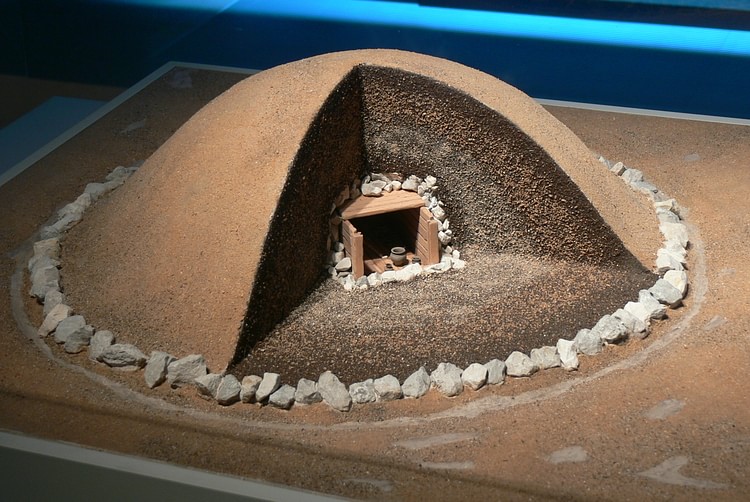
[ 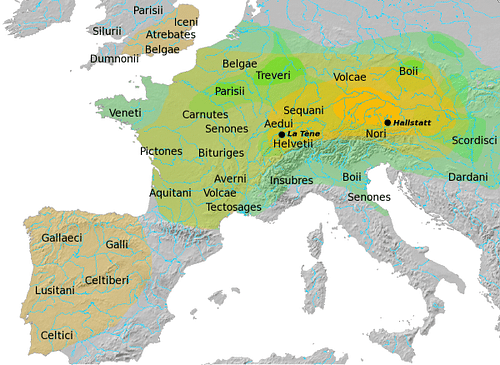 Map of Hallstatt & La Tène Cultures Dbachmann (GNU FDL) ](https://www.worldhistory.org/image/88/map-of-hallstatt--la-tene-cultures/ "Map of Hallstatt & La Tène Cultures")The second proto-Celtic group was the [Hallstatt culture](https://www.worldhistory.org/Hallstatt_Culture/), named after the site of that name in Upper Austria, which existed from c. 1200 to c. 450 BCE but was at its peak in the 8th to 6th century BCE. The Hallstatt culture spread to cover what is today western Austria, southern Germany, Switzerland, and eastern France on the one side, and eastern Austria, Bohemia, and parts of the Balkans on the other. It was the western side of this area that would eventually develop into what we might today call the ancient Celts. The Hallstatt culture likely spread via various means such as trade, tribal alliances, intermarriages, imitation, and migration. These peoples prospered thanks to local deposits of salt, iron, and [copper](https://www.worldhistory.org/copper/); commodities which could be traded along waterways. That trade reached as far south as the Mediterranean cultures (the [Etruscans](https://www.worldhistory.org/Etruscan_Civilization/) in [Italy](https://www.worldhistory.org/italy/) and the [Greek](https://www.worldhistory.org/disambiguation/greek/) colonies in southern France) is evidenced by the presence of imported goods in Hallstatt burial mounds and precious goods such as [gold](https://www.worldhistory.org/gold/) and [amber](https://www.worldhistory.org/Amber/) jewellery. The Hallstatt culture went into decline in the 5th century BCE, likely due to local resources running out, increased tribal competition, and the shift of trade routes elsewhere.
The third group significant in the formation of Celtic culture proper is the [La Tène culture](https://www.worldhistory.org/La_Tene_Culture/) (c. 450 - c. 50 BCE), named after the site of that name on the northern shores of Lake Neuchâtel in Switzerland. Perhaps best identified as a group of diverse tribes unified by common features in art and religion, the La Tène culture was eventually present in a wide arc covering western and central Europe, spanning from Ireland to Romania. Cultural features include ironworking, making votive offerings in water sources, depositing weapons in tombs, and art which is stylised with swirling, geometrical, and vegetal designs. Once again, there is a multitude of evidence for trade with the Mediterranean states. La Tène centres were particularly successful around major river points such as the Loire, Marne, Moselle, and Elbe. The La Tène culture does not exactly correspond to the Celtic peoples since it existed in non-Celtic areas, for example in Germanic-speaking Denmark. Nevertheless, the term La Tène, one originally coined by archaeologists to classify artefacts, is still commonly (if imprecisely) used as a synonym for Celtic culture in Europe during the second half of the first millennium BCE.
### Celtic Language
One of the striking points of connection between many of the peoples of Iron Age Europe is their common language: Celtic. The Celtic language is a branch of the [Indo-European](https://www.worldhistory.org/Indo-European_Languages/) language family. Scholars have divided Celtic languages into two groups: Insular Celtic and Continental Celtic. The latter group was no longer widely spoken after the Roman imperial period, and, unfortunately, the only surviving examples of it are mentions in the works of Greek and Roman writers and some short epigraphic remains such as [pottery](https://www.worldhistory.org/pottery/) graffiti and votive and funerary stelae. The best documented of this group is Gaulish.
[  Celtic Burial Mound Reconstruction, Hallstatt Wolfgang Sauber (CC BY-SA) ](https://www.worldhistory.org/image/13668/celtic-burial-mound-reconstruction-hallstatt/ "Celtic Burial Mound Reconstruction, Hallstatt")The Insular Celtic group of languages are two: British or Brittonic (Breton, Cornish, and Welsh) and Goidelic (Irish and its medieval derivatives, Scots Gaelic, and Manx). Brittonic was spoken in all of Britain in the Roman period. From it evolved Cumbrian (extinct since medieval times), Cornish (no longer spoken after the 18th century CE but recently revived), Breton (likely introduced by 5th-century CE British settlers and not connected directly to Gaulish), and Welsh, which is still spoken today. The earliest evidence of Goidelic-Irish dates to the 5th century CE, and it later evolved into Middle Irish (c. 950-1200 CE) and, thereafter, morphed again into Modern Irish, which is still spoken today.
### [Celtic Religion](https://www.worldhistory.org/disambiguation/Celtic_Religion/)
The second common characteristic of those people we call ancient Celts is their religion. This was a polytheistic religion with a multitude of gods, although our knowledge of them is limited to classical authors given the lack of written works by the Celts themselves. Variations existed across regions and the centuries, but common features of the [ancient Celtic religion](https://www.worldhistory.org/Ancient_Celtic_Religion/) include:
- the reverence for sacred groves and other natural sites like rivers and springs.
- the dedication of votive offerings to gods such as foodstuffs, weapons, animal and (more rarely) human sacrifice.
- the depositing of valuable and everyday goods with the deceased in tombs, indicating a belief in an afterlife.
- a belief in the protective power of totems, particularly animals like the stag and boar.
- a reverence for the human head, which was considered the location of the soul.
- the use of taboos to ensure compliance with religious and community rules.
- ceremonies led by druids.
With druids loath to commit their knowledge to [writing](https://www.worldhistory.org/writing/), there are no surviving sacred texts, hymns, or prayers for the Celtic religion. Key gods were given all-embracing powers or characteristics, and these include [Cernunnos](https://www.worldhistory.org/Cernunnos/), 'the horned [god](https://www.worldhistory.org/God/)' who likely represented nature and fertility. Another major figure is Lugus (known as [Lugh](https://www.worldhistory.org/Lugh/) in later periods), perhaps the only universally worshipped god in the Celtic world, who represented the sun and who was regarded as all-wise and all-seeing. There were many female goddesses associated with healing springs and rivers such as Sequana, a personification of the River Seine, and [Epona](https://www.worldhistory.org/article/153/epona/), who was linked with horses.
[  Celtic God, Gundestrup Cauldron Unknown Artist (Public Domain) ](https://www.worldhistory.org/image/13381/celtic-god-gundestrup-cauldron/ "Celtic God, Gundestrup Cauldron")An unusual feature of Celtic gods was that some were viewed as a trio, perhaps representing three different aspects of the same divinity. One [trinity](https://www.worldhistory.org/Trinity/) example is the three mother goddesses, the Matronae who represent individually the similar concepts of strength, power, and fertility. Of the numerous local and regional gods, many were associated with those things of primary concern to everyday life such as warfare, sovereignty, tribal identity, healing, hunting, and the protection of specific groups like mothers and children. There was a Greek and Roman influence on the Celtic religion from the 2nd century BCE when Celtic sacred sites, which had previously been mere clearings surrounded by earthworks, began to use larger stone temples. So, too, some Greco-Roman gods were incorporated into the Celtic [pantheon](https://www.worldhistory.org/Pantheon/).
### Celtic Society
Once again, without first-hand written records it is difficult to reconstruct the intricacies of [ancient Celtic society](https://www.worldhistory.org/article/1720/ancient-celtic-society/). Nevertheless, we do know that society in many Celtic tribes was hierarchical. At the top were rulers and elite warriors, then there were the religious leaders and repositories of the community's collected knowledge, the druids, who were exempt from taxes and military service. Then there were specialised craftworkers, traders, slaves, and farmers - the largest group by far in societies that were rural and agrarian.
Celtic societies were led first by monarchs and then by elected chiefs or, alternatively, a small council of elders. Over time, many tribes joined together for mutual assistance or became dependent on another, more powerful one and so paid some kind of tribute. By the end of the period, there were large confederations of tribes, joined to meet the common threat from the Romans. We know that some [women](https://www.worldhistory.org/disambiguation/women/) were chiefs in Celtic Britain, for example, Cartimandua, ruler of the Brigantes tribe in the north of [England](https://www.worldhistory.org/disambiguation/england/) in the mid-1st century CE, and [Boudicca](https://www.worldhistory.org/Boudicca/) (d. 61 CE), queen of the Iceni tribe, who led a revolt of several tribes against the Roman occupation in 60 CE. There is also evidence that some women were treated as equally as men in terms of burial with precious goods, for example, in the 6th-5th century BCE Vix burial near Châtillon-sur-Seine in northeast France.
[  Waterloo Helmet British Museum (Copyright) ](https://www.worldhistory.org/image/10827/waterloo-helmet/ "Waterloo Helmet")There was a strong kinship system where rulers and their extended family dominated the society through their ownership of land and revenue from trade. Rulers maintained the loyalty of their followers through gift-giving, organising [Celtic feasts](https://www.worldhistory.org/article/1680/celtic-feasts/), and social display. Ties were reinforced between families by fostering children with other aristocratic families, a method also used to bind different tribes together in alliances. There was also a system where the elite undertook the welfare and protection of those who gave some sort of service in return, much like [feudalism](https://www.worldhistory.org/Feudalism/) in the Middle Ages.
Except for slaves, there is no evidence of any barriers for the child of one of the social groups to eventually enter another group provided they acquired the necessary wealth (through valour in [war](https://www.worldhistory.org/disambiguation/War/), for example) or went through the required education or apprenticeship, which for a [druid](https://www.worldhistory.org/druid/) lasted some 20 years. [Julius Caesar](https://www.worldhistory.org/Julius_Caesar/) (c. 100-44 BCE) noted in his *Gallic Wars* that Celtic women in [Gaul](https://www.worldhistory.org/gaul/) brought to their husbands a dowry and that this could be inherited by the woman if her partner died before her. [Caesar](https://www.worldhistory.org/disambiguation/caesar/) also noted that husbands had the power of life and [death](https://www.worldhistory.org/disambiguation/Death/) over their wives and their children. Whether these assessments are accurate and whether they applied to Celts elsewhere is much debated by scholars.
### [Celtic Art](https://www.worldhistory.org/disambiguation/Celtic_Art/)
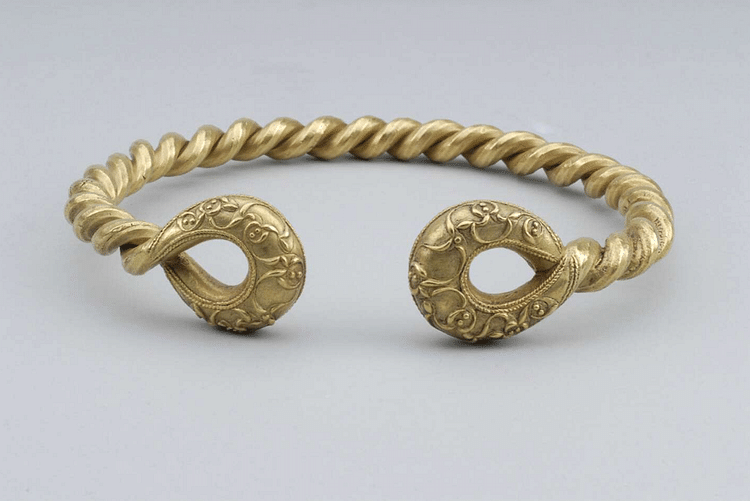
Alongside language and religious practices, another common feature of Celts throughout Europe is the art they produced. Celtic art was influenced by that of the earlier indigenous Iron Age cultures mentioned above and by neighbouring cultures or trading partners like the Thracians, [Scythians](https://www.worldhistory.org/Scythians/), Greeks, Etruscans, and Romans, and through these peoples, ideas from the [Near East](https://www.worldhistory.org/Near_East/). Materials used include pottery, stone, iron, bronze, and gold with extra decoration achieved using imported exotic materials like glass, coral, and amber. Metals were cast, engraved, punched, traced, inlaid, and worked on using repoussé (grooving the material from behind to create a relief on the other side). Typical art objects include ornate cauldrons, sandstone or wooden human figures, [Celtic bronze shields](https://www.worldhistory.org/article/1686/celtic-bronze-shields/), gold torcs, penannular brooches (composed of a pin and ring), and animal figurines to be used as votive offerings.
[  Celtic Heads Sculpture, Entremont Michel Wal (CC BY-SA) ](https://www.worldhistory.org/image/13613/celtic-heads-sculpture-entremont/ "Celtic Heads Sculpture, Entremont")Prominent features of Celtic art include:
- a love of flowing forms.
- depictions of gods and warriors, particularly the heads of these.
- depictions of animals (real or imagined), especially stags, boars, horses, and hunting dogs.
- a love of complex vegetal designs, abstract patterns, and swirling interlocking lines.
- a desire to beautify even functional everyday items.
- a desire to convey messages of power and religious ideas.
### Trade in the Celtic World
As noted above, the proto-Celtic cultures in western and central Europe had already established trade links with the Mediterranean cultures, and this continued with the Celts. Tin from Britain, amber from the Baltic, and horses from eastern Europe and the Balkans were also imported and used or passed on southwards. Celtic resources which were traded included salt, slaves, iron, gold, wool cloth, and furs. These goods were exchanged for wine (in huge quantities), [silver](https://www.worldhistory.org/Silver/), luxury manufactured goods (like bronze flagons, fine [Greek pottery](https://www.worldhistory.org/Greek_Pottery/), and [Etruscan](https://www.worldhistory.org/Etruscan_Civilization/) bronze kraters), [silk](https://www.worldhistory.org/Silk/), and the precious materials for use in art objects and jewellery mentioned in the previous section.
Trade had secondary consequences besides giving access to scarce resources. Ideas in art, religion, and technology were passed on. The Celts adopted flat [grave](https://www.worldhistory.org/burial/) burials and minted their own coins, for example. There was, too, an increase in the competition between Celtic tribes to acquire the resources needed for trade. The Celtic world was expanding its horizons and the creation of an ever-growing rich elite would have consequences for the wider continent as the Celts began to enviously eye the very heartlands of their rich trading partners and vice-versa.
[  Celtic Torc, Belstead Brook The British Museum (CC BY-NC-SA) ](https://www.worldhistory.org/image/13447/celtic-torc-belstead-brook/ "Celtic Torc, Belstead Brook")### [Celtic Warfare](https://www.worldhistory.org/Celtic_Warfare/)
That warfare was a major part of Celtic culture is clear from the number of gods in the [ancient Celtic pantheon](https://www.worldhistory.org/article/1715/the-ancient-celtic-pantheon/) associated with war and the great number of weapons deposited in tombs. Courage and prowess on the battlefield were also important in determining status within society. [Celtic warriors](https://www.worldhistory.org/Celtic_Warrior/) in Gaul are described as bleaching their long hair using lime-water, while in Britain, they painted designs on their bodies. Several classical authors also comment on the strange fact that Celtic warriors could enter [battle](https://www.worldhistory.org/disambiguation/battle/) naked and that they collected the heads of their victims. Many Celtic warriors wore a torc necklace, and these were likely a symbol of status and rank within the community. There is evidence that Celtic women participated in warfare.
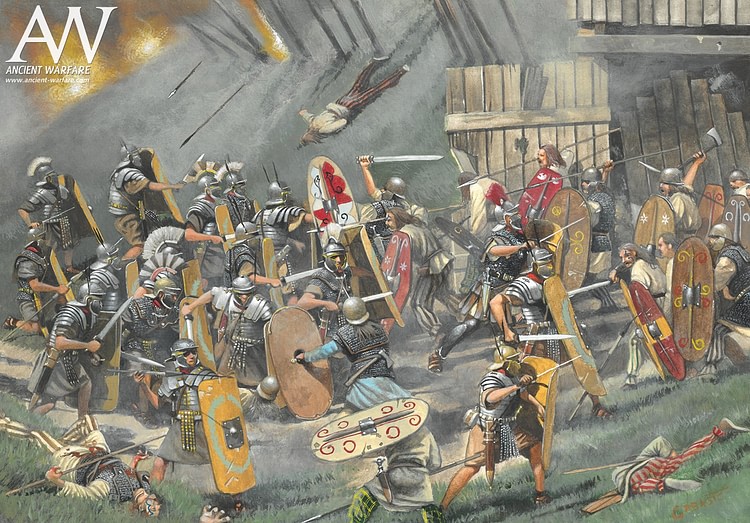
Celtic warriors used spears, long swords, and distinctive large rectangular or oval shields. Celtic armies employed slingers, chariots, and cavalry, while organization on the battlefield was achieved through the use of standards and war horns. Celtic armies did cause quite a few problems for their neighbours from the 4th century BCE onwards as tribes moved west, south, and eastwards in waves to find new wealth opportunities in what is sometimes called the Celtic Migration. [Brennus](https://www.worldhistory.org/brennus/), chief of the Gallic Senones tribe, famously sacked [Rome](https://www.worldhistory.org/Rome/) in 390 BCE, and the Celts again caused havoc when they looted [Delphi](https://www.worldhistory.org/delphi/) in 279 BCE as they passed through [Greece](https://www.worldhistory.org/greece/) on their way to Asia where they became known as the Galatians. The Celtic collection of tribes attacked the Romans again in 225 BCE and were frequent mercenary allies of [Carthage](https://www.worldhistory.org/carthage/) during the [Punic Wars](https://www.worldhistory.org/Punic_Wars/) (264-146 BCE). In the longer term, though, Celtic armies were no match for more disciplined and better-equipped enemies like the [Hellenistic](https://www.worldhistory.org/Hellenic_World/) kingdoms and the Romans in large-scale battles. However, once conquered, Celtic warriors, who had always been recognised for their bravery, did subsequently fight successfully as mercenaries in many Greek and Roman armies.
[  Battle Between Romans & Celts at Cadbury Castle Ancient Warfare Magazine/ Karwansaray Publishers (Copyright) ](https://www.worldhistory.org/image/12734/battle-between-romans--celts-at-cadbury-castle/ "Battle Between Romans & Celts at Cadbury Castle")### Decline & Legacy
The first real sign of trouble in the Celtic world was a marked increase in local competition for resources and trade opportunities, and this manifested itself in the building of *[oppida](https://www.worldhistory.org/oppidum/)* in the 2nd and 1st century BCE. An *[oppidum](https://www.worldhistory.org/oppidum/)* was the Roman name for larger settlements which we now apply specifically to fortified sites, usually located on high points in the landscape or on plains at naturally defensible points like river bends. The fortifications usually consisted of an earthworks circuit [wall](https://www.worldhistory.org/wall/), sometimes with outer ditches. *Oppida* were used as a point of refuge in war and otherwise as a safe place to concentrate manufacturing workshops and store the community’s resources.
This hostile environment deteriorated further when the Romans became intent on revenge for the havoc caused by the migrating Celtic tribes in the two previous centuries and, lured by the promise of gold and other resources, total conquest. In 125 BCE the Romans attacked the Arverni tribe in Gaul and, less than a century later, [Julius](https://www.worldhistory.org/disambiguation/Julius/) Caesar attacked and conquered Gaul, despite stiff resistance from such tribal leaders as [Vercingetorix](https://www.worldhistory.org/vercingetorix/) (82-46 BCE). The Roman [Empire](https://www.worldhistory.org/empire/) kept on expanding, direct attacks were made on such important community figures as the druids, and so the continental Celts and those in southern Britain were eventually assimilated into Roman culture. The Celts did continue to thrive in more isolated places like Ireland and northern Britain. It is from these areas that Celtic culture would continue into the medieval period and express itself most visibly in the epic poems of Irish, Welsh, and Scottish [medieval literature](https://www.worldhistory.org/Medieval_Literature/) and in art, now Christianized. The old Celtic traditions lived on in these epic poems and in the form of complex curvilinear designs within [illuminated manuscripts](https://www.worldhistory.org/Illuminated_Manuscripts/), in the ubiquitous penannular brooches, and in the sophisticated vegetal motifs on imposing stone crosses in churchyards.
#### Editorial Review
This human-authored definition has been reviewed by our editorial team before publication to ensure accuracy, reliability and adherence to academic standards in accordance with our [editorial policy](https://www.worldhistory.org/static/editorial-policy/).
## Bibliography
- [Allen, Stephen & Reynolds, Wayne. *Celtic Warrior–AD 100.* Osprey Publishing, 2001.](https://www.worldhistory.org/books/1841761435/)
- [Anglim, S. *Fighting Techniques of the Ancient World 3000 BCE-500CE.* Amber Books, 2013.](https://www.worldhistory.org/books/1909160466/)
- Bagnall, R. et al. *The Encyclopedia of Ancient History.* Wiley-Blackwell, 2012
- [Campbell, B. et al. *The Oxford Handbook of Warfare in the Classical World.* Oxford University Press, 2013.](https://www.worldhistory.org/books/0195304659/)
- [Chadwick, Nora & Cunliffe, Barry. *The Celts.* Penguin Books, 1998.](https://www.worldhistory.org/books/0140250743/)
- [Cunliffe, Barry. *The Ancient Celts.* Oxford University Press, 2018.](https://www.worldhistory.org/books/0198752938/)
- [Eluere, Christiane . *The Celts First Masters of Europe /anglais.* THAMES HUDSON, 1993.](https://www.worldhistory.org/books/0500300348/)
- [Farley, Julia & Fraser, Hunter. *Celts - Art and Identity.* British Museum Press, 2015.](https://www.worldhistory.org/books/0714128368/)
- [Hornblower, S. *The Oxford Classical Dictionary.* Oxford University Press, 2012.](https://www.worldhistory.org/books/0199545561/)
- [Laing, Jennifer & Laing, Lloyd. *Art of the Celts.* Thames & Hudson, 1992.](https://www.worldhistory.org/books/0500202567/)
- [MacKillop, James. *A Dictionary of Celtic Mythology .* Oxford University Press, 2017.](https://www.worldhistory.org/books/0198804849/)
- [Maier, Bernhard. *Dictionary of Celtic Religion and Culture .* BOYE6, 2000.](https://www.worldhistory.org/books/0851156606/)
## About the Author
Mark is WHE’s Publishing Director and has an MA in Political Philosophy (University of York). He is a full-time researcher, writer, historian and editor. Special interests include art, architecture and discovering the ideas that all civilizations share.
## Timeline
- **c. 1400 BCE**: The beginning of [Celtic](https://www.worldhistory.org/celt/) [culture](https://www.worldhistory.org/disambiguation/culture/) in the upper Danube region of central [Europe](https://www.worldhistory.org/europe/).
- **c. 1200 BCE - c. 450 BCE**: Widest date range accepted by scholars for the [Hallstatt culture](https://www.worldhistory.org/Hallstatt_Culture/) in central [Europe](https://www.worldhistory.org/europe/).
- **c. 900 BCE**: [Celtic](https://www.worldhistory.org/celt/) Migration begins in [Europe](https://www.worldhistory.org/europe/) with many [Celts](https://www.worldhistory.org/celt/) landing in [Scotland](https://www.worldhistory.org/disambiguation/Scotland/).
- **c. 800 BCE - c. 600 BCE**: The Early [Iron Age](https://www.worldhistory.org/disambiguation/Iron_Age/) [Hallstatt culture](https://www.worldhistory.org/Hallstatt_Culture/) is at its peak in central [Europe](https://www.worldhistory.org/europe/).
- **c. 700 BCE**: [Iron Age](https://www.worldhistory.org/disambiguation/Iron_Age/) begins in [Scotland](https://www.worldhistory.org/disambiguation/Scotland/).
- **600 BCE**: [Celts](https://www.worldhistory.org/celt/) settle [Iberia](https://www.worldhistory.org/disambiguation/iberia/).
- **c. 600 BCE**: The Hirschlanden Warrior, a sandstone representation of a [Celtic Warrior](https://www.worldhistory.org/Celtic_Warrior/) from Ludwigsburg, Germany, is made.
- **550 BCE - 500 BCE**: The creation of the [Hallstatt culture](https://www.worldhistory.org/Hallstatt_Culture/) Horchdorf [burial](https://www.worldhistory.org/burial/) in southern Germany.
- **c. 500 BCE**: The creation of the [Hallstatt culture](https://www.worldhistory.org/Hallstatt_Culture/) Vix [burial](https://www.worldhistory.org/burial/) in northeast France.
- **c. 475 BCE**: [Celts](https://www.worldhistory.org/celt/) defeat the [Etruscans](https://www.worldhistory.org/Etruscan_Civilization/) at the Ticino River.
- **c. 450 BCE**: The [La Tène culture](https://www.worldhistory.org/La_Tene_Culture/) replaces the [Hallstatt culture](https://www.worldhistory.org/Hallstatt_Culture/) as the dominant regional [culture](https://www.worldhistory.org/disambiguation/culture/) in central [Europe](https://www.worldhistory.org/europe/).
- **c. 450 BCE - c. 50 BCE**: Period of the [La Tène culture](https://www.worldhistory.org/La_Tene_Culture/) in northern/western/central [Europe](https://www.worldhistory.org/europe/).
- **400 BCE**: [Celts](https://www.worldhistory.org/celt/) enter [Italy](https://www.worldhistory.org/italy/) and settle in the Po Valley.
- **396 BCE**: [Celts](https://www.worldhistory.org/celt/) defeat an [Etruscan](https://www.worldhistory.org/Etruscan_Civilization/) army at the [battle](https://www.worldhistory.org/disambiguation/battle/) of Melpum. Afterwards the Celts heavily settle all over the Po Valley.
- **391 BCE**: Senones besiege Clusium, an [Etruscan](https://www.worldhistory.org/Etruscan_Civilization/) [city](https://www.worldhistory.org/city/).
- **c. 390 BCE**: "Gallic Catastrophe:" [Brennus](https://www.worldhistory.org/brennus/) of the Senones defeats the Romans at Allia, and subsequently sacks [Rome](https://www.worldhistory.org/Rome/).
- **380 BCE**: [Celtic](https://www.worldhistory.org/celt/) groups, possibly from northern [Italy](https://www.worldhistory.org/italy/) and the eastern Alps, begin to raid Illyrian territories.
- **367 BCE**: [Celtic](https://www.worldhistory.org/celt/) mercenaries fight with the Spartans against [Thebes](https://www.worldhistory.org/disambiguation/Thebes/).
- **367 BCE**: [Livy](https://www.worldhistory.org/livy/) mentions [Celtic](https://www.worldhistory.org/celt/) armies in Ancona and one such group moves against [Rome](https://www.worldhistory.org/Rome/) once more.
- **335 BCE**: [Alexander the Great](https://www.worldhistory.org/Alexander_the_Great/) receives [Celtic](https://www.worldhistory.org/celt/) ambassadors in the Balkans.
- **334 BCE**: [Rome](https://www.worldhistory.org/Rome/) signs a peace treaty with the Senones tribe.
- **323 BCE**: [Alexander the Great](https://www.worldhistory.org/Alexander_the_Great/) receives [Celtic](https://www.worldhistory.org/celt/) delegations in [Babylon](https://www.worldhistory.org/babylon/).
- **297 BCE**: [Celts](https://www.worldhistory.org/celt/) and Samnites join forces and defeat the Romans at Camertium.
- **c. 295 BCE**: In a [battle](https://www.worldhistory.org/disambiguation/battle/) lasting all day, Romans narrowly defeat a force of [Celts](https://www.worldhistory.org/celt/) and Samnites at Sentinum.
- **285 BCE**: [Roman](https://www.worldhistory.org/disambiguation/Roman/) forces heavily defeat the Senones at Lake Vadimo.
- **285 BCE - 282 BCE**: [Rome](https://www.worldhistory.org/Rome/) defeats the [Celts](https://www.worldhistory.org/celt/) in [Italy](https://www.worldhistory.org/italy/). Rome's dominance in central Italy is secured.
- **284 BCE**: Gauls of the Insubres and Boii tribes defeat the Romans at [Arretium](https://www.worldhistory.org/arretium/).
- **283 BCE**: [Rome](https://www.worldhistory.org/Rome/) decisively defeats the Senones at Picenum.
- **283 BCE**: Romans defeat the [Etruscans](https://www.worldhistory.org/Etruscan_Civilization/) and [Celts](https://www.worldhistory.org/celt/) at lake Vadimo.
- **282 BCE**: A [Celtic](https://www.worldhistory.org/celt/) army with many youth among their ranks is again defeated by Romans.
- **280 BCE**: [Celts](https://www.worldhistory.org/celt/) join with [Pyrrhus](https://www.worldhistory.org/pyrrhus/), aiding in his victory over the Romans at Heraclea.
- **279 BCE**: Gauls attack the sanctuary of [Delphi](https://www.worldhistory.org/delphi/).
- **279 BCE**: [Celts](https://www.worldhistory.org/celt/) stay with [Pyrrhus](https://www.worldhistory.org/pyrrhus/) and fight in the Epirote army at Asculum, a victory over the Romans.
- **279 BCE**: [Celts](https://www.worldhistory.org/celt/) invade Thrace and [Anatolia](https://www.worldhistory.org/Asia_Minor/).
- **277 BCE - 276 BCE**: 4,000 [Celts](https://www.worldhistory.org/celt/) are employed in [Egypt](https://www.worldhistory.org/egypt/) under [Ptolemy II](https://www.worldhistory.org/Ptolemy_II_Philadelphus/).
- **275 BCE**: Seleucids successfully defeat the Galatian [Celts](https://www.worldhistory.org/celt/) in the 'Elephant [Battle](https://www.worldhistory.org/disambiguation/battle/)'.
- **c. 263 BCE**: Antaros and 3000 [Celts](https://www.worldhistory.org/celt/) fight with [Carthage](https://www.worldhistory.org/carthage/) in the [First Punic War](https://www.worldhistory.org/First_Punic_War/).
- **261 BCE**: Antiochus I Soter of the [Seleucid Empire](https://www.worldhistory.org/Seleucid_Empire/) killed in [battle](https://www.worldhistory.org/disambiguation/battle/) against the Galatians at [Ephesus](https://www.worldhistory.org/ephesos/) in [Asia Minor](https://www.worldhistory.org/Asia_Minor/).
- **c. 260 BCE**: Timaeos is the first to use the term 'Celtiberian' when refering to [Celts](https://www.worldhistory.org/celt/) living in [Iberia](https://www.worldhistory.org/disambiguation/iberia/).
- **259 BCE**: [Celts](https://www.worldhistory.org/celt/) in [Egypt](https://www.worldhistory.org/egypt/) fail to overthrow [Ptolemy II](https://www.worldhistory.org/Ptolemy_II_Philadelphus/) and are starved to [death](https://www.worldhistory.org/disambiguation/Death/) on an island.
- **c. 237 BCE - 241 BCE**: Attalus I of [Pergamon](https://www.worldhistory.org/pergamon/) defeats the Galatians at the headwaters of the Caioc River.
- **232 BCE**: [Attalos](https://www.worldhistory.org/disambiguation/attalos/) I defeats the Galatians a second time.
- **225 BCE**: Two [Roman](https://www.worldhistory.org/disambiguation/Roman/) armies surround and defeat a [Celtic](https://www.worldhistory.org/celt/) army at Telamon.
- **225 BCE**: [Celts](https://www.worldhistory.org/celt/) defeat 6000 Romans at Faesulae and proceed to overrun [Etruria](https://www.worldhistory.org/Etruscan_Civilization/).
- **223 BCE**: Romans successfully campaign against [Celtic](https://www.worldhistory.org/celt/) tribes of Cisalpine [Gaul](https://www.worldhistory.org/gaul/).
- **222 BCE**: The [Celts](https://www.worldhistory.org/celt/) are defeated at Clastidium by [Roman](https://www.worldhistory.org/disambiguation/Roman/) forces.
- **218 BCE**: The Aegosages [Celts](https://www.worldhistory.org/celt/) enter [Anatolia](https://www.worldhistory.org/Asia_Minor/) under [Attalos](https://www.worldhistory.org/disambiguation/attalos/) of [Pergamon](https://www.worldhistory.org/pergamon/).
- **c. 217 BCE - 218 BCE**: 30,000 [Celtic](https://www.worldhistory.org/celt/) infantry and 4,000 Celtic cavalry join [Hannibal](https://www.worldhistory.org/hannibal/). [Celts](https://www.worldhistory.org/celt/) constitute just over 50% of his army in [Italy](https://www.worldhistory.org/italy/).
- **217 BCE**: 14,000 [Celts](https://www.worldhistory.org/celt/) serve under [Ptolemy](https://www.worldhistory.org/disambiguation/Ptolemy/) IV in his victory at Raphia over the [Seleucid](https://www.worldhistory.org/Seleucid_Empire/) King Antiochus III.
- **217 BCE**: Prusias of Bithynia in [Asia Minor](https://www.worldhistory.org/Asia_Minor/) massacres the Aegosages including the [women](https://www.worldhistory.org/disambiguation/women/) and children.
- **c. 215 BCE - c. 216 BCE**: The Boii crush a [Roman army](https://www.worldhistory.org/Roman_Army/) 25,000 strong at Litana. Victory was, in part, achieved by pushing precariously cut trees down atop the horrified Romans as they marched.
- **212 BCE**: The [Celtic](https://www.worldhistory.org/celt/) kingdom of Tylis in Thrace is overthrown by native Thracians. Cavaros is the last ruler of the small kingdom.
- **c. 200 BCE**: Iron in the [Celtic](https://www.worldhistory.org/celt/) world experiences a significant boom. Iron manufacturing increase in all facets of life such as weapon construction and [agriculture](https://www.worldhistory.org/disambiguation/Agriculture/) items.
- **200 BCE - 100 BCE**: *[Oppida](https://www.worldhistory.org/oppidum/)* ([Celtic](https://www.worldhistory.org/celt/) fortified tribal centers) were constructed in [Iron Age](https://www.worldhistory.org/disambiguation/Iron_Age/) [Europe](https://www.worldhistory.org/europe/)
- **193 BCE**: The Boii are defeated by the Romans, suffering, according to [Livy](https://www.worldhistory.org/livy/), 14,000 dead.
- **137 BCE**: 4,000 Celtiberians trap a force of 20,000 Romans at Numantia forcing their surrender.
- **133 BCE**: Numantia falls to the Romans who besiege the [oppidum](https://www.worldhistory.org/oppidum/). Mass suicide ensues among many of the survivors. Land reforms by [Tiberius Gracchus](https://www.worldhistory.org/Gracchi_Brothers/).
- **125 BCE**: [Rome](https://www.worldhistory.org/Rome/) intervenes on behalf of Massalia against the Saluvii [Celts](https://www.worldhistory.org/celt/).
- **106 BCE**: The governor of the [Roman](https://www.worldhistory.org/disambiguation/Roman/) province of Macedonia, M. Minucius Rufus, celebrates his victory over a raid of the Dacians allied with the [Celtic](https://www.worldhistory.org/celt/) tribe of the Scordiscii in the Balkans.
- **82 BCE - 46 BCE**: Life of [Vercingetorix](https://www.worldhistory.org/vercingetorix/).
- **64 BCE**: [Galatia](https://www.worldhistory.org/galatia/) becomes a client state of [Rome](https://www.worldhistory.org/Rome/).
- **c. 60 BCE**: Boii in eastern [Europe](https://www.worldhistory.org/europe/) crushed by the Dacians.
- **58 BCE**: [Caesar](https://www.worldhistory.org/disambiguation/caesar/) attacks the Helvetii while on migration and defeats them.
- **58 BCE - 51 BCE**: [Julius Caesar](https://www.worldhistory.org/Julius_Caesar/)'s [conquest](https://www.worldhistory.org/warfare/) of [Gaul](https://www.worldhistory.org/gaul/).
- **57 BCE**: A [Roman army](https://www.worldhistory.org/Roman_Army/) under [Caesar](https://www.worldhistory.org/disambiguation/caesar/) narrowly defeats an army of Nervii, Atrebates, and Viromandui.
- **56 BCE**: The navies of [Rome](https://www.worldhistory.org/Rome/) and the Veneti Gauls clash resulting in a [Roman](https://www.worldhistory.org/disambiguation/Roman/) victory. This is the first recorded naval [battle](https://www.worldhistory.org/disambiguation/battle/) in the Atlantic Ocean.
- **54 BCE - 53 BCE**: [Ambiorix](https://www.worldhistory.org/ambiorix/) of the Eburones tribe destroys around 9,000 [Roman](https://www.worldhistory.org/disambiguation/Roman/) soldiers at Atuatuca.
- **52 BCE**: [Julius Caesar](https://www.worldhistory.org/Julius_Caesar/) is defeated at Gergovia by [Vercingetorix](https://www.worldhistory.org/vercingetorix/).
- **52 BCE**: After becoming trapped and besieged at Alesia, [Vercingetorix](https://www.worldhistory.org/vercingetorix/) surrenders to [Caesar](https://www.worldhistory.org/disambiguation/caesar/).
- **52 BCE**: [Caesar](https://www.worldhistory.org/disambiguation/caesar/) sacks the [city](https://www.worldhistory.org/city/) of Avaricum.
- **51 BCE**: [Caesar](https://www.worldhistory.org/disambiguation/caesar/)'s siege and capture of Uxellodunum ends the Gallic [War](https://www.worldhistory.org/disambiguation/War/).
- **c. 51 BCE - c. 30 BCE**: 300 [Celts](https://www.worldhistory.org/celt/) serve as elite bodyguards for [Cleopatra VII](https://www.worldhistory.org/Cleopatra_VII/) during her reign.
- **46 BCE**: The Bellovaci unsuccessfully rise against [Roman](https://www.worldhistory.org/disambiguation/Roman/) rule in Belgica.
- **44 BCE**: The Allobroges unsuccessfully rise against [Roman](https://www.worldhistory.org/disambiguation/Roman/) rule in southern [Gaul](https://www.worldhistory.org/gaul/).
- **33 BCE**: The Belgic Morini and the [Celts](https://www.worldhistory.org/celt/) of Aquitania unsuccessfully rise against [Roman](https://www.worldhistory.org/disambiguation/Roman/) rule.
- **4 BCE**: At the funeral of Herod II, his [Celtic](https://www.worldhistory.org/celt/) bodyguards are in attendance.
- **59 CE**: The [druid](https://www.worldhistory.org/druid/) centre on Anglesey is systematically attacked by a [Roman army](https://www.worldhistory.org/Roman_Army/).
- **60 CE - 61 CE**: [Boudicca](https://www.worldhistory.org/Boudicca/) revolts, the [Legio II Augusta](https://www.worldhistory.org/Legio_II_Augusta/) does not respond to a call to arms.
- **c. 1100 CE**: The [Lebor Gabála Erenn](https://www.worldhistory.org/Lebor_Gabala_Erenn/) ('Book of invasions') recounts, through tales of [mythology](https://www.worldhistory.org/mythology/), the ancient and medieval history of [Ireland](https://www.worldhistory.org/disambiguation/Ireland/).
## External Links
- [Interactive Map of the Roman Empire and Celtic Lands](http://resourcesforhistory.com/map.htm)
- [Celtic Warriors](http://www.ancientmilitary.com/celtic-warriors.htm)
- [Who were the Celts? | British Museum](https://www.britishmuseum.org/blog/who-were-celts)
## Cite This Work
### APA
Cartwright, M. (2021, April 01). Ancient Celts. *World History Encyclopedia*.
### Chicago
Cartwright, Mark. "Ancient Celts." *World History Encyclopedia*, April 01, 2021. .
### MLA
Cartwright, Mark. "Ancient Celts." *World History Encyclopedia*, 01 Apr 2021, .
## License & Copyright
Submitted by [Mark Cartwright](https://www.worldhistory.org/user/markzcartwright/ "User Page: Mark Cartwright"), published on 01 April 2021. The copyright holder has published this content under the following license: [Creative Commons Attribution-NonCommercial-ShareAlike](https://creativecommons.org/licenses/by-nc-sa/4.0/deed.en). This license lets others remix, tweak, and build upon this content non-commercially, as long as they credit the author and license their new creations under the identical terms. When republishing on the web a hyperlink back to the original content source URL must be included. Please note that content linked from this page may have different licensing terms.