---
title: Burial
author: Joshua J. Mark
source: https://www.worldhistory.org/burial/
format: machine-readable-alternate
license: Creative Commons Attribution-NonCommercial-ShareAlike (https://creativecommons.org/licenses/by-nc-sa/4.0/)
updated: 2023-02-25
---
# Burial
_Authored by [Joshua J. Mark](https://www.worldhistory.org/user/JPryst/)_
Burial of the dead is the act of placing the corpse of a deceased person in a [tomb](https://www.worldhistory.org/tomb/) constructed for that purpose or in a grave dug into the earth. Archaeological excavations have revealed [Neanderthal](https://www.worldhistory.org/Neanderthal/) graves dating back 130,000 years, marking burial as among the earliest human activities. Grave goods with the corpse suggest proper burial associated with an afterlife.
In cultures such as [Mesopotamia](https://www.worldhistory.org/Mesopotamia/), tombs and graves were cut into the ground in the expectation that the soul of the individual so buried would more easily reach the afterlife which was thought to exist underground. Graves in the cultures of the ancient world were usually marked by a stone bearing the person's likeness and name or by an elaborate tomb (such as the [pyramids](https://www.worldhistory.org/pyramid/) of [Egypt](https://www.worldhistory.org/egypt/) or the *tholos* tombs of [Greece](https://www.worldhistory.org/greece/)) or [megalithic](https://www.worldhistory.org/disambiguation/megalithic/) stone dolmens, passage graves, and cairns such as those found in [Scotland](https://www.worldhistory.org/disambiguation/Scotland/) and [Ireland](https://www.worldhistory.org/disambiguation/Ireland/).
Whatever kind of grave or tomb was constructed, however, the importance of the proper burial of the dead was emphasized by every ancient [culture](https://www.worldhistory.org/disambiguation/culture/) and the rites accompanying burial were among the most elaborate and significant in many ancient cultures. Burial of the dead in the ground has been traced back over 100,000 years of [civilization](https://www.worldhistory.org/civilization/) as evidenced by the Grave of Qafzeh in [Israel](https://www.worldhistory.org/disambiguation/Israel/), a group tomb of 15 people buried in a cave along with their tools and other ritual artifacts. The earliest grave uncovered thus far in [Europe](https://www.worldhistory.org/europe/) is that of the Red Lady of Wales, dated at 29,000 years old, and, in the [Near East](https://www.worldhistory.org/Near_East/), the Shanidar Cave in the Zagros Mountains, dated to between 60,000 and 45,000 years ago.
### Burial Practices in Mesopotamia
Burial in Mesopotamia with recognizable grave goods began prior to c. 5000 BCE in ancient [Sumer](https://www.worldhistory.org/sumer/) where food and tools were interred with the dead. According to the historian Will Durant, "The [Sumerians](https://www.worldhistory.org/Sumerians/) believed in an after-life. But like the Greeks they pictured the other world as a dark abode of miserable shadows, to which all the dead descended indiscriminately” and that the land of the dead was beneath the earth (128). Because of this, it seems, graves were constructed in the ground to provide the deceased with easier access to the netherworld.
Throughout Mesopotamia, those who were not royalty were buried below the family home or next to it so that the grave could be regularly maintained. If a person was not buried properly they could return as a [ghost](https://www.worldhistory.org/ghost/) to haunt the living. [Ghosts in ancient Mesopotamia](https://www.worldhistory.org/article/2101/ghosts-in-ancient-mesopotamia/) were understood as just another aspect of life and their appearance, though often unwelcome was recognized as a haunting for some purpose.
This haunting could take the form familiar from popular ghost stories or films where a disembodied spirit causes problems in the home or, more seriously, as a form of possession in which the spirit entered into the individual through the ear and wreaked havoc on one's personal life and health. In either case, one of the most common causes for the return of the dead was an improper burial.
Cremation was uncommon throughout Mesopotamia owing to the scarcity of wood but, even if fuel for a fire had been available, the Mesopotamians believed that the proper place for the souls of the dead was in the netherworld of the goddess [Ereshkigal](https://www.worldhistory.org/Ereshkigal/) and not in the realm of the gods. If one were cremated, it was thought, one's soul ascended skyward toward the home of the gods and, as a human soul, would not be at home there. It was far more fitting for one's soul to descend to the underworld with other human souls. In ancient Sumer, as in later [Babylonia](https://www.worldhistory.org/babylon/) and, more or less, throughout Mesopotamian history, it was believed that the dead “went to a dark and shadowy realm within the bowels of the earth, and none of them saw the light again” (Durant, 240). In Babylonia, the dead were buried in vaults, although, as Durant notes:
> A few were cremated and their remains were preserved in urns. The dead body was not embalmed, but professional mourners washed and perfumed it, clad it presentably, painted its cheeks, darkened its eyelids, put rings upon its fingers, and provided it with a change of linen. (240)
This burial process would be developed further by the Egyptians although whether their practices derived from those of Mesopotamia or developed independently is still debated.
### Burial in Egypt
In Egypt, the dead were also buried underground and, famously, in the pyramids of such as those at [Giza](https://www.worldhistory.org/giza/). Durant writes:
> The pyramids were tombs, lineally descended from the most primitive of burial mounds. Apparently the [Pharaoh](https://www.worldhistory.org/pharaoh/) believed, like any commoner among his people, that every living body was inhabited by a \[spirit\] which need not die with the breath…The [pyramid](https://www.worldhistory.org/pyramid/), by its height, its form and its position, sought stability as a means of deathlessness. (148)
For most Egyptians, however, a grave in the earth was the usual final resting place. The deceased would be buried with grave goods and as many shabti dolls as a family could afford to help with chores in the afterlife. [Egyptian burial](https://www.worldhistory.org/Egyptian_Burial/) practices extended to one's pets and [Herodotus](https://www.worldhistory.org/herodotus/) has recorded how, in an [Egyptian](https://www.worldhistory.org/disambiguation/Egyptian/) home that has lost a cat, the family would shave their eyebrows and observe a period of mourning on par with the [death](https://www.worldhistory.org/disambiguation/Death/) of a human being. Cats were mummified as were dogs and other pets (such as baboons, gazelles, birds, fish) and rituals observed at their passing.
[  Male Egyptian Mummy with Amulets Osama Shukir Muhammed Amin (Copyright) ](https://www.worldhistory.org/image/5216/male-egyptian-mummy-with-amulets/ "Male Egyptian Mummy with Amulets")For both common Egyptians and royalty, sacred spells from the work known as *The [Egyptian Book of the Dead](https://www.worldhistory.org/Egyptian_Book_of_the_Dead/)* were recited in order to provide guidance in the afterlife. Although there were set pieces of this work one could purchase, the wealthy paid for personalized manuscripts that included spells specific to their lives and position. The spells included in such works direct the soul toward the Hall of Truth and the judgment of the great [god](https://www.worldhistory.org/God/) [Osiris](https://www.worldhistory.org/osiris/). Osiris would then weigh the heart of the deceased against the white feather of [Ma'at](https://www.worldhistory.org/Ma'at/) (truth and harmony) and, if one's heart was found lighter than the feather, one was given passage to the [Field of Reeds](https://www.worldhistory.org/Field_of_Reeds/), the Egyptian paradise which was an eternal mirror image of one's life on earth. If one's heart was found to be heavier than the feather of Ma'at, however, it was thrown to the floor where it was eaten by the god Amenti (also known as Amut) and the soul of the individual then ceased to exist. In ancient Egypt, non-existence was the worst punishment imaginable.
The Egyptian tradition among royalty of creating great monuments and tombs inscribed with their deeds was observed to make sure the ruler would not be forgotten by the living and so would continue to exist on earth even after death. To erase one's memory on earth was to erase one's immortality and this is why [Thutmose III](https://www.worldhistory.org/Thutmose_III/), who vandalized the public statuary of Queen [Hatshepsut](https://www.worldhistory.org/hatshepsut/), left those monuments to her which were out of the public eye untouched. He may have wanted to discourage other [women](https://www.worldhistory.org/disambiguation/women/) from following Hatshepsut's example in the future but did not wish to condemn her to non-existence by removing all trace of her name and deeds.
### Burial Rituals in Greece
Ancient Greece also employed burial under the earth and, as previously noted by Durant, continued the tradition of the afterlife existing below the ground. The ancient Greeks (perhaps following an Egyptian tradition) made sure to provide their dead with carefully carved stones to remind the living of who the deceased were and what honors were still due them. Remembrance of the dead was a very important civic and religious duty, not simply a personal concern, and was dictated according to the concept of *eusebia* which, though frequently translated into English as 'piety', was much closer to 'civic duty' or 'social obligation'.
*Eusebia* dictated how one should interact with one's social superiors, how the youth treated their elders, how masters interacted with slaves, and how husbands treated their wives. It also extended, though elevated to the concept of *housia* (holiness) to one's relationship with the gods. Different [Greek](https://www.worldhistory.org/disambiguation/greek/) [city](https://www.worldhistory.org/city/)-states observed their own particular burial rites but the one aspect they all had in common was the continued remembrance of the dead and, especially, their names.
Sons were named for their father's father and daughters for their mother's mother in order to preserve the memory of that individual (to take one example, [Aristotle](https://www.worldhistory.org/aristotle/)'s son, Nichomachus, was named for Aristotle's father). Whether buried in an elaborate tomb or in a simple grave, the Greeks maintained that the dead must continually be remembered and respected in order for their souls to continue to exist in the afterlife.
### [Maya](https://www.worldhistory.org/disambiguation/Maya/) Burial Rituals
The Maya viewed life after death as a dismal world fraught with peril and darkness and their burial rites centered on directing the soul in the right path toward freedom from the underworld. The dead were buried with maize placed in their mouth as a symbol of the rebirth of their soul and also as nourishment for the soul's journey through the dark lands of [Xibalba](https://www.worldhistory.org/Xibalba/), the netherworld, also known as Metnal.
Bodies were positioned in graves underground, as in Mesopotamia, to allow easy access to Xibalba and were aligned in accordance with the directions of the Maya paradise (north or west). As the color red was associated with death, corpses were sprinkled with the shavings of the red mineral cinnabar and were then wrapped in cotton for burial. The Maya afterlife was a terrifying place of demons that could as easily harm one as help in the soul's journey toward paradise and perhaps the cinnabar was thought to disguise the soul as one of these infernal spirits and so aid the individual in their journey through the afterlife.
[  Jade Death Mask of Kinich Janaab Pakal Gary Todd (Public Domain) ](https://www.worldhistory.org/image/3099/jade-death-mask-of-kinich-janaab-pakal/ "Jade Death Mask of Kinich Janaab Pakal")Everyone who died descended into the darkness of Xibalba except for those who died in childbirth, in [battle](https://www.worldhistory.org/disambiguation/battle/), in sacrifice, or by suicide. Sacrifice included death incurred during the play of the ball game Pok-a-Tok, considered the game of the gods. However one died, the rites of burial were more or less the same except, of course, for kings and nobility.
### Burial Rites in [India](https://www.worldhistory.org/india/)
In ancient India, as throughout India's history, cremation was the usual practice in caring for the dead. Durant writes:
> In [Buddha](https://www.worldhistory.org/Siddhartha_Gautama/)'s days, the Zoroastrian exposure of the corpse to birds of prey was the usual mode of departure; but persons of distinction were burned, after death, on a pyre, and their ashes were buried under a top or [stupa](https://www.worldhistory.org/stupa/) – i.e. a memorial shrine. In later days cremation became the privilege of every man; each night one might see fagots being brought together for the burning of the dead. (501)
Even so, that was not the only means by which the dead were sent on to the next realm. It is also recorded that the elderly would often choose to have themselves rowed out into the middle of the [Ganges](https://www.worldhistory.org/Ganges/) River where they would then fling themselves into the sacred water and be swept away. Most people, though, were cremated and their ashes then strewn in the waters of the Ganges, thought to be the source of all life.
Depending on one's actions, beliefs, and behavior in life, the soul then rose to join with the Oversoul (the Atman) or descended back to the earthly plane in another incarnation. According to [Hindu](https://www.worldhistory.org/hinduism/) belief, the soul would continue to take on as many bodies in as many lifetimes as necessary to finally free one's self from the cycle of rebirth and death; a belief also held by adherents of [Jainism](https://www.worldhistory.org/jainism/) and [Buddhism](https://www.worldhistory.org/buddhism/).
### [Roman](https://www.worldhistory.org/disambiguation/Roman/) Burial Customs
According to Durant, “Suicide under certain conditions has always found more approval in the East than in the West” but, as in India and with the Maya, the Romans also approved of those who killed themselves as they believed it was preferable to disgrace and dishonor. The Roman belief in the continual presence of one's ancestors in one's life encouraged the practice of taking one's life in order to prevent shame attaching itself to the family name. There was, therefore, no difference, in pre-Christian [Rome](https://www.worldhistory.org/Rome/), in the burial of a suicide and one who died by other means.
Roman burial practices always took place at night in order to prevent the disruption of the daily activities of the city. A funeral procession began in the city and ended outside the walls at the cemetery. In order to maintain the boundary between the living and the dead (and also, no doubt, simply for health concerns) no one could be buried inside the city. The corpse was then either burned, and the ashes gathered in an urn, or placed in a grave or tomb.
[ 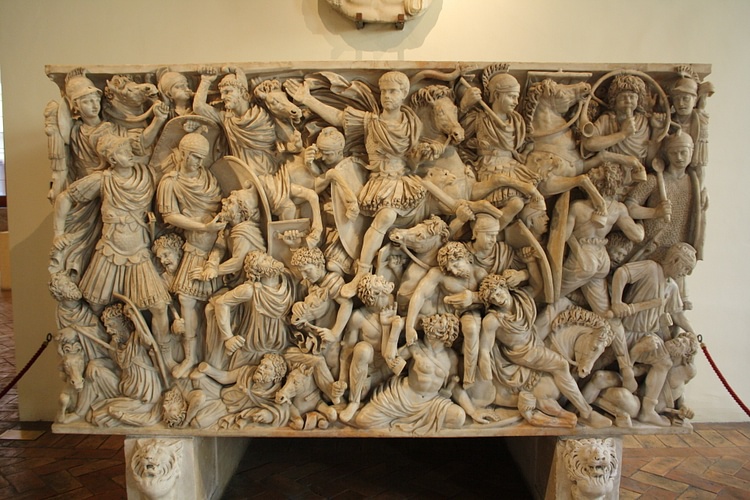 Grand Ludovisi Sarcophagus Mark Cartwright (CC BY-NC-SA) ](https://www.worldhistory.org/image/2120/grand-ludovisi-sarcophagus/ "Grand Ludovisi Sarcophagus")So important was the proper burial of the dead to the Romans that funeral societies, known as *collegia*, were common in which members paid monthly dues to make sure their funeral rites would be performed in accordance with tradition and their status in the community. Those who were buried without the proper rituals could return as ghosts. In Rome, as in other civilizations, ghosts were as much a part of the natural world as any other phenomena and were usually feared (an exception being the spirit of a loved one delivering a message). Proper burial of the dead with all attendant rites, therefore, was considered vital in keeping the dead happily in their place and the living untroubled by spirits in theirs.
### Chinese Burial Rites
This same understanding of funerary rites informed mortuary rituals in [China](https://www.worldhistory.org/china/). Chinese burial practice, no matter what era or dynasty, was conducted in accordance with strictly observed ceremonies to ensure the passage of the spirit to the other realm. Burial, as in other cultures, included the placement of personal property in the tomb or grave of the deceased as an important aspect of the funerary rites. The particular items interred with the dead changed with dynasties and the passage of time but the belief in an afterlife which was very much like earthly existence (similar to the Egyptian concept in many ways) maintained that the dead would need their favorite objects, as well as things of value, in the other world.
According to The British Museum, “Chinese burial practices had two main components: tombs and their contents, and ceremonies to honour the dead, performed in temples and offering halls by their relatives.” The tomb of the first emperor of China, [Qin Shi Huangdi](https://www.worldhistory.org/Shi_Huangdi/), is the most famous example of Chinese burial practices in the ancient world. [Shi Huangdi](https://www.worldhistory.org/Shi_Huangdi/)'s tomb was designed to symbolize the realm he presided over in life and included all he would need in the next - including a [terracotta army](https://www.worldhistory.org/Terracotta_Army/) of over 8,000 men - and the rites observed at his funeral were elaborate versions of those common throughout China.
[  The Terracotta Army, Shaanxi Province Shawn Kinkade (CC BY-NC-SA) ](https://www.worldhistory.org/image/7541/the-terracotta-army-shaanxi-province/ "The Terracotta Army, Shaanxi Province")In the [Neolithic](https://www.worldhistory.org/Neolithic/) [Banpo village](https://www.worldhistory.org/Banpo_Village/), for example, people were buried in individual graves c. 4500 BCE along with their possessions and tools. What rituals may have accompanied these early burials is not known. Later, however, as one's ancestors were considered an important influence on one's life, and their continued existence in the afterlife a certainty, prayers were offered both to those who had gone before and to the principle of divine harmony to aid the dead person in transition from this world to the next. As in Rome, Egypt, and other cultures, proper burial of the dead was considered most important in allowing the dead to rest in peace and prevent a haunting by an angry ghost.
### Burial in Scotland & Ireland
Burial practices in Scotland and Ireland were remarkably similar early on in that both cultures built cairns, dolmens, and passage graves to house their dead. It is not known what precise rites were performed at the funerals in [ancient Scotland](https://www.worldhistory.org/Scotland_(Ancient)/) or Ireland because there is no written record of these proceedings. It seems that burial in cairns dates to at least 4000 BCE while burial in graves becomes more common c. 2000 BCE. Wooden coffins also appear in the 2000 BCE range along with personal possessions buried with the dead.
As so many cairns were looted through the centuries, whatever may have been interred in burial has long ago been carried away. Some, however, like the famous [dolmen](https://www.worldhistory.org/dolmen/) of [Poulnabrone](https://www.worldhistory.org/Poulnabrone/) (County Clare, Ireland) still had enough grave goods and remains for archaeologists to be able to positively identify it as an important burial site. The Neolithic site of [Clava Cairns](https://www.worldhistory.org/Clava_Cairns/) (Inverness, Scotland) is another example of an intact burial site which also seems to have served astronomical purposes.
[  Balnuaran of Clava Dave Conner (CC BY-NC-SA) ](https://www.worldhistory.org/image/937/balnuaran-of-clava/ "Balnuaran of Clava")More modest graves, which held the dead in coffins or sarcophagi, were more often overlooked by looters and so their contents remain better preserved. In these cultures, as in the others, a belief in the continued existence of the soul after death prevailed and, while their precise rites are not known, they most probably were similar to those of other cultures and included prayers and supplications to higher powers for aid in the journey of the deceased. Although there is no written record of a belief in the afterlife from these cultures, the cairns, dolmens, and passage graves themselves attest to this belief in their construction and orientation with astrological directions and events.
With the coming of [Christianity](https://www.worldhistory.org/christianity/) to Ireland and then Scotland, the burial rites became Christianized and are known through the written record. Although Christ was then addressed as the higher power that would comfort and lead the dead toward the afterlife, it is thought that this deity simply replaced the older, pagan, god who would have been featured in the rituals. This same process of the 'Christianizing' of older burial rituals and rites took place in every culture where Christianity established itself and, most notably, in Rome. It was the city of Rome from which the Catholic traditions concerning burial originated and developed into the most common customs surrounding modern-day burials, whether secular or religious, in the west.
#### Editorial Review
This human-authored definition has been reviewed by our editorial team before publication to ensure accuracy, reliability and adherence to academic standards in accordance with our [editorial policy](https://www.worldhistory.org/static/editorial-policy/).
## Bibliography
- [Durant, W. *Our Oriental Heritage.* Simon & Schuster, 2000.](https://www.worldhistory.org/books/B00005WJGO/)
- [Ikram, S. *Death and Burial in Ancient Egypt.* Longman, 2003.](https://www.worldhistory.org/books/0582772168/)
- [Kramer, S. N. *The Sumerians.* University of Chicago Press, 1971.](https://www.worldhistory.org/books/0226452387/)
- [Nardo, D. *Living in Ancient Rome.* Chelsea House Publications, 2008.](https://www.worldhistory.org/books/0816063400/)
- [Pre-historic Burials in Scotland](http://www.historic-scotland.gov.uk/prehistoric-burials.pdf "Pre-historic Burials in Scotland"), accessed 1 Dec 2016.
- [Scarre, C. & Fagan, B.F. *Ancient Civilizations.* Pearson, 2007.](https://www.worldhistory.org/books/0131928783/)
- [Stuart, G.S. *Lost Kingdoms of the Maya.* National Geographic Society, 1993.](https://www.worldhistory.org/books/0870449281/)
- [The British Museum: Burial Practices in China](https://www.britishmuseum.org/explore/highlights/articles/b/burial_practices_in_china.aspx "The British Museum: Burial Practices in China"), accessed 24 Jan 2017.
## About the Author
Joshua J. Mark is World History Encyclopedia's co-founder and Content Director. He was previously a professor at Marist College (NY) where he taught history, philosophy, literature, and writing. He has traveled extensively and lived in Greece and Germany.
- [Linkedin Profile](https://www.linkedin.com/pub/joshua-j-mark/38/614/339)
## Timeline
- **c. 6000 BCE**: [Burial](https://www.worldhistory.org/burial/) of the dead in [Egypt](https://www.worldhistory.org/egypt/).
- **c. 6000 BCE**: Earliest [Egyptian](https://www.worldhistory.org/disambiguation/Egyptian/) mastabas dug at Saqqara.
- **c. 5000 BCE**: Evidence of [burial](https://www.worldhistory.org/burial/) in [Sumer](https://www.worldhistory.org/sumer/).
- **c. 5000 BCE**: Dead buried with [grave](https://www.worldhistory.org/burial/) goods at [Banpo Village](https://www.worldhistory.org/Banpo_Village/), [China](https://www.worldhistory.org/china/).
- **4300 BCE**: First [megalithic](https://www.worldhistory.org/disambiguation/megalithic/) tombs in [Europe](https://www.worldhistory.org/europe/).
- **c. 4000 BCE**: Carrowmore [Megalithic](https://www.worldhistory.org/disambiguation/megalithic/) Cemetery begins in Sligo, [Ireland](https://www.worldhistory.org/disambiguation/Ireland/).
- **c. 3300 BCE**: Early Harappan [Civilization](https://www.worldhistory.org/civilization/) of [India](https://www.worldhistory.org/india/) practices [burial](https://www.worldhistory.org/burial/) of the dead.
- **3300 BCE**: [Newgrange](https://www.worldhistory.org/Newgrange/) [Burial](https://www.worldhistory.org/burial/) Mound constructed in [Ireland](https://www.worldhistory.org/disambiguation/Ireland/).
- **3000 BCE**: Stone tombs on [Crete](https://www.worldhistory.org/crete/).
- **3000 BCE**: [Tomb](https://www.worldhistory.org/tomb/) of the Eagles created in [Scotland](https://www.worldhistory.org/disambiguation/Scotland/).
- **c. 3000 BCE - c. 2800 BCE**: [Maeshowe](https://www.worldhistory.org/Maeshowe/) Passage [Grave](https://www.worldhistory.org/burial/) completed in [Scotland](https://www.worldhistory.org/disambiguation/Scotland/).
- **3000 BCE - 2000 BCE**: First rock-cut [burial](https://www.worldhistory.org/burial/) chambers at [Akrotiri](https://www.worldhistory.org/thera/).
- **c. 2800 BCE**: Later Harappan [Civilization](https://www.worldhistory.org/civilization/) turns to cremation over [burial](https://www.worldhistory.org/burial/).
- **c. 2600 BCE**: Mayan [Culture](https://www.worldhistory.org/disambiguation/culture/) buries their dead individually under homes.
- **c. 2600 BCE - c. 2000 BCE**: The Royal Graves of [Ur](https://www.worldhistory.org/ur/) used in [Sumer](https://www.worldhistory.org/sumer/).
- **c. 2560 BCE**: The [Great Pyramid of Giza](https://www.worldhistory.org/Great_Pyramid_of_Giza/) is constructed by [Pharaoh](https://www.worldhistory.org/pharaoh/) Khufu (Cheops).
- **c. 1700 BCE - c. 1600 BCE**: First shaft graves constructed at [Mycenae](https://www.worldhistory.org/mycenae/).
- **c. 1500 BCE**: First tholos tombs built at [Mycenae](https://www.worldhistory.org/mycenae/).
- **c. 1500 BCE - c. 1400 BCE**: First [palace](https://www.worldhistory.org/disambiguation/palace/) structure and Treasury of [Atreus](https://www.worldhistory.org/Atreus/) [tomb](https://www.worldhistory.org/tomb/) built at [Mycenae](https://www.worldhistory.org/mycenae/).
- **c. 1100 BCE**: Greeks implement use of individual tombs and graves.
- **c. 700 BCE**: [Tomb](https://www.worldhistory.org/tomb/) of Mayan King K'utz Chman of Retalhuleu constructed in Guatemala.
- **500 BCE - 300 BCE**: Rich [Scythian](https://www.worldhistory.org/Scythians/) burials.
## Questions & Answers
### How long ago did humans begin burying their dead?
Burial of the dead has been dated back 130,000 years as evidenced by Neanderthal graves.
### What are the earliest burials?
The earliest human gravesite found thus far is the Qafzeh Cave in modern-day Israel dated to 120,000 years ago although Neanderthals were burying their dead prior to this time.
### Why was burial important?
Burial was important simply for health reasons but also to honor the deceased, allow the living to grieve their loss, and encourage the spirit of the departed to pass on to the afterlife. Improper burial rituals were understood as a main cause for hauntings.
### Did all ancient cultures practice burial rituals?
All ancient cultures observed some form of funerary rites in the burial of their dead.
## External Links
- [Archaeologists puzzle over mystery woman in early Christian cemetery](https://www.nationalgeographic.com/culture/2019/01/mystery-woman-cemetery-ljubljana-slovenia-archaeology/)
- [10 extraordinary burial ceremonies from around the world](https://matadornetwork.com/bnt/10-extraordinary-burial-ceremonies-from-around-the-world/)
- [Evidence of earliest human burial](http://news.bbc.co.uk/1/hi/sci/tech/2885663.stm)
- [Qafzeh: Oldest Intentional Burial](http://humanorigins.si.edu/evidence/behavior/burial/qafzeh-oldest-intentional-burial)
- [An Artisan's Tomb in New Kingdom Egypt | Essay | The Metropolitan Museum of Art | Heilbrunn Timeline of Art History](https://www.metmuseum.org/toah/hd/srvt/hd_srvt.htm)
## Cite This Work
### APA
Mark, J. J. (2009, September 02). Burial. *World History Encyclopedia*.
### Chicago
Mark, Joshua J.. "Burial." *World History Encyclopedia*, September 02, 2009. .
### MLA
Mark, Joshua J.. "Burial." *World History Encyclopedia*, 02 Sep 2009, .
## License & Copyright
Submitted by [Joshua J. Mark](https://www.worldhistory.org/user/JPryst/ "User Page: Joshua J. Mark"), published on 02 September 2009. The copyright holder has published this content under the following license: [Creative Commons Attribution-NonCommercial-ShareAlike](https://creativecommons.org/licenses/by-nc-sa/4.0/deed.en). This license lets others remix, tweak, and build upon this content non-commercially, as long as they credit the author and license their new creations under the identical terms. When republishing on the web a hyperlink back to the original content source URL must be included. Please note that content linked from this page may have different licensing terms.