---
title: Augustus
author: Joshua J. Mark
source: https://www.worldhistory.org/augustus/
format: machine-readable-alternate
license: Creative Commons Attribution-NonCommercial-ShareAlike (https://creativecommons.org/licenses/by-nc-sa/4.0/)
updated: 1970-01-01
---
# Augustus
_Authored by [Joshua J. Mark](https://www.worldhistory.org/user/JPryst/)_
Augustus [Caesar](https://www.worldhistory.org/disambiguation/caesar/) (27 BCE - 14 CE) was the name of the first and, by most accounts, greatest [Roman emperor](https://www.worldhistory.org/Roman_Emperor/). Augustus was born Gaius Octavius Thurinus on 23 September 63 BCE. Octavian was adopted by his great-uncle [Julius Caesar](https://www.worldhistory.org/Julius_Caesar/) in 44 BCE, and then took the name Gaius [Julius](https://www.worldhistory.org/disambiguation/Julius/) Caesar. In 27 BCE the Senate awarded him the honorific Augustus ("the illustrious one"), and he was then known as Gaius Julius Caesar Augustus.
Owing to the many names the man went by in his life, it is common to call him Octavius when referring to events between 63 and 44 BCE, Octavian when referring to events between 44 and 27 BCE, and Augustus regarding events from 27 BCE to his [death](https://www.worldhistory.org/disambiguation/Death/) in 14 CE. It should be noted, however, that Octavian himself, between the years 44 and 27 BCE, never went by that name, choosing instead to align himself closely with his great uncle by carrying the same name; a decision which prompted [Mark Antony](https://www.worldhistory.org/Mark_Antony/)'s famous accusation, as recorded by [Cicero](https://www.worldhistory.org/Cicero/): "You, boy, owe everything to your name".
### Augustus, [Mark](https://www.worldhistory.org/disambiguation/Mark/) [Antony](https://www.worldhistory.org/Mark_Antony/) & Lepidus
After Julius Caesar's assassination in March of 44 BCE, Octavian allied himself with Caesar's close friend and relative, Mark Antony. Together with another supporter of Caesar, Marcus Aemilius Lepidus, Antony and Octavian formed the Second Triumvirate in October of 43 BCE. Their first order of business seems to have been the systematic killing of any political rivals and supporters of Caesar's assassins. Exactly which of the three was most responsible for the killings is disputed by ancient and modern writers alike with some claiming Octavian innocent and others ascribing to him the most bloodshed. Having cleansed Rome of the 'bad blood' of their opposition, the Second Triumvirate then turned their attention to Caesar's assassins. At the [Battle](https://www.worldhistory.org/disambiguation/battle/) of Phillipi in October 42 BCE, the forces of Brutus and Cassius were defeated by those of the Second Triumvirate forcing both assassins to kill themselves.
[  Division of the Second Triumvirate ColdEl (CC BY-SA) ](https://www.worldhistory.org/image/4951/division-of-the-second-triumvirate/ "Division of the Second Triumvirate")Between 38 and 36 BCE, Octavian and Lepidus battled Sextus Pompeius (son of [Pompey](https://www.worldhistory.org/pompey/) Magnus, Julius Caesar's great rival) for rule of Rome with Antony lending aid from [Egypt](https://www.worldhistory.org/egypt/). The Second Triumvirate was victorious over Pompeius, and Lepidus, glorying in the [triumph](https://www.worldhistory.org/Roman_Triumph/) and confident of his strength, insulted Octavian by ordering him to leave [Sicily](https://www.worldhistory.org/sicily/), the [theatre](https://www.worldhistory.org/disambiguation/theatre/) of operations, with his troops. Octavian, however, offered Lepidus' troops more money than Lepidus could pay and his army defected to Octavian. Lepidus was stripped of all his titles save Pontifex Maximus and the Second Triumvirate came to an end.
### Augustus, Antony & [Cleopatra](https://www.worldhistory.org/disambiguation/cleopatra/)
During this time, however, relations between Octavian and Mark Antony began to deteriorate. In 40 BCE, in an effort to solidify their alliance, Octavian had given his sister, [Octavia Minor](https://www.worldhistory.org/Octavia_Minor/), in marriage to Antony. Antony, though, had allied himself closely with [Cleopatra VII](https://www.worldhistory.org/Cleopatra_VII/) of Egypt (the former lover of Julius Caesar and mother of his son [Caesarion](https://www.worldhistory.org/caesarion/)) and, in fact, had become her lover. Octavian charged that Antony had misused his sister when Antony divorced [Octavia](https://www.worldhistory.org/disambiguation/Octavia/) in favor of Cleopatra in 33 BCE which prompted Antony to write Octavian, “What's upset you? Because I go to bed with Cleopatra? But she's my wife and I've been doing so for nine years, not just recently. Does it really matter where, or with what [women](https://www.worldhistory.org/disambiguation/women/), you get your excitement?”
To Octavian, Antony's behavior in the east, both in private, politically and militarily, was intolerable. He forced the priestesses of the [temple](https://www.worldhistory.org/temple/) of [Vesta](https://www.worldhistory.org/Vesta/) in Rome to surrender Antony's will and had it read in the [Roman Senate](https://www.worldhistory.org/Roman_Senate/). The will gave away [Roman](https://www.worldhistory.org/disambiguation/Roman/) territories to Antony's sons and contained directions for a great mausoleum to be built in [Alexandria](https://www.worldhistory.org/alexandria/) for Antony and Cleopatra, among other stipulations which Octavian felt threatened the grandeur of Rome and branded Antony a renegade.
Among the worst of Antony's offenses was his declaration that Caesarion was the true heir of Julius Caesar, not Octavian. The Senate revoked Antony's consulship and declared [war](https://www.worldhistory.org/disambiguation/War/) on Cleopatra VII. At the [Battle of Actium](https://www.worldhistory.org/Battle_of_Actium/) on 2 September 31 BCE Octavian's forces, under the general [Marcus Agrippa](https://www.worldhistory.org/Marcus_Agrippa/), defeated the combined forces of Antony and Cleopatra, scattered them (many had already defected to Octavian's side before the battle) and pursued the survivors until 1 August 30 BCE when, after the loss of Alexandria, Antony and Cleopatra killed themselves. Octavian had Caesarion strangled (stating that “two Caesars are one too many”) and Antony's eldest son executed as a possible threat to Rome.
[ 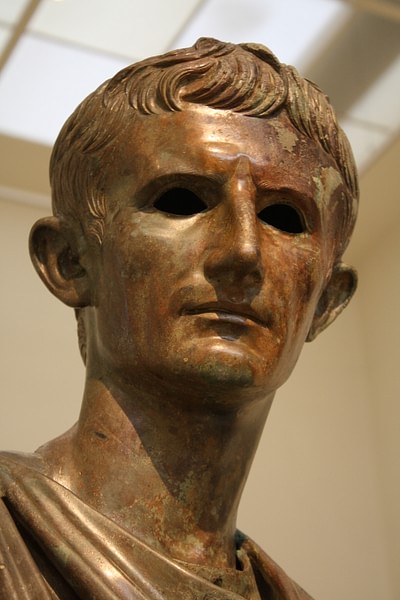 Augustus, Bronze Head from Euboea Mark Cartwright (CC BY-NC-SA) ](https://www.worldhistory.org/image/3257/augustus-bronze-head-from-euboea/ "Augustus, Bronze Head from Euboea")Octavian was now the supreme ruler of Rome and all its territories but, in order to keep from making the same mistake his adoptive father had of seeming to covet power, Octavian was careful to characterize all of his political stratagems as being for the good of the [Roman Republic](https://www.worldhistory.org/Roman_Republic/). In January of 27 BCE, Octavian resigned his powers humbly only to receive them back from the grateful Senate who also bestowed upon him the title Augustus. Octavian was careful not to refer to himself by that title at any time in public, simply calling himself '*Princeps*', or, First Citizen. So carefully did Octavian play the political game in Rome that his claims to restoration of the Republic seemed in earnest, even when he gained supreme power, giving him absolute control over Rome and its colonies.
### Augustus as Emperor
Popular already with the soldiers of his army, the title Augustus solidified his power in the provinces as *Imperator*, or commander-in-chief (from which the English word 'emperor' is derived). The month of August was named in his honor. In the year 19 BCE, he was given *Imperium Maius* (supreme power) over every province in the [Roman Empire](https://www.worldhistory.org/Roman_Empire/) and, from that time on, Augustus Caesar ruled supremely, the first emperor of Rome and the measure by which all later emperors would be judged. By 2 BCE Augustus was declared *Pater Patriae*, the father of his country.
[  Map of the Provinces of the Roman Empire under Augustus Simeon Netchev (CC BY-NC-ND) ](https://www.worldhistory.org/image/15518/map-of-the-provinces-of-the-roman-empire-under-aug/ "Map of the Provinces of the Roman Empire under Augustus")
The era of Augustus' reign was a golden age in every respect. The peace which Augustus restored and kept (the *[Pax Romana](https://www.worldhistory.org/Pax_Romana/)*) caused the [economy](https://www.worldhistory.org/disambiguation/economy/), the arts and [agriculture](https://www.worldhistory.org/disambiguation/Agriculture/) to flourish. An ambitious building program was initiated in which Augustus completed the plans made by Julius Caesar and then continued on with his own grand designs. In his famous inscription *Res Gestae Divi Augusti* (The Deeds of the Divine Augustus) he claims to have restored or built 82 temples in one year. The famous public [Roman baths](https://www.worldhistory.org/Roman_Baths/) were constructed under Augustus by his second-in-command, [Agrippa](https://www.worldhistory.org/Marcus_Agrippa/), and the poet [Virgil](https://www.worldhistory.org/virgil/) composed his epic the *[Aeneid](https://www.worldhistory.org/The_Aeneid/)*. Augustus took great personal concern in the arts and was a personal patron of many artists.
He passed many sweeping reforms as well as laws to maintain stability in marriage and to raise the birth rate in Rome, making adultery illegal, offering tax incentives to families with over three children and penalties for childless marriages. So strictly did Augustus himself adhere to his laws that he banished his own daughter, Julia, and his granddaughter, for adultery.
[  Augustus of Prima Porta Andreas Wahra (original), new version by Till Niermann (CC BY-SA) ](https://www.worldhistory.org/image/97/augustus-of-prima-porta/ "Augustus of Prima Porta")### Death
Augustus died at Nola in 14 CE. His official last words were, “I found Rome a [city](https://www.worldhistory.org/city/) of clay but left it a city of marble” which aptly describes Augustus' achievements during his reign as emperor. According to his wife [Livia Drusilla](https://www.worldhistory.org/Livia_Drusilla/) and his adopted son [Tiberius](https://www.worldhistory.org/Tiberius/) (r. 14-37 CE), however, his last words were actually, “Have I played the part well? Then applaud as I exit.”
Augustus' body was brought back to Rome, and on the day of the funeral, all businesses in Rome closed out of respect for the emperor. He was succeeded by Tiberius who he had adopted in 4 CE and who read the eulogy (along with his own son, Drusus) at Augustus' famously grand funeral. The emperor's body was cremated and his ashes interred in his mausoleum. Augustus' death was mourned as the loss of a great ruler of immense talent and vision, and he was proclaimed a [god](https://www.worldhistory.org/God/) among the host of the Roman [pantheon](https://www.worldhistory.org/Pantheon/).
#### Editorial Review
This human-authored definition has been reviewed by our editorial team before publication to ensure accuracy, reliability and adherence to academic standards in accordance with our [editorial policy](https://www.worldhistory.org/static/editorial-policy/).
## Bibliography
- [Durant, W. *Caesar and Christ.* Simon and Schuster, 1972.](https://www.worldhistory.org/books/B000TK5PNI/)
- [Everitt, A. *Augustus.* Random House Trade Paperbacks, 2014.](https://www.worldhistory.org/books/0812970586/)
- [Hamilton, E. *The Roman Way.* W. W. Norton & Company, 1993.](https://www.worldhistory.org/books/0393310787/)
- [Suetonius. *Suetonius, Vol. 1.* Loeb Classical Library, 1914.](https://www.worldhistory.org/books/0674995708/)
## About the Author
Joshua J. Mark is World History Encyclopedia's co-founder and Content Director. He was previously a professor at Marist College (NY) where he taught history, philosophy, literature, and writing. He has traveled extensively and lived in Greece and Germany.
- [Linkedin Profile](https://www.linkedin.com/pub/joshua-j-mark/38/614/339)
## Timeline
- **23 Sep 63 BCE**: [Octavian](https://www.worldhistory.org/augustus/) born Gaius Octavius Thurinus at [Rome](https://www.worldhistory.org/Rome/).
- **Mar 44 BCE**: [Octavian](https://www.worldhistory.org/augustus/) / [Augustus](https://www.worldhistory.org/augustus/) adopted posthumously by [Julius Caesar](https://www.worldhistory.org/Julius_Caesar/).
- **43 BCE - 36 BCE**: [Second Triumvirate](https://www.worldhistory.org/Second_Triumvirate/): [Antony](https://www.worldhistory.org/Mark_Antony/), [Octavian](https://www.worldhistory.org/augustus/), and Lepidus (official approval by the [Roman Senate](https://www.worldhistory.org/Roman_Senate/)). Mass proscriptions including [Cicero](https://www.worldhistory.org/Cicero/).
- **42 BCE**: [Octavian](https://www.worldhistory.org/augustus/) and [Antony](https://www.worldhistory.org/Mark_Antony/) defeat Republicans under Brutus and Cassius at the [Battle](https://www.worldhistory.org/disambiguation/battle/) of [Philippi](https://www.worldhistory.org/Philippi/) ([Greece](https://www.worldhistory.org/greece/)).
- **38 BCE**: [Octavian](https://www.worldhistory.org/augustus/) amasses a naval fleet to defeat Sextus [Pompey](https://www.worldhistory.org/pompey/).
- **36 BCE**: [Octavian](https://www.worldhistory.org/augustus/) strips Lepidus of all power but Pontifex Maximus (supreme priest). Lepidus dies of old age in 12 BC.
- **31 BCE**: [Octavian](https://www.worldhistory.org/augustus/) uses [Corcyra](https://www.worldhistory.org/corcyra/) as a [Roman](https://www.worldhistory.org/disambiguation/Roman/) naval base.
- **2 Sep 31 BCE**: The [Battle of Actium](https://www.worldhistory.org/Battle_of_Actium/). [Octavian](https://www.worldhistory.org/augustus/) defeats [Mark Antony](https://www.worldhistory.org/Mark_Antony/) and [Cleopatra VII](https://www.worldhistory.org/Cleopatra_VII/).
- **29 BCE**: [Octavian](https://www.worldhistory.org/augustus/) celebrates a triple [triumph](https://www.worldhistory.org/Roman_Triumph/) in [Rome](https://www.worldhistory.org/Rome/).
- **27 BCE**: [Augustus](https://www.worldhistory.org/augustus/) creates the [Praetorian Guard](https://www.worldhistory.org/Praetorian_Guard/).
- **27 BCE**: [Octavian](https://www.worldhistory.org/augustus/) is given extraordinary powers and the name [Augustus](https://www.worldhistory.org/augustus/) by the [Roman Senate](https://www.worldhistory.org/Roman_Senate/).
- **27 BCE - 14 CE**: Reign of [Augustus](https://www.worldhistory.org/augustus/) [Caesar](https://www.worldhistory.org/disambiguation/caesar/). [Athens](https://www.worldhistory.org/Athens/) and the [Agora](https://www.worldhistory.org/agora/) restored.
- **c. 23 BCE**: [Augustus](https://www.worldhistory.org/augustus/) takes over most of the powers of the tribuni plebis.
- **19 BCE**: Arch of [Augustus](https://www.worldhistory.org/augustus/) built in [Rome](https://www.worldhistory.org/Rome/) to commemorate victory over the Parthians.
- **19 BCE**: [Augustus](https://www.worldhistory.org/augustus/) is given supreme powers by the [Roman Senate](https://www.worldhistory.org/Roman_Senate/).
- **c. 10 BCE**: [Augustus](https://www.worldhistory.org/augustus/) rebuilds the [Temple of Castor and Pollux](https://www.worldhistory.org/article/632/temple-of-castor--pollux/) in [Rome](https://www.worldhistory.org/Rome/)'s [Forum Romanum](https://www.worldhistory.org/Roman_Forum/).
- **c. 10 BCE**: Statue of [Augustus](https://www.worldhistory.org/augustus/) as Pontifex Maximus sculpted.
- **9 BCE**: A massive altar the Ara Pacis is completed by [Augustus](https://www.worldhistory.org/augustus/) in [Rome](https://www.worldhistory.org/Rome/).
- **2 BCE**: Augusutus inaugurates the [Temple](https://www.worldhistory.org/temple/) of [Mars](https://www.worldhistory.org/Mars/) Ultor in [Rome](https://www.worldhistory.org/Rome/) to commemorate his victory at the [Battle](https://www.worldhistory.org/disambiguation/battle/) of [Philippi](https://www.worldhistory.org/Philippi/) in 42 BCE.
- **c. 2 BCE**: [Augustus](https://www.worldhistory.org/augustus/) is declared "Father of the Country".
- **2 BCE**: [Augustus](https://www.worldhistory.org/augustus/) appoints two Prefects (praefectus praetorio) to command the [Praetorian Guard](https://www.worldhistory.org/Praetorian_Guard/).
- **6 CE**: [Augustus](https://www.worldhistory.org/augustus/) creates the aerarium militare, a treasury drawn from taxes in order to fund a professional [Roman army](https://www.worldhistory.org/Roman_Army/).
- **6 CE**: [Augustus](https://www.worldhistory.org/augustus/) creates [Rome](https://www.worldhistory.org/Rome/)'s permanent firefighting force, the [Vigiles](https://www.worldhistory.org/Vigiles/).
- **c. 13 CE**: [Augustus](https://www.worldhistory.org/augustus/) creates the [cohortes urbanae](https://www.worldhistory.org/Cohortes_Urbanae/) in [Rome](https://www.worldhistory.org/Rome/) to help maintain public order.
- **19 Aug 14 CE**: [Augustus](https://www.worldhistory.org/augustus/) dies at Nola of natural causes.
## External Links
- [A tribute to Augustus](http://followinghadrian.com/2014/08/18/a-tribute-to-augustus/)
- [Why did Augustus exile his own daughter?](https://www.missedinhistory.com/podcasts/why-did-augustus-exile-his-own-daughter.htm)
- [History vs. Augustus - Alex Gendler and Peta Greenfield](https://ed.ted.com/lessons/history-vs-augustus-alex-gendler-and-peta-greenfield)
- [Roman Emperors](http://www.roman-emperors.org/auggie.htm)
- [List of Rulers of the Roman Empire | Lists of Rulers | Heilbrunn Timeline of Art History | The Metropolitan Museum of Art](https://www.metmuseum.org/toah/hd/roru/hd_roru.htm)
## Cite This Work
### APA
Mark, J. J. (2018, May 04). Augustus. *World History Encyclopedia*.
### Chicago
Mark, Joshua J.. "Augustus." *World History Encyclopedia*, May 04, 2018. .
### MLA
Mark, Joshua J.. "Augustus." *World History Encyclopedia*, 04 May 2018, .
## License & Copyright
Submitted by [Joshua J. Mark](https://www.worldhistory.org/user/JPryst/ "User Page: Joshua J. Mark"), published on 04 May 2018. The copyright holder has published this content under the following license: [Creative Commons Attribution-NonCommercial-ShareAlike](https://creativecommons.org/licenses/by-nc-sa/4.0/deed.en). This license lets others remix, tweak, and build upon this content non-commercially, as long as they credit the author and license their new creations under the identical terms. When republishing on the web a hyperlink back to the original content source URL must be included. Please note that content linked from this page may have different licensing terms.