---
title: Ashur: The First Great Assyrian City
author: Joshua J. Mark
source: https://www.worldhistory.org/ashur/
format: machine-readable-alternate
license: Creative Commons Attribution-NonCommercial-ShareAlike (https://creativecommons.org/licenses/by-nc-sa/4.0/)
updated: 2026-03-02
---
# Ashur: The First Great Assyrian City
_Authored by [Joshua J. Mark](https://www.worldhistory.org/user/JPryst/)_
Ashur (also known as [Assur](https://www.worldhistory.org/assur/)) was an Assyrian [city](https://www.worldhistory.org/city/) located on a plateau above the Tigris River in [Mesopotamia](https://www.worldhistory.org/Mesopotamia/) (today known as Qal'at Sherqat, al-Shirqat District, northern Iraq). The city was an important center of [trade](https://www.worldhistory.org/disambiguation/trade/), as it lay squarely on a caravan trade route that ran through Mesopotamia to [Anatolia](https://www.worldhistory.org/Asia_Minor/) and down through the [Levant](https://www.worldhistory.org/levant/). In time, however, it became the capital of the Assyrian [Empire](https://www.worldhistory.org/empire/) and one of the wealthiest [cities](https://www.worldhistory.org/city/) in ancient Mesopotamia.
It was originally established during the [Early Dynastic](https://www.worldhistory.org/disambiguation/Early_Dynastic/) I period (circa 2900-2750/2700 BCE) but began to gain prominence after circa 1900 BCE, becoming the first great Assyrian city and, under the [Neo-Assyrian Empire](https://www.worldhistory.org/Neo-Assyrian_Empire/) (912-612 BCE), an important religious and cultural site. The city that would become Ashur rose on the site of a pre-existing community that had been built by the Akkadians at some point during the reign of [Sargon the Great](https://www.worldhistory.org/Sargon_of_Akkad/) (2334-2279 BCE) of [Akkad](https://www.worldhistory.org/akkad/).
According to one interpretation of passages in the biblical [book of Genesis](https://www.worldhistory.org/Book_of_Genesis/) (chapters 10 and 22), Ashur was founded by a man named Ashur, son of Shem, son of [Noah](https://www.worldhistory.org/Noah/), after the Great Flood, who then went on to found the other important Assyrian cities. A more likely foundation account is that the city was named Ashur/Assur after the deity of that name sometime in the 3rd millennium BCE; the same [god](https://www.worldhistory.org/God/)'s name is the origin for *[Assyria](https://www.worldhistory.org/assyria/)*. The biblical version of the origin of Ashur appears later in the historical record after the Assyrians had accepted [Christianity](https://www.worldhistory.org/christianity/), and so it is thought to be a re-interpretation of their early history, which was more in keeping with their new belief system.
Because of the lucrative trade Ashur enjoyed with the city of Karum Kanesh in Anatolia, it flourished long before it became the capital of the Assyrian Empire. Even after the capital was moved to the cities of [Kalhu](https://www.worldhistory.org/Kalhu/) ([Nimrud](https://www.worldhistory.org/Kalhu/)), then [Dur-Sharrukin](https://www.worldhistory.org/Dur-Sharrukin/), and finally [Nineveh](https://www.worldhistory.org/nineveh/), Ashur continued to be an important spiritual center for the Assyrians. All of the great kings (except for [Sargon II](https://www.worldhistory.org/Sargon_II/), whose body was lost in [battle](https://www.worldhistory.org/disambiguation/battle/)) were buried at Ashur, from the earliest days of the Assyrian Empire to the last pre-612 BCE, no matter where the capital city was located. Ashur was destroyed by the coalition led by the Babylonians and [Medes](https://www.worldhistory.org/Medes/) in 612 BCE, later by the [Sassanian](https://www.worldhistory.org/Sasanian_Empire/) Persians, and, today, is listed by UNESCO as a World Heritage Site.
### Early History
Archaeological excavations show that a city of some sort existed at the site as early as the 3rd millennium BCE. What precise form this city took is not known, nor is its size. The oldest foundations discovered thus far are those beneath the first [Ishtar](https://www.worldhistory.org/ishtar/) [Temple](https://www.worldhistory.org/temple/), which probably formed the base for an earlier temple, as the Mesopotamians generally built the same sort of structure on the ruins of an earlier one.
From [pottery](https://www.worldhistory.org/pottery/) and other artifacts found *in situ*, it is known that Ashur was an important center of trade early in the [Akkadian Empire](https://www.worldhistory.org/akkad/) and had been an outpost of the city of Akkad. In time, trade between Mesopotamia and Anatolia increased, and Ashur was among the most important cities in these transactions owing to its location. Merchants would send their wares via caravan into Anatolia and trade primarily at Karum Kanesh. The scholar [Paul](https://www.worldhistory.org/disambiguation/Paul/) Kriwaczek writes:
> For several generations the trading houses of Karum Kanesh flourished, and some became extremely wealthy – ancient millionaires. However not all business was kept within the family. Ashur had a sophisticated banking system and some of the capital that financed the Anatolian trade came from long-term investments made by independent speculators in return for a contractually specified proportion of the profits.
> (214)
[ 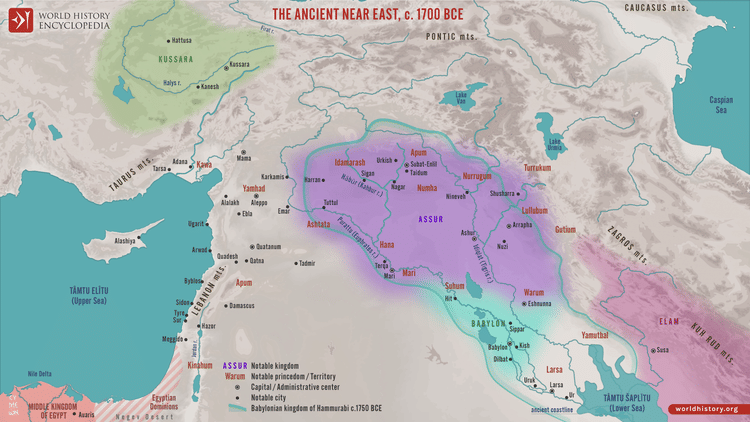 Map of Tthe Ancient Near East c. 1700 BCE Simeon Netchev (CC BY-NC-ND) ](https://www.worldhistory.org/image/15146/map-of-tthe-ancient-near-east-c-1700-bce/ "Map of Tthe Ancient Near East c. 1700 BCE")These profits were spent largely in the city on renovations and modifications to private homes and public buildings. Through trade, Ashur prospered and expanded, becoming the capital of Assyria by the 2nd millennium BCE. Walls were built around the city to enhance its natural defenses, even though these defenses were quite advantageous on their own. Regarding this, scholar Gwendolyn Leick writes:
> The city of Ashur was built on a rocky limestone cliff that forced the fast-flowing Tigris into a sharp curve. The main stream was also joined by a side-arm in antiquity, so that an oval-shaped island was created with a shoreline of 1.80 kilometres (1.1 miles). Rocky outcrops rose some 25 metres (82 feet) above the valley floor, with steep sides. This naturally sheltered position had strategic importance as it made the site comparatively easy to defend, besides forming a landmark with a wide view over the valley. (194-195)
### The Rise of Ashur
As the city flourished, the Assyrians expanded their territory outwards. The Assyrian king Shamashi Adad I (reign 1813-1791 BCE) drove out the invading [Amorite](https://www.worldhistory.org/amorite/) tribes and secured the borders of Ashur and the Assyrian land against further incursions. The city grew under the reign of Shamashi Adad I and then fell to the might of [Babylon](https://www.worldhistory.org/babylon/) under [Hammurabi](https://www.worldhistory.org/hammurabi/) (reign 1792-1750 BCE).
Hammurabi treated Ashur well and respected the gods and the temples, but he no longer permitted the city to trade with Anatolia. Babylon took over the trade route that had made Ashur wealthy, and the Assyrian city was forced to trade only with Babylon; this caused a decline in the prosperity of Ashur, and it languished as a vassal state.
[  A Cult Relief from Ashur Osama Shukir Muhammed Amin (Copyright) ](https://www.worldhistory.org/image/2975/a-cult-relief-from-ashur/ "A Cult Relief from Ashur")When Hammurabi died in 1750 BCE, the region erupted in turmoil and civil [war](https://www.worldhistory.org/disambiguation/War/) as city-states competed with each other for control. Stability was finally achieved by the Assyrian king Adasi (reign 1726-1691 BCE), but by that time, the kingdom of [Mitanni](https://www.worldhistory.org/Mitanni/) had grown up in western Anatolia and slowly spread through Mesopotamia, now holding Ashur as part of its territory. Ashur again languished as a vassal state until the rise of the Assyrian king Ashur-Ubalit I (reign 1353-1318 BCE), who defeated the Mitanni and took large portions of their territory.
The Kingdom of Mitanni had suffered significant losses since the days of its prime, ever since the [Hittite](https://www.worldhistory.org/hittite/) king [Suppiluliuma I](https://www.worldhistory.org/Suppiluliuma_I/) (reign 1344-1322 BCE) conquered them and replaced Mitanni rulers with Hittite officials. Ashur-Ubalit I defeated these Hittite rulers in combat but could not dislodge their hold on the region completely. The later king [Adad Nirari I](https://www.worldhistory.org/Adad_Nirari_I/) (reign 1307-1275 BCE) conquered the [Hittites](https://www.worldhistory.org/hittite/) and took the lands of the Mitanni to create the first semblance of an Assyrian empire.
[  Map of the Middle Assyrian Empire Simeon Netchev (CC BY-NC-ND) ](https://www.worldhistory.org/image/15147/map-of-the-middle-assyrian-empire/ "Map of the Middle Assyrian Empire")Ruling from Ashur, he led his victorious army throughout the region and sent the loot from his conquests back to the city. Ashur was again prosperous and began to develop and expand. Adad Nirari I commissioned many building projects in the city and improved the walls. It is from this point on that Ashur becomes the city of note, made famous as the capital of the Assyrian Empire.
### Ashur the Capital
Adad Nirari I's son, Shalmaneser I (reign 1274-1245 BCE), continued improvements on the city and was so prosperous that he was also able to build the city of Kalhu (also known as Nimrud, which would later become the capital). His son, [Tukulti-Ninurta I](https://www.worldhistory.org/Tukulti-Ninurta_I/) (reign 1244-1208 BCE), took renovations and building projects even further. Tukulti-[Ninurta](https://www.worldhistory.org/Ninurta/) I built his own city, called Kar-Tukulti-Ninurta (Harbor of Tukulti-Ninurta) across the river from Ashur.
For some time now, historians have claimed that this city was built after Tukulti-Ninurta I's sack of Babylon circa 1225 BCE because of inscriptions found at the site, which seemed to support this version of history. It is now thought, based on other inscriptions and records and archeological evidence at the site, that the king began building his city early in his reign. His reasons for doing so could have been that there was little left to improve on in the city of Ashur, and he wanted an impressive building project that would separate his name from that of his predecessors.
[  Clay tablet from the Archaic Buildings of Ishtar Temple Osama Shukir Muhammed Amin (Copyright) ](https://www.worldhistory.org/image/2992/clay-tablet-from-the-archaic-buildings-of--ishtar/ "Clay tablet from the Archaic Buildings of Ishtar Temple")He had already renovated the Temple of Ishtar in Ashur and commissioned other projects, but these were simply improving upon what the earlier kings had accomplished. As Tukulti-Ninurta I was an ambitious man with a grand vision of himself, only the construction of a completely new city bearing his name seemed to suit his purposes. Although Kar-Tukulti-Ninurta was earlier thought to have been built as the new capital to replace Ashur, this theory is no longer accepted by most historians.
Records indicate that the same officials who worked in the [palace](https://www.worldhistory.org/disambiguation/palace/) at Ashur also worked across the river in Kar-Tukulti-Ninurta at the same time, suggesting that business continued as usual in the capital city. Tukulti-Ninurta I clearly favored his new city, however, since he seems to have lavished the wealth he plundered from the temples of Babylon on his new palace and other projects in Kar-Tukulti-Ninurta. The king was assassinated in his palace by his son because of his treatment of Babylon and, especially, the sack of the temples; after his [death](https://www.worldhistory.org/disambiguation/Death/), his city was abandoned in favor of Ashur and eventually decayed and collapsed.
Ashur continued as the capital and jewel of the empire into the later reign of Tiglath Pileser I (1115-1076 BCE), who issued his famous [law](https://www.worldhistory.org/disambiguation/law/) code from the city and lavished his wealth on improvements to the palace and walls. Like his predecessors, he campaigned with his troops throughout the region and expanded Assyrian territory significantly, but after his death, the kingdom he had built fell apart. Ashur, during this time, remained stable, if not especially prosperous, and the kings who followed Tiglath Pileser I were able to retain the lands surrounding the city, even though they lost regions further away.
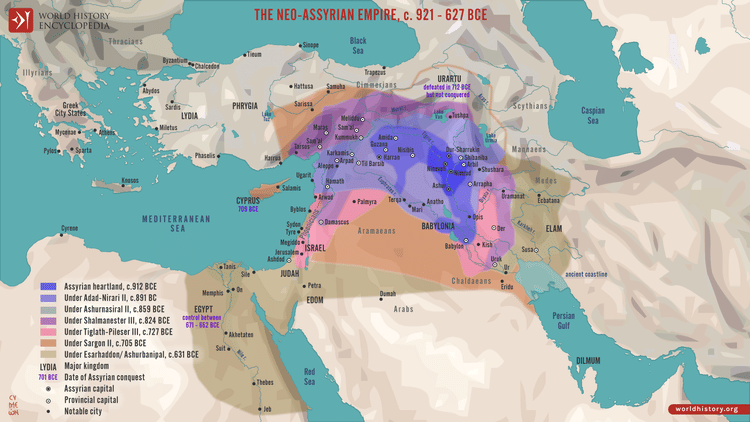
With the rise of Adad-Nirari II (reign 912-891 BCE), the city again enjoyed its former prosperity, and the Neo-Assyrian Empire began to rise. Adad-Nirari II reconquered the regions that had slipped from Assyrian control and expanded the empire further in every direction. Ashur was now the hub of the [giant](https://www.worldhistory.org/Giants/) wheel of empire, and wealth regularly flowed into the capital from the military campaigns of the kings.
The Assyrian policy of deporting and relocating large segments of the population of conquered regions also impacted Ashur in that scribes and scholars were regularly sent there to work in the library, palace, or in the schools. This helped to make Ashur a center of learning and [culture](https://www.worldhistory.org/disambiguation/culture/). When Tukulti-Ninurta I sacked Babylon, part of the loot he brought back to Ashur was books. The clay tablets upon which the stories, myths, and legends of Babylon were written now filled the shelves of Ashur's library and, as they were copied by the scribes, influenced Assyrian writers and were also preserved for the future.
[  Map of the Neo-Assyrian Empire Simeon Netchev (CC BY-NC-ND) ](https://www.worldhistory.org/image/15148/map-of--the-neo-assyrian-empire/ "Map of the Neo-Assyrian Empire")### Ashur in the Neo-Assyrian Empire
The king [Ashurnasirpal II](https://www.worldhistory.org/Ashurnasirpal_II/) (reign 884-859 BCE) moved the capital from Ashur to Kalhu, but this had no effect on the prosperity or importance of Ashur. Kalhu was renovated following Ashurnasirpal II's successful campaigns, and he most likely made it his capital for the same reason Tukulti-Ninurta I built his city: to elevate his name above his predecessors. The historian Marc Van De Mieroop writes:
> The kings must have had a motivation for the building of these vast cities, but when we look at their records no reason for the work is declared. Ashurnasirpal's justification for the work on Kalhu is merely a statement that the city built by his predecessor Shalmaneser had become dilapidated.
> (55)
There is also no reason stated for making Kalhu the new capital, and this move seems particularly strange when one considers the natural defenses of Ashur and the strength of its walls. One suggested theory is that Ashurnasirpal II wanted a virgin city whose populace had no cohesive identity. Ashur, by this time, was a very prestigious city, and its citizens prided themselves on their city and being Ashurians. It has therefore been proposed that Ashurnasirpal II moved the capital in order to create a royal power base with a less proud, and therefore more easily managed, population.
A stele found in the ruins of Kalhu describes the inauguration festival of the new capital at which Ashurnasirpal II fed 69,574 men and [women](https://www.worldhistory.org/disambiguation/women/) from his kingdom for ten days. Other inscriptions in the city tell of how Ashurnasirpal II referred to Kalhu as "my royal dwelling and for my lordly pleasure for all time" and how he planted saplings of 41 types of trees around the new city and dug massive canals and irrigation ditches (Van De Mieroop, 68). All of this was done to elevate the new capital city above Ashur, and yet there is no evidence of any decline in Ashur's status throughout the next 150 years in which Kalhu was the capital.
Ashur was successfully defended during the civil wars that marked the reign of Shamshi Adad (824-811 BCE) and was renovated under the kings who followed him. [Tiglath Pileser III](https://www.worldhistory.org/Tiglath_Pileser_III/) (reign 745-727 BCE) further enriched the city and strengthened the walls, and his successors would do likewise. [Sennacherib](https://www.worldhistory.org/sennacherib/) (reign 705-681 BCE) brought the spoils of his sack of Babylon back to Ashur even though, by that time, Nineveh was the capital city and the site of his palace "without rival". He clearly poured this wealth into the gardens, parks, and the palace at Nineveh, but continued to honor the ancient city of his ancestors.
[  Alabaster Panel from the Central Palace of Tiglath Pileser III Osama Shukir Muhammed Amin (Copyright) ](https://www.worldhistory.org/image/2474/alabaster-panel-from-the-central-palace-of-tiglath/ "Alabaster Panel from the Central Palace of Tiglath Pileser III")The kings who followed him, [Esarhaddon](https://www.worldhistory.org/Esarhaddon/) (reign 681-669 BCE) and [Ashurbanipal](https://www.worldhistory.org/Ashurbanipal/) (reign 668-627 BCE), also honored the city with gifts and building projects. When Ashurbanipal died, the regions of the Assyrian Empire rose in revolt, and the empire began to break apart. Ashurbanipal's successors could do nothing to stop the rapid decline, and the empire fell.
### Conclusion
The city of Ashur was destroyed in 612 BCE by the combined forces of the Babylonians, Medes, and Persians, along with the other great Assyrian cities such as Nineveh. The city lay in ruin but was repopulated and partially rebuilt at some point. Ashur became an administrative center under the [Achaemenid Empire](https://www.worldhistory.org/Achaemenid_Empire/) (circa 550-330 BCE) and flourished again under the [Parthian Empire](https://www.worldhistory.org/Parthia_(Empire)/) (247 BCE to 224 CE). Circa 116, the city and surrounding region were taken by [Rome](https://www.worldhistory.org/Rome/) under Emperor [Trajan](https://www.worldhistory.org/trajan/), and Ashur was later destroyed by King [Ardashir I](https://www.worldhistory.org/Ardashir_I/) of the [Sassanian Empire](https://www.worldhistory.org/Sasanian_Empire/) (224-651). Parts of the ruined city remained populated through the 14th century, after which it was abandoned.
The ruins of Ashur were first identified in the mid-19th century by archaeologists Austin Henry Layard and H. Rassam, who did some work there, but the first major excavation took place 1903-1914 by Robert Koldewey and Walter Andrae. Work at the site has continued since, as often as funding and conflicts in the region allow, and, most recently, by the Assur Excavation Project led by Professor Karen Radner. Thousands of clay tablets, artworks, and artifacts have been retrieved from the site.
Ashur was declared a UNESCO World Heritage Site in 2003 and, that same year, also made the UNESCO list of endangered historical sites. The ruins of the city were threatened at that time by a proposed dam (a project put on hold in 2003 but presently renewed), and structures at the site were damaged in 2015 when it was occupied by soldiers of the Islamic State of Iraq and the Levant (ISIL), but far less seriously than other ancient ruins in the region. Today, there is little left of the city that was once among the greatest in Mesopotamia, and its story is remembered through artifacts, pottery, and inscriptions on clay tablets.
#### Editorial Review
This human-authored definition has been reviewed by our editorial team before publication to ensure accuracy, reliability and adherence to academic standards in accordance with our [editorial policy](https://www.worldhistory.org/static/editorial-policy/).
## Bibliography
- [Bertman, S. *Handbook to Life in Ancient Mesopotamia.* Oxford University Press, 2003.](https://www.worldhistory.org/books/0195183649/)
- [Bottéro, J. *Everyday Life in Ancient Mesopotamia.* Johns Hopkins University Press, 2001.](https://www.worldhistory.org/books/0801868645/)
- [Durant, W. *Our Oriental Heritage.* Simon & Schuster, 1954.](https://www.worldhistory.org/books/B0000DSW4P/)
- [Kriwaczek, P. *Babylon: Mesopotamia and the Birth of Civilization.* Thomas Dunne Books, 2010.](https://www.worldhistory.org/books/B00DIKTPXC/)
- [Leick, G. *Mesopotamia: The Invention of the City.* Penguin Books, 2002.](https://www.worldhistory.org/books/0140265740/)
- [Van de Mieroop, M. *The Ancient Mesopotamian City.* Oxford University Press, 1998.](https://www.worldhistory.org/books/0198150628/)
- [Von Soden, W. *The Ancient Orient.* Wm. B. Eerdmans Publishing Company, 1994.](https://www.worldhistory.org/books/0802801420/)
- [Wise Bauer, S. *The History of the Ancient World.* W. W. Norton & Company, 2007.](https://www.worldhistory.org/books/039305974X/)
## About the Author
Joshua J. Mark is World History Encyclopedia's co-founder and Content Director. He was previously a professor at Marist College (NY) where he taught history, philosophy, literature, and writing. He has traveled extensively and lived in Greece and Germany.
- [Linkedin Profile](https://www.linkedin.com/pub/joshua-j-mark/38/614/339)
## Timeline
- **c. 2900 BCE - c. 2700 BCE**: The [city](https://www.worldhistory.org/city/) of [Ashur](https://www.worldhistory.org/ashur/) is established.
- **2334 BCE - 2279 BCE**: Reign of [Sargon of Akkad](https://www.worldhistory.org/Sargon_of_Akkad/), [Akkadian](https://www.worldhistory.org/disambiguation/akkadian/) outpost build at site of future [city](https://www.worldhistory.org/city/) of [Ashur](https://www.worldhistory.org/ashur/).
- **c. 1900 BCE**: [Ashur](https://www.worldhistory.org/ashur/), future capital of the Assyrian [Empire](https://www.worldhistory.org/empire/), is founded.
- **1813 BCE - 1791 BCE**: Reign of Shamashi Adad I, [Ashur](https://www.worldhistory.org/ashur/) flourishes.
- **1792 BCE - 1750 BCE**: Reign of [Hammurabi](https://www.worldhistory.org/hammurabi/) of [Babylon](https://www.worldhistory.org/babylon/), [Ashur](https://www.worldhistory.org/ashur/) becomes vassal state.
- **c. 1740 BCE - c. 1350 BCE**: [Ashur](https://www.worldhistory.org/ashur/) is vassal state of the Kingdom of [Mitanni](https://www.worldhistory.org/Mitanni/).
- **1353 BCE - 1318 BCE**: King [Ashur](https://www.worldhistory.org/ashur/)-Ubalit I frees [Assyria](https://www.worldhistory.org/assyria/) from [Mitanni](https://www.worldhistory.org/Mitanni/) rule.
- **1307 BCE - 1275 BCE**: [Adad Nirari I](https://www.worldhistory.org/Adad_Nirari_I/) conquers [Hittites](https://www.worldhistory.org/hittite/), [Ashur](https://www.worldhistory.org/ashur/) is capital of Assyrian [Empire](https://www.worldhistory.org/empire/).
- **1244 BCE - 1208 BCE**: Reign of [Tukulti-Ninurta I](https://www.worldhistory.org/Tukulti-Ninurta_I/), [Ashur](https://www.worldhistory.org/ashur/) renovated. Kar-Tukulti-[Ninurta](https://www.worldhistory.org/Ninurta/) built across from [city](https://www.worldhistory.org/city/).
- **1115 BCE - 1076 BCE**: Reign of [Tiglath Pileser I](https://www.worldhistory.org/Tiglath_Pileser_I/) who issues [law](https://www.worldhistory.org/disambiguation/law/) code from [Ashur](https://www.worldhistory.org/ashur/).
- **912 BCE - 891 BCE**: [Ashur](https://www.worldhistory.org/ashur/) prospers under the reign of Adad Nirari II.
- **884 BCE - 859 BCE**: Reign of [Ashurnasirpal II](https://www.worldhistory.org/Ashurnasirpal_II/), capital moved from [Ashur](https://www.worldhistory.org/ashur/) to [Kalhu](https://www.worldhistory.org/Kalhu/) ([Nimrud](https://www.worldhistory.org/Kalhu/)).
- **c. 879 BCE - c. 627 BCE**: [Ashur](https://www.worldhistory.org/ashur/) remains an important spiritual center for [Assyria](https://www.worldhistory.org/assyria/), though no longer the capital.
- **612 BCE**: The great Assyrian [cities](https://www.worldhistory.org/city/) of [Ashur](https://www.worldhistory.org/ashur/), [Kalhu](https://www.worldhistory.org/Kalhu/), and [Nineveh](https://www.worldhistory.org/nineveh/) are sacked and burned by the [Medes](https://www.worldhistory.org/Medes/), Babylonians, and Persian forces.
- **224 CE - 240 CE**: [Ashur](https://www.worldhistory.org/ashur/) is destroyed by the [Sassanian](https://www.worldhistory.org/Sasanian_Empire/) Persians during the reign of [Ardashir I](https://www.worldhistory.org/Ardashir_I/).
## Questions & Answers
### What was Ashur?
Ashur (also given as Assur) was among the greatest cities of ancient Mesopotamia and the capital of the Assyrian Empire.
### How did Ashur/Assur get its name?
The city of Ashur got its name, most likely, from the god Ashur, the head deity of the Assyrian pantheon.
### How and when did Ashur fall?
Ashur first fell in 612 BCE when it was sacked by a coalition of Babylonians and Medes. It was destroyed by the Sassanian Persians under their king Ardashir I in circa 224-240.
### Where are the ruins of Ashur today?
The ruins of the city of Ashur are found today at Qal`at Sherqat, al-Shirqat District, Iraq.
## External Links
- [Ashur (Qal'at Sherqat) - UNESCO World Heritage Centre](https://whc.unesco.org/en/list/1130/)
- [Brown University:City of Assur ... Land of Assyria](https://webhelper.brown.edu/joukowsky/courses/assyrianempire11/15666.html)
- [Smithsonian Magazine: At the Iraqi Site of Assur, Ancient History Stands at Risk of Destruction by Leon McCarron](https://www.smithsonianmag.com/history/iraqi-site-assur-ancient-history-stands-risk-disappearing-180979241/)
- [The Metropolitan Museum of Art: Assyria, 1365–609 B.C.](https://www.metmuseum.org/essays/assyria-1365-609-b-c)
## Cite This Work
### APA
Mark, J. J. (2026, March 02). Ashur: The First Great Assyrian City. *World History Encyclopedia*.
### Chicago
Mark, Joshua J.. "Ashur: The First Great Assyrian City." *World History Encyclopedia*, March 02, 2026. .
### MLA
Mark, Joshua J.. "Ashur: The First Great Assyrian City." *World History Encyclopedia*, 02 Mar 2026, .
## License & Copyright
Submitted by [Joshua J. Mark](https://www.worldhistory.org/user/JPryst/ "User Page: Joshua J. Mark"), published on 02 March 2026. The copyright holder has published this content under the following license: [Creative Commons Attribution-NonCommercial-ShareAlike](https://creativecommons.org/licenses/by-nc-sa/4.0/deed.en). This license lets others remix, tweak, and build upon this content non-commercially, as long as they credit the author and license their new creations under the identical terms. When republishing on the web a hyperlink back to the original content source URL must be included. Please note that content linked from this page may have different licensing terms.