---
title: Buddhist Illuminated Scripts of Ancient Korea
author: Mark Cartwright
source: https://www.worldhistory.org/article/980/buddhist-illuminated-scripts-of-ancient-korea/
format: machine-readable-alternate
license: Creative Commons Attribution-NonCommercial-ShareAlike (https://creativecommons.org/licenses/by-nc-sa/4.0/)
updated: 1970-01-01
---
# Buddhist Illuminated Scripts of Ancient Korea
_Authored by [Mark Cartwright](https://www.worldhistory.org/user/markzcartwright/)_
The [Goryeo](https://www.worldhistory.org/Goryeo/) (Koryo) kingdom ruled ancient [Korea](https://www.worldhistory.org/Korea/) from 918 CE to 1392 CE, and it oversaw a flourishing of the arts, [literature](https://www.worldhistory.org/literature/), and [architecture](https://www.worldhistory.org/disambiguation/architecture/). One of these developments was the production of finely crafted illuminated [Buddhist](https://www.worldhistory.org/buddhism/) texts. Painted laboriously by Buddhist monks, they spread the sacred texts of [Buddhism](https://www.worldhistory.org/buddhism/) and their production aided the monk's meditation and progression towards enlightenment.
[ 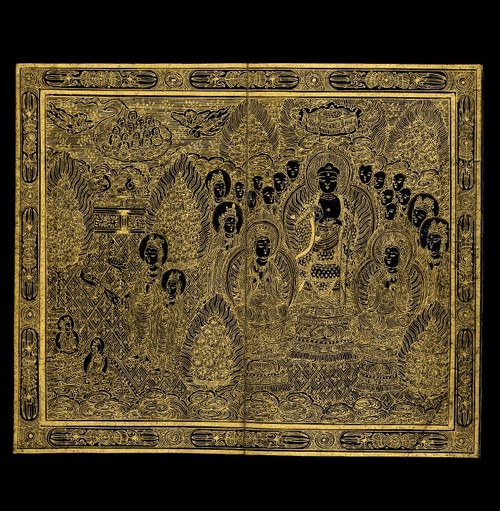 Amitabha Sutra Frontispiece The British Museum (Copyright) ](https://www.worldhistory.org/image/6052/amitabha-sutra-frontispiece/ "Amitabha Sutra Frontispiece")Buddhism made significant contributions to the arts in ancient Korea from [sculpture](https://www.worldhistory.org/disambiguation/Sculpture/) to poetry, but one of the most time-consuming and meritorious was the hand-copying of sutras or sermons attributed to the [Buddha](https://www.worldhistory.org/Siddhartha_Gautama/). The two most popular choices of [sutra](https://www.worldhistory.org/Sutra/) were the *Hwaomgyong* or Avatamsaka sutra and the *Pophwagyong* or Lotus sutra. Such was the popularity of these scripts that a Royal Sutra Scriptorium (*Sagyongwon*) was established to meet demand in the 12th century CE. Here not only monks but professional calligraphers worked to produce these popular religious texts. Production was still going strong in the early 14th century CE when king Chungnyeol (r. 1274-1308 CE) split the workload into two branches: the *Kumjawon* and *Unjawon*, Scriptoriums of [Gold](https://www.worldhistory.org/gold/) and [Silver](https://www.worldhistory.org/Silver/) Letters, respectively.
These [illuminated manuscripts](https://www.worldhistory.org/Illuminated_Manuscripts/) or *sagyong* formed scrolls and folded books. The art form was also present in [China](https://www.worldhistory.org/china/) and [Japan](https://www.worldhistory.org/disambiguation/Japan/), but those produced in the [Goryeo dynasty](https://www.worldhistory.org/Goryeo/) are particularly intricate and splendid such was the level of state endorsement of Buddhism. The scripts were written by monk-scribes expert in calligraphy, who gained great merit for their work in helping the spread of Buddha's teachings, as did the person who commissioned it. Both could expect a more promising future life because of their spiritual endeavour. They were written on *[hanji](https://www.worldhistory.org/Hanji/)*, the especially fine paper produced from the inner bark of the mulberry tree, which was considered the highest quality paper in Asia. The paper was usually dyed a deep indigo, but sometimes white or pale yellow *hanji* was used.
The text was written in Chinese characters (*haeso*), with 15-17 characters on each vertical line. Bright dyes were used and often even silver and gold, especially on the spectacular frontispiece, where there was a large panoramic image, typically of Buddha preaching alongside his followers in paradise. The scene is picked out in gold set along fine iron wiring and bordered by Buddhist symbols such as the *cakra wheel (symbol of Buddhist [Law](https://www.worldhistory.org/disambiguation/law/)) and the *vajra* thunderbolt (symbol of the power of Buddha's words).
[ 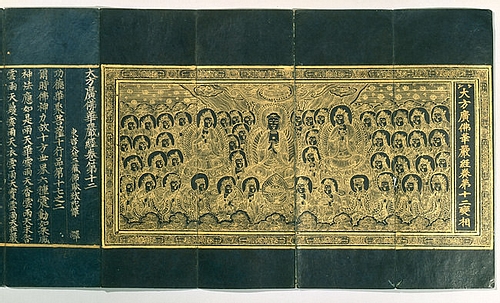 Avatamsaka Sutra Frontispiece Unknown Artist (Public Domain) ](https://www.worldhistory.org/image/6053/avatamsaka-sutra-frontispiece/ "Avatamsaka Sutra Frontispiece")The front and back covers were decorated with *posang tangcho*, large flowers known as 'precious visages.' The title of the text was written within a rectangular box down one edge of the front cover, usually written in gold lettering. As Buddha's words were contained within, the title was enclosed in a mantra corresponding to the *siddham* seed character *om*, meaning the 'lion's roar', ie: Buddha's own voice. The first page of the book indicated who had originally translated the [Sanskrit](https://www.worldhistory.org/Sanskrit/) or Pali text, and there is sometimes a royal inscription too. The last page indicates the date of [writing](https://www.worldhistory.org/writing/) and who commissioned the text and why. The motivation for composition ranged from such lofty and desperate aims as saving Korea from invasion to personal salvation, well-being, or even just to make money. Only rarely was the name of the monk who actually created the text noted.
Many illuminated sutras were carefully stored in specially-made boxes of decorated wood or [bronze](https://www.worldhistory.org/disambiguation/bronze/), and some were even placed in tombs or buried at the foot or within stone pagodas at [temple](https://www.worldhistory.org/temple/) sites. One example of the latter is the stone pagoda at Kuhwangni, [Gyeongju](https://www.worldhistory.org/Gyeongju/), built in 692 CE by the [Silla](https://www.worldhistory.org/Silla/) king Hyoso. An illuminated sutra was placed within the pagoda in 706 CE by King Seongdeok in memory of his predecessor and the Queen mother Sinmok.
[  Buddhist Illuminated Manuscript, Goryeo Period Eggmoon (CC BY-SA) ](https://www.worldhistory.org/image/5920/buddhist-illuminated-manuscript-goryeo-period/ "Buddhist Illuminated Manuscript, Goryeo Period")A great many of the Goryeo illuminated scripts ended up abroad, for they were highly prized by the Chinese, Japanese, and [Mongols](https://www.worldhistory.org/Mongol_Empire/). When the kingdom was obliged to pay tribute to China, illuminated scripts were often a part of it. The monks themselves were sometimes sent to work abroad too, as one passage in the 15th-century CE official Goryeo history *Goryeosa* (*Koryo sa*) indicates:
> In March of the 16th year of King Chungnyeol (1290), the [Chinese emperor](https://www.worldhistory.org/Chinese_Emperor/) ordered the writing of gold and silver sutras, and selected excellent monk scribes, therefore 35 Korean monks were dispatched to the Yuan court...In April of the same year, 65 Koryo monks, sutra-writers, were dispatched to Yuan... (Portal, 88)
In Japan many illuminated sutras were kept in their own Buddhist temples, indeed the oldest surviving example, dating to 1006 CE, resides in the Bunkacho in Tokyo. Besides those remaining in Korea, the British Museum in London has a particularly fine example of the Amitabha sutra. The frontispiece shows a panoramic scene where Buddha and bodhisattvas welcome new souls to paradise. It is painted in silver and gold and dates to 1341 CE, as indicated on its inscription. The text also notes that it was written by a monk called Chonggo for his mother.
This content was made possible with generous support from the [British Korean Society](http://www.britishkoreansociety.org.uk/?utm_source=ancient.eu&utm_medium=link&utm_campaign=ancient.eu).
#### Editorial Review
This human-authored article has been reviewed by our editorial team before publication to ensure accuracy, reliability and adherence to academic standards in accordance with our [editorial policy](https://www.worldhistory.org/static/editorial-policy/).
## Bibliography
- Kim, C. *The Arts of Korea.* Thames & Hudson, 1966
- [Portal, J. *Korea: Art & Archaeology.* Thames & Hudson, 2000.](https://www.worldhistory.org/books/0500282021/)
- [Pratt, K. *Korea.* Routledge, 1999.](https://www.worldhistory.org/books/0700704639/)
- [Seth, M.J:. *A History of Korea.* Rowman & Littlefield Publishers, 2010.](https://www.worldhistory.org/books/074256715X/)
## About the Author
Mark is WHE’s Publishing Director and has an MA in Political Philosophy (University of York). He is a full-time researcher, writer, historian and editor. Special interests include art, architecture and discovering the ideas that all civilizations share.
## Cite This Work
### APA
Cartwright, M. (2016, November 20). Buddhist Illuminated Scripts of Ancient Korea. *World History Encyclopedia*.
### Chicago
Cartwright, Mark. "Buddhist Illuminated Scripts of Ancient Korea." *World History Encyclopedia*, November 20, 2016. .
### MLA
Cartwright, Mark. "Buddhist Illuminated Scripts of Ancient Korea." *World History Encyclopedia*, 20 Nov 2016, .
## License & Copyright
Submitted by [Mark Cartwright](https://www.worldhistory.org/user/markzcartwright/ "User Page: Mark Cartwright"), published on 20 November 2016. The copyright holder has published this content under the following license: [Creative Commons Attribution-NonCommercial-ShareAlike](https://creativecommons.org/licenses/by-nc-sa/4.0/deed.en). This license lets others remix, tweak, and build upon this content non-commercially, as long as they credit the author and license their new creations under the identical terms. When republishing on the web a hyperlink back to the original content source URL must be included. Please note that content linked from this page may have different licensing terms.