---
title: Banking in the Roman World
author: Victor Labate
source: https://www.worldhistory.org/article/974/banking-in-the-roman-world/
format: machine-readable-alternate
license: Creative Commons Attribution-NonCommercial-ShareAlike (https://creativecommons.org/licenses/by-nc-sa/4.0/)
updated: 1970-01-01
---
# Banking in the Roman World
_Authored by [Victor Labate](https://www.worldhistory.org/user/info_3/)_
Just as in other ancient civilizations, the first banks in [Rome](https://www.worldhistory.org/Rome/) began in the temples consecrated to the ancient Gods. Many temples held in their basements the Romans' money and treasure, and were involved in banking activities such as lending. Because they were always occupied by devout workers and priests and regularly patrolled by soldiers, wealthy Romans felt they were safe places to deposit money. Money was commonly stored in various different temples for both practical and security reasons as a [temple](https://www.worldhistory.org/temple/) could catch fire or be ransacked. Priests kept track of deposits and loans. Temples did not pay interest on deposits but charged interest on loans and were involved in currency exchange and validation. There were literally thousands of temples throughout the [Roman](https://www.worldhistory.org/disambiguation/Roman/) territories that were also repositories noting that during the [Empire](https://www.worldhistory.org/empire/) public deposits gradually started to be held in private repositories. The Temple of [Saturn](https://www.worldhistory.org/Saturn/) in Rome housed the Aerarium which was Rome's public treasury. Some temples such as the [Juno](https://www.worldhistory.org/Juno/) Moneta temple were also mints.
[  Roman Balance Weights Mark Cartwright (CC BY-NC-SA) ](https://www.worldhistory.org/image/4744/roman-balance-weights/ "Roman Balance Weights")###
THE ROMAN MONEY-CHANGERS: THE ARGENTARII
The development of commerce throughout the [Mediterranean](https://www.worldhistory.org/disambiguation/mediterranean/) and the expansion of [trade](https://www.worldhistory.org/disambiguation/trade/) to new foreign markets between the 3rd century BCE and the 3rd century CE, led to the growth of banking in the Roman world. Aside from temples, money changers located at shops and stalls in the Forum also dealt with banking activities and their role gained greater importance with the development of commerce. Money-changers were preceded by the *trapezites* (from the [Greek](https://www.worldhistory.org/disambiguation/greek/) word *trapeza* which means counter), who dealt with bank transactions in counting houses around the Forum. The Greek term was later replaced by the Latin terms *argentarii* and *mensarii* (from the word *mensa* or 'bank' in Latin).
Three types of persons conducted banking activities in Rome: the *argentarii*, the *mensarii* and the *nummularii*. The *argentarii*, also called a*rgenteae mensae exercitores, argenti distractores* or *negotiatores stipis argentariae*, were private persons, free citizens, independent from the State. They belonged to a guild which accepted only a limited number of new members. The *argentarii*'s main function was to exchange foreign currency for Roman currency (*permutatio*). They had shops or stalls around the Forum (owned by the state and built by the censors) and their role expanded over time to include almost every money transaction including holding money, lending money, participating in auctions, determining the value of coins (and detecting forged coins), and circulating newly minted money. Their job greatly resembled that of modern-day banks. There were *argentarii* of all kinds. Some were highly respected and from the upper class, usually the ones carrying out business on a large scale and for very wealthy people while some were looked down upon, usually the ones charging high rates and doing business on a small scale.
*Permutatio* or currency exchange was done for a small fee (*collybus*). The *argentarii* also became involved in bills of exchange (already common in [Greece](https://www.worldhistory.org/greece/)): they received a sum of money, for example, to be paid in [Athens](https://www.worldhistory.org/Athens/) and they drew a bill payable in Athens by another banker in the Greek [city](https://www.worldhistory.org/city/). They had to know the exact value of a foreign [coin](https://www.worldhistory.org/coinage/) in different places and at different times. The *argentarii* also kept money deposited by other persons (*depositum*), which could sometimes amount to very large sums of money, and made payments on behalf of other persons, just as modern banks do. Payments were made when the owner of the money told the *argentarius* or when the owner used a cheque (*perscriptio*) to make a payment. If two persons involved in a transaction used the same *argentarius*, the *argentarius* would record (*scribere*) in his books called *codices* (or *tabulae, rationes*) the transfer of money from one account to the other. The *codices* were very accurate; they recorded dates and every transaction. These records were looked upon as documents of high authority and used in courts of justice as unquestionable evidence. When the money was merely deposited, the *argentarius* paid no interest and the money was called *vacua pecunia*. When the money was deposited for an interest paid by the *argentarius*, the *argentarius* could use the money in other lucrative transactions (for example, loaning money to other persons).
[  Temple of Saturn, Rome Elias Rovielo (CC BY-NC-SA) ](https://www.worldhistory.org/image/1080/temple-of-saturn-rome/ "Temple of Saturn, Rome")The *argentarii* were involved in public auctions and in commercial transactions. They were almost always present in public auctions acting on behalf of other persons, receiving payments and registering the parties involved, the transactions, the articles sold and their price. In commercial transactions, they acted as agents for either party (the seller or the purchaser) and could be involved in selling the entire estate of a person. When large payments were involved, the *argentarii* were almost always present. They also determined the value of foreign coins and tested the genuineness of coins (*probatio nummorum*). During the empire, the *argentarii* were also obligated to purchase newly coined money (*solidorum venditio*) from the mints and to circulate it among the people.
### ROME'S PUBLIC BANKERS: THE MENSARII
The *mensarii* (from the word *mensa* or 'bank' in Latin) were highly respected public bankers appointed by the state in special circumstances, usually in periods of general poverty, especially during periods of [war](https://www.worldhistory.org/disambiguation/War/), their goal being to help [plebeians](https://www.worldhistory.org/Plebeians/) overcome economic difficulties and avert social unrest. We note that in ancient Rome plebeians carrying debt (*nexum*) could be exposed to slavery when they were unable to fulfil their debt obligations. The *mensarii* first appeared in 352 BCE. *Quinqueviri mensarii,* forming a five-man commission, were appointed and a public bank was created to address the problem of citizens' indebtedness. The citizens who could provide security were covered from public resources by the *quinqueviri mensarii.* The citizens who could not do so, transmitted their property to creditors after a reliable valuation was done by public officials. Later, the *Lex Minucia De Triumviris Mensariis* was passed in 216 BCE which appointed a commission of three people that operated continually until 210 BCE. Its function was the same as the *quinqueviri mensarii* and even wider.
Some of the functions of the *mensarii* were actually the same as the *argentarii* and even during ancient times people confused the two. For example, the *mensarii* held deposits (e.g. soldiers' pay), and they determined the value of coins and their genuineness. The *mensarii'*s role was considered to be positive overall as they were able to address the problem of excess debt in the Roman [economy](https://www.worldhistory.org/disambiguation/economy/). The names of some *mensarii* such as Gaius Duilius, Publius [Decius](https://www.worldhistory.org/Decius/) Mus, Marcus Papirius, Quintus Publius and [Titus](https://www.worldhistory.org/disambiguation/Titus/) Emilius were widely known in the Roman world.
[  Roman Empire Silver Coins Mark Cartwright (CC BY-NC-SA) ](https://www.worldhistory.org/image/4344/roman-empire-silver-coins/ "Roman Empire Silver Coins")###
THE OFFICERS OF THE MINT: THE NUMMULARII
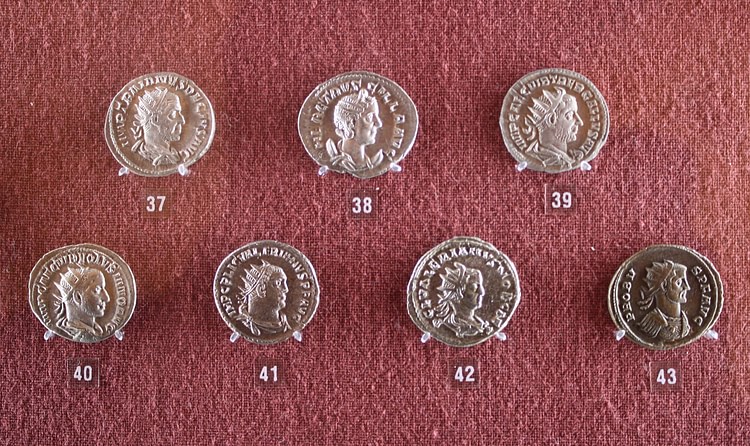
The *nummularii* were officers of the mint and their main role was to test the quality of new coins. They held a bank that put new coins into circulation and took old or foreign coins in exchange for new coins. Just like the *argentarii* and the *mensarii*, they tested the genuineness of coins especially when large sums were involved in transactions. Many of their functions were the same as the *argentarii*: they exchanged money for their own account, held deposits, lent money, made payments on behalf of their clients, executed sales – especially auctions of property according to a deceased's will, executed payments at foreign places through local bankers, and they kept books (*codex*) which could be used as proof in courts.
### CONCLUSION
Besides being places of worship, many temples were initially repositories where money was deposited and where most banking transactions were conducted. The Roman money-changers, the *argentarii*, took a more important role in banking activities as [trade in the Roman world](https://www.worldhistory.org/article/638/trade-in-the-roman-world/) grew. Their role was very similar to that of modern-day bankers as they were involved in a wide variety of banking functions. The *mensarii* were public bankers appointed by the state in periods of general poverty in charge of solving the problem of citizens' indebtedness. They were in a way similar to the "bad banks" set up nowadays, often with public funds to address the problem of non-performing loans in the economy. The *nummularii* were officers of the mint and their main role was the circulation of new coins, a function also done by modern-day banks. In conclusion, it is quite remarkable how widespread the use of credit was and how developed and complex banking activities were in the Roman world. Banking greatly contributed to the development of commerce and trade, and to the creation of wealth in ancient Rome.
#### Editorial Review
This human-authored article has been reviewed by our editorial team before publication to ensure accuracy, reliability and adherence to academic standards in accordance with our [editorial policy](https://www.worldhistory.org/static/editorial-policy/).
## Bibliography
- [Ancient Roman banking (Romae Vitam)](https://www.vita-romae.com/ancient-roman-banking.html "Ancient Roman banking (Romae Vitam)"), accessed 1 Dec 2016.
- [Andreau, J. *Banking and Business in the Roman World.* Cambridge University Press, 1999.](https://www.worldhistory.org/books/0521380316/)
- Bromberg, B. "Temple Banking in Rome." *The Economic History Review*, No. 2 / Vol. 10 / Nov. 1940, pp. 128-131.
- Niczyporuk, P. "Mensarii, bankers acting for public and private benefit." *Central European Journal of Social Sciences and Humanities*, 2011.
## About the Author
Victor is an ancient history enthusiast currently residing in Greece and the owner of Romae Vitam, a website focused on ancient Roman history.
- [Facebook Profile](https://www.facebook.com/vitaromae/ )
## Cite This Work
### APA
Labate, V. (2016, November 17). Banking in the Roman World. *World History Encyclopedia*.
### Chicago
Labate, Victor. "Banking in the Roman World." *World History Encyclopedia*, November 17, 2016. .
### MLA
Labate, Victor. "Banking in the Roman World." *World History Encyclopedia*, 17 Nov 2016, .
## License & Copyright
Submitted by [Victor Labate](https://www.worldhistory.org/user/info_3/ "User Page: Victor Labate"), published on 17 November 2016. The copyright holder has published this content under the following license: [Creative Commons Attribution-NonCommercial-ShareAlike](https://creativecommons.org/licenses/by-nc-sa/4.0/deed.en). This license lets others remix, tweak, and build upon this content non-commercially, as long as they credit the author and license their new creations under the identical terms. When republishing on the web a hyperlink back to the original content source URL must be included. Please note that content linked from this page may have different licensing terms.