---
title: Korean Celadon Pottery
author: Mark Cartwright
source: https://www.worldhistory.org/article/945/korean-celadon-pottery/
format: machine-readable-alternate
license: Creative Commons Attribution-NonCommercial-ShareAlike (https://creativecommons.org/licenses/by-nc-sa/4.0/)
updated: 1970-01-01
---
# Korean Celadon Pottery
_Authored by [Mark Cartwright](https://www.worldhistory.org/user/markzcartwright/)_
The celadon (or greenware) ceramics produced in ancient [Korea](https://www.worldhistory.org/Korea/) during the [Goryeo Dynasty](https://www.worldhistory.org/Goryeo/) (918-1392 CE), are regarded as some of the finest and most elegant [pottery](https://www.worldhistory.org/pottery/) pieces produced anywhere. With a pale green lustre reminiscent of jade and a super smooth glaze [Goryeo](https://www.worldhistory.org/Goryeo/) celadons remain some of the most prized collector's items in the world of ceramics.
### Etymology
The name celadon is a 17th-century CE French word of [Greek](https://www.worldhistory.org/disambiguation/greek/) origin used to refer to colours ranging from blue-green ('kingfisher') to soft grey-green seen in certain ceramics. The French had chosen the word as it was the name of the shepherd hero of the pastoral romance *Astrée* by Honoré d'Urfé. This character wore a striking green cloak and so the word came to be fashionable for describing particular greens. Celadon was incorporated into the English language from the 19th century CE for the same purpose. Ceramics experts, however, prefer to use the term 'greenware.'
[  Celadon Fish-Dragon Ewer, Goryeo Dynasty National Museum of Korea (CC BY) ](https://www.worldhistory.org/image/5606/celadon-fish-dragon-ewer-goryeo-dynasty/ "Celadon Fish-Dragon Ewer, Goryeo Dynasty")### Origin & Process
First produced in [China](https://www.worldhistory.org/china/), celadon wares quickly gained popularity across Asia and in Korea specifically from the 9th century CE when there was increased contact with the [Song Dynasty](https://www.worldhistory.org/Song_Dynasty/). It may be that the colour association with precious jade was another reason for celadon's success. As one Xu Jing, an envoy from China, noted on visiting the Goryeo court, "Korean's call the green colour of ceramics jade" (Koehler, 24).
Initially, the Korean wares were rather crude, but by the 12th century CE Korean celadon ceramics, with their soft pale grey-green colour, were even finer than those produced in China. Again, Xu Jing noted that "The recent techniques are more sophisticated and the glaze even more beautiful" (ibid). Areas particularly noted for their skill at producing fine celadons included the Buan and Gangjin regions in the Jeolla Province of southwest Korea where the kilns were controlled by the government. The popularity and esteem with which celadons were held are attested by their presence in royal Korean tombs.
The green colour of celadons is achieved by firing the clay in an oxygen-reducing kiln with a glaze containing a low percentage of iron oxide (*cheolhwa*). It is the quantity of the latter which determines the hue of the green. Firing temperatures were around 1150 °C. The method gives an extremely smooth surface to the finished vessel although many fine cracks in the glaze are typical, even desirable.
[ 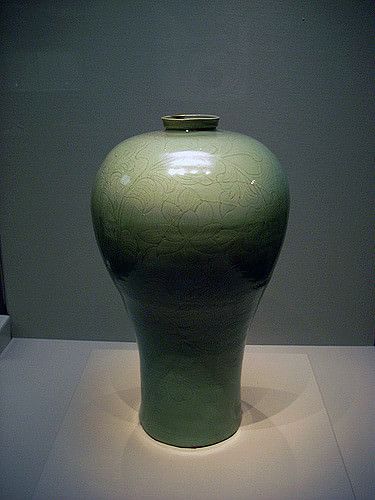 Maebyeong Celadon Vase, Goryeo Dynasty NeIC (CC BY-NC-ND) ](https://www.worldhistory.org/image/5604/maebyeong-celadon-vase-goryeo-dynasty/ "Maebyeong Celadon Vase, Goryeo Dynasty")With the [Mongol](https://www.worldhistory.org/Mongol_Empire/) invasions of the peninsula and the systematic destruction of workshops in the 13th century CE production of celadons was, unfortunately, brought to a halt. When potters were able to resume their work in the late 13th and 14th centuries CE, the wares were no longer as outstanding as previously, and the famous pale green lustre was replaced by an altogether darker and duller green finish. Today, modern workshops using traditional methods are once again producing celadon ceramics, especially in the 16 kilns of Gangjin, where there is an annual celadon festival.
### Designs & Decoration
Korean vases are almost always tall and elegantly curved whilst other pieces such as those depicting animals and people are intricately carved. Vessels were decorated with low or high relief designs, especially floral patterns using the lotus leaf and flower, peony and chrysanthemum flowers, and birds such as waterfowl. Many motifs, especially cranes and clouds, are also associated with [Buddhism](https://www.worldhistory.org/buddhism/) (the state [religion](https://www.worldhistory.org/religion/) of the time), and more than one historian has noted, like Kyung Moon Hwang, that "these ceramics' almost indescribable sheen itself seems to evoke [Buddhist](https://www.worldhistory.org/buddhism/) spirituality" (42).
[  Korean Celadon Incense Burner Steve46814 (CC BY-SA) ](https://www.worldhistory.org/image/5608/korean-celadon-incense-burner/ "Korean Celadon Incense Burner")Vessels left undecorated often have simple linear designs engraved on them while others have more intricate black, red, brown, and white clay inlays in a technique unique to Korea known as 'Sanggam.' Here designs are carved on the surface and the inlays added before applying a translucent slip. Some later vessels were also inlaid with [gold](https://www.worldhistory.org/gold/). The inlays are so fine and the workmanship of such a high standard that, on the finished vessel, they appear to be brush strokes. Adding a dark red colour to pick out designs or used for outlines became common in the later period of Korean celadons, achieved by using a [copper](https://www.worldhistory.org/copper/) underglaze - the first such instance in world ceramics. Another popular decorative effect was to add mouldings which could then also be made into openwork.
While vases, jugs, and bowls were the most popular shapes, potters also produced a myriad of other items using celadon. Ceramic pillows with carved lion figures supporting a smooth cross-section, pitchers in the form of Taoist monks or mythical dragon-fish creatures, incense burners (used in temples and private homes) with intricate cut-out designs and topped by animal figures through whose mouths the incense smoke exits, and even curvaceous roof tiles were all executed with the finesse seen in more classical vessels. Indeed, such was celadon's popularity that King Uijong had one of his royal pavilions at the Goryeo capital of Gaeseong entirely covered in celadon roof tiles in 1157 CE.
[ 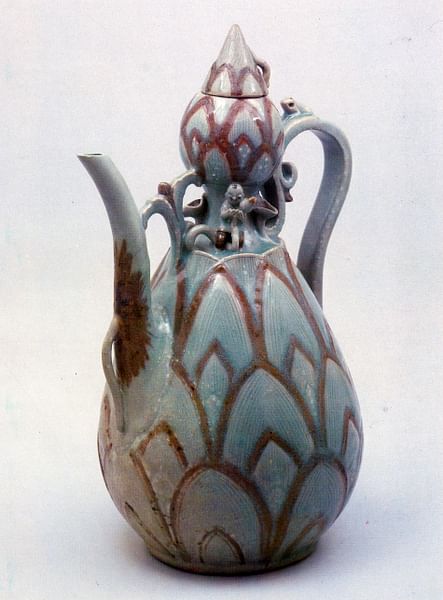 Celadon Ewer, Goryeo Dynasty Unknown (Public Domain) ](https://www.worldhistory.org/image/5605/celadon-ewer-goryeo-dynasty/ "Celadon Ewer, Goryeo Dynasty")However, despite this variety in design, it is probably the *maebyeong* shape which best defines Korean celadon ceramics. These tall vases rise from a narrow base to an elegant and generously curved shoulder which ends in a small circular mouth. Many *maebyeong* vases, along with the finest examples of carved celadon wares, are on display at the National Museum of Korea and the Leeum, Samsung Museum of Art, both in Seoul, South Korea.
This content was made possible with generous support from the [British Korean Society](http://www.britishkoreansociety.org.uk/?utm_source=ancient.eu&utm_medium=link&utm_campaign=ancient.eu).
#### Editorial Review
This human-authored article has been reviewed by our editorial team before publication to ensure accuracy, reliability and adherence to academic standards in accordance with our [editorial policy](https://www.worldhistory.org/static/editorial-policy/).
## Bibliography
- [Celadon - Metropolitan Museum of Art, N.Y.](http://www.metmuseum.org/toah/hd/cela/hd_cela.htm "Celadon - Metropolitan Museum of Art, N.Y."), accessed 1 Dec 2016.
- [Koehler, R. *Korean Ceramics.* Seoul Selection USA, Inc., 2013.](https://www.worldhistory.org/books/8997639072/)
- [Kyung Hwang. *A History of Korea.* Palgrave Macmillan, 2010.](https://www.worldhistory.org/books/0230205461/)
- [Pratt, K. *Korea A Historical & Cultural Dictionary.* Routledge, 2016.](https://www.worldhistory.org/books/B01181H0VG/)
## About the Author
Mark is WHE’s Publishing Director and has an MA in Political Philosophy (University of York). He is a full-time researcher, writer, historian and editor. Special interests include art, architecture and discovering the ideas that all civilizations share.
## Cite This Work
### APA
Cartwright, M. (2016, September 07). Korean Celadon Pottery. *World History Encyclopedia*.
### Chicago
Cartwright, Mark. "Korean Celadon Pottery." *World History Encyclopedia*, September 07, 2016. .
### MLA
Cartwright, Mark. "Korean Celadon Pottery." *World History Encyclopedia*, 07 Sep 2016, .
## License & Copyright
Submitted by [Mark Cartwright](https://www.worldhistory.org/user/markzcartwright/ "User Page: Mark Cartwright"), published on 07 September 2016. The copyright holder has published this content under the following license: [Creative Commons Attribution-NonCommercial-ShareAlike](https://creativecommons.org/licenses/by-nc-sa/4.0/deed.en). This license lets others remix, tweak, and build upon this content non-commercially, as long as they credit the author and license their new creations under the identical terms. When republishing on the web a hyperlink back to the original content source URL must be included. Please note that content linked from this page may have different licensing terms.