---
title: The Hellenistic World: The World of Alexander the Great
author: Joshua J. Mark
source: https://www.worldhistory.org/article/94/the-hellenistic-world-the-world-of-alexander-the-g/
format: machine-readable-alternate
license: Creative Commons Attribution-NonCommercial-ShareAlike (https://creativecommons.org/licenses/by-nc-sa/4.0/)
updated: 1970-01-01
---
# The Hellenistic World: The World of Alexander the Great
_Authored by [Joshua J. Mark](https://www.worldhistory.org/user/JPryst/)_
The [Hellenistic World](https://www.worldhistory.org/Hellenistic_Period/) (from the [Greek](https://www.worldhistory.org/disambiguation/greek/) word *Hellas* for [Greece](https://www.worldhistory.org/greece/)) is the known world after the conquests of [Alexander the Great](https://www.worldhistory.org/Alexander_the_Great/) and corresponds roughly with the [Hellenistic Period](https://www.worldhistory.org/Hellenistic_Period/) of ancient Greece, from 323 BCE ([Alexander](https://www.worldhistory.org/disambiguation/Alexander/)'s [death](https://www.worldhistory.org/disambiguation/Death/)) to the annexation of Greece by [Rome](https://www.worldhistory.org/Rome/) in 146 BCE. Although Rome's rule ended Greek independence and autonomy it did nothing to significantly change nor did it in any way halt the Hellenization of the world of the day; in fact, it encouraged it.
Alexander the Great (r. 336-323 BCE) of [Macedon](https://www.worldhistory.org/macedon/) led his army on a series of campaigns which successfully conquered the then-known world from Macedon, through Greece, down to [Egypt](https://www.worldhistory.org/egypt/), across [Persia](https://www.worldhistory.org/Persia/), to [India](https://www.worldhistory.org/india/). Alexander's tutor was the Greek philosopher [Aristotle](https://www.worldhistory.org/aristotle/) (384-322 BCE) who impressed upon him the value of [Greek culture](https://www.worldhistory.org/disambiguation/Greek_Culture/) and [philosophy](https://www.worldhistory.org/philosophy/). As Alexander campaigned, he spread Greek thought and [culture](https://www.worldhistory.org/disambiguation/culture/) in his wake, thus "hellenizing" (to make 'Greek' in culture and [civilization](https://www.worldhistory.org/civilization/)) those he conquered.
[  Perga / Perge Irene Fanizza (Copyright) ](https://www.worldhistory.org/image/797/perga--perge/ "Perga / Perge")After Alexander's death his [Empire](https://www.worldhistory.org/empire/) was divided among his four generals (known in Latin as the Diadochi, the name by which they are still referenced, from the Greek, *Diadokhoi,* meaning "successors"):
- **[Lysimachus](https://www.worldhistory.org/Lysimachus/)** - who took Thrace and much of [Asia Minor](https://www.worldhistory.org/Asia_Minor/).
- **[Cassander](https://www.worldhistory.org/Cassander/)** - controlled Macedonia and Greece.
- **[Ptolemy I](https://www.worldhistory.org/Ptolemy_I/)** - ruled Egypt, [Palestine](https://www.worldhistory.org/palestine/), [Cilicia](https://www.worldhistory.org/Cilicia/), Petra, and [Cyprus](https://www.worldhistory.org/cyprus/). He founded the [Ptolemaic Dynasty](https://www.worldhistory.org/Ptolemaic_Dynasty/) which lasted until the death of [Cleopatra VII](https://www.worldhistory.org/Cleopatra_VII/) in 30 BCE.
- **[Seleucus I Nicator](https://www.worldhistory.org/Seleucos_I/)** - ruled the remainder of Asia and founded the [Seleucid Empire](https://www.worldhistory.org/Seleucid_Empire/) which was comprised of [Mesopotamia](https://www.worldhistory.org/Mesopotamia/), the [Levant](https://www.worldhistory.org/levant/), Persia, and part of India.
To greater or lesser extents, all of these regions were Hellenized as Greek culture and religious beliefs influenced those of the indigenous people.
### Greek Culture & [Philip II of Macedon](https://www.worldhistory.org/Philip_II_of_Macedon/)
Alexander of Macedon was the son of [Philip II](https://www.worldhistory.org/disambiguation/Philip_II/) (r. 359-336 BCE) who recognized that his neighbors considered Macedon a backward region of little importance and decided to change that view dramatically. Philip II had been a hostage for three years in Greek [Thebes](https://www.worldhistory.org/disambiguation/Thebes/) where he was exposed to Greek culture, military tactics and formations, and philosophy.
Although he made the greatest use of the military information, he decreed a complete overhaul of his country's educational methods and goals to create a significant center of learning at his capital of Pella. He invited the great Greek philosopher Aristotle to tutor his son and his son's peers. As the reputation of the school at Pella grew, Philip II encouraged the nobles of Greece to send their sons to Pella which not only improved the nation's reputation but gave Philip II valuable hostages which prevented the Greeks from attacking him.
Greece at this time was not a unified nation but a loose confederation of [city](https://www.worldhistory.org/city/)-states each of which had its own patron deity, social structure, [coinage](https://www.worldhistory.org/coinage/), and government. These city-states would sometimes ally and sometimes [war](https://www.worldhistory.org/disambiguation/War/) on each other but their only common bond was their language and, to a greater or lesser extent, their religious belief structure. They celebrated different festivals at different times of the year and made war in different ways.
[ 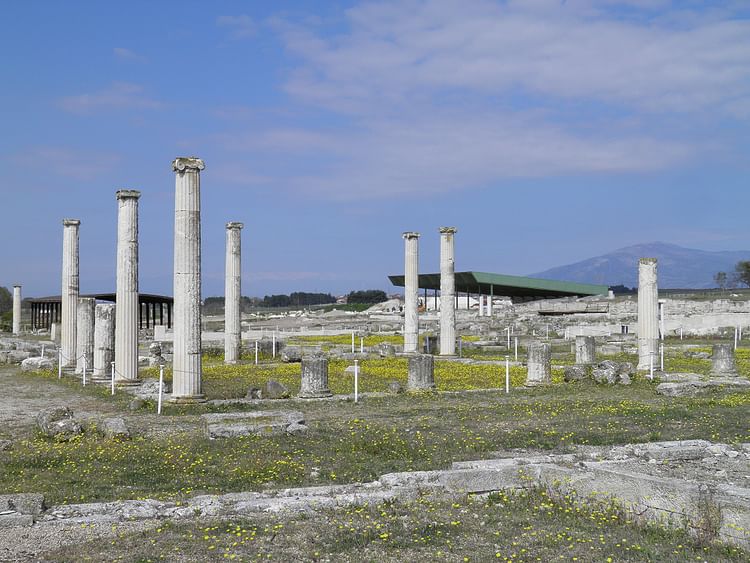 Pella, Macedonia Carole Raddato (CC BY-NC-ND) ](https://www.worldhistory.org/image/5020/pella-macedonia/ "Pella, Macedonia")If they could agree on one thing, however, it was their dislike of foreigners, whom they referred to as `barbarians', meaning anyone who could not speak Greek. Greek culture at this time encompassed every aspect of civilization from [literature](https://www.worldhistory.org/literature/) to philosophy, [science](https://www.worldhistory.org/science/), [architecture](https://www.worldhistory.org/disambiguation/architecture/), the arts, mathematics, astronomy, [law](https://www.worldhistory.org/disambiguation/law/), [medicine](https://www.worldhistory.org/disambiguation/medicine/), war, and so on. The Greeks were justifiably proud of their intellectual achievements and tended to look down on non-Greeks.
The region of Macedon spoke a dialect of Greek but its people were still considered barbarians by the Greeks because they did not feel it had any culture. Macedon was thought to be good for raw materials but little else until Philip II established the school at Pella and, even then, the reputation of the school came from the Greek scholars Philip employed, not from any Macedonian.
At the same time Phillip was encouraging education and culture in his capital, however, he was reorganizing his army and enlarging it but the Greeks did not seem to notice. They became aware of his military strength in 356 BCE during the so-called Third [Social War](https://www.worldhistory.org/Social_War/) in which he defeated the Phocians who had seized the sacred site of [Delphi](https://www.worldhistory.org/delphi/). At the [Battle](https://www.worldhistory.org/disambiguation/battle/) of Crocus Field in 352 BCE he completely defeated the Phocians and then engaged in a series of campaigns between 355-348 BCE during which he captured a number of Greek [cities](https://www.worldhistory.org/city/), renaming the city of Crenides [Philippi](https://www.worldhistory.org/Philippi/) in honor of himself.
[  Greek Phalanx CA (Copyright) ](https://www.worldhistory.org/image/2567/greek-phalanx/ "Greek Phalanx")The Athenian orator [Demosthenes](https://www.worldhistory.org/Demosthenes/) (c.384-322 BCE) delivered a number of speeches denouncing Philip II but these did nothing to halt Macedon's growing power. The Greek city-states continued to war with each other while Philip II was calmly taking their cities for his own and enlarging his treasury. At the [Battle of Chaeronea](https://www.worldhistory.org/Battle_of_Chaeronea/) in 338 BCE, Philip II and his 18-year old son Alexander defeated the combined forces of [Athens](https://www.worldhistory.org/Athens/) and Thebes and this victory enabled him to form the [Pan](https://www.worldhistory.org/Pan/)-[Hellenic](https://www.worldhistory.org/greece/) Congress, with himself as its head, which established peace and effectively brought Greece under Macedonian control. Philip did not enjoy his great victory for long, however, as he was assassinated in 336 BCE and Alexander took the throne.
### The Campaigns of Alexander the Great
Alexander inherited not only a vast standing army but a healthy treasury, infrastructure, and an entire nation which was now subject to his will. He did not need to make bargains or concessions with any other country in order to initiate his policies. He had enough power and wealth to do whatever he pleased and he chose to fulfil his father's desire to [conquer](https://www.worldhistory.org/warfare/) Persia and topple what was then the greatest empire in the world.
He crossed from Greece into Asia Minor in 334 BCE with an army of 32,000 infantry and 5,100 cavalry and sacked the city of [Baalbek](https://www.worldhistory.org/Baalbek/) and took [Ephesus](https://www.worldhistory.org/ephesos/). In 333 BCE at the [Battle of Issus](https://www.worldhistory.org/Battle_of_Issus/), he defeated [Darius the Great](https://www.worldhistory.org/Darius_I/) of [Syria](https://www.worldhistory.org/syria/) but could not capture him. He went on to take Syria from the Persians in 332 BCE and Egypt in 331 BCE. Throughout all these campaigns, Alexander spread the culture of Greece while allowing the people of the various regions to continue worshipping the gods of their choice and conducting themselves as they pleased – as long as they caused him no trouble and kept his supply lines open – while simultaneously investigating and recording the culture and other aspects of each land. Scholar Ian Worthington comments:
> [Homer](https://www.worldhistory.org/homer/) was Alexander's [bible](https://www.worldhistory.org/bible/) and he took Aristotle's edition with him to Asia...During his campaigns Alexander was always intent on finding out everything he could about the areas through which he passed. He took with him an entourage of scientists to record and analyse this information, from botany, biology, zoology and meteorology, to topography. His desire to learn, and to have information recorded as scientifically as possible, probably stemmed from Aristotle's teachings and enthusiasm. (34-35)
[ 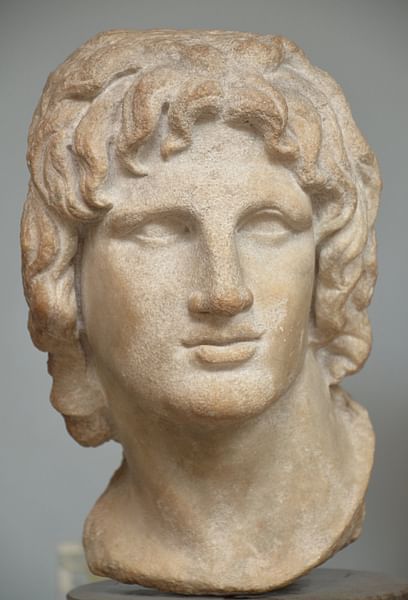 Alexander the Great, Marble Head Carole Raddato (CC BY-SA) ](https://www.worldhistory.org/image/2675/alexander-the-great-marble-head/ "Alexander the Great, Marble Head")In 331 BCE Alexander decisively defeated Darius at the Battle of [Gaugamela](https://www.worldhistory.org/Battle_of_Gaugamela/) and was now supreme ruler of the regions formerly belonging to the Persian Empire. He adopted the title ShahanShah (King of Kings) and introduced Persian customs into his army while, at the same time, sharing Greek culture with the people of Persia. He carried this culture with him to India in his 327 BCE invasion which was halted only because his men threatened mutiny if he did not turn back. He was allegedly contemplating another move to expand his empire when he died, after ten days of fever, in June of 323 BCE. As he did not name a successor, his four generals divided his empire between them.
### The Diadochi & Hellenization
These generals, Lysimachus, Cassander, [Ptolemy](https://www.worldhistory.org/disambiguation/Ptolemy/), and Seleucus, initially spent their time warring with each other for more territory but even as they ravaged the land with battles, their very presence in the region encouraged the diffusion of Hellenization which had been established by Alexander.
Easily the most successful of these four, in this regard as in others, was Ptolemy I (r. 323-282 BCE). While the other three continued their wars against each other (and against even more of Alexander's officers or family members), Ptolemy I made an honest attempt at furthering Alexander's vision of a multicultural world. His efforts at [Alexandria](https://www.worldhistory.org/alexandria/) produced an almost seamless blending of [Egyptian](https://www.worldhistory.org/disambiguation/Egyptian/) and Greek cultures as epitomized in his personal [god](https://www.worldhistory.org/God/) [Serapis](https://www.worldhistory.org/Serapis/).
Serapis was a combination of Egyptian and Greek gods ([Osiris](https://www.worldhistory.org/osiris/), [Apis](https://www.worldhistory.org/Apis/), and [Zeus](https://www.worldhistory.org/zeus/)) and his worship was established as a state [religion](https://www.worldhistory.org/religion/) by Ptolemy I. Although other gods continued to be venerated, Ptolemy I encouraged the cult of Serapis by building the great [temple](https://www.worldhistory.org/temple/) of the Serapeum in Alexandria and the Great Library to accompany it. The library drew scholars from around the world and elevated Alexandria to a center of learning which rivaled even Athens. Under Ptolemy I, construction of the Lighthouse at Alexandria (one of [the Seven Wonders](https://www.worldhistory.org/The_Seven_Wonders/) of the Ancient World) began and the city, as well as the entire region under his control, flourished.
[  Map of the Successor Kingdoms, c. 303 BCE Javierfv1212 (Public Domain) ](https://www.worldhistory.org/image/581/map-of-the-successor-kingdoms-c-303-bce/ "Map of the Successor Kingdoms, c. 303 BCE")As the [wars of the Diadochi](https://www.worldhistory.org/Wars_of_the_Diadochi/) settled down and finished, Hellenic influence continued to spread throughout their regions and Greek dedications, statues, architecture and inscriptions have been found in abundance in every locale. The Great Library at Alexandria steadily grew to become the most important center for learning in the ancient world, drawing scholars from all over who then returned to their native towns and cities inspired by Hellenic beliefs and scientific methods. [Greek theatre](https://www.worldhistory.org/Greek_Theatre/) flourished throughout the lands conquered by Alexander and held by his generals and the amphitheaters built during the [Hellenistic](https://www.worldhistory.org/Hellenic_World/) Period show markedly Greek features no matter the nationality of the architect nor the country of construction, one example being, Ai-Khanoum on the edge of [Bactria](https://www.worldhistory.org/Bactria/), modern-day Afghanistan.
Greek language introduced [Greek literature](https://www.worldhistory.org/Greek_Literature/) into the former Persian Empire, thereby influencing the philosophical thought and [writing](https://www.worldhistory.org/writing/) of the region and the same held true for the area known as Palestine where Greek literature found its way into the religious thought and scripture of [Judaism](https://www.worldhistory.org/disambiguation/judaism/) and, later, [Christianity](https://www.worldhistory.org/christianity/). Hellenization, in fact, inspired one of the most popular Jewish holidays, Chanukah, which celebrates the liberation of the Temple of [Jerusalem](https://www.worldhistory.org/jerusalem/) from the Syrian Greeks under Antiochus IV Epiphanes (175-164 BCE) who, according to the traditional story, tried to force Hellenic gods on the Jewish people and instigated the [Maccabean Revolt](https://www.worldhistory.org/article/827/the-maccabean-revolt/) of c. 168 BCE.
Recent scholarship suggests, however, that the revolt was actually a civil war between Jewish factions: Hellenic Jews who embraced Greek values and traditionalists who resisted them. In this version of the story, Antiochus IV Epiphanes becomes involved in this civil war on the behalf of the Hellenistic Jews and his participation is forced as opposed to the traditional story in which he is depicted as imposing his will on the Jewish people of Palestine. Either way, Hellenism played a crucial role in the revolt of the Maccabees who would later found the Hasmonean Dynasty which, through its wars with the neighboring [Kingdom of Nabatea](https://www.worldhistory.org/Kingdom_of_Nabatea/), would attract the attention of Rome and lead to the eventual [conquest](https://www.worldhistory.org/warfare/) of the region.
[  Demetrius I Tetradrachm Mark Cartwright (CC BY-NC-SA) ](https://www.worldhistory.org/image/839/demetrius-i-tetradrachm/ "Demetrius I Tetradrachm")Hellenistic thought is evident in the narratives which make up the books of the Bible as the Hebrew Scriptures were revised and canonized during the Second Temple Period (c.515 BCE-70 CE), the latter part of which was during the [Hellenic Period](https://www.worldhistory.org/Hellenistic_Period/) of the region. [The gospels](https://www.worldhistory.org/The_Gospels/) and epistles of the Christian [New Testament](https://www.worldhistory.org/New_Testament/) were written in Greek and draw on [Greek philosophy](https://www.worldhistory.org/Greek_Philosophy/) and religion as, for example, in the first chapter of the [Gospel of John](https://www.worldhistory.org/Gospel_of_John/) in which the word becomes flesh, a Platonic concept.
The spread of Greek influence and language is also shown through coinage. Portraits became more realistic, and the obverse of the [coin](https://www.worldhistory.org/coinage/) was often used to display a propaganda image, commemorating an event or displaying the image of a favored god. The use of Greek-style portraits and Greek language continued into the Parthian period (247 BCE to 224 CE), even as Greek as a language was in decline.
With the rise of the Republic of Rome and then the [Roman Empire](https://www.worldhistory.org/Roman_Empire/), Greek language, attitudes, philosophy, understanding, and overall culture spread even further. The Romans borrowed much of their civilization from the Greeks and as they conquered various regions which had previously been held by Alexander's generals, they encouraged Hellenic thought and culture.
The Romans were far from tolerant of the beliefs of other nations unless they corresponded closely with their own. Adherence to Hellenic thought, therefore, was a popular alternative to persecution for the citizens of these regions. Greek thought, language, and culture spread north to [Europe](https://www.worldhistory.org/europe/) through [trade](https://www.worldhistory.org/disambiguation/trade/) and, further, by [Roman](https://www.worldhistory.org/disambiguation/Roman/) conquest of regions such as modern-day France, Spain, and [Britain](https://www.worldhistory.org/disambiguation/Britain/), Hellenizing the entire world of antiquity and influencing virtually every culture which has contributed to the formation of learning and understanding in the world today.
#### Editorial Review
This human-authored article has been reviewed by our editorial team before publication to ensure accuracy, reliability and adherence to academic standards in accordance with our [editorial policy](https://www.worldhistory.org/static/editorial-policy/).
## Bibliography
- [Arrian. *The Anabasis of Alexander.* Ulan Press, 2012.](https://www.worldhistory.org/books/B009K72976/)
- [Diodorus Siculus. *Diodorus Siculus' Histories.* Harvard University Press, 1935.](https://www.worldhistory.org/books/0674993349/)
- [Durant, W. *The Life of Greece.* Scribner's Publishing, 1954.](https://www.worldhistory.org/books/1567310133/)
- [Freeman, K. *The Greek City States.* Cambridge University Press, 2007.](https://www.worldhistory.org/books/0521615569/)
- [Green, P. *The Hellenistic Age: A Short History.* Modern Library, 2008.](https://www.worldhistory.org/books/0812967402/)
- [Hellenistic period](http://www.sullivan-county.com/id2/gnostic_files/hellenism.htm "Hellenistic period"), accessed 1 Dec 2016.
- [Internet Ancient History Sourcebook: Hellenistic World](http://www.fordham.edu/halsall/ancient/asbook08.html "Internet Ancient History Sourcebook: Hellenistic World"), accessed 1 Dec 2016.
- [Plato. *The Collected Dialogues of Plato.* Princeton University Press, 2005.](https://www.worldhistory.org/books/0691097186/)
- [Plutarch. *Plutarch's Lives.* Benediction Classics, 2015.](https://www.worldhistory.org/books/1781395136/)
- [Various Ancient Writers. *The King James Translation of the Bible.* Thomas Nelson, 2008.](https://www.worldhistory.org/books/0718020685/)
- [Waterfield, R. *Dividing the Spoils.* Oxford University Press, 2011.](https://www.worldhistory.org/books/0195395239/)
- [Worthington, I. *Alexander the Great.* Routledge, 2012.](https://www.worldhistory.org/books/B01K0RPZOS/)
## About the Author
Joshua J. Mark is World History Encyclopedia's co-founder and Content Director. He was previously a professor at Marist College (NY) where he taught history, philosophy, literature, and writing. He has traveled extensively and lived in Greece and Germany.
- [Linkedin Profile](https://www.linkedin.com/pub/joshua-j-mark/38/614/339)
## External Links
- [List of Rulers of the Ancient Greek World | Lists of Rulers | Heilbrunn Timeline of Art History | The Metropolitan Museum of Art](https://www.metmuseum.org/toah/hd/gkru/hd_gkru.htm)
## Cite This Work
### APA
Mark, J. J. (2018, November 01). The Hellenistic World: The World of Alexander the Great. *World History Encyclopedia*.
### Chicago
Mark, Joshua J.. "The Hellenistic World: The World of Alexander the Great." *World History Encyclopedia*, November 01, 2018. .
### MLA
Mark, Joshua J.. "The Hellenistic World: The World of Alexander the Great." *World History Encyclopedia*, 01 Nov 2018, .
## License & Copyright
Submitted by [Joshua J. Mark](https://www.worldhistory.org/user/JPryst/ "User Page: Joshua J. Mark"), published on 01 November 2018. The copyright holder has published this content under the following license: [Creative Commons Attribution-NonCommercial-ShareAlike](https://creativecommons.org/licenses/by-nc-sa/4.0/deed.en). This license lets others remix, tweak, and build upon this content non-commercially, as long as they credit the author and license their new creations under the identical terms. When republishing on the web a hyperlink back to the original content source URL must be included. Please note that content linked from this page may have different licensing terms.