---
title: Roman Mills
author: Victor Labate
source: https://www.worldhistory.org/article/907/roman-mills/
format: machine-readable-alternate
license: Creative Commons Attribution-NonCommercial-ShareAlike (https://creativecommons.org/licenses/by-nc-sa/4.0/)
updated: 1970-01-01
---
# Roman Mills
_Authored by [Victor Labate](https://www.worldhistory.org/user/info_3/)_
The Romans constructed mills for use in [agriculture](https://www.worldhistory.org/disambiguation/Agriculture/), mining and construction. Around the 3rd century BCE, the first mills were used to grind grain. Later developments and breakthroughs in milling technology expanded their use to crushing ores in mining and such construction activities as cutting wood and marble. Mills became an important part of the [Roman](https://www.worldhistory.org/disambiguation/Roman/) [economy](https://www.worldhistory.org/disambiguation/economy/), decreasing the reliance on human labour, and dramatically increasing productivity and efficiency in many sectors of the Roman economy.
### MILLS USED IN AGRICULTURE
**Hand-driven Mills**
In the agricultural sector, mills allowed for the production of large quantities of flour which was essential to bread production. Before mills were ever invented, humans ground cereals with the use of saddle querns which consisted of a rounded stone pressed manually against a flat stone bed. The first significant innovation in milling came in the late 5th century BCE in [Greece](https://www.worldhistory.org/greece/), with the introduction of the first milling machine: the Olynthus Mill, also known as the hopper mill. The Olynthus Mill consisted of rectangular-shaped lower and upper stones. The top stone had a long handle and was moved in reciprocal fashion from side to side. The mill also had a hollow cavity (or hopper) with a narrow slot at its centre through which the miller fed the grain.
[  A Pompeii Bakery Penn State Libraries Pictures Collection (CC BY-NC-SA) ](https://www.worldhistory.org/image/955/a-pompeii-bakery/ "A Pompeii Bakery")**Animal-driven Mills**Rotary mills were an improvement over the Olynthus Mill in that cranks could be attached to a beast for grinding. The animal-driven rotary mill appeared around the 3rd century BCE in [Italy](https://www.worldhistory.org/italy/), one of the best examples being the Pompeian mill which is often associated with the rise of commercial bakeries. Such Pompeian mills were driven by two donkeys harnessed to a wooden frame. The mill consisted of two parts: the lower stone (the *meta*) and the upper stone (the *catillus*), both made of strong volcanic rock. The upper concave and hour-glass shaped *catillus* was turned by donkeys. It had a hole through its centre and a hopper at its top through which the miller poured the grain. This stone rotated against the lower *meta* stone which was slightly convex and immobile. The animal-driven rotary mill saved humans from the drudgery of milling and significantly increased the flour output and quality as donkeys could drive the mill for [hours](https://www.worldhistory.org/Horae/) at a time.
**Water-driven Mills**
The watermill was another significant invention which, according to most historians, came later in the last century BCE, or slightly earlier. In this version of the mill, water striking paddles drove the upper catillus stone with much greater power than had been available from animals. Watermills could therefore produce even greater amounts of flour.
Many engineering challenges had to be solved for their construction. For example, a constant supply of running water was needed, with the ability to turn it off during inspections and repairs. This was addressed with mill-channels, sometimes several kilometres long, with a system of reservoirs and sluice-gates that could limit or cut off the amount of water admitted to the paddle wheels. In some cases, [aqueducts](https://www.worldhistory.org/aqueduct/) rather than canals ensured a constant water supply.
Another technical challenge was the conversion of the circular movement of the waterwheel to a rotation of the upper *catillus* or "runner stone" outside the water stream. In the horizontal-wheeled mill version, this movement was transferred directly to the runner stone by means of a vertical shaft. In the vertical-wheeled watermill, the vertical, circular movement of the waterwheel was converted to a horizontal rotation through the use of a right-angle gear. The right-angle gear, invented about 270 BCE, was a transmission system consisting of two cogwheels which increased the velocity of the runner stone, thereby, generating additional power.
There were three variants of the vertical-wheeled mill:
- the undershot mill (water hitting the bottom of the wheel)
- the overshot (water hitting the paddles at the top of the wheel)
- the breastshot water wheel (water hitting the middle of the wheel)
The undershot mill was the simplest, earliest, and most common application of the three.
[ 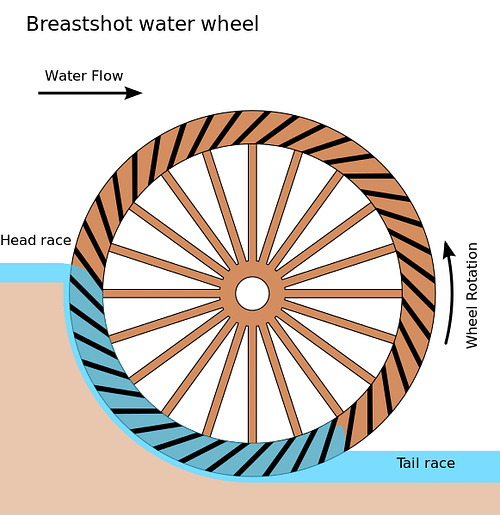 Breastshot Waterwheel KVDP (CC BY-SA) ](https://www.worldhistory.org/image/5198/breastshot-waterwheel/ "Breastshot Waterwheel")To justify a watermill's construction costs there had to be a large enough concentration of people (between 200 and 400 inhabitants in the surrounding area). When the population's concentration was even greater than this, clusters of mills were built, such as the Janiculum mills (early 3rd century CE) in [Rome](https://www.worldhistory.org/Rome/) or the Barbegal complex (early 2nd century CE) in southern France. At the Barbegal complex, for example, an [aqueduct](https://www.worldhistory.org/aqueduct/) could supply water to sixteen overshot wheels while on the slope of the Janiculum hill in Rome, a large number of mills also used aqueduct water to produce flour on an industrial scale from the 3rd through to the 6th century CE.
### MILLS USED IN MINING
Stamp mills were used in mining to crush ore from deep deposits into small pieces before further processing. The [metal](https://www.worldhistory.org/disambiguation/metal/) ores needed to be crushed down to a pea or walnut size before it could be smelted. At times, the mills were also used in metal working after the completion of the smelting while the metal was red hot. The presence of stone anvils with marks from trip-hammers at Dolaucothi and other ancient Roman mining sites is proof that stamp mills were widely used in this way to pound extracted ore.
These stamp mills consisted of waterwheels, cams and trip-hammers (mola). They first appeared in Greece around the 3rd century BCE, and then spread across Italy throughout the first century CE. Before this invention, such crushing of ores was done manually, which required a lot of men and effort. As was the case with grain mills, these stamp mills saved greatly on manpower, while also greatly increasing the speed of ore processing. Stamp mills were mostly used in mining applications, but at times were also used to pound and hull grain.
Because water powered these stamping machines, aqueducts were often constructed near mining sites. For example, at the Dolaucothi mines in Wales, or in the Rio Tinto in Spain, long aqueducts were built to power a number of such stamp mills. There, aqueduct water was used as well in ore extraction techniques known as "hushing" and "ground sluicing". Some metal ores such as [gold](https://www.worldhistory.org/gold/) needed to be finely ground in order to release the tiny metal particles from surrounding rock, salts and sands. For this purpose, the Romans constructed watermills similar to the previously mentioned agricultural ones, but these had even harder grinding stones.
### MILLS USED in CONSTRUCTION
The sawmill was another example of a surprisingly-sophisticated machine which consisted of a reciprocating saw powered by a waterwheel. It could cut large amounts of wood or stone, thereby saving enormous amounts of effort and labour. The waterwheel was connected to a rod linked to one or multiple crank-activated saws. The earliest known sawmill was the Hierapolis mill dating back to 250-300 CE. It was the earliest known machine to use a crank with a connecting rod mechanism. A relief on the sarcophagus of [Marcus Aurelius](https://www.worldhistory.org/Marcus_Aurelius/) Ammianos (dating back to 250-300 CE), in the ancient [city](https://www.worldhistory.org/city/) of Hierapolis near modern-day Pamukkale in [Turkey](https://www.worldhistory.org/Asia_Minor/), gives a clear representation of how it functioned.
[ 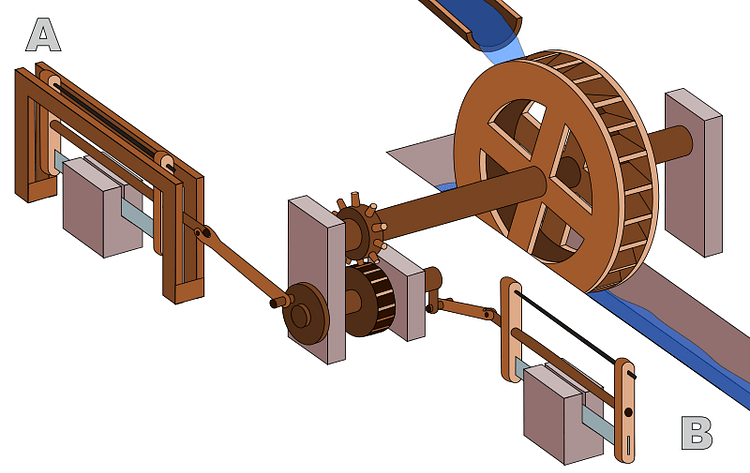 Roman Sawmill Chris (CC BY) ](https://www.worldhistory.org/image/5199/roman-sawmill/ "Roman Sawmill")Sawmills were also commonly used to cut marble. A Roman poet called Ausonius writes in an epic poem about the river Moselle in Germany in the late 4th century CE and describes the shrieking sound of a water-powered sawmill used to cut marble. These sawmills were also used to cut various other types of stones. Sawmills dating from the 6th century CE were also found in Gerasa (in modern-day [Jordan](https://www.worldhistory.org/Jordan/)) and [Ephesus](https://www.worldhistory.org/ephesos/) (in modern-day Turkey). Therefore, it is safe to say that they were used throughout the [Roman empire](https://www.worldhistory.org/Roman_Empire/) for various uses.
### CONCLUSION
The invention of mechanically-driven milling technology, and later of watermills, decreased reliance on human labour and greatly improved productivity in many sectors of the Roman economy, thereby, improving the daily lives of Romans. Watermills such as the Janiculum mills in Rome allowed for the production of flour and bread on industrial scales. Stamp mills accelerated ore processing at mining sites throughout the [empire](https://www.worldhistory.org/empire/), while sawmills allowed for marble and other stones to be cut precisely and at record speeds. Roman milling technology progressed from manual to animal-driven rotary mills in the 1st century BCE, and then to the more complex water-powered and crank activated sawmills of the 3rd century CE. Many of the principles used in the construction of these early machines are still applied to modern mill designs today. Such mills are additional examples of the ingenuity, impressive design, and manufacturing skills of the Romans.
#### Editorial Review
This human-authored article has been reviewed by our editorial team before publication to ensure accuracy, reliability and adherence to academic standards in accordance with our [editorial policy](https://www.worldhistory.org/static/editorial-policy/).
## Bibliography
- [Marcus Vitruvius Pollio. *Vitruvius. The Ten Books on Architecture.* Adamant Media Corporation, 2005.](https://www.worldhistory.org/books/1421270110/)
- [Oleson, J.P. et al. *The Oxford Handbook of Engineering and Technology in the Classical World.* Oxford University Press, 2009.](https://www.worldhistory.org/books/0199734852/)
- [Pliny the Elder. *Natural History.* Penguin Classics, 1991.](https://www.worldhistory.org/books/0140444130/)
## About the Author
Victor is an ancient history enthusiast currently residing in Greece and the owner of Romae Vitam, a website focused on ancient Roman history.
- [Facebook Profile](https://www.facebook.com/vitaromae/ )
## Cite This Work
### APA
Labate, V. (2016, June 13). Roman Mills. *World History Encyclopedia*.
### Chicago
Labate, Victor. "Roman Mills." *World History Encyclopedia*, June 13, 2016. .
### MLA
Labate, Victor. "Roman Mills." *World History Encyclopedia*, 13 Jun 2016, .
## License & Copyright
Submitted by [Victor Labate](https://www.worldhistory.org/user/info_3/ "User Page: Victor Labate"), published on 13 June 2016. The copyright holder has published this content under the following license: [Creative Commons Attribution-NonCommercial-ShareAlike](https://creativecommons.org/licenses/by-nc-sa/4.0/deed.en). This license lets others remix, tweak, and build upon this content non-commercially, as long as they credit the author and license their new creations under the identical terms. When republishing on the web a hyperlink back to the original content source URL must be included. Please note that content linked from this page may have different licensing terms.