---
title: The Temples of Pattadakal
author: Dhruba RC
source: https://www.worldhistory.org/article/899/the-temples-of-pattadakal/
format: machine-readable-alternate
license: Creative Commons Attribution-NonCommercial-ShareAlike (https://creativecommons.org/licenses/by-nc-sa/4.0/)
updated: 1970-01-01
---
# The Temples of Pattadakal
_Authored by [Dhruba RC](https://www.worldhistory.org/user/dhrubaraic/)_
The history of Pattadakal goes back to a time when it was called Kisuvolal, a valley of red soil. It even found a mention in [Ptolemy](https://www.worldhistory.org/disambiguation/Ptolemy/)'s *Geography* in the 2nd century CE. Presently Pattadakal is located in the district of Bagalkot, state of Karnataka, [India](https://www.worldhistory.org/india/). The Chalukyas of Badami (ancient Vatapi) or Early Chalukyas (543-753 CE) built a large complex of temples for royal commemoration and coronation in Pattadakal. This complex is on the left bank of the Malaprabha River which runs further north to meet the river [Krishna](https://www.worldhistory.org/Krishna/). It was accorded World Heritage Status by UNESCO in 1987.
[ 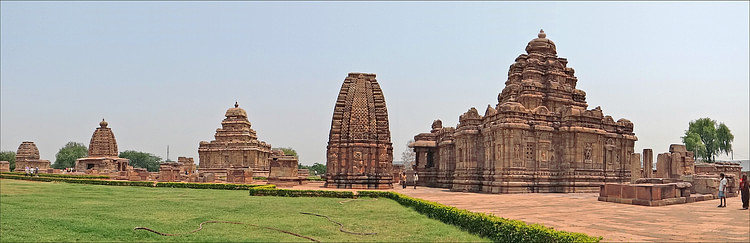 Temple Complex in Pattadakal Jean-Pierre Dalbéra (CC BY-SA) ](https://www.worldhistory.org/image/5013/temple-complex-in-pattadakal/ "Temple Complex in Pattadakal")Pattadakal literally means 'coronation stone' and bears testimony to the later phase of evolution of the distinctive Early Chalukyan [architecture](https://www.worldhistory.org/disambiguation/architecture/). The gestation phase of this development which took place in [Aihole](https://www.worldhistory.org/Aihole/), Badami (the ancient capital), Alampur, and Mahakuta finds its culmination here. It is in the last few decades, during the successive reigns of Vijayaditya (696-733 CE), Vikramaditya II (733-746 CE) and Kirtivarman II (746-753 CE), that several temples were gradually constructed in this fertile valley. A Jain shrine was constructed much later, after the collapse of the [empire](https://www.worldhistory.org/empire/) by their successor [Rashtrakuta Dynasty](https://www.worldhistory.org/Rashtrakuta_Dynasty/) (8th-10th centuries CE) in the 9th century CE.
### [Temple](https://www.worldhistory.org/temple/) Architecture
The basic plan of a temple runs thus: the *garbha griha* (sanctum sanctorum) opens to an *antarala* (vestibule) and houses the *murti* (enshrined image) on a *pitha* (pedestal). An expansive pillared *mandapa* (hall) adjoins the *antarala*. A *shikhara* (superstructure) rises on top of the *garbha griha* and contains an *amalaka* (a ribbed stone) with a *kalash* (pot with mango leaves and a coconut) at its finial. The *vimana* then comprises both the *garbha griha* and *shikhara*.
Temples built here are all dedicated to [Shiva](https://www.worldhistory.org/shiva/) and face east. However, depiction of religious motifs through free-standing sculptures and reliefs is not limited to Shaivism but recruits images generously from the [Hindu](https://www.worldhistory.org/hinduism/) [pantheon](https://www.worldhistory.org/Pantheon/). Other than the nine Shaiva temples in the compound, there is one Jain temple located almost a kilometre to the west dedicated to the 23rd Tirthankar, Parsvanatha.
### Virupaksha Temple
The epigraphy reveals this to have been built by Queen Loka Mahadevi (originally named as Lokeswara) after the successful military campaigns of King Vikramaditya II against the Pallavas (4th-9th centuries CE). In ground plan it resembles the Kailasnatha temple of [Kanchipuram](https://www.worldhistory.org/Kanchipuram/), citadel of the Pallavas, but in stone it is a realisation of the fully mature Early Chalukyan architecture in all its glory.
A square *garbha griha*, with an ambulatory path surrounding it, is connected to the *antarala*. Two small shrines are laterally placed to the *antarala*, one for [Ganesha](https://www.worldhistory.org/Ganesha/) and the other for Mahisasurmardini. Three porches from the east, north and south open up to an expansive *mandapa*. Further east, a separate [Nandi](https://www.worldhistory.org/Nandi/) *mandapa* is placed on a plinth. The whole temple is surrounded by *prakara* (enclosure) walls that are provided with subsidiary shrines on its inner side. Only a handful of these remain out of the original 32. The magnificently built Dravida *shikhara* with a well-preserved *sukanasa* ('nose,' arched projection) on the front is one of the hallmarks of the temple. The superstructure is three-storied and topped by a four-sided *amalaka* with a *kalash* at its finial.
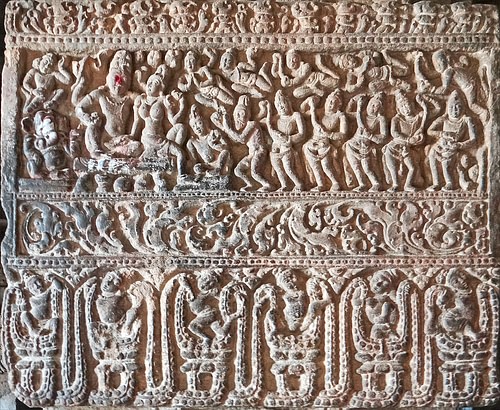
[ 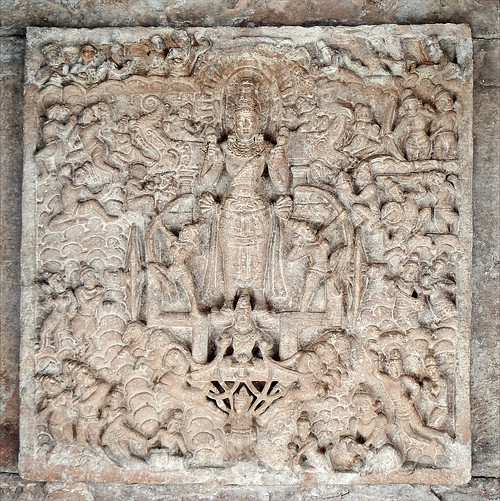 Relief Sculpture of Surya in Virupaksha Temple, Pattadakal Jean-Pierre Dalbéra (CC BY) ](https://www.worldhistory.org/image/5012/relief-sculpture-of-surya-in-virupaksha-temple-pat/ "Relief Sculpture of Surya in Virupaksha Temple, Pattadakal")The temple walls are divided into projections and recesses. Sculptures of Harihara, Narasimha, Bhairava, Lakulisha adorn the *Devakoshthas* (niches) on sanctum walls. Recesses have filigree windows. The temple interior is covered with friezes depicting stories of the abduction of Sita, Bhishma lying on a bed of arrows and Krishna lifting the Govardhan Mountain among other narratives from ancient texts. Many inscriptions have been found engraved in different parts of the temple, some of which also name the architect(s) involved in building the structure.
[  Hara Gauri in Virupaksha Temple, Pattadakal Jean-Pierre Dalbéra (CC BY) ](https://www.worldhistory.org/image/5014/hara-gauri-in-virupaksha-temple-pattadakal/ "Hara Gauri in Virupaksha Temple, Pattadakal")### Mallikarjuna Temple
It was originally called the Trailokeswara temple in honour of the Queen Trailokya Mahadevi. Almost like a twin, the Mallikarjuna temple was built for the same purpose, at the same time as Virupaksha temple which stands beside it. There are only a few noticeable differences between these two, one of them being a hemispherical *amalaka* as opposed to a four-sided one, and a parapet devoid of certain architectural elements such as *kuta* (square), *sala* (oblong) etc. that correspond to the projections and recesses below.
The shrines, lateral to the *antarala*, are sadly missing the images of their respective deities. *Prakara* (walls) too are largely destroyed. Tales from the *puranas* (religious texts) and epics carved inside the temple include sculptures of Mahisasurmardini, *samudra manthan*, Narasimha fighting Hiranyakashipu, the slaying of Mareecha etc. The niches on temple walls are also gracefully decorated.
### Sangameswara Temple
This temple was built in 720 CE by Vijayaditya and originally named as the Vijayeswara temple. The *garbha griha* typically houses a *lingum* (phallus symbol) and there are sub-shrines on either side of the *antarala*. To the east of the *mandapa*, an image of the bull Nandi (*vahana* or 'mount' of Shiva) is supported on a small plinth.
[ 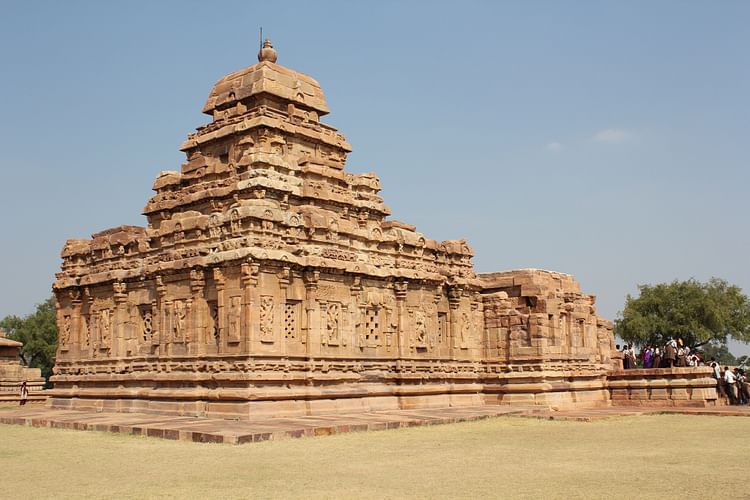 Pattadakal, Sangameswara Temple Arian Zwegers (CC BY) ](https://www.worldhistory.org/image/5043/pattadakal-sangameswara-temple/ "Pattadakal, Sangameswara Temple")The temple itself is built on a high plinth consisting of five mouldings decorated with animal and floral motifs. On the temple walls, niches bearing sculptures of different avatars of [Vishnu](https://www.worldhistory.org/Vishnu/) and Shiva alternate with beautifully designed windows. Below the *kapota* (eave), a row of wonderfully carved round-bodied figures are placed as if the whole load of the roof above is being held by them. The *shikhara* is two-tiered and topped by a four-sided *amalaka* with a *kalash*.
### Kadasiddheswara Temple
This modest structure was constructed sometime during the middle to late 7th century CE. It attests to the still evolving Early Chalukyan architecture with its *shikhara* being developed along the northern style (*rekha nagara*) of curvilinear profile and a simple *sukanasa* projecting from the superstructure at the front, above the *antarala*. The *sukanasa* depicts an image of a dancing Shiva with Parvati as a shallow relief *chaitya* (prayer hall) arch. The *Devakoshthas* houses images of Ardhanariswar, Harihara and Shiva on the north, west, and south sides respectively.
The rectangular *mandapa* might have had a *mukha mandapa* (porch) at the front as suggested by the plinth, with usual decorative moulds. The figures of Shiva and Parvati grace the lintel of the door to the *garbha griha* with carvings of [Brahma](https://www.worldhistory.org/Brahma/) and Vishnu on either side.
### Jambulingeswara Temple
Its ground plan and period of construction are both comparable to the Kadasiddheswara temple mentioned before. The square *garbha griha* houses a *lingum* on a *pitha* and opens to the *antarala* at front which further expands to a *mandapa*. A *sukanasa* projects from the *sikhara* (built in northern style in three diminishing stages) at the front. The small Nandi *mandapa* to the east is in a ruinous state with the crouching image of Nandi all but destroyed. A minutely detailed frieze of swans runs below the cornice of the temple [wall](https://www.worldhistory.org/wall/) all along. The moulded plinth is decorated with figures of *Kudu*, birds and other ornamental elements.
### Galaganatha Temple
This temple, one of the last to be built at the site around 750 CE, possesses an exquisitely developed superstructure in the northern style as adopted by Early Chalukyan architects. It has been largely preserved with the *amalaka* and *kalash* at the top save for the partially damaged *sukanasa* at the front.
[ 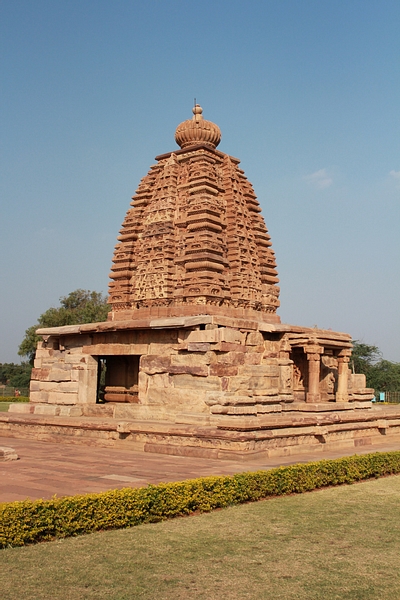 Pattadakal, Galaganatha Temple Arian Zwegers (CC BY) ](https://www.worldhistory.org/image/5042/pattadakal-galaganatha-temple/ "Pattadakal, Galaganatha Temple")The *pradakshinapatha* (passage for circumambulation) is closed on three sides but the large open space atop the plinth in front of the temple suggests the regrettable loss of the *mandapa* to the ravages of time. The plinth with three mouldings is luxuriously decorated with playful figures among other common motifs. Stories from *Panchatantra* and Shiva slaying Andhakasura from the *puranas* are variously depicted. The entrance to the sanctum is flanked by River Goddesses on both sides with the lintel being carved with a Nataraja.
### Chandrashekhara Temple
This relatively small structure is placed between the Sangameswara and Galganatha temples. There is no superstructure on top of the *garbha* *griha* which follows the tradition of enshrining a *lingum* on a *pitha*. A *Devakoshtha* is designed on both the north and south walls of the sanctum. *Dwarpalas* (door keeper) grace either side of the entrance door to the shrine.
### Papanatha Temple
Located to the south of Virupaksha temple, it boasts of a *vimana* of the northern style with an elaborately carved *sukanasa* at front. Lamentably, both the *amalaka* and *kalash* are missing. It is the largest temple in the compound in the *rekha nagara* (northern) style and seems to have undergone additions and modifications outside those of the original plan. It is possible that the temple, in the beginning, consisted of the typical composition consisting of a sanctum, a rectangular *mandapa* and a separate Nandi *mandapa*. Later modification(s) aimed to enlarge the existing *mandapa* and incorporate an enclosed circumambulatory path around the sanctum. This was extended in such a way that the once separate Nandi *mandapa* now became a part of it. A finely built Nandi figure now [graces](https://www.worldhistory.org/Graces/) the passage at the entrance of the *mandapa*.
Only one of the *dwarpalas* now survives at the entrance of the *mandapa*. Pillars and pilasters inside the hall are resplendently covered with figures in *tribhanga mudra* (thrice-bent pose), foliage motifs and other elements. Images of Shiva and Parvati, Anantasayana Vishnu surrounded by Dikpalas, Nagaraja, Gajalakshmi are carved on the ceiling while narrative panels depicting episodes from Kirtarjuniya, [Ramayana](https://www.worldhistory.org/The_Ramayana/) and other ancient texts adorn the walls. The façade of the *garbha griha* is beautifully decorated with a [Garuda](https://www.worldhistory.org/Garuda/) on the lintel and decorative pilasters on either side, accompanied by gracefully sculpted figures of [Ganga](https://www.worldhistory.org/Ganges/) & Jamuna.
### Kasivisweswara Temple
This is probably the last temple built in this compound, datable to the middle of the 8th century CE. It showcases the wonderfully developed style of *rekha nagara shikhara* rising in five stages, unfortunately the *amalaka* and *kalash* are missing. A well-preserved *sukanasa* adorns the front of the *shikhara* with an image of Uma-Maheswara carved within a *chaitya* arch. The whole *shikhara* surface is designed in a mesh-like manner.
In plan, the temple follows the general pattern of Early Chalukyan architecture as evidenced in other temples of this location. Sculptures of Ardhanariswara and Kalabhairaba grace the northern side of *mandapa* wall. The walls are also decorated with paired pilasters supporting the pediments of the elaborately relieved *chaitya* arches. Stories from Shiva and Bhagavat *puranas* are also a delight to behold. An exquisitely prepared ceiling panel that lies at the center of the *mandapa* depicts Shiva, Parvati holding Kartikeya, and Nandi. Beyond the *mandapa*, further east a small Nandi *mandapa*, now largely ruined, is placed.
### Monolithic Stone Pillar
A monolithic stone pillar bearing inscription stands in front of the Mallikarjuna temple. The inscription is in Siddhamatrika and Kannada – Tamil characters of 8th century CE. It starts with invocations of Shiva and Hara Gauri and refers to the reigns of Kings Vijayaditya and Vikramaditya II.
### Jain Temple
Locally named the Jain Narayana temple, it was constructed much later during the rule of Rashtrakuta Dynasty in 9th century CE. Though built a century after the temple complex and under a different ruler, it follows the basic pattern which was developed during the Early Chalukyan era.
[ 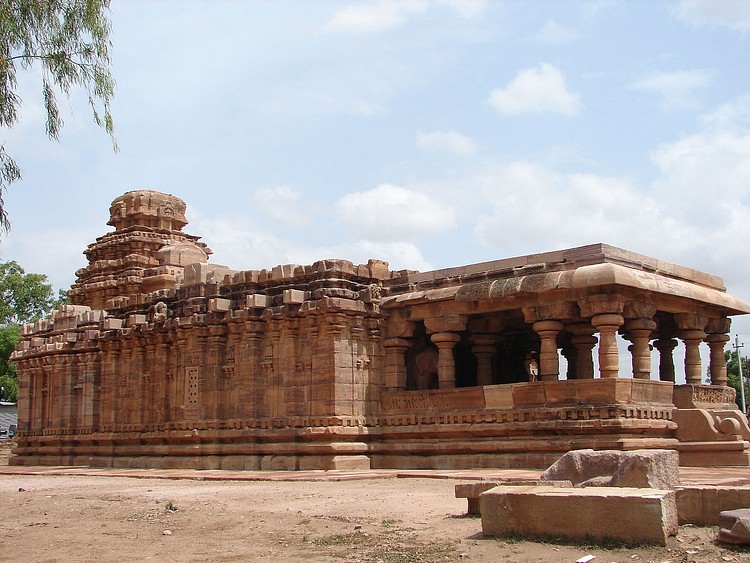 Jain Narayana Temple Dineshkannambadi (CC BY-SA) ](https://www.worldhistory.org/image/11127/jain-narayana-temple/ "Jain Narayana Temple")It is a three-storied temple with the two lower stories still functional. The square *garbha griha* houses an image of Parsvanatha. The adjoining *antarala* runs into a *mandapa* and finally a beautifully pillared *mukha mandapa* graces the visitor. A circumambulatory path, though with collapsed walls, is also present. The superstructure is built in a southern *vimana* style with a four-sided *amalaka* at top. The plinth is decorated with triple mouldings.
The projections and recesses of the *mandapa* walls contain images of Jina in various postures among other figures. The pillars of the porch are partially lathe turned, and the doorway has on either side an elephant with its rider. A large figure of Makara (crocodile) in florid detail marks the entrance to the *garbha griha*.
The enduring achievement of Early Chalukyan reign in the field of architecture set the stage for future generations to develop their own vocabulary around certain basic attributes. In Pattadakal, for instance, the astonishing evolution that temple architecture underwent is made visible by means of a bewildering variety of structural elements in use only a few metres away from each other. And yet, it represents the culmination of the movement. After well over a millennium, it takes on a new character, that of an intermediate stage that found its continuity and elaboration in later years through the Western Chalukyas (973 CE – 1189 CE) and especially Hoysala Emperors (1026 CE – 1343 CE) who broke new ground in this field.
#### Editorial Review
This human-authored article has been reviewed by our editorial team before publication to ensure accuracy, reliability and adherence to academic standards in accordance with our [editorial policy](https://www.worldhistory.org/static/editorial-policy/).
## Bibliography
- [Coomaraswamy, A.K. *The History of Indian and Indonesian Art.* Kessinger Publishing, LLC, 2010.](https://www.worldhistory.org/books/1169788491/)
- [Hardy, A. *Indian Temple Architecture.* Abhinav Pubns, 1995.](https://www.worldhistory.org/books/8170173124/)
- [Kramrisch, S. *The Hindu Temple (Pt. 1 & 2).* Motilal Banarsidass, 2015.](https://www.worldhistory.org/books/8120802225/)
## Cite This Work
### APA
RC, D. (2016, May 06). The Temples of Pattadakal. *World History Encyclopedia*.
### Chicago
RC, Dhruba. "The Temples of Pattadakal." *World History Encyclopedia*, May 06, 2016. .
### MLA
RC, Dhruba. "The Temples of Pattadakal." *World History Encyclopedia*, 06 May 2016, .
## License & Copyright
Submitted by [Dhruba RC](https://www.worldhistory.org/user/dhrubaraic/ "User Page: Dhruba RC"), published on 06 May 2016. The copyright holder has published this content under the following license: [Creative Commons Attribution-NonCommercial-ShareAlike](https://creativecommons.org/licenses/by-nc-sa/4.0/deed.en). This license lets others remix, tweak, and build upon this content non-commercially, as long as they credit the author and license their new creations under the identical terms. When republishing on the web a hyperlink back to the original content source URL must be included. Please note that content linked from this page may have different licensing terms.