---
title: Greek Theatre Architecture
author: Mark Cartwright
source: https://www.worldhistory.org/article/895/greek-theatre-architecture/
format: machine-readable-alternate
license: Creative Commons Attribution-NonCommercial-ShareAlike (https://creativecommons.org/licenses/by-nc-sa/4.0/)
updated: 1970-01-01
---
# Greek Theatre Architecture
_Authored by [Mark Cartwright](https://www.worldhistory.org/user/markzcartwright/)_
The ancient Greeks built open-air theatres where the public could watch the performances of [Greek comedy](https://www.worldhistory.org/Greek_Comedy/), tragedy, and [satyr](https://www.worldhistory.org/satyr/) plays. They then exported the idea to their colonies throughout the [Aegean](https://www.worldhistory.org/aegean/) so that theatres became a typical feature of the urban landscape in all [Greek](https://www.worldhistory.org/disambiguation/greek/) [cities](https://www.worldhistory.org/city/). The Romans continued and expanded on the concept, added a monumental backstage, and generally made the structure more grandiose. The large semi-circular structures, still with their excellent acoustics, are visible today at many archaeological sites, and several of them remain in use not only for modern concerts and performances but also for festivals of ancient [Greek drama](https://www.worldhistory.org/Greek_Theatre/).
[  Theatre of Delphi Mark Cartwright (CC BY-NC-SA) ](https://www.worldhistory.org/image/415/theatre-of-delphi/ "Theatre of Delphi")### Early Theatres
The earliest Greek theatres can be traced back to the [Minoan civilization](https://www.worldhistory.org/Minoan_Civilization/) on [Crete](https://www.worldhistory.org/crete/) where a large open space with stepped seating can still be seen today at the site of [Phaistos](https://www.worldhistory.org/Phaistos/). Evolving from a stage area of tramped earth set before a natural hill on which spectators might sit and watch religious ceremonies, the early theatres appeared from the 6th century BCE and were built wholly of wood. Early examples may also have had a rectangular arrangement of seating (as at Thoricus and Trachones in Attica) but this soon developed into the semi-circular arrangement which allowed more people to see the spectacle and have a better view.
According to 5th-4th century BCE [Greek pottery](https://www.worldhistory.org/Greek_Pottery/) decoration the stage was built around one metre above the ground and had steps at the front. Actors performed on the stage which had an entrance on the left and right sides and from a single central doorway (soon expanded to three) in the scenery behind, usually made to resemble a [temple](https://www.worldhistory.org/temple/), [palace](https://www.worldhistory.org/disambiguation/palace/), or cave. The use of painted scenery is also very likely. The stage scene could also have a top platform from which actors could play gods speaking down upon the audience and actors alike. The excitement of performances was enhanced with one or two technical additions. A wheeled platform (*ekkylema*) was pushed out of the doorway and used to dramatically reveal new scenery, and a crane (*mechane*) was situated to the right of the stage and used to lift actors who were playing gods or heroes.
### From Wood to Stone
The oldest theatre is that of Dionysos Eleuthereus on the south slope of the acropolis of Athens which was first built in the 6th century BCE. The theatre would host the Great Dionysia, held each year in March/April, during the month of Elaphebolion, where the most famous playwrights such as [Euripides](https://www.worldhistory.org/Euripides/), [Sophocles](https://www.worldhistory.org/sophocles/), and [Aristophanes](https://www.worldhistory.org/Aristophanes/) presented their plays in competition. Its evolution was typical of most Greek theatres in other cities. At the end of the 5th century BCE a rectangular stage building was added with wings on each side. Still, only the front seats were made of stone and the rest of wood. Monumental entrances were built at the sides of the stage for the public to enter.
[  Theatre of Dionysos Eleuthereus, Athens Mark Cartwright (CC BY-NC-SA) ](https://www.worldhistory.org/image/3763/theatre-of-dionysos-eleuthereus-athens/ "Theatre of Dionysos Eleuthereus, Athens")In the 4th century BCE all the seats were made in stone (benches) and walkways made between sections of seats to facilitate access. Stone ramps were added to the entrances to allow the audience to leave the theatre in good order. Finally, the stage scenery or backdrop also came to be made of stone and faced with semi-columns. The theatre had finally acquired the architectural form which became more or less the standard across the Greek and later [Roman](https://www.worldhistory.org/disambiguation/Roman/) worlds.
### Architectural Elements
**Auditorium** – the area between the stage and seats.
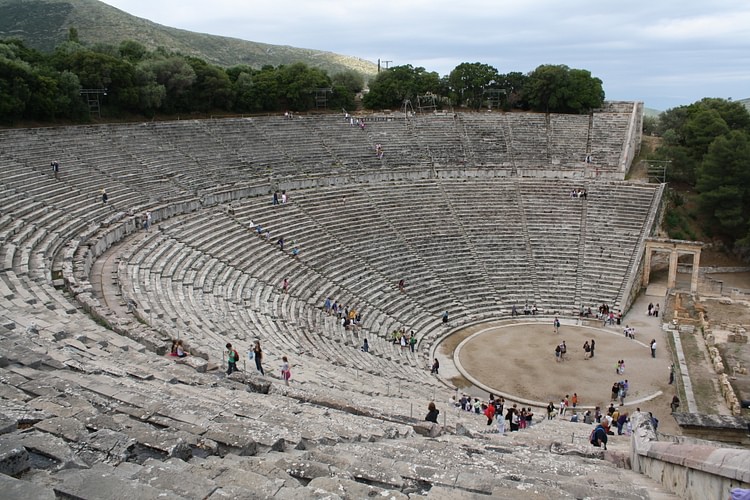
**Cavea (theatron)** – the approximately semi-circular bank of seating.
**Cunei** – the wedge-shaped sections of seats separated by horizontal walkways and vertical steps.
[ 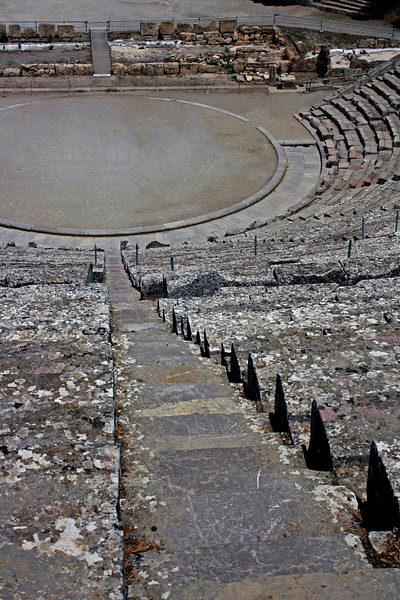 The Theatre of Epidaurus James Lloyd (CC BY-NC-SA) ](https://www.worldhistory.org/image/3883/the-theatre-of-epidaurus/ "The Theatre of Epidaurus")**Diazoma** – the horizontal walkways between tiers of seats.
**Orchestra** - the flat area where the chorus stood, sang, and danced.
**Paradoi** – the monumental passageways and gateway entrance on each side of the auditorium.
[  Theatre Parodoi, Epidaurus Mark Cartwright (Copyright) ](https://www.worldhistory.org/image/1087/theatre-parodoi-epidaurus/ "Theatre Parodoi, Epidaurus")**Paraskenia** – the wings at the end of each side of the *skene* stage building.
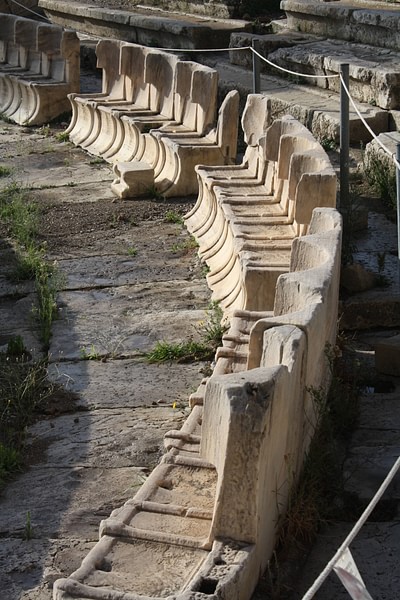
**Proedria** – throne-like seats in the front rows for VIPs.
[  Seats of the Theatre of Dionysos, Athens Mark Cartwright (CC BY-NC-SA) ](https://www.worldhistory.org/image/3766/seats-of-the-theatre-of-dionysos-athens/ "Seats of the Theatre of Dionysos, Athens")**Proskenion** – a platform supported by columns in front of the skene initially decorative but then used as a second, higher stage.
**Skene** – the backdrop of the stage. First merely a tent or curtained area for actors to change costumes but later a more permanent structure which also acted as scenery for the performance.
[  Theatre of Segesta Mark Cartwright (CC BY-NC-SA) ](https://www.worldhistory.org/image/2599/theatre-of-segesta/ "Theatre of Segesta")### Outstanding Examples
We have already mentioned the [theatre of Dionysos Eleuthereus](https://www.worldhistory.org/article/814/theatre-of-dionysos-eleuthereus/), the very home of [Greek theatre](https://www.worldhistory.org/Greek_Theatre/), which still has its front row of 67 proedria seats. The 2nd-3rd century CE reliefs of the *bema* (low speaker's platform) are still in place too and show scenes from the myths of Dionysos. Many other theatres, though, were built across [Greece](https://www.worldhistory.org/greece/) and the Aegean as the Greeks themselves colonized [Ionia](https://www.worldhistory.org/ionia/) and [Magna Graecia](https://www.worldhistory.org/Magna_Graecia/). One of the largest is the theatre of [Argos](https://www.worldhistory.org/argos/) which had 81 rows of seats and a capacity for 20,000 spectators. Perhaps the 3rd-century BCE theatre at [Ephesus](https://www.worldhistory.org/ephesos/) was larger still, with a capacity of 24,000. One of the best preserved, and with surviving *paradoi*, is at [Epidaurus](https://www.worldhistory.org/epidaurus/) which was first built in the 4th century BCE and which is the site of an important annual festival of ancient Greek Drama.
[  Seating of the Theatre of Epidaurus Mark Cartwright (CC BY-NC-SA) ](https://www.worldhistory.org/image/482/seating-of-the-theatre-of-epidaurus/ "Seating of the Theatre of Epidaurus")Greek architects liked to site their theatres in such places that gave the audience a spectacular view not just of the actors on the stage but also the landscape behind. The 2nd-century BCE theatre at [Pergamon](https://www.worldhistory.org/pergamon/) in modern [Turkey](https://www.worldhistory.org/Asia_Minor/) built by Eumenes II must hold one of most breathtaking positions, as it is, perched on a steep hillside looking down on the plain of the river Caicus far below. [Segesta](https://www.worldhistory.org/Segesta/) in [Sicily](https://www.worldhistory.org/sicily/), built from the 4th century BCE, boasts another example of a theatre seat with a view, this time looking out to the sea and the Gulf of Castellamare. For sheer picturesque location, though, it is difficult to challenge one of the earliest, the theatre at [Delphi](https://www.worldhistory.org/delphi/). Built in the 4th century BCE and quite small, with only 5,000 seats, it nestles on the wooded sides of Mt. Parnassus and commands a view of the whole green-carpeted valley below.
[  Theatre of Pergamon Benh Lieu Song (CC BY-SA) ](https://www.worldhistory.org/image/1138/theatre-of-pergamon/ "Theatre of Pergamon")### Roman Additions
The Romans greatly admired [Greek architecture](https://www.worldhistory.org/Greek_Architecture/) and, in typical fashion, they copied and enhanced the idea of tightly-packed public spectacles. They enlarged the permanent scenery behind the stages of Greek theatres making it into a multi-story backdrop (*scaenae frons*) that joined the sides of the *cavea*. [Nero](https://www.worldhistory.org/Nero/), for example, added a monumental Roman-style stage building to the Dionysos Eleuthereus theatre which reduced the now marble stage area to its semi-circular form still seen today. A low speaker's platform (*bema*) was added to the enlarged stage too in the 2nd or 3rd century CE. The Romans also paved the orchestra, sometimes added an awning roof (*vela*), built substructures under the seating, and generally added more decoration to theatres by adding monumental statues, exotic marble columns, and relief carvings to the stage area. With their high backstage and covered roof, the enclosed and almost claustrophobic atmosphere of the Roman theatre would more and more come to resemble the modern theatres of today.
#### Editorial Review
This human-authored article has been reviewed by our editorial team before publication to ensure accuracy, reliability and adherence to academic standards in accordance with our [editorial policy](https://www.worldhistory.org/static/editorial-policy/).
## Bibliography
- Bagnall, R. et al. *The Encyclopedia of Ancient History.* Wiley-Blackwell, 2012
- [Hornblower, S. *The Oxford Classical Dictionary.* Oxford University Press, 2012.](https://www.worldhistory.org/books/0199545561/)
- Kavvadias, G. & E. Giannikapani. *South Slope of the Acropolis.* Hellenic Ministry of Culture, 2004
- [Wheeler, M. *Roman Art and Architecture.* Thames & Hudson, 1985.](https://www.worldhistory.org/books/0500200211/)
## About the Author
Mark is WHE’s Publishing Director and has an MA in Political Philosophy (University of York). He is a full-time researcher, writer, historian and editor. Special interests include art, architecture and discovering the ideas that all civilizations share.
## External Links
- [Architecture in Ancient Greece | Essay | The Metropolitan Museum of Art | Heilbrunn Timeline of Art History](https://www.metmuseum.org/toah/hd/grarc/hd_grarc.htm)
## Cite This Work
### APA
Cartwright, M. (2016, April 22). Greek Theatre Architecture. *World History Encyclopedia*.
### Chicago
Cartwright, Mark. "Greek Theatre Architecture." *World History Encyclopedia*, April 22, 2016. .
### MLA
Cartwright, Mark. "Greek Theatre Architecture." *World History Encyclopedia*, 22 Apr 2016, .
## License & Copyright
Submitted by [Mark Cartwright](https://www.worldhistory.org/user/markzcartwright/ "User Page: Mark Cartwright"), published on 22 April 2016. The copyright holder has published this content under the following license: [Creative Commons Attribution-NonCommercial-ShareAlike](https://creativecommons.org/licenses/by-nc-sa/4.0/deed.en). This license lets others remix, tweak, and build upon this content non-commercially, as long as they credit the author and license their new creations under the identical terms. When republishing on the web a hyperlink back to the original content source URL must be included. Please note that content linked from this page may have different licensing terms.