---
title: Nazca Pottery
author: Mark Cartwright
source: https://www.worldhistory.org/article/883/nazca-pottery/
format: machine-readable-alternate
license: Creative Commons Attribution-NonCommercial-ShareAlike (https://creativecommons.org/licenses/by-nc-sa/4.0/)
updated: 2024-08-23
---
# Nazca Pottery
_Authored by [Mark Cartwright](https://www.worldhistory.org/user/markzcartwright/)_
The [pottery](https://www.worldhistory.org/pottery/) of the [Nazca civilization](https://www.worldhistory.org/Nazca_Civilization/), which flourished in ancient Peru between 200 BCE and 600 CE, is amongst the most distinctive art produced by any [civilization](https://www.worldhistory.org/civilization/) from antiquity. Endlessly inventive both in form and in its use of strong colours and bold decorative designs, the ceramic wares of the [Nazca](https://www.worldhistory.org/Nazca_Civilization/) are instantly recognisable. This ease of identification is no doubt because, in a [culture](https://www.worldhistory.org/disambiguation/culture/) without [writing](https://www.worldhistory.org/writing/), designs on pottery vessels were an important means of communicating shared ideas and religious practices. Not simply for everyday use, then, the Nazca created vessels for ritual use, [burial](https://www.worldhistory.org/burial/) offerings, and pure decoration. Nazca potters, although employing very simple techniques, were technically accomplished and their ceramics display the widest colour range found in any ancient Americas pottery.
[  Nazca Vase with Dancing Male Osama Shukir Muhammed Amin (Copyright) ](https://www.worldhistory.org/image/4208/nazca-vase-with-dancing-male/ "Nazca Vase with Dancing Male")### Forms
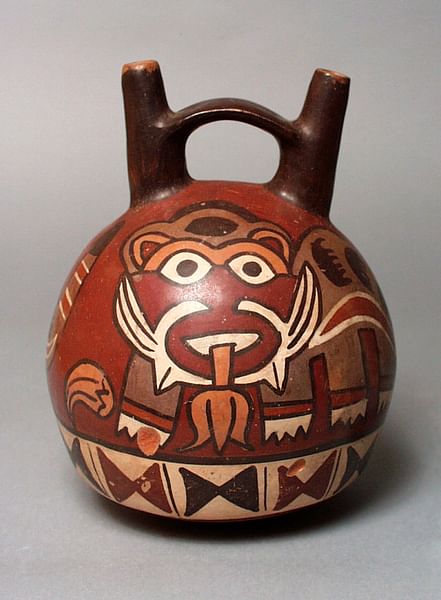
Nazca pottery, made where the pottery wheel was unknown, was made by hand, mostly by the method of coiling where a tube of clay was spiralled around a base to build up the vessel. Potters did use a turntable but this was for manual slow-turning during the decoration process. The sides of the vessel - both inside and out - were then thinned and smoothed by hand or using a flat stone as desired. Vessels were thin-walled and could take on a wide variety of shapes. Distinctive forms include the double-spouted containers with a single handle and generally bulbous vessels without a flat bottom or base. Bowls, beakers, plain jars, and effigy jars were also common. There were vessels in the shape of human heads too, no doubt inspired by the Nazca practice of taking trophy-heads following battles. The three-dimensional stepped fret shape is unique to the Nazca. Besides vessels, ceramic effigy figures, drums, [panpipes](https://www.worldhistory.org/Panpipes/), and masks were also produced, typically for burial with the dead.
[  Nazca Double-spouted Pot Wikipedia \_User: Fae (Public Domain) ](https://www.worldhistory.org/image/2669/nazca-double-spouted-pot/ "Nazca Double-spouted Pot")### Decorative Designs
Influenced by the earlier Paracas culture designs, Nazca pottery vessels were decorated with a slip (before firing) to produce a wide array of vividly rendered patterns. Specific real people and events are never represented in Nazca art. Rather, vessels are decorated with an endless variety of unspecific images of gods, people (abstract, more [women](https://www.worldhistory.org/disambiguation/women/) than men, and most often just faces), shamanic imagery in various anthropomorphic transformational stages, crustaceans, killer whales, condors and other predatory birds, monkeys, lizards, insects, trophy heads, decapitated victims, and mythical transformational creatures, especially felines which are highly stylized but almost always recognisable via their whiskered mouths. Staring eyes - achieved by painting the [iris](https://www.worldhistory.org/Iris/) all around the pupil in stark white – are another typical Andean feature which most scholars believe depicts a drug-induced trance state. Sometimes the navel on figures is represented as an eye and may also represent a shamanic blending of the senses. In earlier vessels plants and fruit were another popular subject and indicate their importance to this agricultural society.
[ 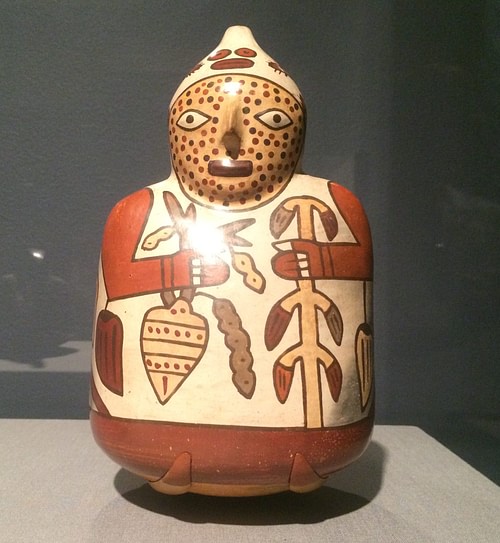 Nazca Figure Vessel James Blake Wiener (CC BY-NC-SA) ](https://www.worldhistory.org/image/4098/nazca-figure-vessel/ "Nazca Figure Vessel")The Nazca did not simply follow the traditions of their predecessors, though, as they eventually created their own unique style and designs evolved from naturalistic to highly ornamented and then, in its final stages, to highly abstract forms and a sort of artist's short-hand. Colours are bold and made more striking via thick black outlines. Often the design covers the entire vessel producing a wrap-around three-dimensional effect, even a narrative, for example, with [battle](https://www.worldhistory.org/disambiguation/battle/) scenes. Designs might also exploit the contours of the vessel, for example, a nose on a protruding part. The lower body of figures is rarely presented and usually blends with the lower, rounded, form of the vessel itself. Designs can even overlap each other to create the illusion of space and depth.
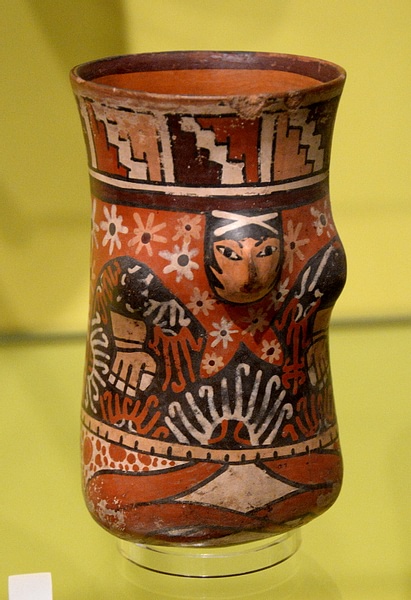
[ 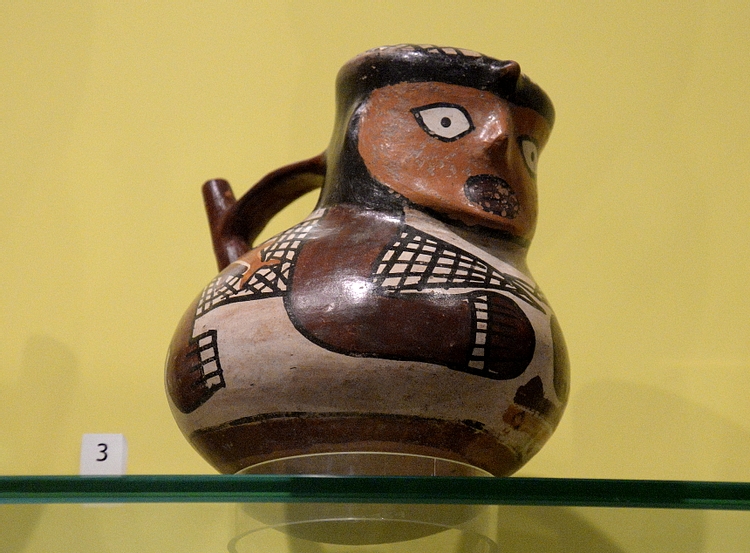 Nazca Fisherman Vessel Osama Shukir Muhammed Amin (Copyright) ](https://www.worldhistory.org/image/4212/nazca-fisherman-vessel/ "Nazca Fisherman Vessel")Maroon, light purple, and blue-grey were a favourite choice of colours but a very wide range was used, more, in fact, than in any other ancient Andean culture. Up to 12 colours were made from mixing water with mineral pigments such as manganese for black and iron oxide for reds. Backgrounds were usually in white, brown, red, or black. Colours were rarely used to depict objects as they appeared in reality but, rather, were used according to a set of artistic conventions. Outlining figures and colour areas with a black line which never varies in thickness is another feature and another example of the Nazca delight in linear design. After firing a final polishing gave the colours a brilliant glossy shine.
[  Nazca Vase wtih Cross-legged Male Osama Shukir Muhammed Amin (Copyright) ](https://www.worldhistory.org/image/4209/nazca-vase-wtih-cross-legged-male/ "Nazca Vase wtih Cross-legged Male")### Legacy
The late Nazca pottery is increasingly abstract in its decoration. Shamans, in particular, are represented with masks carrying many protrusions and body parts disappear into abstract lines and shapes so that the figure is now difficult to identify. This attempt to capture the transformational process during shamanic rituals is known as the Bizarre Innovation Style and it would influence later cultures as the art of the Americas generally became increasingly abstract. The Nazca civilization was conquered by the [Wari](https://www.worldhistory.org/Wari_Civilization/) but their artistic influence on their successors would be passed on again to the [Inca civilization](https://www.worldhistory.org/Inca_Civilization/) and ensured that their art, at least, endured. Nazca artists also worked in precious metals but the fact that they so valued pottery - [archaeology](https://www.worldhistory.org/Archaeology/)'s best survivor - as an art form has meant that their remarkable work has been preserved for posterity.
#### Editorial Review
This human-authored article has been reviewed by our editorial team before publication to ensure accuracy, reliability and adherence to academic standards in accordance with our [editorial policy](https://www.worldhistory.org/static/editorial-policy/).
## Bibliography
- [Alden Mason, J. *Ancient Civilizations of Peru.* Viking Penguin, 1975.](https://www.worldhistory.org/books/B003F9528I/)
- [Baudin, L. *Daily Life of the Incas.* Dover Publications, 2011.](https://www.worldhistory.org/books/0486428001/)
- [Jones, D.M. *The Complete Illustrated History of the Inca Empire.* Lorenz Books, 2012.](https://www.worldhistory.org/books/075482358X/)
- [Kubler, G. *The Art and Architecture of Ancient America, Third Edition.* Yale University Press, 1984.](https://www.worldhistory.org/books/0300053258/)
- [Moseley, M.E. *The Incas and Their Ancestors.* Thames & Hudson, 2001.](https://www.worldhistory.org/books/0500282773/)
- [Stone, R.R. *Art of the Andes.* Thames & Hudson, 2012.](https://www.worldhistory.org/books/0500204152/)
## About the Author
Mark is WHE’s Publishing Director and has an MA in Political Philosophy (University of York). He is a full-time researcher, writer, historian and editor. Special interests include art, architecture and discovering the ideas that all civilizations share.
## External Links
- [Who were the Nasca? | British Museum](https://www.britishmuseum.org/blog/who-were-nasca)
## Cite This Work
### APA
Cartwright, M. (2016, April 05). Nazca Pottery. *World History Encyclopedia*.
### Chicago
Cartwright, Mark. "Nazca Pottery." *World History Encyclopedia*, April 05, 2016. .
### MLA
Cartwright, Mark. "Nazca Pottery." *World History Encyclopedia*, 05 Apr 2016, .
## License & Copyright
Submitted by [Mark Cartwright](https://www.worldhistory.org/user/markzcartwright/ "User Page: Mark Cartwright"), published on 05 April 2016. The copyright holder has published this content under the following license: [Creative Commons Attribution-NonCommercial-ShareAlike](https://creativecommons.org/licenses/by-nc-sa/4.0/deed.en). This license lets others remix, tweak, and build upon this content non-commercially, as long as they credit the author and license their new creations under the identical terms. When republishing on the web a hyperlink back to the original content source URL must be included. Please note that content linked from this page may have different licensing terms.