---
title: Ellora Caves
author: Mark Cartwright
source: https://www.worldhistory.org/article/874/ellora-caves/
format: machine-readable-alternate
license: Creative Commons Attribution-NonCommercial-ShareAlike (https://creativecommons.org/licenses/by-nc-sa/4.0/)
updated: 1970-01-01
---
# Ellora Caves
_Authored by [Mark Cartwright](https://www.worldhistory.org/user/markzcartwright/)_
Ellora (also known as Elura and, in ancient times, as Elapura) is a sacred site in Maharastra, central [India](https://www.worldhistory.org/india/). The Ellora Caves are listed by UNESCO as a World Heritage Site and is celebrated for its [Hindu](https://www.worldhistory.org/hinduism/), [Buddhist](https://www.worldhistory.org/buddhism/), and Jain temples and monuments which were carved from the local cliff rock in the 6th to 8th century CE. The most spectacular example is the 8th century CE Kailasa [temple](https://www.worldhistory.org/temple/) which, at 32 metres high, is the largest rock-cut monument in the world.
[  Kailasa Temple, Ellora Jean-Pierre Dalbéra (CC BY-NC-SA) ](https://www.worldhistory.org/image/4565/kailasa-temple-ellora/ "Kailasa Temple, Ellora")### Hindu Caves
Located in the Sahyadri hills near Aurangabad, Ellora is the most important second-wave site of ancient rock-cut [architecture](https://www.worldhistory.org/disambiguation/architecture/) in India. In the western face of one hill, composed of volcanic Basalt rock, there are 35 caves and rock-cut temples, largely produced during the reign of the Kalachuri dynasty in the 6th and 7th centuries CE.
The earliest cave, the Hindu Ramesvara (no. 21), dates to the 6th century CE. Typical of early Hindu temples there is an inner sanctum (*garbhagriha*), a circumambulatory corridor for worshippers to walk around, vestibules with double porticoes, and extensive decoration via high-relief friezes and carvings depicting scenes from the Puranas sacred texts. Cave 21 has carved river goddesses on the exterior, a [Nandi](https://www.worldhistory.org/Nandi/) [sculpture](https://www.worldhistory.org/disambiguation/Sculpture/) at the entrance and inside are both a large dancing [Shiva](https://www.worldhistory.org/shiva/) surrounded by musicians and Durga slaying the buffalo demon king. Other points of interest are the use of couple figures for brackets (*salabhanjikas*) as well as reliefs of elephants and *mithuna* (lover) figures.
[ 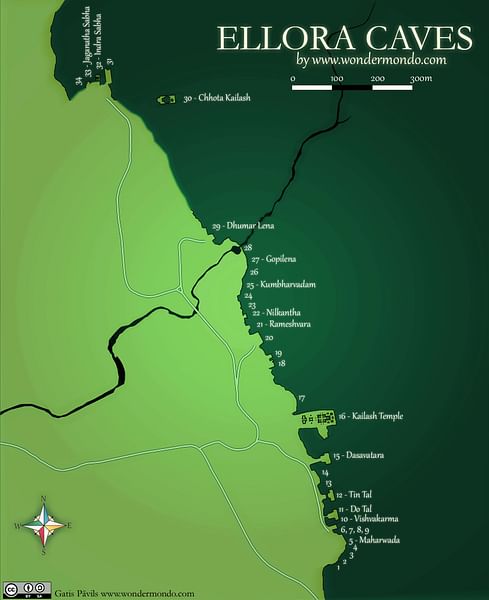 Ellora Caves Map Gatis Pavils (CC BY-NC-SA) ](https://www.worldhistory.org/image/4607/ellora-caves-map/ "Ellora Caves Map")The Dhumar Lena cave (no. 29) seems to replicate the famous cave at Elephanta suggesting a connection between Ellora and the Kalachuris. The figure brackets of cave 21 are additional evidence of a cultural link between the two sites.
The [Ravana](https://www.worldhistory.org/Ravana/)-ka-Khai cave (no. 14) was probably dedicated to a Hindu goddess. It has a wide walk-around passage and colonnaded hall leading to the inner sanctum. The interior walls are decorated with five relief panels, separated by ornate pilasters, and showing show figures of Shiva and [Vishnu](https://www.worldhistory.org/Vishnu/).
### Kailasa Temple
The Kailasa temple (structure no. 16) is one of the most spectacular monuments in the world and it is the largest rock-cut structure anywhere. Built by Krsna I (r. 756-773 CE) of the [Rashtrakuta dynasty](https://www.worldhistory.org/Rashtrakuta_Dynasty/) to celebrate his victory over the Pallavas, it increased even more the grandeur of Ellora, which had been made capital by Dantidurga, Krsna's predecessor, following his victory over the rival Chalukyas in c. 753 CE. The Kailasa is the most northern example of the southern Dravida temple style and is similar to the Kailasanatha at [Kanchipuram](https://www.worldhistory.org/Kanchipuram/). It is a pancayatana or five-shrine temple.
[  Staircase of the Kailasa Temple, Ellora Jean-Pierre Dalbéra (CC BY) ](https://www.worldhistory.org/image/4153/staircase-of-the-kailasa-temple-ellora/ "Staircase of the Kailasa Temple, Ellora")As its name suggests (the name of Shiva's mythical dwelling in the Himalaya) the temple was dedicated to Shiva, and indeed, may have sought to replicate his [palace](https://www.worldhistory.org/disambiguation/palace/) on earth. That this was the architect's intention is supported by the carved scene of Ravana trapped beneath Shiva's mountain placed under the temple itself. An additional mountain effect is achieved by the whole temple being situated on a high platform which worshippers must climb via two monumental staircases.
The temple was built by digging out from the sloping basalt hill two massive tranches, each 90 m long and joined with a connecting trench 53 m in length. The temple was then carved from the remaining central portion. This resulted in a 32-metre high structure that seems to come out of the ground. The temple has a three-storey *vimana* (tower) with octagonal dome and two huge free-standing columns (*dhvajastambhas*) flanking the mandapa entrance hall which has 16 columns set in groups of four. There is also the usual Nandi shrine with Shiva's sacred bull calf staring in the direction of the inner sanctuary. The temple, even if they are not structurally required, has all the architectural details of a real, block-built temple with bases, beams, columns, capitals, brackets, and pilasters.
[ 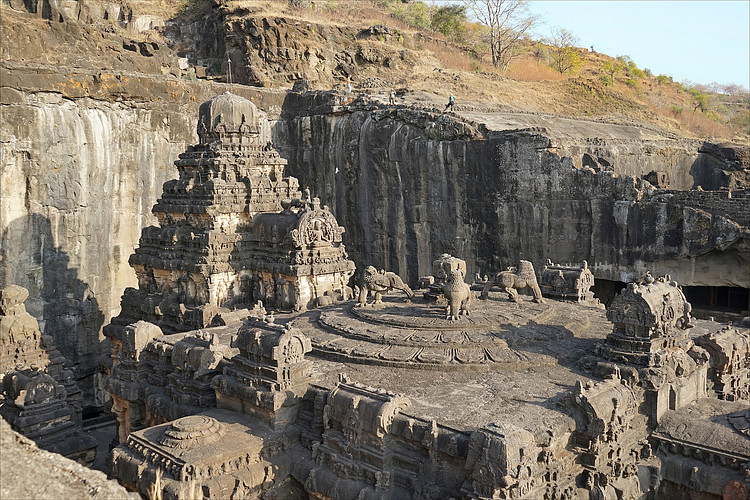 Roof of Kailasa Temple, Ellora Jean-Pierre Dalbéra (CC BY) ](https://www.worldhistory.org/image/4566/roof-of-kailasa-temple-ellora/ "Roof of Kailasa Temple, Ellora")Shiva is represented in sculptural additions such as his trident and sacred cow Nandi which are carved on the two [giant](https://www.worldhistory.org/Giants/) columns, and a huge *linga* (phallus) was stored in the inner sanctum. The whole temple carries relief carvings of scenes from the sacred Hindu texts the [Mahabharata](https://www.worldhistory.org/Mahabharata/) and [Ramayana](https://www.worldhistory.org/The_Ramayana/), as well as groups of elephants and lions.
A [copper](https://www.worldhistory.org/copper/) plate contemporary with the temple's construction gives this impressive description:
> A temple...on the hill at Elapura, of a wonderful structure, - on seeing which the best of [immortals](https://www.worldhistory.org/disambiguation/immortals/) who move in celestial cars, struck with astonishment, think much constantly, saying, 'this temple of Shiva is self-existant; in a thing made by art such beauty is not seen, a temple the architect-builder of which, in consequence of the failure of his energy as regards another such work, was himself suddenly struck with astonishment, saying "Oh, how was it that I built it."' (Harle, 181)
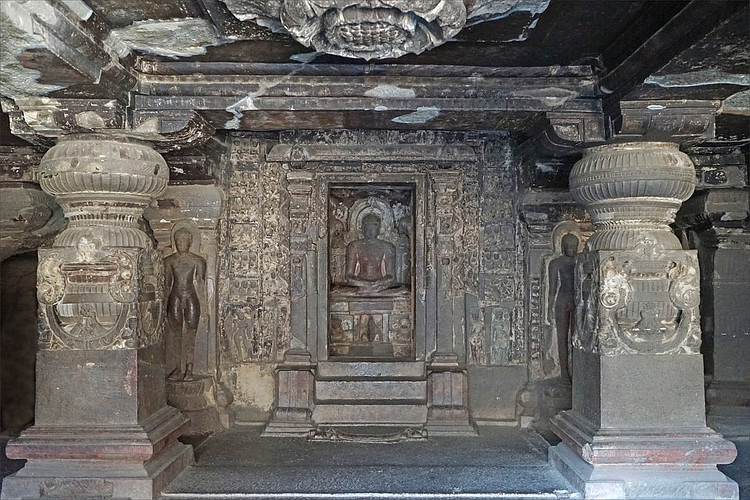
On the left side of the temple a monumental gateway (*gopura*) was carved and the rest of the surrounding walls were carved to create shrines and galleries. Just off from the Kailasa are two more temples, albeit on a much smaller scale. There is the [Indra](https://www.worldhistory.org/Indra/) Sabha with its gopura and the Jagannatha Sabha; both are Jain temples and were the last structures to be built at ancient Ellora.
[  Indra Sabha Cave Temple, Ellora Jean-Pierre Dalbéra (CC BY) ](https://www.worldhistory.org/image/4150/indra-sabha-cave-temple-ellora/ "Indra Sabha Cave Temple, Ellora")### Buddhist Caves
The Buddhist caves are amongst the largest excavated anywhere and were carved later than the Hindu ones, probably between the 7th and 8th centuries CE. Their layouts are more complex and the capitals in the colonnades are either the vase and foliage or chamfered cushions type. Cave 5 is especially grand and unusually deep. It has 17 cells and a large rectangular hall with two rows of 10 columns between which are set stone benches in two rows. The function of these remains a mystery beyond the surmise that monks gathered there for assemblies of some sort.
The interior decoration of these caves displays figures of [Buddha](https://www.worldhistory.org/Siddhartha_Gautama/) in his various guises and many Bodhisattvas, some being the earliest instances, for example of [Tara](https://www.worldhistory.org/Tara_(Goddess)/). Several of the inner sanctums are flanked by a Bodhisattva figure. There are examples of Hindu influence in the depiction of four-armed figures, with the carving in Cave 8 being the earliest such example yet discovered.
[ 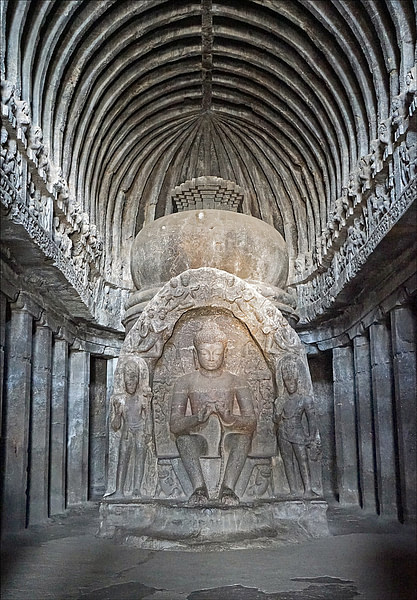 Visvakarma Cave Temple, Ellora Jean-Pierre Dalbéra (CC BY) ](https://www.worldhistory.org/image/4151/visvakarma-cave-temple-ellora/ "Visvakarma Cave Temple, Ellora")Cave 12 is the most ornate of the Buddhist caves while the Visvakarma cave (no. 10) has one of the largest seated Buddha figures. The latter cave was probably cut in c. 650 CE and, after a large open court space, presents a hugely impressive facade on two levels. The ground floor has a four-[column](https://www.worldhistory.org/column/) facade while above is a veranda with a large central caitya window. On either side of this window, which leads to an interior barrel-vaulted gallery, is a deep and richly carved niche and relief panels. Finally, the Dasavatara cave (no. 15) is of interest as it contains the only significant ancient inscription, in this case, describing a visit by Rastrakuta Dantidurga, a local ruler, between c. 730 and 755 CE.
#### Editorial Review
This human-authored article has been reviewed by our editorial team before publication to ensure accuracy, reliability and adherence to academic standards in accordance with our [editorial policy](https://www.worldhistory.org/static/editorial-policy/).
## Bibliography
- [Craven, R.C. *Indian Art.* Thames & Hudson, 1997.](https://www.worldhistory.org/books/0500203024/)
- [Harle, J.C. *The Art and Architecture of the Indian Subcontinent, Second Edition.* Yale University Press, 1994.](https://www.worldhistory.org/books/0300062176/)
- [Michell, G. *Hindu Art and Architecture.* Thames & Hudson, 2000.](https://www.worldhistory.org/books/0500203377/)
- [Mitter, P. *Indian Art.* Oxford University Press, 2001.](https://www.worldhistory.org/books/B010DTXVYY/)
## About the Author
Mark is WHE’s Publishing Director and has an MA in Political Philosophy (University of York). He is a full-time researcher, writer, historian and editor. Special interests include art, architecture and discovering the ideas that all civilizations share.
## Cite This Work
### APA
Cartwright, M. (2016, March 08). Ellora Caves. *World History Encyclopedia*.
### Chicago
Cartwright, Mark. "Ellora Caves." *World History Encyclopedia*, March 08, 2016. .
### MLA
Cartwright, Mark. "Ellora Caves." *World History Encyclopedia*, 08 Mar 2016, .
## License & Copyright
Submitted by [Mark Cartwright](https://www.worldhistory.org/user/markzcartwright/ "User Page: Mark Cartwright"), published on 08 March 2016. The copyright holder has published this content under the following license: [Creative Commons Attribution-NonCommercial-ShareAlike](https://creativecommons.org/licenses/by-nc-sa/4.0/deed.en). This license lets others remix, tweak, and build upon this content non-commercially, as long as they credit the author and license their new creations under the identical terms. When republishing on the web a hyperlink back to the original content source URL must be included. Please note that content linked from this page may have different licensing terms.