---
title: The Library of Hadrian, Athens
author: Mark Cartwright
source: https://www.worldhistory.org/article/839/the-library-of-hadrian-athens/
format: machine-readable-alternate
license: Creative Commons Attribution-NonCommercial-ShareAlike (https://creativecommons.org/licenses/by-nc-sa/4.0/)
updated: 2025-06-18
---
# The Library of Hadrian, Athens
_Authored by [Mark Cartwright](https://www.worldhistory.org/user/markzcartwright/)_
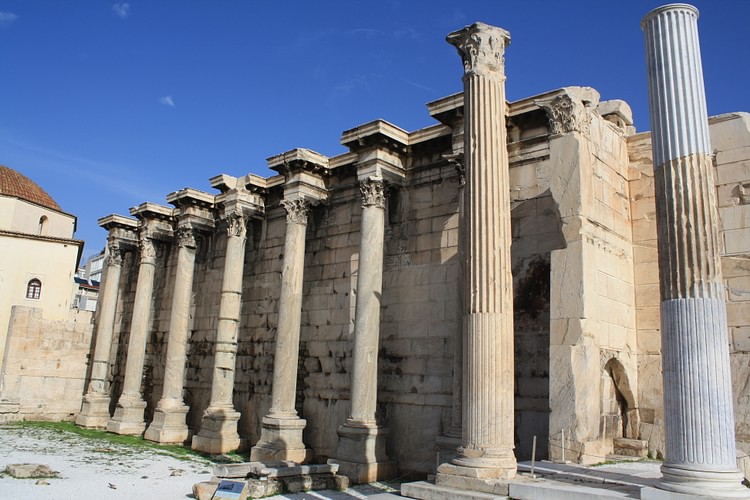
The Library of [Hadrian](https://www.worldhistory.org/hadrian/) (aka Hadrian's Library) in [Athens](https://www.worldhistory.org/Athens/) was constructed circa 132-134 CE as part of [Roman Emperor](https://www.worldhistory.org/Roman_Emperor/) Hadrian's grand re-building plan for the [city](https://www.worldhistory.org/city/). The library was the largest in Athens and with its columned façade and high surrounding walls, built to impress. The building was used to store important literary works and legal and administrative documents as well as offer a place to hear lectures and host various philosophical schools.
[  Facade, Library of Hadrian, Athens Mark Cartwright (CC BY-NC-SA) ](https://www.worldhistory.org/image/4133/facade-library-of-hadrian-athens/ "Facade, Library of Hadrian, Athens")### Historical Overview
Located just outside the northern corner of the [Roman](https://www.worldhistory.org/disambiguation/Roman/) [Agora](https://www.worldhistory.org/agora/), the library was built on the site of Late [Hellenistic](https://www.worldhistory.org/Hellenic_World/) and Early Roman housing. Becoming the largest library in Athens it was built to house not only books but also as a repository for the official state archives. Several important schools of learning and [philosophy](https://www.worldhistory.org/philosophy/) also occupied the building.
Libraries in antiquity were not generally used as lending libraries but rather as places of study and storage. Documents were usually in the form of papyrus scrolls which were kept in partitioned wooden cupboards (*armaria*) set in niches in the walls of the room. Libraries were also a place to hear lectures and orators, and discuss intellectual matters with fellow visitors in the tranquility of the library garden. The Library of Hadrian was famously described by [Pausanias](https://www.worldhistory.org/disambiguation/Pausanias/) as "the building with 100 columns of Phrygian marble, with halls with painted ceilings, alabaster walls, and niches with statues, in which books were kept" (*Attica*).
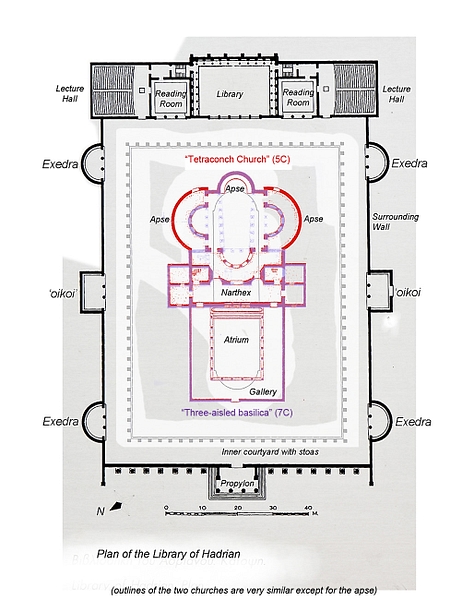
During the invasion by the Heruli in 267 CE, the library suffered notable damage and in 277 CE, when the city sought to better protect itself, the library was made part of a fortification [wall](https://www.worldhistory.org/wall/). The library was renovated by Herculius (407-12 CE), the Prefectus (Eparch) of the Illyricum, and a statue of him was erected at the building's entrance. The inscription related to this statue is still visible on the left side of the entrance. It is possible that at the same time an early Christian church was built in the central garden space, although this four-apse structure may have been built in the mid-5th century CE. This Christian church, Athens' first in fact, was destroyed in the 6th century CE and so replaced by a large three-aisled basilica.
[  Plan of Hadrian's Library Robert H.Consoli (Copyright) ](https://www.worldhistory.org/image/4136/plan-of-hadrians-library/ "Plan of Hadrian's Library")### Layout & Dimensions
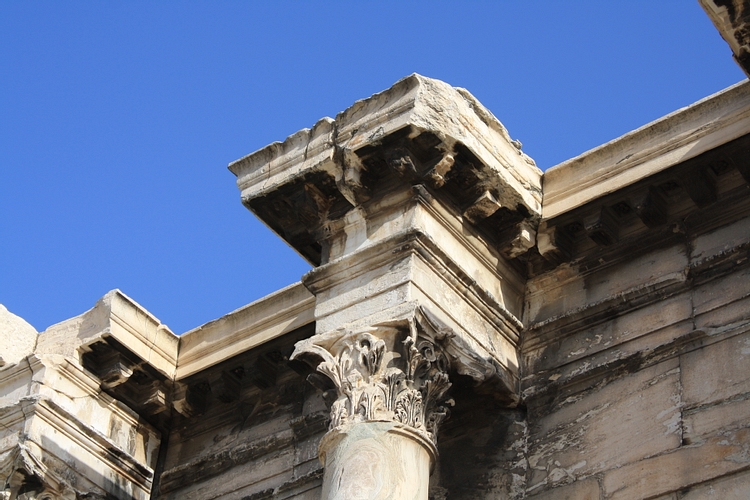
Built on a rectangular plan the peristyle-formed library measured 122 x 82 m. The impressive entrance, located on the west side of the building, had a Corinthian columned porch (*[propylon](https://www.worldhistory.org/Propylaea/)*). This was built in the centre of a columned façade with seven Corinthian columns in green Karystos marble either side of the entrance doorway. These columns may originally have had statues above them backed by a solid wall of Pentelic marble. The entrance was given even greater grandeur by clearing a 22 metre-wide courtyard space immediately in front of the building.
The large interior courtyard was surrounded by colonnades with 100 columns whilst the exterior of the library presented a high plain wall of poros blocks. The courtyard had *exedrae* (semi-circular seating spaces) at each corner with *oikoi* (rectangular spaces) at the centre points. In the centre of the courtyard was a garden and decorative pool. An inscription at the site indicates that the library was open 'from the first hour until the sixth'.
[  Capital, Library of Hadrian Mark Cartwright (CC BY-NC-SA) ](https://www.worldhistory.org/image/4134/capital-library-of-hadrian/ "Capital, Library of Hadrian")The main part of the building was opposite the entrance on the eastern side. Here in the centre was the square library itself with a reading room on either side and a lecture hall (*auditorium*) at each end of the wing. The lecture halls each had rows of curved seating rising as in an [amphitheatre](https://www.worldhistory.org/amphitheatre/). The structure originally had a second floor or attic with a gallery looking down on the lower floor and with more niches for the storage of books and documents.### Later History
Like many ancient buildings the library complex saw an eventful and chequered history in the last 1000 years. The large 7th century CE basilica at the site was destroyed by fire in the 11th century CE and so was replaced by another basilica, the Megali Panagia, in the 12th century CE, only this time on a smaller scale with only a single aisle. Contemporary with this new cathedral was a smaller church, the Agios Asomatos sta Skalia dedicated to the Archangel Michael which was built near the entrance.
When Athens came under Turkish control the library was once again used as a centre of administration and became the residence of the Turkish Administrator of Athens. From the 15th century CE it was also the site of two important bazaars and some residential buildings. During the 18th century CE the building served both as a mosque and as a fortress. A tower was built in 1814 CE which would later carry a clock given by Lord Elgin and in the 19th century CE the library saw service as an army barracks and then as a prison.
[ 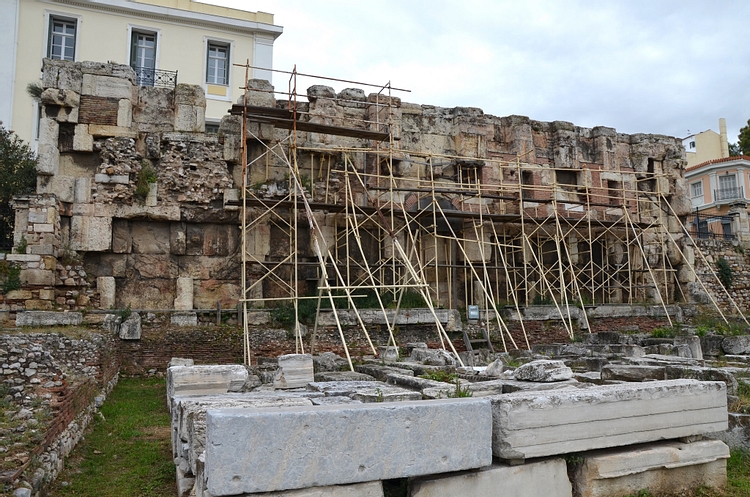 Library of Hadrian, East Wall Carole Raddato (CC BY-SA) ](https://www.worldhistory.org/image/4135/library-of-hadrian-east-wall/ "Library of Hadrian, East Wall")Excavations at the site began in the late 19th century CE but it was not until the second half of the 20th century CE that the later buildings were cleared from the site and an attempt was made to restore parts of the library to its original form. Today the entrance façade survives in sufficient form (including restorations) to give an idea of the scale of the building and part of the interior wall of the east wing still stands where one can see some of the original niches for documents. The bench supports of the northeast lecture hall, including the curved stone first row, are also still *in situ*. Finally, architectural elements of the various churches built in the central courtyard are still visible, including portions of their [mosaic](https://www.worldhistory.org/Mosaic/) flooring.
#### Editorial Review
This human-authored article has been reviewed by our editorial team before publication to ensure accuracy, reliability and adherence to academic standards in accordance with our [editorial policy](https://www.worldhistory.org/static/editorial-policy/).
## Bibliography
- Choremi-Spetsieri, A. *Roman Agora - Library of Hadrian.* Hellenic Ministry of Culture, Athens, 2004
- Green, P. *The Parthenon.* Newsweek Book Divsiion, N.Y., 1973
- [Hornblower, S. *The Oxford Classical Dictionary.* Oxford University Press, 2012.](https://www.worldhistory.org/books/0199545561/)
- Soulas, D. *The Library of Hadrian.* Hellenic Ministry of Culture, Athens, 2014
## About the Author
Mark is WHE’s Publishing Director and has an MA in Political Philosophy (University of York). He is a full-time researcher, writer, historian and editor. Special interests include art, architecture and discovering the ideas that all civilizations share.
## Cite This Work
### APA
Cartwright, M. (2015, November 05). The Library of Hadrian, Athens. *World History Encyclopedia*.
### Chicago
Cartwright, Mark. "The Library of Hadrian, Athens." *World History Encyclopedia*, November 05, 2015. .
### MLA
Cartwright, Mark. "The Library of Hadrian, Athens." *World History Encyclopedia*, 05 Nov 2015, .
## License & Copyright
Submitted by [Mark Cartwright](https://www.worldhistory.org/user/markzcartwright/ "User Page: Mark Cartwright"), published on 05 November 2015. The copyright holder has published this content under the following license: [Creative Commons Attribution-NonCommercial-ShareAlike](https://creativecommons.org/licenses/by-nc-sa/4.0/deed.en). This license lets others remix, tweak, and build upon this content non-commercially, as long as they credit the author and license their new creations under the identical terms. When republishing on the web a hyperlink back to the original content source URL must be included. Please note that content linked from this page may have different licensing terms.