---
title: Temple of Olympian Zeus, Athens
author: Mark Cartwright
source: https://www.worldhistory.org/article/815/temple-of-olympian-zeus-athens/
format: machine-readable-alternate
license: Creative Commons Attribution-NonCommercial-ShareAlike (https://creativecommons.org/licenses/by-nc-sa/4.0/)
updated: 1970-01-01
---
# Temple of Olympian Zeus, Athens
_Authored by [Mark Cartwright](https://www.worldhistory.org/user/markzcartwright/)_
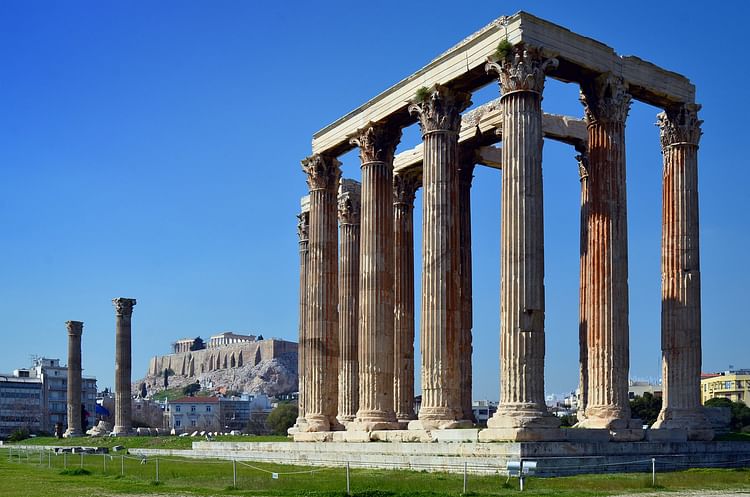
The [Temple](https://www.worldhistory.org/temple/) of Olympian [Zeus](https://www.worldhistory.org/zeus/) in [Athens](https://www.worldhistory.org/Athens/), also known as the Olympieion, was built over several centuries starting in 174 BCE and only finally completed by [Roman emperor](https://www.worldhistory.org/Roman_Emperor/) [Hadrian](https://www.worldhistory.org/hadrian/) in 131 CE. Its unusually tall columns and ambitious layout made the temple one of the largest ever built in the ancient world.
[  The Temple of Olympian Zeus, Athens George Rex (CC BY-SA) ](https://www.worldhistory.org/image/4005/the-temple-of-olympian-zeus-athens/ "The Temple of Olympian Zeus, Athens")### Historical Overview
Located south-east of Athens' [acropolis](https://www.worldhistory.org/Acropolis/) near the River Ilissos, the temple would become the [city](https://www.worldhistory.org/city/)'s largest. The site shows evidence of habitation from the [Neolithic period](https://www.worldhistory.org/Neolithic/) while [Pausanias](https://www.worldhistory.org/disambiguation/Pausanias/) claimed the ancient sanctuary to Zeus was first created at the site by the mythical figure of Deukalion. The earliest archaeological evidence of a temple in the area dates to the 6th century BCE. The tyrant [Peisistratos](https://www.worldhistory.org/Pisistratus/) the Younger began to build a new and much bigger Doric temple in 515 BCE. The plans were devised by the architects Antistates, Callaeschrus, and Antimachides but work got no further than the limestone base before Peisistratos was deposed and the project was abandoned.
Building work began again in 174 BCE under [Antiochos](https://www.worldhistory.org/disambiguation/antiochos/) IV Epiphanes, the King of [Syria](https://www.worldhistory.org/syria/). He employed the skills of the [Roman](https://www.worldhistory.org/disambiguation/Roman/) architect Cossutius and by 163 BCE the columns and entablature of the now Corinthian order temple were finally erected. Unfortunately, once again the project fell by the wayside upon the [death](https://www.worldhistory.org/disambiguation/Death/) of Antiochos. Another couple of centuries passed before no less a figure than Hadrian, during his stay in Athens between 124 and 125 CE, took up the construction again. [Sulla](https://www.worldhistory.org/sulla/) had actually stolen a few of the columns in 86 BCE for re-use in [Rome](https://www.worldhistory.org/Rome/)'s Temple of [Jupiter](https://www.worldhistory.org/jupiter/) and [Augustus](https://www.worldhistory.org/augustus/) had dabbled a little with rebuilding the temple in the early 1st century CE but it was Hadrian, the great philhellene, who finally managed to finish one of the biggest ever ancient temples in 131 CE.
[  Temple of Olympian Zeus, Athens Mark Cartwright (CC BY-NC-SA) ](https://www.worldhistory.org/image/386/temple-of-olympian-zeus-athens/ "Temple of Olympian Zeus, Athens")Between 124 and 132 CE a rectangular precinct [wall](https://www.worldhistory.org/wall/) was built around the temple, [Roman baths](https://www.worldhistory.org/Roman_Baths/) were added to the site, and a monumental arch 18 m high, Hadrian's Arch, set at the entrance to the new sanctuary area. Also in 131/2 CE, the Temple of Zeus Panhellenios was built to the south of the main temple and in 150 CE the Temple of Kronos and [Rhea](https://www.worldhistory.org/Rhea/) added nearby. These buildings were then enclosed within the main complex by the [Valerian](https://www.worldhistory.org/valerian/) Wall, a fortification built between 256 and 260 CE. In 450 CE the Basilica Olympieion was built along the northern side of the original precinct wall.
### Layout & Dimensions
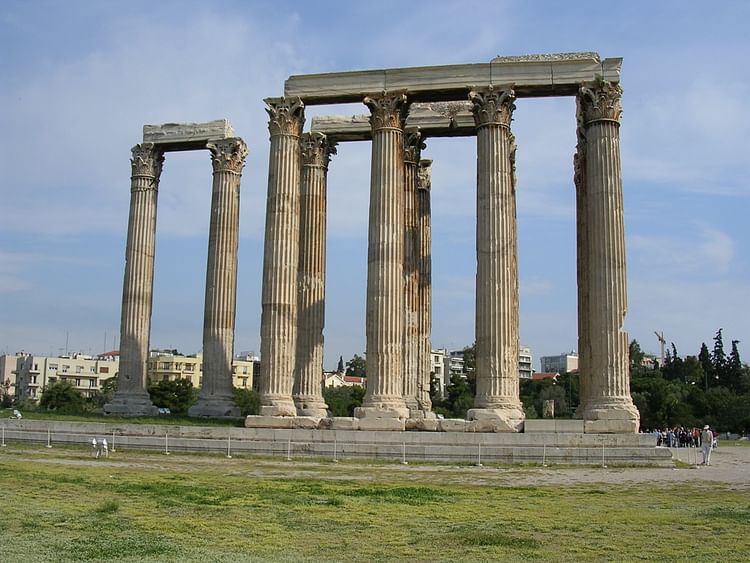
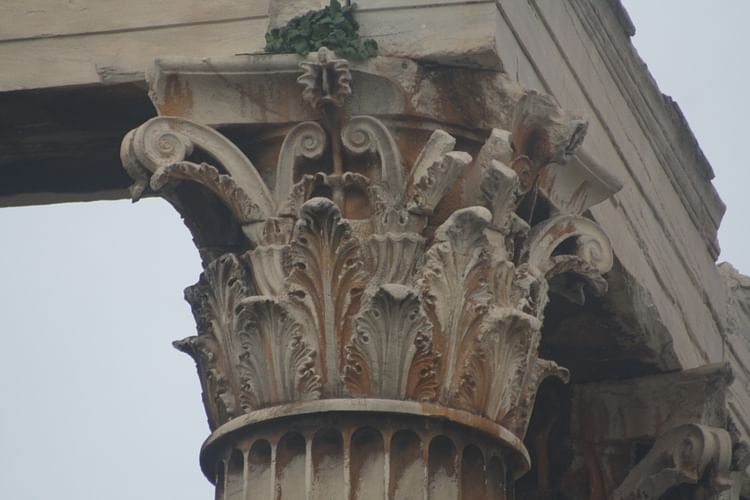
The temple was given extra grandeur by being built in an open space of 250 x 130 m. This area was enclosed by a low poros wall buttressed with regularly spaced Corinthian columns set along the interior face. A [propylon](https://www.worldhistory.org/Propylaea/) gate in Hymettan marble was placed in the north-west corner of the wall. In the centre of this rectangle the massive marble Temple of Zeus measured 110.35 x 43.68 m. The Corinthian columns are unusually tall at 17.25 m and have a diameter of 1.7 m and 20 flutes. The long side presented 20 columns each and the short sides 8 (dipteral octastyle). These were placed in double rows along the length and triple rows at each short side. Thus there were originally 104 columns. The columns are capped by highly decorative Corinthian capitals carved from two massive blocks of marble. Within the cella were gigantic chryselephantine ([gold](https://www.worldhistory.org/gold/) and ivory) statues of Zeus and the temple's main benefactor Hadrian, who was given equal status to the great [Greek](https://www.worldhistory.org/disambiguation/greek/) [god](https://www.worldhistory.org/God/).
[  Corinthian Capital, Temple of Zeus, Athens Mark Cartwright (CC BY-NC-SA) ](https://www.worldhistory.org/image/4004/corinthian-capital-temple-of-zeus-athens/ "Corinthian Capital, Temple of Zeus, Athens")The temple suffered over the centuries and much of its material was re-used in other buildings so that today only 15 of the temple's columns are still standing, 2 in the south-west corner and 13 at the south-east corner. One other [column](https://www.worldhistory.org/column/) collapsed as recently as 1852 CE in a storm and now lies across the site with its column drums picturesquely spread along a perfect line.
#### Editorial Review
This human-authored article has been reviewed by our editorial team before publication to ensure accuracy, reliability and adherence to academic standards in accordance with our [editorial policy](https://www.worldhistory.org/static/editorial-policy/).
## Bibliography
- Ananiades, D. *Ancient Greece: Temples & Sanctuaries.* Toubis, 2010
- Chatzipoulou, E. *The Olympieion.* Hellenic Ministry of Culture, 2014
- [Hornblower, S. *The Oxford Classical Dictionary.* Oxford University Press, 2012.](https://www.worldhistory.org/books/0199545561/)
## About the Author
Mark is WHE’s Publishing Director and has an MA in Political Philosophy (University of York). He is a full-time researcher, writer, historian and editor. Special interests include art, architecture and discovering the ideas that all civilizations share.
## Cite This Work
### APA
Cartwright, M. (2015, August 18). Temple of Olympian Zeus, Athens. *World History Encyclopedia*.
### Chicago
Cartwright, Mark. "Temple of Olympian Zeus, Athens." *World History Encyclopedia*, August 18, 2015. .
### MLA
Cartwright, Mark. "Temple of Olympian Zeus, Athens." *World History Encyclopedia*, 18 Aug 2015, .
## License & Copyright
Submitted by [Mark Cartwright](https://www.worldhistory.org/user/markzcartwright/ "User Page: Mark Cartwright"), published on 18 August 2015. The copyright holder has published this content under the following license: [Creative Commons Attribution-NonCommercial-ShareAlike](https://creativecommons.org/licenses/by-nc-sa/4.0/deed.en). This license lets others remix, tweak, and build upon this content non-commercially, as long as they credit the author and license their new creations under the identical terms. When republishing on the web a hyperlink back to the original content source URL must be included. Please note that content linked from this page may have different licensing terms.