---
title: Theatre of Dionysos Eleuthereus
author: Mark Cartwright
source: https://www.worldhistory.org/article/814/theatre-of-dionysos-eleuthereus/
format: machine-readable-alternate
license: Creative Commons Attribution-NonCommercial-ShareAlike (https://creativecommons.org/licenses/by-nc-sa/4.0/)
updated: 1970-01-01
---
# Theatre of Dionysos Eleuthereus
_Authored by [Mark Cartwright](https://www.worldhistory.org/user/markzcartwright/)_
The [theatre](https://www.worldhistory.org/disambiguation/theatre/) of [Dionysos](https://www.worldhistory.org/Dionysos/) Eleuthereus on the south slope of the [acropolis](https://www.worldhistory.org/Acropolis/) of [Athens](https://www.worldhistory.org/Athens/) was first built in the 6th century BCE. Modified and expanded over the centuries, it is the oldest [Greek theatre](https://www.worldhistory.org/Greek_Theatre/) and is the site where some of the most famous [Greek](https://www.worldhistory.org/disambiguation/greek/) plays from antiquity were first performed.
### Early Form
The theatre was part of a wider sanctuary dedicated to Dionysos Eleuthereus from the [Archaic period](https://www.worldhistory.org/Archaic_Period/). The cult to the Greek [god](https://www.worldhistory.org/God/) of wine, merriment, and theatre was brought to Athens via the nearby deme of Eleutherai, although it can be traced back to [Mycenaean](https://www.worldhistory.org/Mycenaean_Civilization/) times. A [temple](https://www.worldhistory.org/temple/) to Dionysos was first constructed by [Peisistratos](https://www.worldhistory.org/Pisistratus/) in the 6th century CE, and a circular area of tramped earth nearby was reserved for religious ceremonies where spectators took their seats on the hillside. Eventually this space evolved into a purpose-built theatre where Greek comedies and tragedies were performed, themselves evolved from earlier religious practices which included singing, wine drinking, animal sacrifices, and the wearing of masks. The climax of the celebrations was the Great Dionysia held each year in March/April, during the month of *Elaphebolion*, where the most famous playwrights such as [Euripides](https://www.worldhistory.org/Euripides/), [Sophocles](https://www.worldhistory.org/sophocles/), and [Aristophanes](https://www.worldhistory.org/Aristophanes/) presented their plays in competition.
[  Theatre of Dionysos Eleuthereus, Athens Mark Cartwright (CC BY-NC-SA) ](https://www.worldhistory.org/image/3763/theatre-of-dionysos-eleuthereus-athens/ "Theatre of Dionysos Eleuthereus, Athens")### 5th Century BCE Remodelling
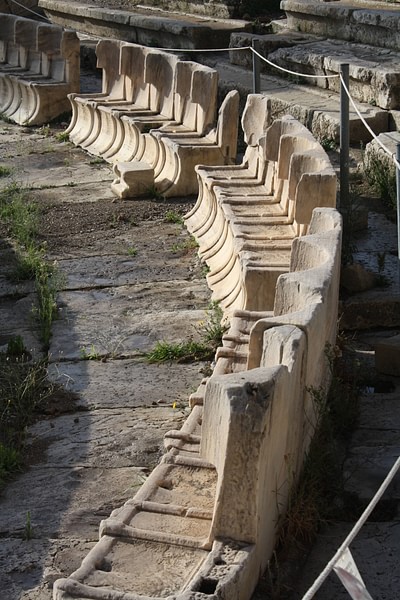
In the 5th century BCE rows of seats were added around the performing area (*orchestra*), the front rows being stone and the rest of wood. These seats formed the first *cavea* which had flights of steps rising to the highest rows thus creating *cunei* or wedge-shaped sections of seats. *Parodoi* or large gateways were built either side of the stage giving access to spectators. A stone rectangular stage building or *skene* was added at the end of the 5th century BCE. The *skene* had *paraskenia* or wings on each side.
[  Seats of the Theatre of Dionysos, Athens Mark Cartwright (CC BY-NC-SA) ](https://www.worldhistory.org/image/3766/seats-of-the-theatre-of-dionysos-athens/ "Seats of the Theatre of Dionysos, Athens")### 4th Century BCE Improvements
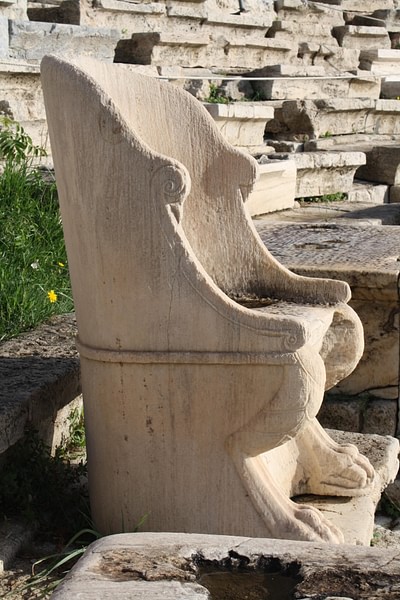
The theatre was remodelled and made much more grandiose in 330 BCE by the archon Lykourgos. Additional rows of seats using limestone from nearby [Piraeus](https://www.worldhistory.org/Piraeus/) were added to the *cavea*, as were two extra horizontal walkways (*diazoma*) between seat sections giving the theatre a capacity of up to 16,000. The front row seats were made more comfortable with the addition of 67 thrones carved in marble. These seats were reserved for VIP officials who even had their names inscribed on them. One central throne in particular was more splendid than the rest and reserved for the priest of Dionysos. Lykourgos re-vamped the stone stage building, too. Sloping access ramps were also added to each side of the theatre to facilitate the emptying of the *cavea* after a performance. At this time three [bronze](https://www.worldhistory.org/disambiguation/bronze/) statues of the great tragedians [Aeschylus](https://www.worldhistory.org/Aeschylus/), Euripides, and Sophocles were erected at the main east entrance.
[  Seat from the Theatre of Dionysos, Athens Mark Cartwright (CC BY-NC-SA) ](https://www.worldhistory.org/image/3764/seat-from-the-theatre-of-dionysos-athens/ "Seat from the Theatre of Dionysos, Athens")### [Roman](https://www.worldhistory.org/disambiguation/Roman/) Aggrandizement
In [Hellenistic](https://www.worldhistory.org/Hellenic_World/) and Roman times the theatre continued to hold performances. The Romans, as they did to most Greek theatres across the [empire](https://www.worldhistory.org/empire/), greatly enlarged the *skene*. [Sulla](https://www.worldhistory.org/sulla/)'s attack on the [city](https://www.worldhistory.org/city/) also damaged the theatre in 86 BCE but restoration work was subsequently carried out. In the 1st century CE [Nero](https://www.worldhistory.org/Nero/) once again added a monumental Romanesque stage building which reduced the now marble stage area to its semi-circular form still seen today. From this period six marble statues of Silenos, the aged companion and tutor of Dionysos, survive which once stood on the stage.
A low speaker's platform (*bema*) was added in front of the skene in the 2nd or 3rd century CE. The *bema* was decorated with marble reliefs depicting myths of Dionysos in the 5th century CE by the archon Phaidros and these, albeit weather-damaged, are still visible today.
[  Sculptural Decoration, Theatre of Dionysos, Athens Mark Cartwright (CC BY-NC-SA) ](https://www.worldhistory.org/image/3765/sculptural-decoration-theatre-of-dionysos-athens/ "Sculptural Decoration, Theatre of Dionysos, Athens")### Later History
In the mid-5th century CE a Christian Basilica was constructed in the east *parodos* of the theatre. In the 13th century CE the theatre was incorporated into the Rizokastro fortification [wall](https://www.worldhistory.org/wall/) which ran around the base of acropolis. Over subsequent centuries many of the acropolis monuments, including the theatre, gradually became covered in earth fill. The theatre was first excavated in 1838 CE by the Archaeological Society of Athens, a process continued in the 1860s and again in the 1880s CE. Further excavation and some restoration of the theatre were first carried out in the 1980s CE and continue today.
#### Editorial Review
This human-authored article has been reviewed by our editorial team before publication to ensure accuracy, reliability and adherence to academic standards in accordance with our [editorial policy](https://www.worldhistory.org/static/editorial-policy/).
## Bibliography
- Ananiades, D. *Ancient Greece: Temples & Sanctuaries.* Toubis, Athens, 2010
- Kavvadias, G. & E. Giannikapani. *South Slope of the Acropolis.* Hellenic Ministry of Culture, 2004
- [Papathanassopoulos, G. *The Acropolis.* Krene, 2006.](https://www.worldhistory.org/books/B000TBGWKC/)
- [Servi, K. *The Acropolis.* Ekdotike Athenon, 2011.](https://www.worldhistory.org/books/9602134526/)
## About the Author
Mark is WHE’s Publishing Director and has an MA in Political Philosophy (University of York). He is a full-time researcher, writer, historian and editor. Special interests include art, architecture and discovering the ideas that all civilizations share.
## Cite This Work
### APA
Cartwright, M. (2015, August 24). Theatre of Dionysos Eleuthereus. *World History Encyclopedia*.
### Chicago
Cartwright, Mark. "Theatre of Dionysos Eleuthereus." *World History Encyclopedia*, August 24, 2015. .
### MLA
Cartwright, Mark. "Theatre of Dionysos Eleuthereus." *World History Encyclopedia*, 24 Aug 2015, .
## License & Copyright
Submitted by [Mark Cartwright](https://www.worldhistory.org/user/markzcartwright/ "User Page: Mark Cartwright"), published on 24 August 2015. The copyright holder has published this content under the following license: [Creative Commons Attribution-NonCommercial-ShareAlike](https://creativecommons.org/licenses/by-nc-sa/4.0/deed.en). This license lets others remix, tweak, and build upon this content non-commercially, as long as they credit the author and license their new creations under the identical terms. When republishing on the web a hyperlink back to the original content source URL must be included. Please note that content linked from this page may have different licensing terms.