---
title: Julius Caesar: The Faults Behind the Myth
author: Marc Hyden
source: https://www.worldhistory.org/article/807/julius-caesar-the-faults-behind-the-myth/
format: machine-readable-alternate
license: Creative Commons Attribution-NonCommercial-ShareAlike (https://creativecommons.org/licenses/by-nc-sa/4.0/)
updated: 2015-06-24
---
# Julius Caesar: The Faults Behind the Myth
_Authored by [Marc Hyden](https://www.worldhistory.org/user/marc.hyden/)_
Last March marked the anniversary of [Julius Caesar](https://www.worldhistory.org/Julius_Caesar/)'s assassination over 2,000 years ago, and after two millennia, his legendary achievements still linger in today's consciousness just as they have for centuries. He was so revered that in [Dante](https://www.worldhistory.org/Dante_Alighieri/)'s Inferno, his conspirators shared the lowest circle of hell with [Judas Iscariot](https://www.worldhistory.org/Judas_Iscariot/), labeling them the worst sinners in history. Even [Alexander Hamilton](https://www.worldhistory.org/Alexander_Hamilton/) claimed, “The greatest man who ever lived was [Julius](https://www.worldhistory.org/disambiguation/Julius/) [Caesar](https://www.worldhistory.org/disambiguation/caesar/).” Could he really have been that great?
[ 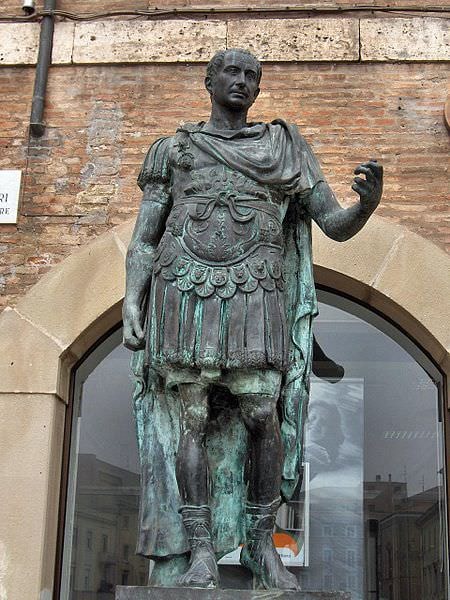 Julius Caesar Georges Jansoone (CC BY-NC-SA) ](https://www.worldhistory.org/image/2737/julius-caesar/ "Julius Caesar")### Early signs of his personality
Caesar was born in the slums of [Rome](https://www.worldhistory.org/Rome/) even though he traced his lineage to the [city](https://www.worldhistory.org/city/)'s noble forbears and even claimed to be a descendant of the goddess [Venus](https://www.worldhistory.org/venus/). Through his brilliance, tenacity, and perpetual willingness to become overwhelmed with debt, he was able to climb the political ladder, called the *cursus honorum*, and reach the pinnacle of power.
But the faults lingering beneath Caesar's charismatic veneer were evident very early in his life. After he was captured by pirates, ransomed, and released, he sought revenge, with good reason. He seized the pirates and turned to the [Roman](https://www.worldhistory.org/disambiguation/Roman/) provincial governor to mete out justice. When he was unhappy with their sentence of slavery, he defiantly had them all crucified. Not long after, he was once again dissatisfied, this time with Rome's reaction to a threat posed by the belligerent King Mithridates. Instead of coordinating with Roman officials or even acquiring permission, he insubordinately led troops against the Mithridatic allies.
### Caesar the commander
While Julius Caesar was a cunning military commander, with successes ranging from [Britannia](https://www.worldhistory.org/Roman_Britain/) to [Egypt](https://www.worldhistory.org/egypt/), not all of his wars were justified. He would often seek even the most dubious of justifications to give him license to attack, invade, and [conquer](https://www.worldhistory.org/warfare/) simply to serve his own interests. Frequently, he claimed it was for the safety of Rome, but that was a stretch. What sort of threat could Britannia pose to Rome when many Romans weren't even convinced that it existed?
As Caesar ravaged countrysides, he was not above sacking towns merely for plunder, murdering [women](https://www.worldhistory.org/disambiguation/women/) and children, or selling countless men into slavery. However, when the southern Gallic fortress of Uxellodunum finally fell to Caesar, he spared the inhabitants' lives, but severed all of their hands. He claimed that he killed one million people in the Gallic wars alone, but he must have known that conquering, killing, and enslaving free and innocent people was immoral. After all, it was Caesar that said: “Human nature everywhere yearns for freedom and hates submitting to domination by another.”
[  Caesar in Gaul The Creative Assembly / SEGA (Copyright) ](https://www.worldhistory.org/image/2171/caesar-in-gaul/ "Caesar in Gaul")### The Triumvirate
When Caesar was unhappy with the stagnant political situation in Rome, he formed the [First Triumvirate](https://www.worldhistory.org/First_Triumvirate/), a partnership with two other Roman power brokers, [Pompey](https://www.worldhistory.org/pompey/) and [Crassus](https://www.worldhistory.org/Marcus_Licinius_Crassus/). This partnership allowed them to control the state through violence and bribes while granting each member lucrative state positions with immunity from prosecution. Caesar wasn't timid about bribing the electorate, the Tribunes of the Plebs (sacrosanct government officials), or even Consuls (one of two executive officers). Of course this was a two-way street, and Caesar was more than willing to accept bribes too, as he did from King [Ptolemy XII](https://www.worldhistory.org/Ptolemy_XII/) of Egypt.
Eventually, the First Triumvirate broke down, and without the power of the collective group, Caesar could no longer enjoy the endless benefits. After deliberation, he crossed the [Rubicon](https://www.worldhistory.org/disambiguation/Rubicon/) and invaded Rome to enforce his will. The pretext for his costly and protracted civil war was to provide justice for the people and protect his dignitas (a Roman concept similar to honor), but it was really just a power grab. This shouldn't have surprised anyone considering that his hero was [Alexander the Great](https://www.worldhistory.org/Alexander_the_Great/), a man [Marcus Tullius Cicero](https://www.worldhistory.org/Cicero/) considered an international scourge.
### The Civil War
During the ensuing civil war, Caesar tried to be on his best behavior to win the public relations [battle](https://www.worldhistory.org/disambiguation/battle/), but sometimes he just couldn't control himself. He looted the Roman treasury, imposed fines on towns that opposed him, and pillaged farms. When the city of Gomphi refused to open their gates, he forced his way into the town. He allowed his soldiers to kill many of the men and violate the women to raise the army's morale and leave a lasting impression on the Greeks.
As the civil war was coming to a close, he forgave many of his enemies, but the Republic and the [Roman Constitution](https://www.worldhistory.org/Roman_Constitution/) were destroyed. He became dictator for life and praefectus morum (master of morality), an interesting choice for someone with no qualms about murdering innocent children, mutilating a whole city, or borrowing many of his friends' wives. He banned exotic goods and even raided private residences to confiscate contraband. He imposed rules of morality while he blatantly ignored them. He defaulted on his enormous debts while forcing others to repay their loans, but excusing himself from laws was to be expected. He built a long career upon that notion, often at the point of a *gladius* sword.
### Dictatorship
He threw exorbitantly lavish festivities for himself, and when three of his soldiers stirred up discontent and chastised him for his waste, he had one executed and the other two ritually killed and dedicated to the [god](https://www.worldhistory.org/God/) [Mars](https://www.worldhistory.org/Mars/). Caesar then publicly displayed their heads near the Regia, a sacred Roman [temple](https://www.worldhistory.org/temple/). His bloated ego would continue to expand and go unchecked. He accepted a golden throne to [mark](https://www.worldhistory.org/disambiguation/Mark/) his seat in the Senate, permitted a cult to be dedicated to himself, proclaimed his birthday a national holiday, and even renamed a month after his family – Julius (July).
For an American founding father like [Alexander](https://www.worldhistory.org/disambiguation/Alexander/) Hamilton to consider Julius Caesar the greatest man who ever lived is profoundly ignorant. The United States Constitution was modeled on the [Roman Republic](https://www.worldhistory.org/Roman_Republic/), and Caesar replaced the Roman Constitution with an autocracy, which would last for centuries. Caesar even once quipped: "The Republic is nothing, just a name without substance or form."
#### Editorial Review
This human-authored article has been reviewed by our editorial team before publication to ensure accuracy, reliability and adherence to academic standards in accordance with our [editorial policy](https://www.worldhistory.org/static/editorial-policy/).
## Bibliography
- [Anthony Everitt. *Cicero.* Random House Trade Paperbacks, 2003.](https://www.worldhistory.org/books/037575895X/)
- [Dante Alighieri. *The Divine Comedy.* NAL, 2003.](https://www.worldhistory.org/books/0451208633/)
- [Matthew Dennison. *The Twelve Caesars.* St. Martin's Press, 2013.](https://www.worldhistory.org/books/125002353X/)
- [Philip Freeman. *Julius Caesar.* Simon & Schuster, 2009.](https://www.worldhistory.org/books/0743289544/)
- [Thomas F. Madden. *Empires of Trust.* Plume, 2009.](https://www.worldhistory.org/books/0452295459/)
## About the Author
Marc Hyden is a Roman historian, the Director of State Government Affairs at a Washington DC-based think tank and a syndicated newspaper columnist.
- [X/Twitter Profile](https://twitter.com/Marc_Hyden)
- [Linkedin Profile](https://www.linkedin.com/pub/marc-hyden/6a/225/17b)
## Cite This Work
### APA
Hyden, M. (2015, June 24). Julius Caesar: The Faults Behind the Myth. *World History Encyclopedia*.
### Chicago
Hyden, Marc. "Julius Caesar: The Faults Behind the Myth." *World History Encyclopedia*, June 24, 2015. .
### MLA
Hyden, Marc. "Julius Caesar: The Faults Behind the Myth." *World History Encyclopedia*, 24 Jun 2015, .
## License & Copyright
Submitted by [Marc Hyden](https://www.worldhistory.org/user/marc.hyden/ "User Page: Marc Hyden"), published on 24 June 2015. The copyright holder has published this content under the following license: [Creative Commons Attribution-NonCommercial-ShareAlike](https://creativecommons.org/licenses/by-nc-sa/4.0/deed.en). This license lets others remix, tweak, and build upon this content non-commercially, as long as they credit the author and license their new creations under the identical terms. When republishing on the web a hyperlink back to the original content source URL must be included. Please note that content linked from this page may have different licensing terms.