---
title: Maya Food & Agriculture
author: Mark Cartwright
source: https://www.worldhistory.org/article/802/maya-food--agriculture/
format: machine-readable-alternate
license: Creative Commons Attribution-NonCommercial-ShareAlike (https://creativecommons.org/licenses/by-nc-sa/4.0/)
updated: 1970-01-01
---
# Maya Food & Agriculture
_Authored by [Mark Cartwright](https://www.worldhistory.org/user/markzcartwright/)_
For the [Maya](https://www.worldhistory.org/disambiguation/Maya/), reliable food production was so important to their well-being that they closely linked the agricultural cycle to astronomy and [religion](https://www.worldhistory.org/religion/). Important rituals and ceremonies were held in honour of specialised workers; from beekeepers to fishermen, and maize, the all-important Mesoamerican staple, even had its own [god](https://www.worldhistory.org/God/). An agricultural society, 90% of the Maya population were involved in farming. Management of land and natural resources brought a more dependable harvest and varied diet, enabling economic growth. This allowed for the flourishing of Maya [culture](https://www.worldhistory.org/disambiguation/culture/) but eventual over-exploitation, an ever-increasing population, and protracted periods of drought may have been factors in the ultimate collapse of the [Maya civilization](https://www.worldhistory.org/Maya_Civilization/).
[ 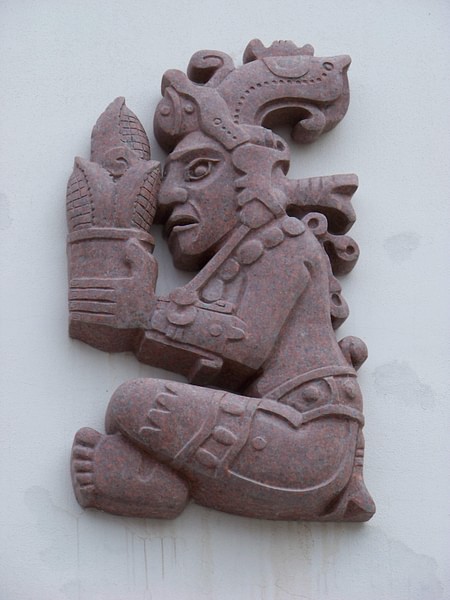 Yum Caax SJu (CC BY-SA) ](https://www.worldhistory.org/image/3833/yum-caax/ "Yum Caax")### The Maize God
One of the most important Maya deities, perhaps even the most important, was the 'Young Maize God'. Typically portrayed with a head in the form of an ear of maize, he could appear in Maya [mythology](https://www.worldhistory.org/mythology/) as the creator god. Descending to the underworld, he reappeared with the world tree which holds the centre of the earth and fixes the four cardinal directions. The world tree was, indeed, sometimes visualised as a maize plant. One of the names of the Maya maize god was Yum Caax ('Master of the Fields in Harvest') but another, as at [Palenque](https://www.worldhistory.org/Palenque/), was [Hun](https://www.worldhistory.org/Huns/)-Nale-Ye ('One Revealed Sprouting'). If any further proof were needed of the Maya reverence for maize, one need only consult the *[Popol Vuh](https://www.worldhistory.org/Popol_Vuh/)* religious text, where the ancestors of humanity are described as being made of maize. Other important foodstuffs besides maize had their own gods, for example, Ek Chuah (aka God M) was considered the god of cacao and so vital was water to crops that the Maya rain god Chac gained special prominence, especially in times of drought.
### Maya Agricultural Methods
The quality and quantity of agricultural land around Maya [cities](https://www.worldhistory.org/city/) varied depending on their location. In the lowlands of the Peten and Puuk regions, for example, the soil was relatively fertile but restricted to small patches. A technique to increase soil fertility was the use of raised fields, especially near water courses and flood plains. At these locations stone-[wall](https://www.worldhistory.org/wall/) terraces were sometimes built to collect fertile silt deposits. Forests were cleared to make way for [agriculture](https://www.worldhistory.org/disambiguation/Agriculture/) but such land quickly declined in fertility and necessitated slash-and-burn techniques to rejuvenate the land after two years of crops, which then requires on average a further 5-7 years to be ready for re-planting. A similar necessity to leave fields to rejuvenate was common in the highland sites, where plots had to be left empty for up to 15 years. To maximise productivity, crops were planted together such as beans and squash in fields of maize so that the beans could climb the maize stalks and the squash could help reduce soil erosion.
Those cities without access to large areas of land suitable for agriculture could [trade](https://www.worldhistory.org/disambiguation/trade/) with more productive cities. For example, slaves, salt, honey and precious goods such as metals, feathers, and shells were often traded for plant products. Just how larger plots of land were distributed, in what manner farmland passed on between generations, and the level of state management in agricultural production remain unclear. It is known, however, that many Maya private homes would have cultivated food in small gardens, especially vegetables and fruit. Once harvested, foodstuffs were stored in wooden cradles above ground and in subterranean sites.
Water management was another necessity, especially in certain Maya cities during the dry winters and hot summers. Water was collected in sinkholes created by collapsed caves and known as a *tz'onot* (corrupted to *cenote* in Spanish) and sometimes brought to fields using canals. Cisterns (*chultunob*) were also excavated, typically bottle-shaped and built using wide plastered aprons around their entrances to maximise the collection of rainwater.
### Maya Crops & Food
Maize (*milpa*) was one of the most important crops but so too were root crops such as sweet manioc, beans, squash, amaranth, and chile peppers. Maize was typically boiled in water and lime, and eaten as a gruel mixed with chile [pepper](https://www.worldhistory.org/Pepper/) (*[saka](https://www.worldhistory.org/Scythians/)'*) for breakfast or made into a dough for baking on a flat-stone (*metate*) as tortillas or flat cakes (*pekwah*) and as *tamales* - stuffed and baked in leaves.
[  Maya kakau glyph VVVladimir (Public Domain) ](https://www.worldhistory.org/image/3540/maya-kakau-glyph/ "Maya kakau glyph")Animals which were hunted include deer, peccary, turkeys, quails, ducks, curassow, guan, spider monkeys, howler monkeys, the tapir, and armadillo. Dogs were also fattened up on maize and eaten. Fish were caught using nets, traps, and lines, and, as in certain Asian cultures, [trained cormorants](http://www.theatlantic.com/china/archive/2013/07/catching-fish-using-birds-stunning-images-of-a-dying-art-in-china/277798/ "Cormorant Fishing") were used to help catch fish: The cormorants' necks were tied so that they could not swallow the bigger fish, which they would then bring back to the fisherman. Meat and fish were typically cooked in stews along with various vegetables and peppers. Fish was either salted and dried or roasted over an open fire.
Fruits eaten included guava, papaya, avocado, custard apple, and sweetsop. A frothy [chocolate](https://www.worldhistory.org/disambiguation/Chocolate/) drink and honey were also popular desserts. Another very popular drink was *[pulque](https://www.worldhistory.org/Pulque/)* [beer](https://www.worldhistory.org/Beer/), known to the Maya as *chih* and made from fermented agave juice.
Important trees used by the Maya for their wood were the sapodilla and breadnut. The bottle gourd was cultivated to make containers from its hard but light-weight fruit shell. The copal was valued for its resin which was burned as incense and used for rubber. Finally, cotton was also cultivated, especially in the Yucatan province, famous for its fine textiles.
#### Editorial Review
This human-authored article has been reviewed by our editorial team before publication to ensure accuracy, reliability and adherence to academic standards in accordance with our [editorial policy](https://www.worldhistory.org/static/editorial-policy/).
## Bibliography
- [Coe, M.D. *The Maya.* Thames & Hudson, 2011.](https://www.worldhistory.org/books/0500289026/)
- [Miller, M.E. *The Art of Mesoamerica.* Thames & Hudson, 2012.](https://www.worldhistory.org/books/0500204144/)
- [Nichols, D.L. *The Oxford Handbook of Mesoamerican Archaeology.* Oxford University Press, 2012.](https://www.worldhistory.org/books/0195390938/)
- [Phillips, C. *The Illustrated Encyclopedia of the Aztec & Maya& Central America - Including The Aztec..* Lorenz Books, 2007.](https://www.worldhistory.org/books/0754817296/)
## About the Author
Mark is WHE’s Publishing Director and has an MA in Political Philosophy (University of York). He is a full-time researcher, writer, historian and editor. Special interests include art, architecture and discovering the ideas that all civilizations share.
## External Links
- [Sustainable Agriculture: The Maya Forest Garden](https://www.ingeniahistory.com/post/sustainable-agriculture-maya-forest-garden)
## Cite This Work
### APA
Cartwright, M. (2015, April 24). Maya Food & Agriculture. *World History Encyclopedia*.
### Chicago
Cartwright, Mark. "Maya Food & Agriculture." *World History Encyclopedia*, April 24, 2015. .
### MLA
Cartwright, Mark. "Maya Food & Agriculture." *World History Encyclopedia*, 24 Apr 2015, .
## License & Copyright
Submitted by [Mark Cartwright](https://www.worldhistory.org/user/markzcartwright/ "User Page: Mark Cartwright"), published on 24 April 2015. The copyright holder has published this content under the following license: [Creative Commons Attribution-NonCommercial-ShareAlike](https://creativecommons.org/licenses/by-nc-sa/4.0/deed.en). This license lets others remix, tweak, and build upon this content non-commercially, as long as they credit the author and license their new creations under the identical terms. When republishing on the web a hyperlink back to the original content source URL must be included. Please note that content linked from this page may have different licensing terms.