---
title: Inca Food & Agriculture
author: Mark Cartwright
source: https://www.worldhistory.org/article/792/inca-food--agriculture/
format: machine-readable-alternate
license: Creative Commons Attribution-NonCommercial-ShareAlike (https://creativecommons.org/licenses/by-nc-sa/4.0/)
updated: 1970-01-01
---
# Inca Food & Agriculture
_Authored by [Mark Cartwright](https://www.worldhistory.org/user/markzcartwright/)_
The [Inca](https://www.worldhistory.org/Inca_Civilization/) [empire](https://www.worldhistory.org/empire/) controlled four climate zones and, consequently, their agricultural produce was diverse. Ancient Andean people were largely vegetarian, supplementing their diet with camelid meat and seafood if they could. The [Incas](https://www.worldhistory.org/Inca_Civilization/) developed a huge farming apparatus where crops and herds were commandeered from conquered peoples and the people themselves were periodically required to work on state-owned farms.
A more positive benefit to local people of Inca rule was the vast network of storage facilities they developed to insure against times of drought and disaster. In addition, foodstuffs were often handed out by Inca officials as gifts which rulers hoped would increase their popularity.
### Organization & Methods
At a micro-level each family unit produced its own food. Family units were part of a wider kin group or *ayllu* which collectively owned farmland. Ideally, an *ayllu* would posses at least some land in both the highlands and more temperate lowlands so that a diversity of foodstuffs could be cultivated. For example, the highlands could offer good pasture and permit potato and maize production, while coca could only be grown at lower altitudes. An area of land for maize cultivation (perhaps around 1.5 acres) called a *tupu* was given to newlyweds by their *ayllu* so that they might be self-sustainable. In addition, their first child entitled the couple to another half *tupu*. If the owner of land died without an heir, then the land was returned to the *ayllu* for future redistribution.
[  Inca Agricultural Terracing McKay Savage (CC BY) ](https://www.worldhistory.org/image/3568/inca-agricultural-terracing/ "Inca Agricultural Terracing")Land was worked using simple tools such as a hoe, clod breaker, and foot plough - the *chakitaqlla*, which consisted of a wooden or [bronze](https://www.worldhistory.org/disambiguation/bronze/) pointed pole that was pushed into the ground by placing one's foot on a horizontal bar. Hoe blades were typically made using sharpened cobble stones. [Agriculture](https://www.worldhistory.org/disambiguation/Agriculture/) was a community practice, and farmers worked in small teams of seven or eight, often singing as they worked with the men hoeing and [women](https://www.worldhistory.org/disambiguation/women/) following behind, breaking up clods and sowing seeds. Meanwhile children and young adults were responsible for tending to the family herd of camelids.
Crops cultivated across the Inca Empire included maize, coca, beans, grains, potatoes, sweet potatoes, ulluco, oca, mashwa, [pepper](https://www.worldhistory.org/Pepper/), tomatoes, peanuts, cashews, squash, cucumber, quinoa, gourd, cotton, talwi, carob, chirimoya, lúcuma, guayabo, and avocado. Livestock was primarily llama and alpaca herds. These animals were vital to many aspects of Andean life as they provided wool, meat, leather, moveable wealth, transportation - especially for the army, and they were often sacrificed in religious ceremonies. Some of the larger state-owned herds could have tens of thousands of animals, and all herds were meticulously accounted for in a state census conducted each November.
The Incas were ambitious farmers, and to maximise agricultural production, they transformed the landscape with terracing, canals, and irrigation networks, whilst wetlands were often drained to make them suitable for farming. In addition, the Incas were fully aware of the values of regular crop rotation, and they also fertilized the land with dried llama dung, guano, or fish heads if these materials were available. Even so, the often harsh Andean climate could bring floods, droughts, and storms which, along with disease, meant that annual crop failures were not infrequent. In such cases the Inca talent for food storage came into its own.
### Food Storage
Foodstuffs (and other goods) were stored in storehouses (*qollqa*) which were built in the tens of thousands across the empire, typically arranged in neat rows and near population centres, large estates, and roadside stations. State officials kept careful accounts of their stocks using the [quipu](https://www.worldhistory.org/Quipu/), a recording device of strings and knots. *Qollqa* were single-roomed stone buildings, either circular or rectangular, which were built in a remarkably uniform manner. Placed on hillsides to take advantage of cool breezes, *qollqa* were designed to maximise the storage time of the perishable goods with which they were filled. They had drainage canals, gravel flooring, and ventilation in both the floor and roof in order to keep the interior as cool and dry as possible so that ordinary goods could be stored for up to two years and freeze-dried foodstuffs for up to four years. Archaeologists have ascertained that maize, potatoes, and quinoa were the most common foodstuffs stored in *qollqa*. Maize and coca from these stores were frequently given to the masses by popularity-seeking rulers and in times of crop failures.
### Agriculture & [Religion](https://www.worldhistory.org/religion/)
Rituals, songs, and sacrifices were a vital part of farming for the Incas. In such ceremonies llamas and guinea pigs were sacrificed and chicha [beer](https://www.worldhistory.org/Beer/) poured into the ground and near rivers and springs in order to win favour from the gods and the elements. In addition, the sometimes harsh Andean environment meant that agriculture was viewed as a form of [warfare](https://www.worldhistory.org/warfare/) so that, as the historian T. N. D'Altroy eloquently put it, "The Incas approached farming with weapons in their hands and prayers on their lips" (276).
There were also many sacred fields in the Inca capital [Cuzco](https://www.worldhistory.org/Cuzco/). The harvest from these was used as offerings in shrines, and one particular field was reserved for the ceremonial planting of the year's first maize. It was here, in the month of August, that the Inca king ceremoniously tilled the first soil of the year with a golden plough. The sacred [Coricancha](https://www.worldhistory.org/Coricancha/), which had a [temple](https://www.worldhistory.org/temple/) to the Inca sun [god](https://www.worldhistory.org/God/) [Inti](https://www.worldhistory.org/Inti/), even had a life-size field of corn made purely from [gold](https://www.worldhistory.org/gold/) and [silver](https://www.worldhistory.org/Silver/) complete with precious [metal](https://www.worldhistory.org/disambiguation/metal/) animals and insects. When the Incas conquered a territory, they divided the land and livestock into three unequal parts - one for the state religion, one for the king, and one for the local inhabitants. Alternatively, as tax was often extracted in the form of labour (*mit'a*), farmers were relocated to work the Inca ruler's lands or help in other state projects, such as road building and large buildings. The agricultural produce of the farmers' own land was largely left untouched, and they were also allowed to cultivate small plots alongside the state farms while performing their *mit'a*.
[ 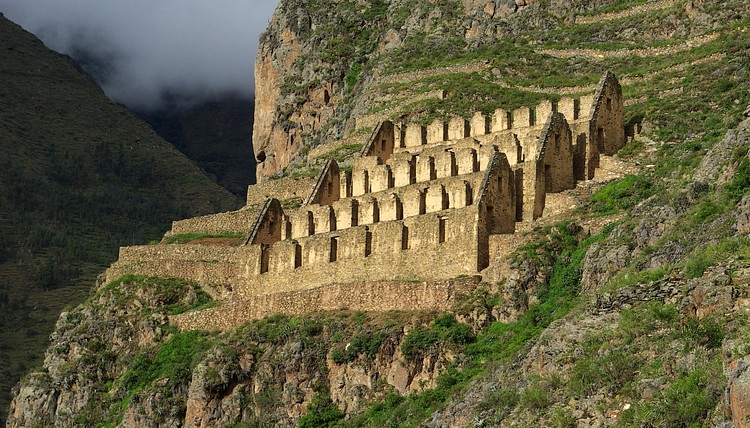 Inca Qollqa Stevage (CC BY-SA) ](https://www.worldhistory.org/image/3569/inca-qollqa/ "Inca Qollqa")### Inca Food & Drink
The Incas had two main meals a day, one early morning and another in the late evening, both taken while seated on the floor without a table. The Inca diet, for ordinary people, was largely vegetarian as meat - camelid, duck, guinea-pig, and wild game such as deer and the vizcacha rodent - was so valuable as to be reserved only for special occasions. More common was freeze-dried meat (*ch'arki*), which was a popular food when travelling. A porridge made from quinoa was a staple food, and near the coasts fish was eaten, typically in stews. Using small reed boats, Inca fishermen hoped to catch anchovies, sardines, tuna, salmon, sea bass, and shellfish. Wild fruits available included sour cherries, custard apples, elderberries, cactus fruits, pineapples, and a type of banana.
Food was prepared on fires of wood or llama dung using a stone or clay stove so that most food was either boiled or roasted. Maize was either cooked in the form of small cakes or toasted, while popcorn was considered a special treat. Potatoes were another important staple, and these could be stored by drying or freeze-drying in the form of chuno. The grains quinoa and canihua were also important, along with the tubers oca, mashua, and maca. Grains were prepared by pounding them between stone mortars or with a pestle. Additional flavours were achieved by adding herbs and spices, especially chili peppers. The most popular drink was the mildly alcoholic *chicha*, a fermented beer-like drink which women prepared by chewing maize or other plants and then allowing the pulp to ferment for several days.
#### Editorial Review
This human-authored article has been reviewed by our editorial team before publication to ensure accuracy, reliability and adherence to academic standards in accordance with our [editorial policy](https://www.worldhistory.org/static/editorial-policy/).
## Bibliography
- [Alden Mason, J. *The Ancient Civilizations of Peru.* Penguin Books, 1991.](https://www.worldhistory.org/books/0140135227/)
- [Baudin, L. *Daily Life of the Incas.* Dover Publications, 2011.](https://www.worldhistory.org/books/0486428001/)
- [D'Altroy, T.N. *The Incas.* Wiley-Blackwell, 2014.](https://www.worldhistory.org/books/1444331159/)
- [Jones, D.M. *The Complete Illustrated History of the Inca Empire.* Lorenz Books, 2012.](https://www.worldhistory.org/books/075482358X/)
- [Moseley, M.E. *By Michael E Moseley - Incas And Their Ancestors Revised Edition (5/29/01).* Thames and Hudson, 2001.](https://www.worldhistory.org/books/B00HTJM8HS/)
## About the Author
Mark is WHE’s Publishing Director and has an MA in Political Philosophy (University of York). He is a full-time researcher, writer, historian and editor. Special interests include art, architecture and discovering the ideas that all civilizations share.
## Cite This Work
### APA
Cartwright, M. (2015, February 07). Inca Food & Agriculture. *World History Encyclopedia*.
### Chicago
Cartwright, Mark. "Inca Food & Agriculture." *World History Encyclopedia*, February 07, 2015. .
### MLA
Cartwright, Mark. "Inca Food & Agriculture." *World History Encyclopedia*, 07 Feb 2015, .
## License & Copyright
Submitted by [Mark Cartwright](https://www.worldhistory.org/user/markzcartwright/ "User Page: Mark Cartwright"), published on 07 February 2015. The copyright holder has published this content under the following license: [Creative Commons Attribution-NonCommercial-ShareAlike](https://creativecommons.org/licenses/by-nc-sa/4.0/deed.en). This license lets others remix, tweak, and build upon this content non-commercially, as long as they credit the author and license their new creations under the identical terms. When republishing on the web a hyperlink back to the original content source URL must be included. Please note that content linked from this page may have different licensing terms.