---
title: How to Read a Maya Glyph
author: Lily Ball
source: https://www.worldhistory.org/article/789/how-to-read-a-maya-glyph/
format: machine-readable-alternate
license: Creative Commons Attribution-NonCommercial-ShareAlike (https://creativecommons.org/licenses/by-nc-sa/4.0/)
updated: 2025-02-04
---
# How to Read a Maya Glyph
_Authored by [Lily Ball](https://www.worldhistory.org/user/lily.c.ball/)_
For over three centuries, the ancient [Maya](https://www.worldhistory.org/disambiguation/Maya/) flourished in Mesoamerica. They built [giant](https://www.worldhistory.org/Giants/) stone [pyramids](https://www.worldhistory.org/pyramid/) surrounded by dense jungle, used a calendrical system that made many believe that 2012 would be the end of the world, and created a [writing](https://www.worldhistory.org/writing/) system that is as beautiful as it is complex. Its decipherment is ongoing, even today. In fact, it is so aesthetically rich and difficult to master, one needed to be an accomplished artist in order to write it properly. Fittingly, ancient Maya scribes and artists were all known by the same title: *t'zib*.
### Deciphering Ancient Maya: Syllables & Concepts
The [Maya writing](https://www.worldhistory.org/article/655/maya-writing/) system is logosyllabic, meaning its symbols can represent sounds in the form of syllables (like “ma” or “tot”), or they might represent whole concepts (like “river” or “house”). This made the language very difficult to decode, and in fact, scholars initially thought the entire writing system was phonetic due to the unfounded assumptions of a missionary named [Diego de Landa](http://www.ancient.eu/Maya_Civilization/). Originally from Spain, de Landa's first language was naturally Spanish. Therefore, when he attempted to decipher the Maya language, he broke it down into individual sounds (vowels and consonants) rather than syllables, the product of which is an inaccurate record of the Maya written and spoken language and a misleading guide for scholars. It wasn't until 1952 CE that it was suggested that the language might be syllabic rather than phonetic. This was a major breakthrough in the decipherment of the ancient Maya written language.
The distinction between a phonetic and a syllabic language is small but essential. A phonetic language uses individual sounds to build spoken words. English, German, and modern Romance languages like French, Italian, and Spanish are phonetic languages, to name a few. When written, each symbol (letter) represents a single sound (a vowel or consonant) like “o” or “b”. Syllabic languages, however, are made up of consonant-vowel (CV) or consonant-vowel-consonant (CVC) combinations, like “ta” or “bot.” Japanese, for example, uses the CV model for the majority of two of its alphabets: katakana and hiragana.
The Maya glyphs are further complicated by their use of conflation, wherein two or more glyphs are combined, and some elements of the glyphs are eliminated or simplified, diminishing their individual complexity in order to create a legible, aesthetically pleasing glyph that fits within the space provided, whether that be on a small decorated cup, or a giant stone stela.
### Reading Ancient Maya
Even with all these hurdles, scholars have managed to decipher much of this ancient written language, which covered topics from the Maya's vast understanding of astronomical mathematics, to their vivid storytelling, to their royal lineage. The basic structure of this writing system consists of one or more main glyphs with additional glyphs attached to it. For example, this complex glyph represents the ancient Maya [city](https://www.worldhistory.org/city/) of [Copan](https://www.worldhistory.org/Copan/). The main glyph is the head of a bat, complete with upturned nose, a flaring ear, and grinning mouth. With a glyph like this, it's easy to see the complex artistry necessary to become an accomplished *t'zib*.
[ 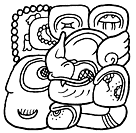 Copan glyph Zykasaa (Public Domain) ](https://www.worldhistory.org/image/3541/copan-glyph/ "Copan glyph")Arguably one of the most famous glyphs of the Maya written language is the glyph for [chocolate](https://www.worldhistory.org/disambiguation/Chocolate/). This glyph has been painted or inscribed onto many vessels, some of which have been found to contain traces of chocolate, leading scholars to believe that in these cases, the Maya labeled vessels with their intended use. Luckily, the glyph for chocolate is entirely syllabic, making it easy for us to read.
[  Maya kakau glyph VVVladimir (Public Domain) ](https://www.worldhistory.org/image/3540/maya-kakau-glyph/ "Maya kakau glyph")There are three elements we need to recognize in order to read this glyph:
1. the main glyph, which resembles a fish (we'll call this part of the glyph element “A”);
2. the oval and hook shapes on the right, which resemble a fish's tail but are actually a separate glyph (let's call this element “B”);
3. the two dots that resemble a colon near the fish's mouth (element “C”).
The main glyph, A, represents the syllable sound “ka”. Element B, near the fish's tail, represents the syllable sound “ua” (also written “wa”). So far, the glyph is pronounced “ka-ua” since the Maya read their glyphs left-to-right and top-to-bottom. Next, we need to take into account element C near the fish's mouth. Anyone who reads [music](https://www.worldhistory.org/disambiguation/Music/) will recognize element C as a repeat sign, which can be placed at the end of a bar of music to indicate that a portion of the piece should be repeated. Surprisingly, that's exactly the function it serves here, too. It tells the reader to repeat the sound of the symbol next to it. Here, that's element A, “ka”. So, when each element is read in the correct order, left-to-right and top-to-bottom, the glyph reads “ka-ka-ua.”
Just one further insight is needed to pronounce this glyph properly: the Maya were known to drop the last vowel of a spoken word. Therefore, this glyph should be read without the final “a” sound at the end. Without that last “a,” the glyph reads “ka-ka-u,” or as we currently spell it, cacao, the main ingredient for chocolate.
#### Editorial Review
This human-authored article has been reviewed by our editorial team before publication to ensure accuracy, reliability and adherence to academic standards in accordance with our [editorial policy](https://www.worldhistory.org/static/editorial-policy/).
## Bibliography
- [Coe, M.D. *Reading the Maya Glyphs, Second Edition.* Thames & Hudson, 2005.](https://www.worldhistory.org/books/0500285535/)
## About the Author
While studying art history in college, Lily became fascinated with ancient Mediterranean and Mesoamerican cultures. She spent a month on an archaeological expedition in Belize in 2004. In her spare time she enjoys beekeeping and reading old ghost stories.
- [Facebook Profile](https://www.facebook.com/lilyball)
- [Linkedin Profile](https://www.linkedin.com/in/lilyball)
## Cite This Work
### APA
Ball, L. (2015, January 25). How to Read a Maya Glyph. *World History Encyclopedia*.
### Chicago
Ball, Lily. "How to Read a Maya Glyph." *World History Encyclopedia*, January 25, 2015. .
### MLA
Ball, Lily. "How to Read a Maya Glyph." *World History Encyclopedia*, 25 Jan 2015, .
## License & Copyright
Submitted by [Lily Ball](https://www.worldhistory.org/user/lily.c.ball/ "User Page: Lily Ball"), published on 25 January 2015. The copyright holder has published this content under the following license: [Creative Commons Attribution-NonCommercial-ShareAlike](https://creativecommons.org/licenses/by-nc-sa/4.0/deed.en). This license lets others remix, tweak, and build upon this content non-commercially, as long as they credit the author and license their new creations under the identical terms. When republishing on the web a hyperlink back to the original content source URL must be included. Please note that content linked from this page may have different licensing terms.