---
title: Athena Parthenos by Phidias
author: Mark Cartwright
source: https://www.worldhistory.org/article/785/athena-parthenos-by-phidias/
format: machine-readable-alternate
license: Creative Commons Attribution-NonCommercial-ShareAlike (https://creativecommons.org/licenses/by-nc-sa/4.0/)
updated: 2022-07-25
---
# Athena Parthenos by Phidias
_Authored by [Mark Cartwright](https://www.worldhistory.org/user/markzcartwright/)_
The magnificent [temple](https://www.worldhistory.org/temple/) on the [Acropolis](https://www.worldhistory.org/Acropolis/) of [Athens](https://www.worldhistory.org/Athens/), known as the [Parthenon](https://www.worldhistory.org/parthenon/), was built between 447 and 432 BCE in the Golden Age of [Pericles](https://www.worldhistory.org/pericles/), and it was dedicated to the [city](https://www.worldhistory.org/city/)'s patron deity [Athena](https://www.worldhistory.org/athena/). The temple was constructed to house the new [gold](https://www.worldhistory.org/gold/) and ivory cult statue of the goddess by the master sculptor [Phidias](https://www.worldhistory.org/Phidias/) (also Pheidias) and to proclaim to the world the success of Athens as leader of the coalition of [Greek](https://www.worldhistory.org/disambiguation/greek/) forces in the [Persian Wars](https://www.worldhistory.org/Persian_Wars/). The cult statue, begun in 447 BCE and dedicated in 438 BCE, would remain the great city's symbol for a thousand years until, in Late Antiquity, it disappeared from the historical record, possibly taken to [Constantinople](https://www.worldhistory.org/Constantinople/) and there later destroyed. Fortunately, copies and representations, the most complete being the 2nd century CE 'Varvakeion statuette', of the statue and some of its sculptural details, along with descriptions by [Plutarch](https://www.worldhistory.org/plutarch/) and [Pausanias](https://www.worldhistory.org/disambiguation/Pausanias/), allow us to fairly accurately reconstruct its original appearance.
[  Athena Parthenos Reconstruction Mary Harrsch (Photographed at the Nashville Parthenon, Tennessee) (CC BY-NC-SA) ](https://www.worldhistory.org/image/907/athena-parthenos-reconstruction/ "Athena Parthenos Reconstruction")### Materials & Dimensions
The name Parthenon derives from one of Athena's many epithets: Athena Parthenos, meaning Virgin. Parthenon means 'house of Parthenos' which was the name given in the 5th century BCE to the chamber (cella) inside the temple which housed the cult statue, and from the 4th century BCE the whole building acquired the name Parthenon.
Although richly decorated on the outside with magnificent decorative sculpture, the most important sculpture was always intended to be the giant statue of Athena inside it. Indeed, there is evidence that the temple was built to measure in order to accommodate the chryselephantine (gold and ivory) statue of Athena by Pheidias. The sculptor was already famous for his colossal [bronze](https://www.worldhistory.org/disambiguation/bronze/) statue of Athena Promachos which stood on the acropolis and was reportedly visible from Cape [Sounion](https://www.worldhistory.org/sounion/), and he was commissioned by Pericles to create a statue worthy of the greatest city in [Greece](https://www.worldhistory.org/greece/) and its patron deity.
The Athena Parthenos was, then, a gigantic statue which, according to Pliny, was around 11.5 metres tall (26 cubits) and was made of carved ivory for flesh parts and gold (1140 kilos or 44 talents of it) for everything else, all wrapped around a wooden core. The gold parts could also be easily removed if necessary in times of financial necessity. Extra embellishments were rendered using glass, [copper](https://www.worldhistory.org/copper/), [silver](https://www.worldhistory.org/Silver/), and jewels. It is estimated the statue cost the city around 5,000 talents, a truly huge sum of money which made it more expensive than the construction costs of the Parthenon itself.
[  The Varvakeion Athena Mark Cartwright (CC BY-NC-SA) ](https://www.worldhistory.org/image/3375/the-varvakeion-athena/ "The Varvakeion Athena")The statue stood on a pedestal measuring 4.09 by 8.04 metres, faced the east door, and was surrounded by the Doric columns of a peristyle set inside the cella. In front of the statue, sunk into the flooring, was a large but shallow tank of water. This had the dual benefit of reflecting light into the chamber and maintaining a moist atmosphere to best preserve the ivory. The cutting in the temple floor in which the central support [column](https://www.worldhistory.org/column/) of the statue was placed is still visible today.
### Sculptural Decoration
The statue represented Athena standing majestic, fully armed and holding a 4 cubit tall statue of [Nike](https://www.worldhistory.org/nike/) in her right hand. Athena wore a peplos which was tucked into a belt. She held a large circular shield in her left hand which rests on the floor. She also has a spear on her left side, and a large coiled sacred snake resided between her feet and the shield. On her triple-crested helmet stood a [sphinx](https://www.worldhistory.org/sphinx/) and two griffins with [Pegasus](https://www.worldhistory.org/Pegasus/) wings either side; griffins also decorated the cheek-pieces. On the goddess' chest was the snake-tasselled aegis given to her by [Zeus](https://www.worldhistory.org/zeus/) with the head of the gorgon [Medusa](https://www.worldhistory.org/Medusa/) in ivory. The sides of Athena's sandals were decorated with the mythical [battle](https://www.worldhistory.org/disambiguation/battle/) between the centaurs and Lapiths. The base of the statue depicted scenes of the birth of [Pandora](https://www.worldhistory.org/Pandora/), watched over by the most important gods of Mt. Olympus.
[ 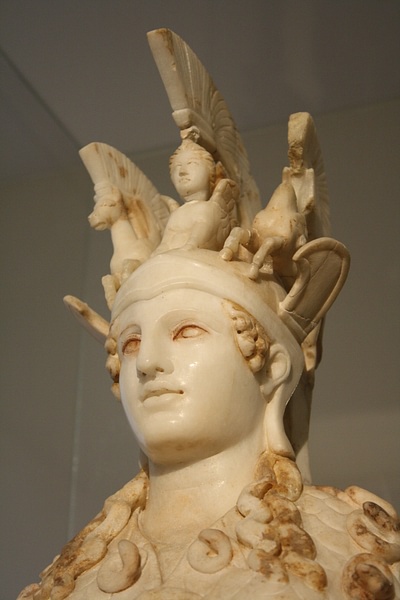 Athena Parthenos, National Museum, Athens Mark Cartwright (CC BY-NC-SA) ](https://www.worldhistory.org/image/3376/athena-parthenos-national-museum-athens/ "Athena Parthenos, National Museum, Athens")The shield of the statue was a wonder in itself and much copied in later antiquity. According to Pliny, it depicted scenes from the Battles of [Theseus](https://www.worldhistory.org/Theseus/) and the [Amazons](https://www.worldhistory.org/amazon/) on the face and the battle of the [Giants](https://www.worldhistory.org/Giants/) on the interior. The 30 or so figures on the exterior were probably made from silver or bronze. The centre was dominated once again by the head of Medusa, the gorgoneion, surrounded by individual duels of Greeks and Amazons striking dramatic poses against a background of landscape features and fortifications. As with the sculpture outside the Parthenon, these images of Greeks victorious against the foreign creatures of [Centaur](https://www.worldhistory.org/centaur/) and [Amazon](https://www.worldhistory.org/amazon/) were a powerful visual metaphor for the Greek victory over the Persians and a celebration of the successful defence of their independence and way of life.
### Legacy
The statue must have been nothing less than awe-inspiring and the richness of it - both artistically and literally - must have sent a very clear message of the wealth and power of the city that could produce such a tribute to their patron [god](https://www.worldhistory.org/God/) and of the power of the goddess herself. Testimony to the statue's lasting artistic legacy is the long line of contemporary and subsequent copies in [Hellenistic](https://www.worldhistory.org/Hellenic_World/) and [Roman](https://www.worldhistory.org/disambiguation/Roman/) times, not only of the complete statue but also of details such as the head and scenes of the Amazonomachy.
[  Warrior & Amazon Mark Cartwright (CC BY-NC-SA) ](https://www.worldhistory.org/image/3251/warrior--amazon/ "Warrior & Amazon")As mentioned above the best preserved and most complete representation of Pheidias' lost masterpiece is the ''Varvakeion statuette' which is a 1.05 metre tall Roman copy in marble from the 2nd century CE and which now resides in the National Archaeological Museum of Athens. Other full figures, albeit with some damage, include the 'Lenormant statuette', another Roman copy, 2nd or 3rd century CE, 42 cm tall (also in Athens); the 86 cm tall 'Patras statuette' (in Patras); a 1.54 m tall figure now in Boston, and a Hellenistic version from [Pergamon](https://www.worldhistory.org/pergamon/) which is 3.1 metres tall and preserves some partial figures on the base (Berlin). Detailed depictions of the head appear on a 4th century BCE gold medallion in St. Petersburg and a red jasper intaglio from the 1st century BCE now in Palazzo Massimo alle Terme, [Rome](https://www.worldhistory.org/Rome/). The statue of Nike in Athena's hand was also much copied, notably in a full-size copy from [Cyrene](https://www.worldhistory.org/cyrene/) now in Philadelphia. Copies of the shield include the 'Strangford shield', a 3rd century version now in the British Museum, London, and scenes of the Amazons are strikingly depicted on 2nd century CE Roman relief slabs from a [Piraeus](https://www.worldhistory.org/Piraeus/) wreck which are now on display in the Archaeological Museum of Piraeus.
#### Editorial Review
This human-authored article has been reviewed by our editorial team before publication to ensure accuracy, reliability and adherence to academic standards in accordance with our [editorial policy](https://www.worldhistory.org/static/editorial-policy/).
## Bibliography
- [Boardman, J. *Greek Sculpture.* Thames & Hudson, 1995.](https://www.worldhistory.org/books/0500202850/)
- [Carpenter, T.H. *Art and Myth in Ancient Greece.* Thames & Hudson, 1991.](https://www.worldhistory.org/books/0500202362/)
- Green, P. *The Parthenon.* Newsweek Book Division, 1973
- [Hornblower, S. *The Oxford Classical Dictionary.* Oxford University Press, 2012.](https://www.worldhistory.org/books/0199545561/)
- [Servi, K. *The Acropolis.* Ekdotike Athenon, 2011.](https://www.worldhistory.org/books/9602134526/)
- Vlassopoulou, C. *Acropolis & Museum.* Hellenic Ministry of Culture, 2009
## About the Author
Mark is WHE’s Publishing Director and has an MA in Political Philosophy (University of York). He is a full-time researcher, writer, historian and editor. Special interests include art, architecture and discovering the ideas that all civilizations share.
## Cite This Work
### APA
Cartwright, M. (2015, January 25). Athena Parthenos by Phidias. *World History Encyclopedia*.
### Chicago
Cartwright, Mark. "Athena Parthenos by Phidias." *World History Encyclopedia*, January 25, 2015. .
### MLA
Cartwright, Mark. "Athena Parthenos by Phidias." *World History Encyclopedia*, 25 Jan 2015, .
## License & Copyright
Submitted by [Mark Cartwright](https://www.worldhistory.org/user/markzcartwright/ "User Page: Mark Cartwright"), published on 25 January 2015. The copyright holder has published this content under the following license: [Creative Commons Attribution-NonCommercial-ShareAlike](https://creativecommons.org/licenses/by-nc-sa/4.0/deed.en). This license lets others remix, tweak, and build upon this content non-commercially, as long as they credit the author and license their new creations under the identical terms. When republishing on the web a hyperlink back to the original content source URL must be included. Please note that content linked from this page may have different licensing terms.