---
title: The Battle of Kadesh & the First Peace Treaty
author: Joshua J. Mark
source: https://www.worldhistory.org/article/78/the-battle-of-kadesh--the-first-peace-treaty/
format: machine-readable-alternate
license: Creative Commons Attribution-NonCommercial-ShareAlike (https://creativecommons.org/licenses/by-nc-sa/4.0/)
updated: 1970-01-01
---
# The Battle of Kadesh & the First Peace Treaty
_Authored by [Joshua J. Mark](https://www.worldhistory.org/user/JPryst/)_
[Ramesses II](https://www.worldhistory.org/Ramesses_II/) (The Great, 1279-1213 BCE) ruled [Egypt](https://www.worldhistory.org/egypt/) for 67 years and, today, the [Egyptian](https://www.worldhistory.org/disambiguation/Egyptian/) landscape still bears testimony to the prosperity of his reign in the many temples and monuments he had built in honor of his conquests and accomplishments. There is virtually no ancient site in Egypt which does not mention the name of [Ramesses](https://www.worldhistory.org/disambiguation/ramesses/) II and his account of his victory at The [Battle](https://www.worldhistory.org/disambiguation/battle/) of [Kadesh](https://www.worldhistory.org/Kadesh/) in 1274 BCE is legendary. Among his greatest moments as [pharaoh](https://www.worldhistory.org/pharaoh/), however, is not an act of [war](https://www.worldhistory.org/disambiguation/War/) but one of peace: the signing of the first peace treaty in history.
While there does exist an earlier treaty, known as the Treaty of Mesilim, between the Mesopotamian [cities](https://www.worldhistory.org/city/) of Umma and Lagash, dated to 2550 BCE, scholarly consensus rejects this as an actual peace treaty and defines it as a Treaty of Delimitation (meaning a treaty which sets borders or boundaries). Further, as the Treaty of Mesilim is actually a written agreement between the gods of Umma and Lagash, and not between the rulers of the [city](https://www.worldhistory.org/city/) or those rulers' representatives, it cannot be considered an actual peace treaty. The Treaty of Kadesh of 1258 BCE, then, holds the distinction as the world's first peace treaty.
### The [HittiTe](https://www.worldhistory.org/hittite/) Threat
In the fifth year of his reign, young Pharaoah Ramesses II marched from his city of [Per-Ramesses](https://www.worldhistory.org/Pi-Ramesses/) ("House of Ramesses") toward [Syria](https://www.worldhistory.org/syria/) to secure the city of Kadesh, a valuable stop on the [trade](https://www.worldhistory.org/disambiguation/trade/) routes of the day. The Hittite king Muwatalli II (1295-1272 BCE) had been making regular incursions into Egyptian territory for some time and, having now fortified Kadesh, had become more of a threat than a nuisance to Ramesses II.
The [Hittites](https://www.worldhistory.org/hittite/) of [Anatolia](https://www.worldhistory.org/Asia_Minor/) had been growing in power since the 2nd millenium BCE until, around 1530 BCE, they had replaced [Babylonia](https://www.worldhistory.org/babylon/) as a kingdom of note and began testing the strength of their neighbor-country Egypt. Letters of intent had been sent to the pharaoh [Akhenaten](https://www.worldhistory.org/Akhenaten/) (1353-1336 BCE) of the 18th dynasty but he had failed to ever reply or take any notice of Hittite activity along his borders. Akhenaten's general [Horemheb](https://www.worldhistory.org/Horemheb/) (who would reign as pharaoh 1320-1292 BCE) had campaigned unsuccessfully against the Hittites and, by the time of the rule of [Tutankhamun](https://www.worldhistory.org/Tutankhamun/) (Akhenaten's successor in 1336 BCE) they had grown even more powerful and were bold enough to fortify regions on or near Egypt's borders.
When Horemheb became pharaoh in 1320 BCE he initiated a more aggressive policy against the Hittites and secured Egypt's borders but never conclusively resolved the problem of Hittite incursions. Seti I (c. 1290-1279 BCE) had secured [Palestine](https://www.worldhistory.org/palestine/) and Kadesh for Egypt but, content with the victory, had made no provision for holding the city. Now Ramesses II, of the 19th dynasty, had to deal with the problem of Hittite invasion and, in 1274 BCE, assembled his forces at Per-Ramesses to drive the Hittites from Kadesh and break the strength of their army.
[ 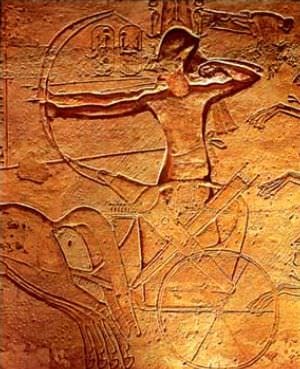 Ramesses II at The Battle of Kadesh Cave cattum (CC BY-SA) ](https://www.worldhistory.org/image/1006/ramesses-ii-at-the-battle-of-kadesh/ "Ramesses II at The Battle of Kadesh")### Ramesses on the March
Riding in his [chariot](https://www.worldhistory.org/chariot/) at the head of four divisions (20,000 men) Ramesses II, completely confident of victory, marched his first division in such haste that he soon outdistanced the other three. Nearing Kadesh, two bedouins were taken prisoner and interrogated as to the whereabouts of Muwatalli II and his army, answering that the army was no where near Kadesh and that Muwatalli II feared the might of Egypt and the young pharaoh. The bedouins were actually spies, however, planted by the Hittites, and Muwatalli II had already fortified Kadesh and his chariots (3,500 of them) and infantry (37,000 men) were waiting just over the next hill.
According to some reports of the battle, Ramesses II captured some other spies who revealed the unpleasant truth of his situation but the intelligence came too late. In his zeal to capture Kadesh and [conquer](https://www.worldhistory.org/warfare/) the Hittite king, Ramesses II had cut himself off from the rest of his army. He hastily sent messengers to the other three divisions just before the Hittite chariots crashed into his camp. Ramesses II describes his situation in the *Poem of Pentaur* which, along with the *Bulletin*, gives the Egyptian account of the battle:
> Not one of my princes, of my chief men and my great, Was with me, not a captain, not a knight; For my warriors and chariots had left me to my fate, Not one was there to take his part in fight…Here I stand, All alone; There is no one at my side, My warriors and chariots afeared, Have deserted me, none heard My voice, when to the cravens I, their king, for succor, cried. But I find that [Amun](https://www.worldhistory.org/amun/)'s grace Is better far to me than a million fighting men and ten thousand chariots be.
The Ptah Division arrived in time to prevent a complete rout of the Egyptian army and Ramesses II personally led the remains of the Amun division repeatedly into battle, driving the Hittite forces back to the Orontes river where many drowned. At this point Muwatalli II only needed to march from the walls of Kadesh to trap Ramesses II's forces between his army by the river and his advance but, for reasons unknown, he decided to remain in the city and never committed his reserve troops to battle.
[  Kadesh Treaty Osama Shukir Muhammed Amin (Copyright) ](https://www.worldhistory.org/image/2574/kadesh-treaty/ "Kadesh Treaty")### Egyptian Victory
Ramesses II claimed a great victory at Kadesh and had a scribe take down his account of the glorious battle; Muwatalli II's account differed considerably, most notably in that he set down Kadesh as a Hittite victory. While Ramesses II failed to achieve his objective of capturing the city, he did break the Hittite army on the field and, while Muwatalli II retained control of Kadesh, he failed to crush the Egyptians as he hoped to. One reason for this failure, aside from his strange unwillingness to commit his reserve troops, was the faster and more agile two-man Egyptian chariot as compared with the three-man, heavier, Hittite vehicle.
After the [death](https://www.worldhistory.org/disambiguation/Death/) of Muwatalli II, Hattusili III (died 1237 BCE) took the throne of the Hittite [Empire](https://www.worldhistory.org/empire/) and it was under his reign that the world's first peace treaty was signed in 1258 BCE reading, in part,
> Ramesses, the great king, the king of the country of Egypt, shall never attack the country of [Hatti](https://www.worldhistory.org/hatti/) to take possession of a part (of this country). And Hattusili, the great king, the king of the country of Hatti, shall never attack the country of Egypt to take possession of a part (of that country).
The Battle of Kadesh, today considered a draw for both sides, was the beginning of the end of hostilities between the two nations in that, eventually, the two kings came to realize neither could substantially gain advantage of the other and the best course to choose was the path of peace. The Hittites and Egyptians then entered into a new relationship with each other in which they shared their knowledge and experience instead of exchanging blows on the battlefield.
The Hittities were skilled in metalwork and taught the Egyptians how to make superior weapons and tools while the Egyptians, masters of [agriculture](https://www.worldhistory.org/disambiguation/Agriculture/), shared their knowledge with the Hittites. The two nations would continue a mutually beneficial relationship until the fall of the Hittite Empire c. 1200 BCE through the combined, and relentless, attacks by the [Sea Peoples](https://www.worldhistory.org/Sea_Peoples/), the Assyrians, and the tribe known as the [Kaska](https://www.worldhistory.org/Kaska/). The peaceful and productive relationship between the two nations, however, enabled both to improve the lives of their people and the economies of the country instead of wasting their resources on war.
#### Editorial Review
This human-authored article has been reviewed by our editorial team before publication to ensure accuracy, reliability and adherence to academic standards in accordance with our [editorial policy](https://www.worldhistory.org/static/editorial-policy/).
## Bibliography
- [Bunson, M. *The Encyclopedia of Ancient Egypt.* Gramercy Books, 1991.](https://www.worldhistory.org/books/B01K3KKFEW/)
- [Durant, W. *Our Oriental Heritage.* Simon & Schuster, 1954.](https://www.worldhistory.org/books/B00005WJGO/)
- [Egypt: Ramses the Great, The Pharaoh Who Made Peace with his Enemies And the First Peace Treaty in History](http://www.touregypt.net/featurestories/treaty.htm "Egypt: Ramses the Great, The Pharaoh Who Made Peace with his Enemies And the First Peace Treaty in History"), accessed 1 Dec 2016.
- [King, L.W. *A History of Sumer and Akkad.* University of Michigan Library, 1910.](https://www.worldhistory.org/books/B003YXXWZA/)
- [Shaw, I. *The Oxford History of Ancient Egypt.* Oxford University Press, 2006.](https://www.worldhistory.org/books/B000OKSGJ8/)
- [Silverman, D. P. *Ancient Egypt.* Oxford University Press, 1997.](https://www.worldhistory.org/books/B01NAO485N/)
## About the Author
Joshua J. Mark is World History Encyclopedia's co-founder and Content Director. He was previously a professor at Marist College (NY) where he taught history, philosophy, literature, and writing. He has traveled extensively and lived in Greece and Germany.
- [Linkedin Profile](https://www.linkedin.com/pub/joshua-j-mark/38/614/339)
## Cite This Work
### APA
Mark, J. J. (2012, January 18). The Battle of Kadesh & the First Peace Treaty. *World History Encyclopedia*.
### Chicago
Mark, Joshua J.. "The Battle of Kadesh & the First Peace Treaty." *World History Encyclopedia*, January 18, 2012. .
### MLA
Mark, Joshua J.. "The Battle of Kadesh & the First Peace Treaty." *World History Encyclopedia*, 18 Jan 2012, .
## License & Copyright
Submitted by [Joshua J. Mark](https://www.worldhistory.org/user/JPryst/ "User Page: Joshua J. Mark"), published on 18 January 2012. The copyright holder has published this content under the following license: [Creative Commons Attribution-NonCommercial-ShareAlike](https://creativecommons.org/licenses/by-nc-sa/4.0/deed.en). This license lets others remix, tweak, and build upon this content non-commercially, as long as they credit the author and license their new creations under the identical terms. When republishing on the web a hyperlink back to the original content source URL must be included. Please note that content linked from this page may have different licensing terms.