---
title: Sicilian Temples (Greek Metrology)
author: Denitsa Dzhigova
source: https://www.worldhistory.org/article/777/sicilian-temples-greek-metrology/
format: machine-readable-alternate
license: Creative Commons Attribution-NonCommercial-ShareAlike (https://creativecommons.org/licenses/by-nc-sa/4.0/)
updated: 1970-01-01
---
# Sicilian Temples (Greek Metrology)
_Authored by Denitsa Dzhigova_
[  Doric Temple, Segesta Mark Cartwright (CC BY-NC-SA) ](https://www.worldhistory.org/image/2597/doric-temple-segesta/ "Doric Temple, Segesta")### Characteristics of Sicilian [Archaic](https://www.worldhistory.org/disambiguation/Archaic/) Temples
The large dimensions of the components, the presence of a propteron, an adyton, and other specific elements of the plan and elevation speak for an originally very autonomous development of Sicilian [architecture](https://www.worldhistory.org/disambiguation/architecture/). The large quantities of available and easy-to-work-with building materials at the sites of [Syracuse](https://www.worldhistory.org/syracuse/), [Megara](https://www.worldhistory.org/disambiguation/Megara/) Hyblaea, and [Selinunte](https://www.worldhistory.org/Selinus/) enabled the establishment of the first generation of stone temples in [Sicily](https://www.worldhistory.org/sicily/); the *metropoleis* were still busy with the process of becoming a [city](https://www.worldhistory.org/city/) (p*olis*) and had not formed monumental architecture yet. In the 6th century BCE the eastern Sicilian colonies were at the forefront of structural developments on the island and had predetermined the tendencies for their later development. The oldest stone buildings in these [poleis](https://www.worldhistory.org/Polis/) – the [Temple](https://www.worldhistory.org/temple/) of [Apollo](https://www.worldhistory.org/apollo/), that of Olympian [Zeus](https://www.worldhistory.org/zeus/) in Syracuse, some remains of buildings from Megara Hyblaea, and the remains of the Temple Y in Selinunte were thus intended from the outset as monumental.
### The Peristasis
Peristasis (gr. Περίστασις) is a four-sided porch or hall of columns surrounding the cella. Temples with such halls of columns, called peripteros (pl. peripteroi), were widespread in the western [Greek](https://www.worldhistory.org/disambiguation/greek/) world from very early on. The western peripteroi were often much more valuable and abundant than the ones in the mother [cities](https://www.worldhistory.org/city/). Very characteristic of the earliest peripteral temples in Sicily is the extension of the hall on the front side (propteron), which probably its origins in the ionic Dipteroi (temples with double colonnades). Most likely the peristasis was built chronologically before the cella, although the structure of the cella decided the number of columns. The late binding of the front of the cella to the front of the peristasis had a strong effect on the overall proportions of the building.
### The Corner Conflict in the Doric Architectural Order
Not less important is the relation between the plan and the triglyphon (triglyph and metope as a unit). The regularly alternating triglyphs and metopes in the frieze were accented through strong colours and played a very important role in addition to other proportions. The rhythm that results from the sequence of columns and intercolumniations repeats in the frieze so that one triglyph is always located at the central axis of the [column](https://www.worldhistory.org/column/) and one in intercolumniation. Therefore, the ratio of column thickness and intercolumniation reflects the ratio of the width of the triglyphs and metopes in the frieze. If the intercolumniation equals the metope width at the end of the frieze, an irregularity arises (corner conflict): the last triglyph was not cantered with the corresponding column. Ancient Greeks were very sensitive to this. A harmonic solution of this irregularity was achieved by the reduction (contraction) of the last intercolumniation on the long side of the temple. This type of solution was preferred in the eastern Greek world and was also held in [Italy](https://www.worldhistory.org/italy/) and Sicily but rather unfavourably. In fact, we find no archaic temple in Sicily that has this simple corner contraction. Either the sensitivity for regularity and symmetry in this early period was not yet developed, or this solution was not understood by Sicilian architects. The later Doric buildings in Sicily have a double contraction, which mitigates the forced irregularities in the frieze by changing the width, not only of the last intercolumniation, but also of the one following it. This solution of the Doric conflict has been implemented in many different ways in different times and places and on diverse buildings. At the end of the [archaic period](https://www.worldhistory.org/Archaic_Period/), it goes against the striving for rational regularity of the construction and for equal intercolumniations.
### Differentiation of Intercolumniations
In the early Sicilian temples, it is noticeable that the spaces between the columns on the narrow and long sides have all different sizes. This applies to the Temple of Apollo and the one of Zeus Olympios in Syracuse as well as Temple C in Selinunte. On temples from the late archaic period like F and G in Selinunte, this difference is already much smaller. It is important to note that this is not an intended differentiation in favour of the solution of the corner conflict, but a lack of regularity which is normal for this early period.
Other characteristics in the plan of earlier Doric temples in Sicily can be found in the arrangement of the internal construction. The archaic cella consists of a pronaos (entrance hall), usually in antis, and a naos (the inner structure of a temple, cella). The adyton is a small place at the back of the hall where the cult statue for a temple was often kept, and it remains typical for the early phase of temple architecture in Sicily. The lack of the back hall and the presence of the propteron are two elements that give the temple front more weight and detach the whole construction of the idea of universalism and symmetry.
These are only the general lines of development that can be observed in Sicily during the archaic period.
### Apollonion (Syracuse, 600/575 BCE)
Columns Proportion 6 x 17 Stylobate 21.57 x 55.36 m Intercolumn.
Long side (LS)
Front side (FS)
Middle Intercolumn.(MI) LS – 3.33 m
FS – 3.90 m
MI – 4.15 m
Corner Contraction none Propteron 2 interc. deep;
wide MI Cella width x Length 11.77 m x 37.2 m Pronaos/Cella Front 2 in antis Arrangement of Inner Columns double colonnade Adyton or Opisthodom Adyton Column Height 7.98 m Lower Diameter 2.05 m Lower D x Column Height 1 : 3 Architrave Height 2.15 m D : Intercolumn. 7 : 8
7 : 10 Frieze Proportion
Triglyph Width : Metope Width No consideration Corner conflict in frieze No consideration Foot/Ell\* 49-50 cm = 1 E
### Olympieion (Syracuse, 560 BCE)
Columns Proportion 6 x 17 Stylobate 22.04 x 62.02 m Intercolumn.
Long side (LS)
Front side (FS)
Middle Intercolumn.(MI) Almost equal Corner Contraction none Propteron 2 interc. deep
Normal MI Cella width x Length - Pronaos/Cella Front 2 in antis Arrangement of Inner Columns none Adyton or Opisthodom Adyton Column Height c. 8 m Lower Diameter 1.84 m Lower D x Column Height 1 : 4,3 Architrave Height - D : Intercolumn. - Frieze Proportion
Triglyph Width : Metope Width With consideration Corner conflict in frieze - Foot/Ell\* -
### Temple C (Selinunte, 560/550 BCE)
[ 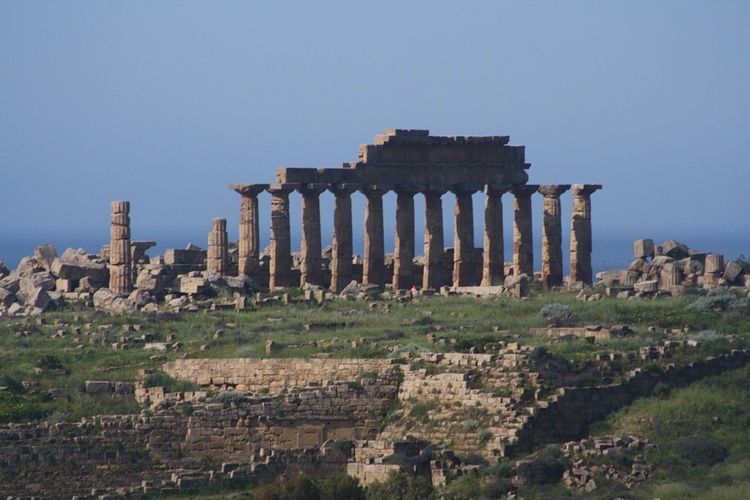 Temple C, Selinus Mark Cartwright (CC BY-NC-SA) ](https://www.worldhistory.org/image/2606/temple-c-selinus/ "Temple C, Selinus") Columns Proportion 6 x 17 Stylobate 23.93 x 63.76 m Intercolumn.
Long side (LS)
Front side (FS)
Middle Intercolumn.(MI) LS – 3.86 m avg.
FS – 4.41 m avg.
In gradation on the east front Corner Contraction none Propteron 2 interc. Deep
Normal MI Cella width x Length 10.40 x 40.89 m
almost 1 : 4 / 20:80 ell Pronaos/Cella Front antae Arrangement of Inner Columns none Adyton or Opisthodom Adyton Column Height 8.76 m/ 8.65 m Lower Diameter c. 1.9 m Lower D x Column Height 1: 4.53 Architrave Height - D : Intercolumn. 3 : 4 4/14 Frieze Proportion
Triglyph Width : Metope Width 9 : 10
The first regulated entablature proportion Corner conflict in frieze Not relevant Foot/Ell\* 52 cm = 1 E
### Temple D (Selinunte, c. 550 BCE)
Columns Proportion 6 x 13 Stylobate 23.63 x 55.96 m Intercolumn.
Long side (LS)
Front side (FS)
Middle Intercolumn.(MI) LS – 4.51 m avg.
FS – 4.37 m avg.
Geringere Jochdiff. Corner Contraction none Propteron none Cella width x Length 9.87 x 39.28 m
almost 1 : 4 / 20:80 ell Pronaos/Cella Front Tetrastyle
2 col. + 2 ¾ col. Arrangement of Inner Columns none Adyton or Opisthodom Adyton Column Height 8.35 m Lower Diameter - Lower D x Column Height 1 : 5 Architrave Height - D : Intercolumn. 3 : 5 4/5 Frieze Proportion
Triglyph Width : Metope Width 8 : 9 Corner conflict in frieze No consideration Foot/Ell\* 49.1 cm = 1E
### Temple F (Selinunte, 550 BCE)
Columns Proportion 6 x 14 Stylobate 24.37 x 61.88 m Intercolumn.
Long side (LS)
Front side (FS)
Middle Intercolumn.(MI) LS – 4.60 m
FS – 4.47 m Corner Contraction none Propteron 2 interc. deep Cella width x Length c. 9.20 x 40 m Pronaos/Cella Front antae Arrangement of Inner Columns ?/none Adyton or Opisthodom Adyton Column Height 9.11 m Lower Diameter 1.79 m Lower D x Column Height c. 1 : 5 Architrave Height - D : Intercolumn. 3:6 Frieze Proportion
Triglyph Width : Metope Width 5:6 Corner conflict in frieze Widening of the corner metopes Foot/Ell\* -
### Temple G (Selinunte, 520 BCE)
Columns Proportion 8 x 17 Stylobate 49.97 x 109.12 m
+/- 5 cm Intercolumn.
Long side (LS)
Front side (FS)
Middle Intercolumn.(MI) East: 6.52 m avg.
West: normal interc. – 6.62 m
angle interc. – 6.28 m
Corner Contraction East - none /West – single Propteron None/ 2 interc. deep Peristasis
(c. 12 m) Cella width x Length 22.50 x 69.10 m Pronaos/Cella Front 4 x 2 Prostyle
and antae Arrangement of Inner Columns double colonnade Adyton or Opisthodom Opisthodomos Column Height 14.7 m Lower Diameter East – 2.97 m
West – 3.26 m Lower D x Column Height East – 1 : 5/ West – 1 : 4 ½ Architrave Height - D : Intercolumn. East : 9 : 17 Frieze Proportion
Triglyph Width : Metope Width 9 : 13 Corner conflict in frieze Widening of the corner metopes (?) Foot/Ell\* -
Heracles ([Agrigento](https://www.worldhistory.org/agrigento/), 488 BCE)
[ 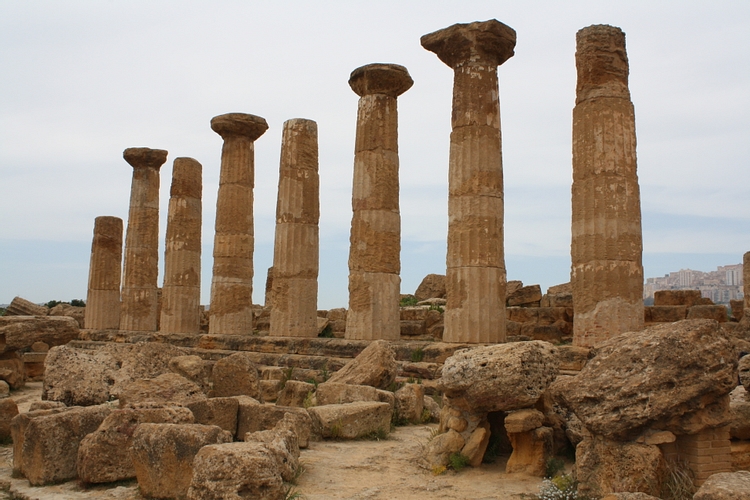 Temple of Hercules, Agrigento Mark Cartwright (CC BY-NC-SA) ](https://www.worldhistory.org/image/2635/temple-of-hercules-agrigento/ "Temple of Hercules, Agrigento")###
Columns Proportion 6 x 15 Stylobate 25.33 x 67 m /
25.28 x 67.04 = 3 : 8 Intercolumn.
Long side (LS)
Front side (FS)
Middle Intercolumn.(MI)
Angle Intercolumn. (AI) LS – 4.612 m avg.
West: NS – 4.62 m = LS
Unit intercolumniation! (UI)
MI – 4.605 m
AI– 4.52 m Corner Contraction single, (8 – 12 cm); only at the front Propteron 2 interc. deep;
East end West Cella width x Length 11.85 x 29.64 m
36 x 90 Fuß Pronaos/Cella Front 5.55 m deep; 2 in antis Arrangement of Inner Columns none Opisthodomus 5.38 m deep in antis Binding of the Cella To the 2d column on FS and the 3th on LS Column Height - Lower Diameter - Lower D x Column Height - Frieze Proportion
W=Width; H=Height - Corner conflict in frieze No consideration I' 29,64 cm
Ion. F.
Olympieion (Agrigento, 488? BCE)
[  Temple of Zeus Model, Agrigento Mark Cartwright (CC BY-NC-SA) ](https://www.worldhistory.org/image/2644/temple-of-zeus-model-agrigento/ "Temple of Zeus Model, Agrigento")###
Columns Proportion 7 x 14/ 1: 2 Stylobate 44.01 x 101.16 m Intercolumn.
Long side (LS)
Front side (FS)
Middle Intercolumn.(MI)
Angle Intercolumn. (AI) LS – 8.12 m
FS – 8.08 m (NormalI)
No MI
Corner Contraction none Propteron 1 interc. deep Cella width x Length 2 x 11 interc. Pronaos/Cella Front 1 inter. deep Arrangement of Inner Columns 2 x 12 pillars Opisthodomus 1 inter. deep Binding of the Cella To the 3th and 5th column on FS Column Height 18.20 m (?) Lower Diameter 4.50 m / 4.42 m ? Lower D x Column Height C. 1 : 4 Frieze Proportion
W=Width; H=Height TrW : MetW =
4 : 5
TrW : TrH = 7: 4 Corner conflict in frieze No consideration I' 32.6 cm
### Big Temple of Himera (480 /466 BCE)
Columns Proportion 6 x 14 /3 : 7 Stylobate 22.46 x 55.91 m
68´ x 170´
almost 2 : 5 Intercolumn.
Long side (LS)
Front side (FS)
Middle Intercolumn.(MI)
Angle Intercolumn. (AI) NI – 4.19 m = MI
AI LS = AI FS – 3.99 m = 12´
Corner Contraction double Propteron - Cella width x Length 11.17 x 39.46 m
34´ x 120´ Pronaos/Cella Front 2 in antis Arrangement of Inner Columns none Opisthodomus yes Binding of the Cella none Column Height - Lower Diameter 1.91 m Lower D x Column Height - Frieze Proportion
W=Width; H=Height TrW : MetW = 2 : 3
TrW : TrH = 3 : 5 Corner conflict in frieze no consideration I' 32.888 cm
### Athenaion (Syracuse, c. 470 BCE)
Columns Proportion 6 x 14/ 3 : 7 Stylobate 22.20 x 55.45 m
68´ x 170´
2 : 5 Intercolumn.
Long side (LS)
Front side (FS)
Middle Intercolumn.(MI)
Angle Intercolumn. (AI)
NI – 4.16 m
MI – 4. 20 m Corner Contraction double Propteron C. 1 ½ interc. deep Cella width x Length 12.50 x 42 m Pronaos/Cella Front 2 in antis Arrangement of Inner Columns none Opisthodomus yes Binding of the Cella To the 2d column on the FS Column Height 8.78 m avg. Lower Diameter 1.97 m Lower D x Column Height 1 : 4 ½ Frieze Proportion
W=Width; H=Height TrW : MetW = 2 : 3
Trw : TrH = 3 : 5 Corner conflict in frieze No consideration I' 32,6206 cm
### Heraion (E 3) (Selinunte, 470 BCE)
[  Temple of Hera, Selinus Mark Cartwright (CC BY-NC-SA) ](https://www.worldhistory.org/image/2600/temple-of-hera-selinus/ "Temple of Hera, Selinus") Columns Proportion 6 x 15/ c. 3 : 8 Stylobate 25. 30 x 67.74 m Intercolumn.
Long side (LS)
Front side (FS)
Middle Intercolumn.(MI)
Angle Intercolumn. (AI) UI – 4.70 - 4.73 m
AI - 4.37 m
Corner Contraction single Propteron 1 ½ interc. deep Cella width x Length c. 14 x 50 m
2 : 7 or 1 : 3 ½ Pronaos/Cella Front 2 in antis Arrangement of Inner Columns none Opisthodomus Opisth + Adyton Binding of the Cella To the 2d column on the FS and in the middle of the 2d interc. on LS Column Height 10.35 m Lower Diameter 2.23 m Lower D x Column Height 1:4 Frieze Proportion
W=Width; H=Height TrW : MetW = 1 : 1,42
TW : TrH = ca. 4 : 7 Corner conflict in frieze .19 m I' -
### Temple A (Selinunte, 450 BCE)
Columns Proportion 6 x 14 Stylobate 16.13 x 40.31 m
C. 1 : 2 ½ / 2 : 5 Intercolumn.
Long side (LS)
Front side (FS)
Middle Intercolumn.(MI)
Angle Intercolumn. (AI) NI LS – 2.99 m
AI LS – 2.89 m
MI – 2.98 m
AI FS – 2.85 m Corner Contraction needed – 0.273 m
Front – 0.169 m double
Side – 0.96 m single Cella Width x Length - Pronaos/Cella Front 2 in antis Arrangement of Inner Columns staircases Opisthodomos 2 in antis Binding of the Cella classical Column Height - Lower Diameter 1.39 m Proportions in Elevation GebälkH : Joch = 5 : 7
UD : NormalJ = 1 : 2,13/4
OD : UD = 8 : 11 Lower D x Column Height - Frieze Proportions W=Width; H=Height TrW : MetW – 8 : 11
Tr W : TrH – 3 : 5 Corner Conflict in Frieze Front – 0.104 m
Side – 0.177 m I' 32.6 cm (?)
### [Juno](https://www.worldhistory.org/Juno/)-Lacinia-Temple (Agrigento, c. 450 BCE)
### [  Temple of Juno, Agrigento Mark Cartwright (CC BY-NC-SA) ](https://www.worldhistory.org/image/2625/temple-of-juno-agrigento/ "Temple of Juno, Agrigento")
Columns Proportion 6 : 13 Stylobate 16.93 x 38.13 m
4 : 9 Intercolumn.
Long side (LS)
Front side (FS)
Middle Intercolumn.(MI)
Angle Intercolumn. (AI) East front
3.05 – 3.08 – 3.15 – 3.08 – 3.04
West front
3.00 – 3.12– 3.13 – 3.13– 3.01
NI LS – 3.07 m
AI LS – 3.00 m Corner Contraction East front – double/complicated.
West front – single
LS – single Cella Width x Length 9.51 x 27.8 m Pronaos/Cella Front 2 in antis; MI – 3.12 m Arrangement of Inner Columns Staircases Opisthodomos 2 in antis; MI – 2.98 m Binding of the Cella Not symmetric Column Height 6.44 m Lower Diameter 1.37 m = 4/9 NI Proportions in Elevation OrderH : StylobateW = 1 : 2
EntablatureH : NormalI = 7 : 10
NormalI : OrderH = 4 : 11
LD : NormalI = 4 : 9
NI = 10 entablature unit Lower D x Column Height 1 : 5 ¼ Frieze Proportions W=Width; H=Height TrW : MetW – 2 : 3
TrW : TrH – 3 : 5
ArchW = LD = 4/9 NI Corner Conflict in Frieze Different solution I' 32.885 cm
### Temple of Concordia (Agrigento, c. 425)
### [  Temple of Concordia, Agrigento Mark Cartwright (CC BY-NC-SA) ](https://www.worldhistory.org/image/2624/temple-of-concordia-agrigento/ "Temple of Concordia, Agrigento")
Columns Proportion 6 x 13 Stylobate 16.91 x 39.44 m
3 : 7 Intercolumn.
Long side (LS)
Front side (FS)
Middle Intercolumn.(MI)
Angle Intercolumn. (AI) East front
3.00 – 3.10 – 3.20 – 3.09 – 3.01
West front
3.01 – 3.11 – 3.20 – 3.09 – 2.98
NI LS – 3.20 m
AI LS – 3.00 m Corner Contraction Single unit contraction on each side Cella Width x Length 9.47 x 28.71 x Pronaos/Cella Front 2 in antis; MI – 2.93 m Arrangement of Inner Columns staircases Opisthodomos 2 in antis; MI – 2.95 m Binding of the Cella classical Column Height 6.71 m Lower Diameter 1.42 m Proportions in Elevation ColumnH : EntablatureH
= 1 : 3
EntablatureH : NormalI
= 7 : 10
LD : NormalI = 4 : 9
NI = 10 entablature unit Lower D x Column Height - Frieze Proportions W=Width; H=Height TrW : MetW – 2 : 3
TrW : TrH – 4 : 7
ArchW : TrW = 1 : 2 Corner Conflict in Frieze - I' 32,885 cm
Ground plan unit = 15´´= 30,83 cm
### Temple of Dioskuri (Agrigento, after 425 BCE)
### [ 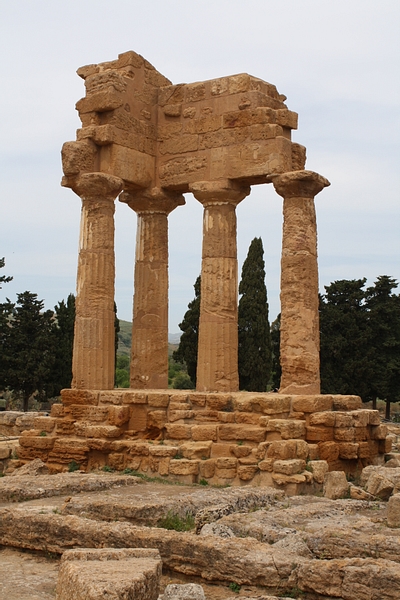 Temple of the Dioscuri, Agrigento Mark Cartwright (CC BY-NC-SA) ](https://www.worldhistory.org/image/2626/temple-of-the-dioscuri-agrigento/ "Temple of the Dioscuri, Agrigento")
Columns Proportion 6 x 13 Stylobate 13.83 x 31.70 m Intercolumn.
Long side (LS)
Front side (FS)
Middle Intercolumn.(MI)
Angle Intercolumn. (AI) NI = 2.54 m = 125 ´´
AI = 2.43 m = 119 ´´ Corner Contraction Single (?) Cella Width x Length - Pronaos/Cella Front - Arrangement of Inner Columns - Opisthodomos - Binding of the Cella classical (?) Column Height 5.83 m Lower Diameter 1.22 m Proportions in Elevation ColumnH : EntablatureH
= 1 : 3,14
EntablatureH : NormalI = 8 : 11 (almost 8 : 12 = 2 : 3)
LD : NormalI = 1 : 2,09
NormalI : ColumnH
= 1 : 2,29
OrderH : StylobateW
= ?5 : 9 Lower D x Column Height c. 1 : 4 ¾ OD : UD = 4 : 5 Frieze Proportions W=Width; H=Height TrW : MetW – 2 : 3
ArchW : angle TrW = 1 : 2 Corner Conflict in Frieze 19, 5 cm (30, 6 cm needed) I' 32,789 cm
Ground plan unit = 25´´ = 51,23 cm
### [Hephaistos](https://www.worldhistory.org/Hephaistos/) (Agrigento, 430/400 BCE)
Columns Proportion 6 x 13 Stylobate 13.39 x 31.00 m Intercolumn.
Long side (LS)
Front side (FS)
Middle Intercolumn.(MI)
Angle Intercolumn. (AI) Nl = ca. 3.16 m
AI = ca. 3.02 m Corner Contraction single
on the LS
needed – 36,1 cm Cella Width x Length ? 1 : 3 Pronaos/Cella Front - Arrangement of Inner Columns - Opisthodomos 2 in antis (?) Binding of the Cella classical (?) Column Height - Lower Diameter c. 1.51 m Proportions in Elevation - Lower D x Column Height - Frieze Proportions W=Width; H=Height - Corner Conflict in Frieze - I' -
### Big Temple ([Segesta](https://www.worldhistory.org/Segesta/), 417/409 BCE)
### [ 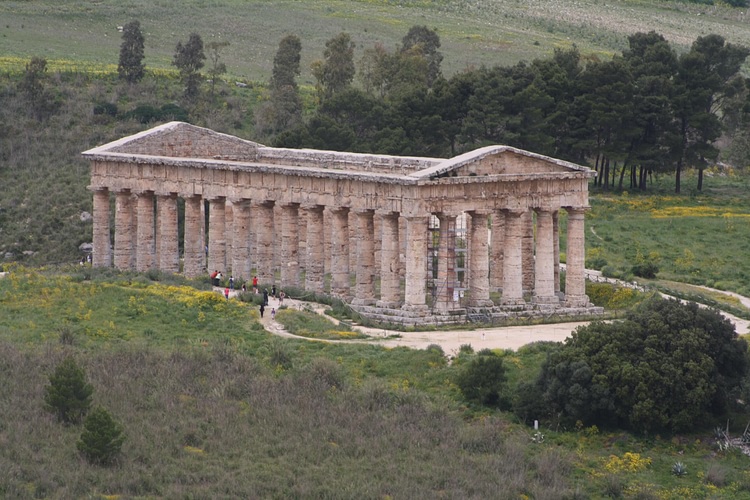 Temple of Segesta Mark Cartwright (CC BY-NC-SA) ](https://www.worldhistory.org/image/2598/temple-of-segesta/ "Temple of Segesta")
Columns Proportion 6 x 14 (3 : 7) Stylobate Styl: 23.17 x 58.07 m
EuthyntW : L = 3 : 7
AxialW : L = 64´x 170´ Intercolumn.
Long side (LS)
Front side (FS)
Middle Intercolumn.(MI)
Angle Intercolumn. (AI) NI LS = 4.35 (13¼´)
AI = 12 ½ ´
MI= 13¼ ´ = NI Corner Contraction double unit contraction on each side Cella Width x Length - Pronaos/Cella Front 2 in antis Arrangement of Inner Columns - Opisthodomos 2 in antis Binding of the Cella classical Column Height 9.33 m Lower Diameter 1.95 m Proportions in Elevation Axial W : ColumnH
= 4 : 9
EntablatureH : NormalI
= 2 : 3
LD : NormalI = 4 : 9 Lower D x Column Height 1 : 4 ¾ Frieze Proportions W=Width; H=Height TrW : MetW – 2 : 3
TrW : TrH – 3 : 5 Corner Conflict in Frieze - I' 32.861 cm
### Glossary
*Adyton* - The adyton (Greek: Άδυτον) or adytum (Latin) was a restricted area within the cella of a Greek or [Roman](https://www.worldhistory.org/disambiguation/Roman/) temple. The adyton was frequently a small area at the farthest end of the cella from the entrance.
*Cella* - The cella (from Latin for "small chamber") or naos (from the Greek ναός, "temple"), is the inner chamber of a temple in classical architecture.
*Euthynteria* - Euthynteria is the ancient Greek term for the uppermost course of a building's foundations, partly emerging from the ground line. The superstructure of the building (stylobate, columns, walls, and entablature) was set on the euthynteria.
*Intercolumniation* - In architecture intercolumniation is the spacing between columns in a colonnade, as measured at the bottom of their shafts. Unit intercolumniation (NI) is the hypothetical/ initial equal size of the spacing on each side of a temple before the alteration of the spacing. The normal intercolumniation (NI), however, is one that has not been altered in order to achieve a contraction. Middle intercolumniation (MI) is the one between the central two columns at the entrance of a temple, usually on the east front.
*Metropolis* - In the past, metropolis was the designation for a city or state of origin of a colony.
*Opisthodomos* - An opisthodomos (ὀπισθόδομος, 'back room') can refer to either the rear room of an ancient Greek temple or to the inner shrine.
*Peristasis* - The Peristasis (Greek: Περίστασις) was a four-sided porch or hall of columns surrounding the cella in an ancient Greek peripteros temple.
*Stylobate* - This is the stepped platform on which colonnades of temple columns are placed (it is the floor of the temple). The platform was built on a levelling course that flattened out the ground immediately beneath the temple.
*Triglyph and metope* - Triglyph is an architectural term for the vertically channelled tablets of the Doric frieze. The rectangular recessed spaces between the triglyphs on a Doric frieze are called metopes.
#### Editorial Review
This human-authored article has been reviewed by our editorial team before publication to ensure accuracy, reliability and adherence to academic standards in accordance with our [editorial policy](https://www.worldhistory.org/static/editorial-policy/).
## Cite This Work
### APA
Dzhigova, D. (2014, December 12). Sicilian Temples (Greek Metrology). *World History Encyclopedia*.
### Chicago
Dzhigova, Denitsa. "Sicilian Temples (Greek Metrology)." *World History Encyclopedia*, December 12, 2014. .
### MLA
Dzhigova, Denitsa. "Sicilian Temples (Greek Metrology)." *World History Encyclopedia*, 12 Dec 2014, .
## License & Copyright
This content is provided by the [Europeana EAGLE Project](http://www.eagle-network.eu/) under a content sharing agreement. Original article by **Denitsa Dzhigova**. Submitted by [Karen Barrett-Wilt](https://www.worldhistory.org/user/klbwilt/ "User Page: Karen Barrett-Wilt"), published on 12 December 2014. The copyright holder has published this content under the following license: [Creative Commons Attribution-NonCommercial-ShareAlike](https://creativecommons.org/licenses/by-nc-sa/4.0/deed.en). This license lets others remix, tweak, and build upon this content non-commercially, as long as they credit the author and license their new creations under the identical terms. When republishing on the web a hyperlink back to the original content source URL must be included. Please note that content linked from this page may have different licensing terms.