---
title: The Roman Domus
author: Steven Fife
source: https://www.worldhistory.org/article/77/the-roman-domus/
format: machine-readable-alternate
license: Creative Commons Attribution-NonCommercial-ShareAlike (https://creativecommons.org/licenses/by-nc-sa/4.0/)
updated: 1970-01-01
---
# The Roman Domus
_Authored by [Steven Fife](https://www.worldhistory.org/user/stevenfife_06/)_
The [Roman](https://www.worldhistory.org/disambiguation/Roman/) *domus* was much more than a place of dwelling for a Roman *familia*. It also served as a place of business and a religious center for worship. The size of a *domus* could range from a very small house to a luxurious mansion. In some cases, one *domus* took up an entire [city](https://www.worldhistory.org/city/)-block, while more commonly, there were up to 8 *domus* per *insula* (city-block). All *domus* were free-standing structures. Some were constructed like modern-day townhouses with common walls between them, while others were detached.
Because safety was a primary concern in ancient [Rome](https://www.worldhistory.org/Rome/), *domus* did not face the streets. Similarly, there were rarely outside-facing windows for this reason, but most *domus* did have two front rooms open to the street. Some families ran their own stores from these rooms, while others leased them out to others.
[  Domus Romana JFJP (CC BY-SA) ](https://www.worldhistory.org/image/105/domus-romana/ "Domus Romana")The *domus* included multiple rooms, indoor courtyards, gardens, and beautifully painted walls.
**Atrium:** The atrium was the central hall, almost like a modern-day foyer, and it was the most conspicuous room in a Roman *domus*. It was open at the roof, which let in light and air for circulation, and also allowed rainwater for drinking and washing to collect in the *impluvium*, a small draining pool in the middle of the atrium. Cisterns were also located throughout the *domus* to collect rainwater, which acted as the primary water supply in the absence of running water.
The atrium was one of the most richly decorated rooms in the *domus*. For one, symbols of the family's wealth and hereditary power were present, in addition to *imagines*, wax representations of the family's ancestors. Paintings and mosaics were also commonplace, and many examples of these have been preserved in houses from [Pompeii](https://www.worldhistory.org/pompeii/).
Finally, before a funeral, the body of the deceased was displayed in the atrium with his/her feet always pointed toward the door. The body was then viewed by family and friends.
[ 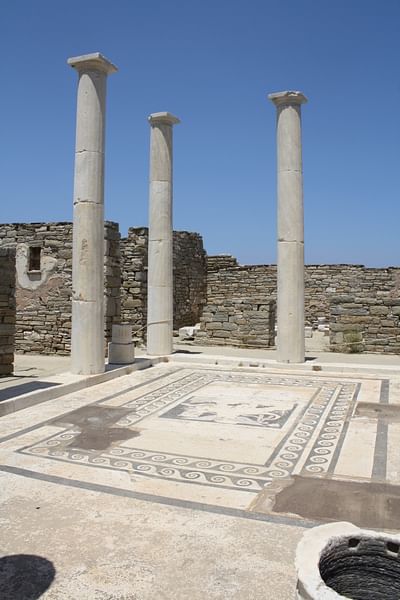 House of Dionysos, Delos Mark Cartwright (CC BY-NC-SA) ](https://www.worldhistory.org/image/2055/house-of-dionysos-delos/ "House of Dionysos, Delos")***Lararium* (household shrine):** Honoring the household gods was an important part of daily life for Romans. Each *domus* contained a *lararium*, or shrine, in the atrium, which was where offerings were left for the household gods (the *Lares*), spirits of the ancestors, and spirits of the underworld.
***Tablinum* (office):** Roman men often conducted business out of their *domus* from a home office known as the *tablinum*. It was also the room where clients would go to meet their patron for the *salutatio*, a formal renewal of their patron-client relationship.
***Triclinium* (dining room):** Dinner parties were very popular in ancient Rome. These were held in the *triclinium,* which translates to “three couch room” because it had three couches arranged in a U-shape. While eating, Romans reclined on these couches and they always dined barefoot. There were no fixed tables in the Roman *triclinium*; food was served on portable tables, sometimes by a high-ranking slave.
Communal dinner parties and public banquets were very common in the Roman world, and helped to strengthen social ties within the city.
***Hortus* (garden):** Unlike most modern gardens, the Roman *hortus* was located at the back of the *domus*. Peristyle gardens with walkways to access other rooms in the house were also very common. When the weather was nice, the garden may have been used for dining and socializing or as a place for Roman children to play.
#### Editorial Review
This human-authored article has been reviewed by our editorial team before publication to ensure accuracy, reliability and adherence to academic standards in accordance with our [editorial policy](https://www.worldhistory.org/static/editorial-policy/).
## Bibliography
- [LacusCurtius • The Roman House (Smith's Dictionary, 1875)](http://penelope.uchicago.edu/Thayer/E/Roman/Texts/secondary/SMIGRA*/Domus.html "LacusCurtius • The Roman House (Smith's Dictionary, 1875)"), accessed 1 Dec 2016.
## Cite This Work
### APA
Fife, S. (2012, January 18). The Roman Domus. *World History Encyclopedia*.
### Chicago
Fife, Steven. "The Roman Domus." *World History Encyclopedia*, January 18, 2012. .
### MLA
Fife, Steven. "The Roman Domus." *World History Encyclopedia*, 18 Jan 2012, .
## License & Copyright
Submitted by [Steven Fife](https://www.worldhistory.org/user/stevenfife_06/ "User Page: Steven Fife"), published on 18 January 2012. The copyright holder has published this content under the following license: [Creative Commons Attribution-NonCommercial-ShareAlike](https://creativecommons.org/licenses/by-nc-sa/4.0/deed.en). This license lets others remix, tweak, and build upon this content non-commercially, as long as they credit the author and license their new creations under the identical terms. When republishing on the web a hyperlink back to the original content source URL must be included. Please note that content linked from this page may have different licensing terms.