---
title: Herodotus in Art
author: Pietro Maria Liuzzo
source: https://www.worldhistory.org/article/768/herodotus-in-art/
format: machine-readable-alternate
license: Creative Commons Attribution-NonCommercial-ShareAlike (https://creativecommons.org/licenses/by-nc-sa/4.0/)
updated: 1970-01-01
---
# Herodotus in Art
_Authored by [Pietro Maria Liuzzo](https://www.worldhistory.org/user/pietro.liuzzo/)_
[Herodotus](https://www.worldhistory.org/herodotus/)' [*Histories*](http://data.perseus.org/citations/urn:cts:greekLit:tlg0016.tlg001.perseus-eng1:1.1.0) with their historical, geographical, ethnographic, and religious aspects, have always been a source of delight and interest, not only for generations of readers, students, and storytellers, but also for artists.
A complete list of the painting representing scenes from Herodotus' [*Histories*](http://data.perseus.org/citations/urn:cts:greekLit:tlg0016.tlg001.perseus-eng1:1.1.0) is a task for a large community of scholars from different fields. This is because the impact of Herodotus' *Histories* goes far beyond the consequences of reading: especially the tales, but also the historical events contained in this work were renown and had traditions of their own, as well.
Each episode and scene could be the subject of a separate study, but there are some in particular which stand out among others: Gyges and the wife of Candaules, Cleobi and Biton, [Solon](https://www.worldhistory.org/solon/) and [Croesus](https://www.worldhistory.org/croesus/) meeting, and [Cyrus](https://www.worldhistory.org/disambiguation/Cyrus/)' life. There are numerous paintings representing these outstanding scenes, and a non-exhaustive list of them is provided at the end of this article. However, in the following article I will focus on less famous episodes such as the judgement of Cambyses and the revenge of Tomyris.
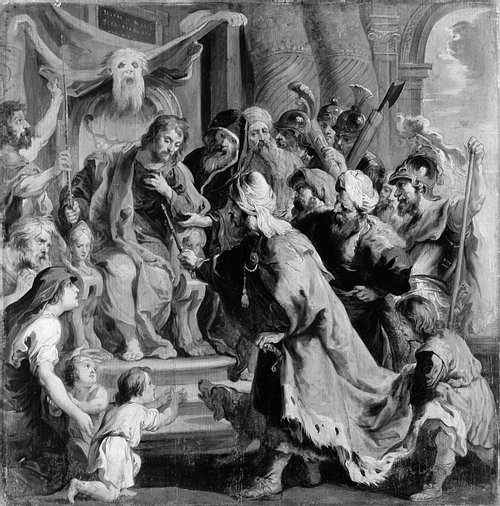
The first one of these consists of the series of images which represents the punishment given to the judge Sisamnes by Cambyses. This is one of the shortest and cruelest tales of punishment in the *Histories*, told almost *en passant* by the author:
> Otanes' father Sisamnes had been one of the royal judges, and Cambyses had cut his throat and flayed off all his skin because he had been bribed to give an unjust judgment. Then he cut leather strips of the skin which had been torn away and with these he covered the seat upon which Sisamnes had sat to give judgment. After doing this, Cambyses appointed the son of this slain and flayed Sisamnes to be judge in his place, admonishing him to keep in mind the nature of the throne on which he was sitting. ([Hdt 5.25](http://data.perseus.org/citations/urn:cts:greekLit:tlg0016.tlg001.perseus-eng1:5.25) Translation by A.D. Godley from [Perseus](https://www.worldhistory.org/Perseus/))
[  The Judgement of Cambyses, David Wikimedia Commons (Public Domain) ](https://www.worldhistory.org/image/3244/the-judgement-of-cambyses-david/ "The Judgement of Cambyses, David")This story is represented as early as in a work from Gerard David (1498) for the main hall of the [city](https://www.worldhistory.org/city/) hall of Bruges. The aim of this painting in this context was clearly to warn judges, administrators, and other officials and remind them of their responsibilities, and the seat was also a memento for the son of Sisamnes, Otanes. People knew the story and, even if they did not, the image was clear enough. However, the reference to Herodotus as the source of this tale might have not been so well known.
[ 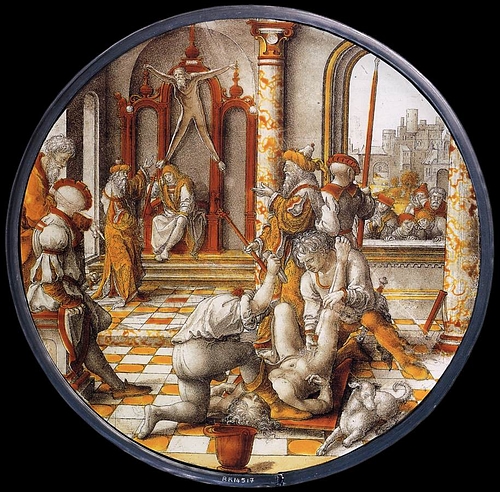 The Judgement of Cambyses, Vellert Wikimedia Commons (Public Domain) ](https://www.worldhistory.org/image/3245/the-judgement-of-cambyses-vellert/ "The Judgement of Cambyses, Vellert")The same scene in a different context takes on a different twist. On the stained glass [wall](https://www.worldhistory.org/wall/) by [Dirk Vellert](https://en.wikipedia.org/wiki/Dirk_Vellert), now at the Rijksmuseum in Amsterdam, for example, the focus is on the flaying only rather than on both the corruption and the punishment as represented by David, in two scenes. Nevertheless, the didactic part of the story is actually the one in which Cambyses puts the young Otanes on the judge's seat. This is also the focus of Rubens' work on this theme in the following century. Of course, the disposition of the skin on the seat is an entirely artistic decision and needs not represent *ad litteram* Herodotus' tale, which speaks about ἱμάντας (leather strip).
[  Cambyses Appointing Otanes Judge Metropolitan Museum (Copyright) ](https://www.worldhistory.org/image/3246/cambyses-appointing-otanes-judge/ "Cambyses Appointing Otanes Judge")One of the stories with the widest range of representations, and certainly one of the most commonly known, is Cyrus' childhood tale. These paintings are based on a mix of versions, including [Xenophon](https://www.worldhistory.org/xenophon/)'s and several others, which circulated since antiquity, also independently from Herodotus' one. This long tale included several elements and themes that were interesting for painters. The mother of Cyrus has ominous dreams about her future son becoming king so that her father, Astyages, asks Arpagus to kill the baby. Through a series of vicissitudes, the baby nevertheless survives and is brought up by a country lady called “Dog” or directly by a dog, until, through a series of episodes, he is recognized and the prophecy can be fulfilled. With a *coupé d'état* Cyrus becomes king of [Persia](https://www.worldhistory.org/Persia/) and sets the foundations of the [Achaemenid](https://www.worldhistory.org/disambiguation/Achaemenid/) dynasty. His chain of incredible successes is brought to an end when he dies at the hands of Tomyris. These stories are often the subject of several scenes and decorative projects.
[ 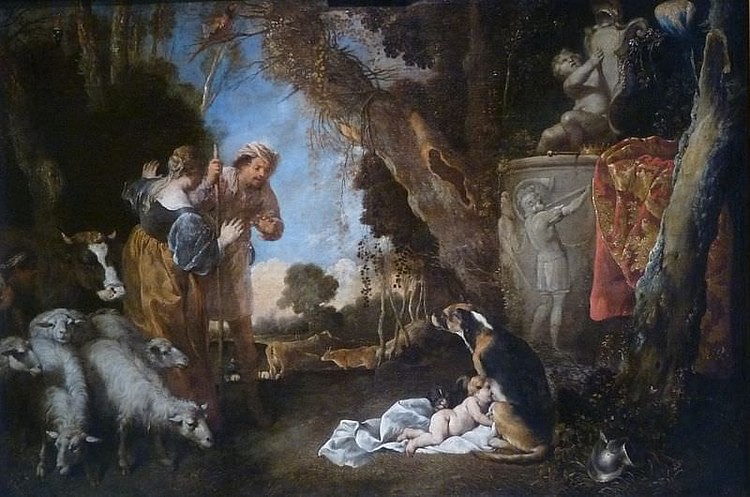 Childhood of King Cyrus Lgtrapp (Public Domain) ](https://www.worldhistory.org/image/3316/childhood-of-king-cyrus/ "Childhood of King Cyrus")Often alternative traditions of these tales coexist and are a testimony to the fact that Herodotus' volumes were not always read for reinterpretation and that some stories made their own way. However, it is most certainly Herodotus' tale that directly influences, for instance, the representations of Spako (Dog) kneeling and pointing her finger at the husband's heart.
An extremely famous example of an image which stayed into the mind of any reader or onlooker is, of course, the one of the deeds of Tomyris, Queen of the Messagetae, after she defeated and killed Cyrus:
> The greater part of the Persian army was destroyed there on the spot, and Cyrus himself fell there, after having reigned for one year short of thirty years. Tomyris filled a skin with human blood, and searched among the Persian dead for Cyrus' body; and when she found it, she pushed his head into the skin, and insulted the dead man in these words: “Though I am alive and have defeated you in [battle](https://www.worldhistory.org/disambiguation/battle/), you have destroyed me, taking my son by guile; but just as I threatened, I give you your fill of blood.” Many stories are told of Cyrus' [death](https://www.worldhistory.org/disambiguation/Death/); this, that I have told, is the most credible. ([Hdt 1.214](http://data.perseus.org/citations/urn:cts:greekLit:tlg0016.tlg001.perseus-eng1:1.214) Translation by A.D. Godley from Perseus)
[  The Revenge of Tomyris Web Gallery of Art (CC BY-NC-SA) ](https://www.worldhistory.org/image/3247/the-revenge-of-tomyris/ "The Revenge of Tomyris")[ 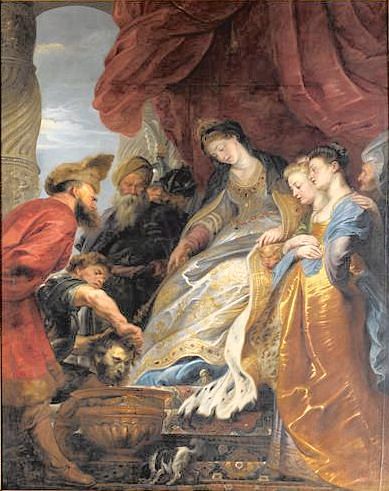 The Vengeance of Tomyris Sailko (Public Domain) ](https://www.worldhistory.org/image/3297/the-vengeance-of-tomyris/ "The Vengeance of Tomyris")In the paintings of this scene, interpretations are as many as there can be. Van Coxcie shows us Tomyris while she dips the head of the king in a bowl held by a courtesan. She has a rather vicious look and a foot on the corpse, which is also attacked by a dog. Rubens instead, at least in this example, has in mind also the despair of Herodotus' queen and the contradiction of her victory and successful revenge; therefore, she does not act with her own hands: she is sad and suffering ([ἀπώλεσας](http://www.perseus.tufts.edu/hopper/morph?l=a%29pw%2Flesas&la=greek&can=a%29pw%2Flesas0&prior=ma/xh%7C)) and holds onto the throne, on the verge of crying. Here we can think that the author knows the content of the entire story well enough, not just the theme of the image. However Rubens' approach is almost completely lost in the following centuries, and the queen of revenge takes over the despairing one of Herodotus' story, partly as a consequence of becoming one in a series of profane subjects which were more or less standard.
[ 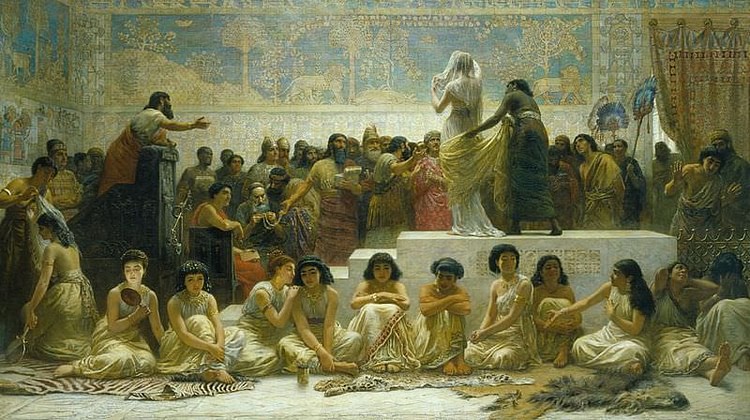 Babylonian Marriage Market Briangotts (Public Domain) ](https://www.worldhistory.org/image/2638/babylonian-marriage-market/ "Babylonian Marriage Market")In the 19th century CE, in the context of renewed explorations of the [Mediterranean](https://www.worldhistory.org/disambiguation/mediterranean/) and with the return of a strong interest in Classics, especially in the historians including Herodotus, a series of scenes never represented before emerges. A relatively well-known example is *The Babylonian Market* by Long, where there is no doubt about the source of the story. This is a famous passage in which Herodotus describes a curious way of giving a husband to each unmarried girl regardless of her status:
> I will now speak of their established customs. The wisest of these, in our judgment, is one which I have learned by inquiry is also a custom of the Eneti in Illyria. It is this: once a year in every village all the maidens as they attained marriageable age were collected and brought together into one place, with a crowd of men standing around. Then a crier would display and offer them for sale one by one, first the fairest of all; and then, when she had fetched a great price, he put up for sale the next most attractive, selling all the maidens as lawful wives. Rich men ofAssyria who desired to marry would outbid each other for the fairest; the ordinary people, who desired to marry and had no use for beauty, could take the ugly ones and money besides. ([Hdt. 1.196](http://data.perseus.org/citations/urn:cts:greekLit:tlg0016.tlg001.perseus-eng1:1.196), Translation by A.D. Godley from Perseus)
In the 19th century CE , when the first newspapers started to print series of illustrated novels, which sometimes had the *Histories* of Herodotus as a first issue, some of these painted stories could be finally traced back, and they continued more and more to provide materials for paintings, new stories, and new works of art. Their power to fascinate remained intact and able to generate, until today, uninterruptedly and in heterogeneous ways, thoughts, images, and ideas.
\*\*\*
A list of paintings with scenes from Herodotus' *Histories:*
1. *Battle between the Athenians and the Persians* (1463) by Apollonio di Giovanni, depicting [Hdt. 7.20f.](http://data.perseus.org/citations/urn:cts:greekLit:tlg0016.tlg001.perseus-eng1:7.20): Online at or [http://www.oberlin.edu/amam/Giovanni\_Battle.htm](http://www.oberlin.edu/amam/Giovanni_Battle.htm)
2. *The Punishment of Cambyses*, Bruges (1498) by Gerard David, depicting [Hdt. 5.25](http://data.perseus.org/citations/urn:cts:greekLit:tlg0016.tlg001.perseus-eng1:5.25). Online [https://commons.wikimedia.org/wiki/File:David\_Diptych\_The\_Judgment\_of\_Cambyses.jpg](https://commons.wikimedia.org/wiki/File:David_Diptych_The_Judgment_of_Cambyses.jpg)
3. *Life of Cyrus*, Bologna, Palazzo Sanguinetti ex Vizzani, (1562-5), by Lorenzino da Bologna, depicting Hdt. [1.107](http://data.perseus.org/citations/urn:cts:greekLit:tlg0016.tlg001.perseus-eng1:1.107)-[1.124](http://data.perseus.org/citations/urn:cts:greekLit:tlg0016.tlg001.perseus-eng1:1.124) and Images in Roversi [Palazzi e case nobili del '500 a Bologna: la storia, le fami…](https://www.zotero.org/pietroliuzzo/items/itemKey/MMI7AJ8J)1986.
4. *Gyges and Candaules*, [Roma](https://www.worldhistory.org/disambiguation/Roma/), Galleria Borghese (1515-1535), by Dosso Dossi, depicting [Hdt 1.8.](http://data.perseus.org/citations/urn:cts:greekLit:tlg0016.tlg001.perseus-eng1:1.8)
5. *King Candaules of [Lydia](https://www.worldhistory.org/lydia/) Showing his Wife to Gyges*, Stoccolma, Museo Nazionale (1646), by Jordaens depicting [Hdt 1.8.](http://data.perseus.org/citations/urn:cts:greekLit:tlg0016.tlg001.perseus-eng1:1.8) Online at [https://commons.wikimedia.org/wiki/File:Jacob\_Jordaens-King\_Candaules\_of\_Lydia\_Showing\_his\_Wife\_to\_Gyges.jpg](https://commons.wikimedia.org/wiki/File:Jacob_Jordaens-King_Candaules_of_Lydia_Showing_his_Wife_to_Gyges.jpg)
6. *Cleobi and Biton*, Fontainbleau Castle, Frances I Gallery (1534-1539), project by Rosso Fiorentino painted by a group including Francesco Primaticcio, depicting [Hdt ](http://data.perseus.org/citations/urn:cts:greekLit:tlg0016.tlg001.perseus-eng1:1.31)[1.31](http://data.perseus.org/citations/urn:cts:greekLit:tlg0016.tlg001.perseus-eng1:1.31).
7. *The Fountain of Youth*, Berlin Staatliche Museen (1546) by Lucas Cranach the Elder depicting Hdt. [3.23](http://data.perseus.org/citations/urn:cts:greekLit:tlg0016.tlg001.perseus-eng1:3.23). Online at
8. *Arion on the Dolphin*, Roma Palazzo Farnese (1602-4), by Annibale Carracci depicting [Hdt. 1.23](http://data.perseus.org/citations/urn:cts:greekLit:tlg0016.tlg001.perseus-eng1:1.23). Online at [http://fe.fondazionezeri.unibo.it](http://fe.fondazionezeri.unibo.it/).
9. *Cambyses Judgement,* Autun, Rolin Museum (1530), depicting [Hdt. 5.25](http://data.perseus.org/citations/urn:cts:greekLit:tlg0016.tlg001.perseus-eng1:5.25).
10. *Cambyses Judgement*, Rijksmuseum Amsterdam (1542), by Dirk Jacobsz Vellert depicting [Hdt. 5.25](http://data.perseus.org/citations/urn:cts:greekLit:tlg0016.tlg001.perseus-eng1:5.25). Online at [https://commons.wikimedia.org/wiki/File:Dirck\_Vellert\_001.jpg](https://commons.wikimedia.org/wiki/File:Dirck_Vellert_001.jpg)
11. *The Ring of [Polycrates](https://www.worldhistory.org/Polycrates/)* (1572) by Giovanni Fedini depicting [Hdt 3.41-43.](http://data.perseus.org/citations/urn:cts:greekLit:tlg0016.tlg001.perseus-eng1:3.41) online at [http://www.wikigallery.org/wiki/painting\_215010/Giovanni-Fedini/The-Ring-of-Polycrates](http://www.wikigallery.org/wiki/painting_215010/Giovanni-Fedini/The-Ring-of-Polycrates)
12. *Solon and Croesus*, The National Gallery (1610), by Hendrick van Steenwyck depicting [Hdt. 1.29-30](http://data.perseus.org/citations/urn:cts:greekLit:tlg0016.tlg001.perseus-eng1:1.29).
13. *The Revenge of Tomyris* (copy of lost original), Vienna (1620), by Michiel Van Coxcie depicting [Hdt. 1.214](http://data.perseus.org/citations/urn:cts:greekLit:tlg0016.tlg001.perseus-eng1:1.214).
14. *Childhood of Cyrus*, Hermitage (1620-1662), by Antonio Maria Vassallo depicting [Hdt. 1.110](http://data.perseus.org/citations/urn:cts:greekLit:tlg0016.tlg001.perseus-eng1:1.110) and [1.122.3](http://data.perseus.org/citations/urn:cts:greekLit:tlg0016.tlg001.perseus-eng1:1.122).
15. *Head of Cyrus Brought to Queen Tomyris*, Museum of fine arts Boston (1622-23), Peter [Paul](https://www.worldhistory.org/disambiguation/Paul/) Rubens depicting Hdt. 1.214. Online at
16. *Childhood of Cyrus*, London and Bordeaux (1630-1664), by Giovanni Benedetto Castiglione depicting [Hdt. 1.110](http://data.perseus.org/citations/urn:cts:greekLit:tlg0016.tlg001.perseus-eng1:1.110) and [1.122.3](http://data.perseus.org/citations/urn:cts:greekLit:tlg0016.tlg001.perseus-eng1:1.122). Online at
17. *Tomyris*, Parigi - Louvre (1620 ca.), by Peter Paul Rubens depicting [Hdt. 1.214](http://data.perseus.org/citations/urn:cts:greekLit:tlg0016.tlg001.perseus-eng1:1.214).
18. *Cambyses Judgement*, New York Metropolitan Museum (1620), by Peter Paul Rubens depicting [Hdt. 5.25](http://data.perseus.org/citations/urn:cts:greekLit:tlg0016.tlg001.perseus-eng1:5.25). Online at
19. *Cambyses Judgement*, Alkmaar (1622), by Nicolaeus Jabobsz depicting [Hdt. 5.25](http://data.perseus.org/citations/urn:cts:greekLit:tlg0016.tlg001.perseus-eng1:5.25).
20. *Solon and Croesus*, Hamburg (1624), by Gerrit van Honthorst depicting [Hdt. 1.30-32](http://data.perseus.org/citations/urn:cts:greekLit:tlg0016.tlg001.perseus-eng1:1.30).
21. *[Darius I](https://www.worldhistory.org/Darius_I/) Opens the [Tomb](https://www.worldhistory.org/tomb/) of Nitocry*, Hermitage (1649 ca.), by Eustache Le Sueur depicting [Hdt 1.187](http://data.perseus.org/citations/urn:cts:greekLit:tlg0016.tlg001.perseus-eng1:1.187). Online at
22. *Cleobi and Biton* (1650), by Thomas Balnchet depicting [Hdt 1.31](http://data.perseus.org/citations/urn:cts:greekLit:tlg0016.tlg001.perseus-eng1:1.31). Online at [http://www.artnet.com/artwork/425991177/10/thom](
#### Editorial Review
This human-authored article has been reviewed by our editorial team before publication to ensure accuracy, reliability and adherence to academic standards in accordance with our [editorial policy](https://www.worldhistory.org/static/editorial-policy/).
## Cite This Work
### APA
Liuzzo, P. M. (2014, December 12). Herodotus in Art. *World History Encyclopedia*.
### Chicago
Liuzzo, Pietro Maria. "Herodotus in Art." *World History Encyclopedia*, December 12, 2014. .
### MLA
Liuzzo, Pietro Maria. "Herodotus in Art." *World History Encyclopedia*, 12 Dec 2014, .
## License & Copyright
Submitted by [Pietro Maria Liuzzo](https://www.worldhistory.org/user/pietro.liuzzo/ "User Page: Pietro Maria Liuzzo"), published on 12 December 2014. The copyright holder has published this content under the following license: [Creative Commons Attribution-NonCommercial-ShareAlike](https://creativecommons.org/licenses/by-nc-sa/4.0/deed.en). This license lets others remix, tweak, and build upon this content non-commercially, as long as they credit the author and license their new creations under the identical terms. When republishing on the web a hyperlink back to the original content source URL must be included. Please note that content linked from this page may have different licensing terms.