---
title: Passing of Philosophy to Religion: The Death of Hypatia
author: Joshua J. Mark
source: https://www.worldhistory.org/article/76/passing-of-philosophy-to-religion-the-death-of-hyp/
format: machine-readable-alternate
license: Creative Commons Attribution-NonCommercial-ShareAlike (https://creativecommons.org/licenses/by-nc-sa/4.0/)
updated: 2023-07-22
---
# Passing of Philosophy to Religion: The Death of Hypatia
_Authored by [Joshua J. Mark](https://www.worldhistory.org/user/JPryst/)_
The [death](https://www.worldhistory.org/disambiguation/Death/) of the philosopher [Hypatia of Alexandria](https://www.worldhistory.org/Hypatia_of_Alexandria/) (l. c. 370-415) has long been considered the "passage of [philosophy](https://www.worldhistory.org/philosophy/) to [religion](https://www.worldhistory.org/religion/)", exemplifying the transition from the pagan values of antiquity to those of the new religion of [Christianity](https://www.worldhistory.org/christianity/). Symbols of older beliefs were destroyed to make room for the new and among these was [Hypatia](https://www.worldhistory.org/Hypatia_of_Alexandria/).
Hypatia was the daughter of Theon, the last professor of the Alexandrian University (associated closely with the famous [Library of Alexandria](https://www.worldhistory.org/Library_of_Alexandria/)). Theon was a brilliant mathematician who closely copied [Euclid](https://www.worldhistory.org/Euclid/)'s *Elements* and the works of [Ptolemy](https://www.worldhistory.org/disambiguation/Ptolemy/) and, in the language of our day, home-schooled his daughter in mathematics and philosophy (Deakin in [Science](https://www.worldhistory.org/science/)/Ockham). Hypatia helped her father in [writing](https://www.worldhistory.org/writing/) commentaries on these works and, in time, wrote her own works and lectured extensively, becoming a woman of note in a [culture](https://www.worldhistory.org/disambiguation/culture/) dominated by male writers and thinkers.
Her influence over her male students, however, was not appreciated by the archbishop of [Alexandria](https://www.worldhistory.org/alexandria/), Cyril (later St. Cyril) who felt she was an obstacle to their acceptance of Christianity. Cyril was especially critical of her friendship with the prefect Orestes over whom he felt she held undue and dangerous influence. Early writers strongly suggest that it was Cyril who encouraged the mob which would eventually attack and murder Hypatia, removing a potent pagan influence from the [city](https://www.worldhistory.org/city/).
[  Hypatia of Alexandria Elbert Hubbard (Public Domain) ](https://www.worldhistory.org/image/103/hypatia-of-alexandria/ "Hypatia of Alexandria")### Alexandria in Hypatia's Time
Alexandria, [Egypt](https://www.worldhistory.org/egypt/), had long been (since its founding by [Alexander the Great](https://www.worldhistory.org/Alexander_the_Great/)) a seat of learning and a place of pilgrimage for philosophers and thinkers from all over the known world. The great library, said to have housed 500,000 books during the [Ptolemaic Period](https://www.worldhistory.org/Ptolemaic_Dynasty/) (323-30 BCE), had declined but was still a major attraction for intellectuals, most of whom had money. Alexandria, therefore, was a prosperous pagan city in the year 415 but, for the past fifteen of those years, had increasingly become a divided city with Jews fighting in the streets with the new religion of Christianity and Pagans and Christians drawing their own [battle](https://www.worldhistory.org/disambiguation/battle/) lines.
Under the reign of Theodosius I (r. 379-395) pagan practices were outlawed and Christian leaders were encouraged to root out anti-Christian and pre-Christian influences in their communities. Temples were to be converted to churches or destroyed, shrines to rival faiths like the popular Cult of [Antinous](https://www.worldhistory.org/antinous/) shared in this same fate, and those who actively preached and taught pagan principles were not to be tolerated. In 391, the Christian bishop Theophilus instituted Theodosius I's policies in the city and closed the temples, resulting in elevated tensions between the pagan and Christian communities.
### Orestes & Cyril
These tensions were exemplified in the relationship between the pagan prefect Orestes and the Christian archbishop Cyril. Orestes tried to keep the peace in the city while Cyril encouraged the Christian mobs against the Jews of Alexandria, looted their synagogues, and finally expelled them from the city. Once the Jews were more or less gone, the Christians turned their attention to the pagans.
Orestes maintained his Paganism in the face of Christianity and cultivated a close relationship with Hypatia. Cyril, it seems, blamed Hypatia for Orestes' refusal to submit to the "true faith" and become a Christian. Tensions between the two men, and their supporters, grew increasingly high as each brushed off the other's advances of reconciliation and peace. Both men were convinced of their own truths and refused to consider the views of the other. The difference between them was that Orestes had no interest in harming or killing others to promote his religious faith while Cyril felt violence was justified in establishing a kingdom of [God](https://www.worldhistory.org/God/) on earth.
### Hypatia
Cyril's fanaticism, which was mirrored by his followers, would finally result in the tragedy of Hypatia's death. Hypatia was popular among pagans and Christians but her insistence on applying reason and what, today, would be called the "[scientific method](https://www.worldhistory.org/Scientific_Method/)" to all things encouraged Cyril's belief that she was a dangerous influence and a threat to Christianity. The scholar M. Mangasarian comments:
> Hypatia was a remarkably gifted woman. Her example demonstrates how all difficulties yield to a strong will. Being a girl, and excluded by the conventions of the time from intellectual pursuits, she could have given many reasons why she should leave philosophy to stronger and freer minds. But she had an all-compelling passion for the life of the mind, which overcame every obstacle that interfered with her purpose. (4)
[  Rachel Weisz as Hypatia of Alexandria Focus Features, Newmarket Films, Telecinco Cinema (Copyright, fair use) ](https://www.worldhistory.org/image/609/rachel-weisz-as-hypatia-of-alexandria/ "Rachel Weisz as Hypatia of Alexandria")By all accounts, Hypatia was a beautiful, chaste and brilliant woman. Even her detractors, and later defenders of Cyril, admitted she was a virtuous, wise and noble philosopher. The historian Will Durant calls her "the most interesting figure in the science of this age" and reports that, "She was so fond of philosophy that she would stop in the streets and explain, to any who asked, difficult points in [Plato](https://www.worldhistory.org/plato/) or [Aristotle](https://www.worldhistory.org/aristotle/)" (Durant, 122). This, however, is not the only view of the philosopher:
> And in those days there appeared in Alexandria a female philosopher, a pagan named Hypatia, and she was devoted at all times to magic, astrolabes and instruments of [music](https://www.worldhistory.org/disambiguation/Music/), and she beguiled many people through Satanic wiles. And the governor of the city \[Orestes\] honoured her exceedingly; for she had beguiled him through her magic. And he ceased attending church as had been his custom....And he not only did this, but he drew many believers to her, and he himself received the unbelievers at his house (Charles, LXXXIV. 87-88).
It did not matter that this report of magic and satanic wiles was not true, nor that Orestes was a pagan, not a Christian, nor did it matter the nobility and virtue Hypatia possessed. One day, in 415, "as Hypatia was returning home, she was set upon, \[by a Christian mob\] torn from her carriage and dragged into a church, where she was stripped naked and battered to death with roofing tiles, 'and while she was still feebly twitching they beat her eyes out'. They then orgiastically tore her body limb from limb, took her mangled remains out from the church, and burned them" (Deakin in Science/Ockham).
Mangasarian adds:
> Some historians intimate that the monks asked her to kiss the cross, to become a Christian and join the nunnery, if she wished her life spared. At any rate, these monks, under the leadership of St. Cyril's right-hand man, Peter the Reader, shamefully stripped her naked, and there, close to the altar and the cross, scraped her quivering flesh from her bones with oystershells. The marble floor of the church was sprinkled with her warm blood. The altar, the cross, too, were bespattered, owing to the violence with which her limbs were torn, while the hands of the monks presented a sight too revolting to describe. (8)
[ 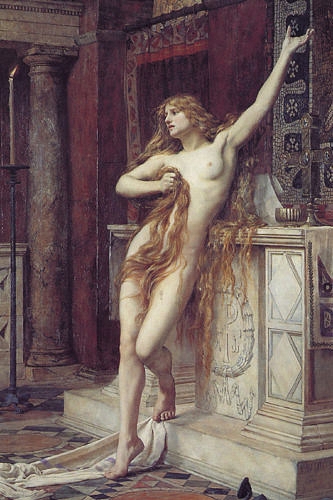 Hypatia Charles William Mitchell (Public Domain) ](https://www.worldhistory.org/image/104/hypatia/ "Hypatia")### The Aftermath
Durant, among many other scholars, notes how, after her death, there was a significant exodus from the city. "Pagan professors of philosophy, after the death of Hypatia, sought security in [Athens](https://www.worldhistory.org/Athens/), where non-Christian teaching was still relatively...free" (Durant, 123). Not only the philosophers, but all intellectuals, fled the city of Alexandria. The [Temple](https://www.worldhistory.org/temple/) of [Serapis](https://www.worldhistory.org/Serapis/), according to some sources, was destroyed completely at this time (destruction of the Serapeum had been initiated and largely carried out by Cyril's uncle Theophilus some 25 years earlier) and, with it, whatever still remained of the Great Library and University was burned (Mangasarian).
Orestes became reconciled to Cyril and converted to Christianity, thus ending the strife in the streets of Alexandria between their supporters. Cyril, himself, was never charged with the murder of Hypatia though, according to his apologist, John of Nikiu: "\[After Hypatia's death\] all the people surrounded the patriarch Cyril and named him 'the new Theophilus'; for he had destroyed the last remains of idolatry in the city" (Deakin in Science/Ockham). Cyril was eventually made a saint and Alexandria became an important center for the Christian faith. Borrowing a phrase from Durant, "The passage from philosophy to religion, from Plato to Christ" was complete; at least one may be sure it was so in Alexandria after the death of Hypatia.
#### Editorial Review
This human-authored article has been reviewed by our editorial team before publication to ensure accuracy, reliability and adherence to academic standards in accordance with our [editorial policy](https://www.worldhistory.org/static/editorial-policy/).
## Bibliography
- [Charles, R. H. *The Chronicle of John, Bishop of Nikiu.* Evolution Pub & Manufacturing, 2007.](https://www.worldhistory.org/books/1889758876/)
- [Deakin, M. *Hypatia of Alexandria.* Prometheus, 2007.](https://www.worldhistory.org/books/1591025206/)
- [Durant, W. *The Age of Faith.* Scribners Publishing, 2000.](https://www.worldhistory.org/books/B018X1PFTI/)
- [Grant, M. *Readings in the Classical Historians.* Scribner, 2010.](https://www.worldhistory.org/books/0684192454/)
- [http://evans-experientialism.freewebspace.com/mangasarian.htm](http://evans-experientialism.freewebspace.com/mangasarian.htm "http://evans-experientialism.freewebspace.com/mangasarian.htm"), accessed 1 Dec 2016.
- [http://www.abc.net.au/rn/science/ockham/or030897.htm](http://www.abc.net.au/rn/science/ockham/or030897.htm "http://www.abc.net.au/rn/science/ockham/or030897.htm"), accessed 1 Dec 2016.
## About the Author
Joshua J. Mark is World History Encyclopedia's co-founder and Content Director. He was previously a professor at Marist College (NY) where he taught history, philosophy, literature, and writing. He has traveled extensively and lived in Greece and Germany.
- [Linkedin Profile](https://www.linkedin.com/pub/joshua-j-mark/38/614/339)
## Questions & Answers
### What did Hypatia teach at Alexandria?
Hypatia was a Neo-Platonist philosopher who taught philosophy and the scientific method at the University of Alexandria.
### What caused the problem between Hypatia and Archbishop Cyril?
Cyril felt that Hypatia was an obstacle to people's acceptance of Christianity and, especially, to the pagan prefect Orestes embracing the new faith.
### Was Hypatia the only female scholar at the University of Alexandria?
Women were allowed to study at the University of Alexandria but Hypatia is the only female professor mentioned at the school during her time.
### Why was Hypatia's death significant?
Hypatia's death was significant because it is thought to have symbolized the end of the classical pagan belief system in Alexandria and, according to some scholars, the ancient world which then steadily embraced Christianity.
## Cite This Work
### APA
Mark, J. J. (2012, January 18). Passing of Philosophy to Religion: The Death of Hypatia. *World History Encyclopedia*.
### Chicago
Mark, Joshua J.. "Passing of Philosophy to Religion: The Death of Hypatia." *World History Encyclopedia*, January 18, 2012. .
### MLA
Mark, Joshua J.. "Passing of Philosophy to Religion: The Death of Hypatia." *World History Encyclopedia*, 18 Jan 2012, .
## License & Copyright
Submitted by [Joshua J. Mark](https://www.worldhistory.org/user/JPryst/ "User Page: Joshua J. Mark"), published on 18 January 2012. The copyright holder has published this content under the following license: [Creative Commons Attribution-NonCommercial-ShareAlike](https://creativecommons.org/licenses/by-nc-sa/4.0/deed.en). This license lets others remix, tweak, and build upon this content non-commercially, as long as they credit the author and license their new creations under the identical terms. When republishing on the web a hyperlink back to the original content source URL must be included. Please note that content linked from this page may have different licensing terms.