---
title: Pherenike the Female Olympic Trainer
author: Joshua J. Mark
source: https://www.worldhistory.org/article/72/pherenike-the-female-olympic-trainer/
format: machine-readable-alternate
license: Creative Commons Attribution-NonCommercial-ShareAlike (https://creativecommons.org/licenses/by-nc-sa/4.0/)
updated: 1970-01-01
---
# Pherenike the Female Olympic Trainer
_Authored by [Joshua J. Mark](https://www.worldhistory.org/user/JPryst/)_
Pherenike (l. c. 388 BCE, also known as Kallipateira) was an athlete from [Rhodes](https://www.worldhistory.org/Rhodes/) who, because she was a woman, could not compete in the [Olympic Games](https://www.worldhistory.org/Olympic_Games/) and, as a married woman, was not allowed to even watch them. Defying these rules and risking the [death](https://www.worldhistory.org/disambiguation/Death/) penalty, she disguised herself as a man to train her son to win.
[  Kallipateira Ubisoft (Copyright, fair use) ](https://www.worldhistory.org/image/14385/kallipateira/ "Kallipateira")She was the daughter of Diagoras of Rhodes (l. 5th century BCE), a famous athlete, and her brothers were also Olympic champions. As a young maiden, she would have been allowed to participate in the Heraean Games (dedicated to the goddess [Hera](https://www.worldhistory.org/Hera/)) and watch the Olympic Games from an area segregated from male spectators, but married [women](https://www.worldhistory.org/disambiguation/women/) were barred from watching or even being in the vicinity of the Olympic Athletic Games on pain of death.
Pherenike’s husband, who had been training their sons, died suddenly, however, and she took over as coach for her son, Peisirodos, in boxing. The historian [Pausanias](https://www.worldhistory.org/disambiguation/Pausanias/) (l. 110-180 CE), among other ancient writers, tells the story of how, when she was caught at the games and brought before the judges, she explained who she was and why she had done as she had. They released her without punishment, but from then on, all trainers had to enter the [stadium](https://www.worldhistory.org/Stadium/) naked to prove they were males.
### [Women in Ancient Greece](https://www.worldhistory.org/article/927/women-in-ancient-greece/)
Outside of [Sparta](https://www.worldhistory.org/sparta/), women in ancient [Greece](https://www.worldhistory.org/greece/) had few rights, and their lives were controlled by the men of their family, first the father, then the husband, and if she outlived both, an adult son or uncle. There were certainly women who found ways to assert their individuality like [Sappho of Lesbos](https://www.worldhistory.org/Sappho_of_Lesbos/), [Telesilla of Argos](https://www.worldhistory.org/Telesilla_of_Argos/), or Agnodice of [Athens](https://www.worldhistory.org/Athens/), but generally speaking, women who wished to live independently and control their own lives and finances only had the option of becoming a *[hetaira](https://www.worldhistory.org/Hetaira/)*, a high-class courtesan, as in the case of [Aspasia of Miletus](https://www.worldhistory.org/Aspasia_of_Miletus/). There is evidence of lower-class women working as craftspeople and selling wares to other women in a segregated section of the Athenian [agora](https://www.worldhistory.org/agora/), but for the most part, women remained indoors in their own quarters of the home which, in Athens anyway, could be locked from the outside.
Women’s lives were restricted in this way because they were thought to be especially weak-willed and given to pursuing whatever they desired. Women were considered wild by nature and were only 'tamed' through marriage which allowed for control of their various whims and urges by the husband. [Aristotle](https://www.worldhistory.org/aristotle/) comments:
> Tame animals have a better nature than wild, and all tame animals are better off when they are ruled by man; for then they are preserved. Again, the male is by nature superior, and the female inferior; and the one rules, and the other is ruled; this principle, of necessity, extends to all mankind. (*Politics*, 1254b2)
Women of all ages, married or single, could participate in religious festivals and, indeed, were expected to, but this was the only area of public life that allowed for active participation. Every fall married women celebrated the Festival of Thesmophoria in honor of [Demeter](https://www.worldhistory.org/demeter/) and [Persephone](https://www.worldhistory.org/persephone/) and the [women of Athena's cult](https://www.worldhistory.org/article/74/the-women-of-athenas-cult/) played an important part in the Panathenaic Festival annually and the Greater Panathenaic every four years.
[  Greek Religious Festival The Creative Assembly (Copyright) ](https://www.worldhistory.org/image/2695/greek-religious-festival/ "Greek Religious Festival")Throughout the year, there were various festivals and games honoring the goddesses of Greece which women participated in but there are few details available on these. Pausanias, however, provides an account of the Heraean Games, restricted to single young maidens, and supervised by older, married women:
> Every fourth year, the sixteen women weave a robe for Hera and also hold the Heraean games. The games consist of footraces for girls. The girls are not all from the same age group, but the youngest run first, and after that the next youngest age-group, and finally the oldest group of girls runs. They run as follows: their hair hangs loose. Their tunics come just above the knee, and they leave their right shoulder bare above the breast. The stadium at [Olympia](https://www.worldhistory.org/Olympia/) is made available for them as well, but they shorten the length of course by about one-sixth. They give the winners crowns of olives and a portion of the cow sacrificed to Hera, and they set up statues of them with their names inscribed. (Greece, 5.16.2-4.G, Lefkowitz & Fant, 277)
Pausanias claims the Heraean Games were ancient, but it is thought they started around 580 BCE, after the [Olympics](https://www.worldhistory.org/Olympic_Games/) were well established, as a religious festival women could participate in, which was also athletic since they were not allowed to compete in the Olympics. The all-female Heraean was held every four years just before the men’s competition of the Olympics, and the maidens who had participated were allowed to watch the male Olympic athletes from their own section while any married women were required to leave the stadium and return home or face the death penalty.
### Women & the Olympic Games
Married women were not allowed to watch the male competitions for the same reason they were strictly controlled in other areas of life: because of the belief that they lacked self-control and would follow their desires if they should find themselves attracted to a young, naked, athlete. Scholar Robin Waterfield comments:
> Married women, apart from the local priestess of Demeter, were not allowed to attend the games, but unmarried women were. Since women tended to be married off around the age of thirteen or fourteen, this was a severe restriction. It may seem to make little sense to stop married rather than unmarried women from seeing naked men, but this is just another occasion when [Greek](https://www.worldhistory.org/disambiguation/greek/) practices confound the modern mind. In any case, the prohibition of women says more about Greek attitudes to women than it does about any sense of modesty or the opposite. Besides, many of the athletes would be in their mid-twenties, close to the age of marriage, and the girls’ fathers – as well as the girls themselves – took the opportunity to pick out prospective husbands. (13)
It is unclear why athletes competed in the nude but, according to various ancient writers, it was for freedom of movement (one could run and jump faster and farther unencumbered by a loincloth), to honor [Zeus](https://www.worldhistory.org/zeus/) (for whom the games were held), to prevent accidents (after a runner tripped over his loincloth when it fell), or simply because they were used to it as they trained in the [gymnasium](https://www.worldhistory.org/Gymnasium/) naked. According to Dionysius of [Halicarnassus](https://www.worldhistory.org/halicarnassus/) (l. 1st century BCE), athletes did not compete naked until 720 BCE, long after the Olympics were founded, and prior to this date, they wore loincloths.
[  Greek Athletes Mark Cartwright (CC BY-NC-SA) ](https://www.worldhistory.org/image/4347/greek-athletes/ "Greek Athletes")The Olympics were established in 776 BCE and would run every four years until closed down by the [Roman emperor](https://www.worldhistory.org/Roman_Emperor/) Theodosius I, (r. 379-395 CE), in 393 CE. According to legend, they were instituted by Zeus himself after he defeated his father Kronos and the Titans, though there are other stories relating the games’ origin, including that they were started as funeral games. One of these stories claims that King Iphitos of Elis, the [city](https://www.worldhistory.org/city/) north of Olympia that ran the games, became frustrated by the constant [warfare](https://www.worldhistory.org/warfare/) of the Greek city-states, and asked the Oracle at [Delphi](https://www.worldhistory.org/delphi/) what he could do to stop it. The Oracle told him to institute the games and declare a truce throughout all of Greece for their duration. Waterfield comments:
> In order to allow athletes and visitors to travel in safety from their homes to Olympia, there was a sacred truce. Well in advance, heralds traveled the length and breadth of the Greek world announcing the precise date of the games and the extent of the surrounding truce. The date was roughly known already, since the games were held every four years, and always in the late summer, with the central day of the festival falling on the second full moon after the summer solstice. (4-5)
Athletes and their trainers, as well as spectators, would travel from all over Greece to the city of Elis for the event and, two days before the games started, competitors, coaches, and officials would walk the 37 miles (60 km) from Elis to Olympia in a procession which would pause periodically to offer sacrifices to Zeus and other deities. Initially, the only event was the stade (*stadion*), a foot race the length of the Olympic Stadium but, in time other events were added, including the *pentathalon* (long jump, discus throw, javelin hurl, sprinting, and wrestling), other foot races, the *[pankration](https://www.worldhistory.org/pankration/)* (a combination of boxing and wrestling), [chariot](https://www.worldhistory.org/chariot/) and horse racing, wrestling, and boxing. There were no second or third place prizes; whoever won an event was considered superior to the others and was honored both at the games and back in their hometown.
### Pherenike’s Family
Pherenike’s family was among those so honored for outstanding athletic achievements. Her father was Diagoras of Rhodes, a famous boxer who won competitions in the Isthmian Games four times, the Nemean Games twice, the Pythian Games once, and the Olympic Games twice as a champion in boxing. He trained his three sons to box and the eldest two, Damagetos and Akousilaos, both won at the Olympic Games in two different categories (the pankration and boxing, respectively) in 448 BCE. The famous statue in Rhodes in the present day depicts the two boys carrying their father in [triumph](https://www.worldhistory.org/Roman_Triumph/) around the stadium after their victories.
[ 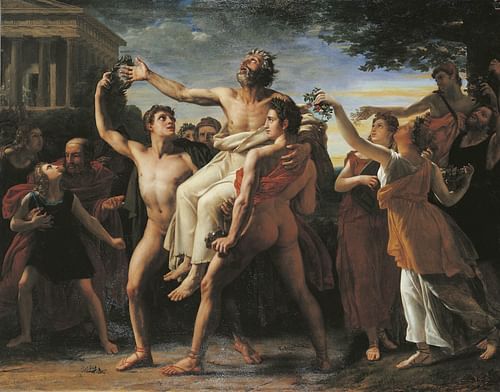 Diagoras of Rhodes Auguste Vinchon (CC BY-SA) ](https://www.worldhistory.org/image/14384/diagoras-of-rhodes/ "Diagoras of Rhodes")Diagoras also trained his youngest son, Dorieus, who also went on to become an Olympic champion, and most likely would have trained, or at least encouraged athleticism, in his daughter, Pherenike. The poet [Pindar](https://www.worldhistory.org/Pindar/) (l. c. 518 - c. 438 BCE) praises Diagoras as a just man who shunned arrogance and injustice in his Olympian Ode VII. Although Diagoras was of the upper class of Rhodes and would have had to have maintained the traditions of Greece regarding women, he famously included his sons in his own renown by training them as champions, and it would be in keeping with his character to have trained his daughters as well.
### Pherenike the Trainer
Pherenike (whose name means "she who brings victory") probably competed in the Heraean Games when she was younger and cheered on her brothers. Once she was married, she may have presided over the Heraean Games and then would have had to return home to Rhodes or, perhaps, only to Elis to await the end of the Olympic Games and then go home with her family. Pausanias describes the penalty for married women who were caught watching the games:
> As you go from Scillus along the road to Olympia, before you cross the Alpheius, there is a mountain with high, precipitous cliffs. It is called Mount Typaeum. It is a [law](https://www.worldhistory.org/disambiguation/law/) of Elis to cast down it any women who are caught present at the Olympic games, or even on the other side of the Alpheius, on the days prohibited to women. However, they say that no woman has been caught, except Kallipateira only, some, however, give the lady the name Pherenike and not Kallipateira. (*Greece*, 5.6.7)
There seems some confusion over whether there were two daughters or only one known by two different names as some ancient writers reference two women and others one. It is possible there was another daughter, Kallipateira, but it seems more likely there was one who was known as Pherenike and then, after the event, referred to as Kallipateira. The best-known version of the story seems to suggest there was one daughter, Pherenike, who was married to an athlete (possibly named Callianax, a boxer, who may have been trained by her father, though this is speculation). The couple may have had two sons, Eucles and Peisirodos (though Eucles may have been her nephew, son of Kallipateira, if she existed). Eucles won the boxing event at the Olympics in 404 BCE, and a few years later Peisirodos was in training for the games when his father died suddenly.
Pherenike took over the boy’s training as his coach and readied him for the games. She accompanied him to Elis disguised as a man, would have walked in the procession from Elis to Olympia, and is said to have been standing in the section with the other trainers when Peisirodos won the boxing event in 388 BCE. She was so overcome with pride, she jumped over the short wall separating the trainers from the competitors, loosening her robe, and revealing her sex. She was brought before the judges where she reminded them of her family’s illustrious history at the games and explained why she had done as she had and was pardoned. A new law was passed, however, that all trainers henceforth had to enter the stadium naked to make sure they were male.
### Conclusion
Pausanias describes the event immediately after discussing the punishment that awaited women who defied the law and attended the games:
> She, being a widow, disguised herself exactly like a gymnastic trainer and brought her son to compete at Olympia. Peisirodos, for so her son was called, was victorious, and Kallipateira, as she was jumping over the enclosure in which they keep the trainers shut up, bared her person. So her sex was discovered, but they let her go unpunished out of respect for her father, her brothers, and her son, all of whom had been victorious at Olympia. But a law was passed that, for the future, trainers should strip before entering the arena. (5.6.8)
Pausanias actually visited the Olympic stadium and the area around it, while it is unknown whether later historians who record Pherenike’s story did the same. Philostratus (l. c. 170-250 CE) also gives an account in his *Gymnasticus* (c. 220 CE), a collection of stories and anecdotes on athletics and the Olympian Games:
> The Eleans tell of a woman named Pherenike whose physical appearance was such that the Eleans at first thought she was a man. At Olympia, she wrapped herself in a trainer’s cloak and trained her son Peisirodos. When the Eleans learned about the trick, they hesitated to execute Pherenike because of their admiration for Diagoras and his children. They passed a law, however, that henceforth the trainer must take off his clothes. (17)
The historian Aelian (l. c. 175 - c. 235 CE) preserved the story in his *Varia Historia* (*Various History*) but adds a novel conclusion to the story not supported by other accounts:
> The officials refused to admit Pherenike as a spectator, but she spoke in public and justified her request by pointing out that her father and three brothers were Olympic victors. She won over the assembly, the law excluding women was lifted, and she attended the Olympic festival. (10.1)
Aelian may only mean the law excluding married women was lifted for Pherenike for that one day or perhaps for that one Olympiad, but there is no record of the ban on married women attending the Olympics being lifted in 388 BCE.
[ 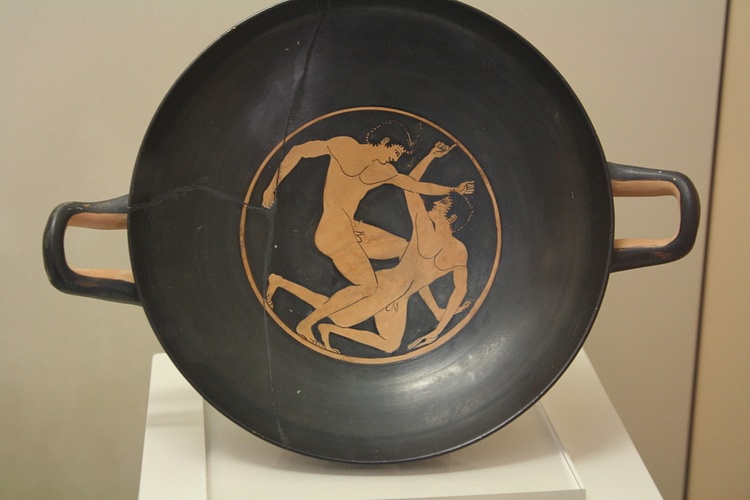 Greek Boxing Mark Cartwright (CC BY-NC-SA) ](https://www.worldhistory.org/image/446/greek-boxing/ "Greek Boxing")In the present day, a number of writers conclude the story of Pherenike with the claim that, after her story became known, she was addressed as Kallipateira, which is translated by some writers as "Mrs. Good Father". It is unclear where this claim originates among ancient writers. It is possible, as noted, that Pherenike had a sister named Kallipateira ("she of the good father") and ancient writers confused which of Diagoras’ daughters attended the Olympics as a male trainer, but it is also possible that the two names refer to one woman who, after the event, was known as a "good father" to her son in risking so much to train him so well.
Either way, Pherenike became famous for chancing her life for her son’s success and the reputation of her family, ideals the Greeks highly valued. Her actions and obvious ability as a trainer should have encouraged the men to question their policies concerning women and the Olympics, especially considering that Pherenike staged her breach of protocol only four years after [Cynisca of Sparta](https://www.worldhistory.org/Cynisca_of_Sparta/) (b. c. 442 BCE) became the first woman to win the Olympic chariot race, twice, first in 396 and then in 392 BCE. Instead, they opted to institute the new rule, making sure all trainers were male, and Pherenike’s story became little more than an interesting Olympic anecdote passed down by later writers until it was noticed in the modern era when the story of the female trainer Mrs. Good Father has become better known and more widely appreciated.
#### Editorial Review
This human-authored article has been reviewed by our editorial team before publication to ensure accuracy, reliability and adherence to academic standards in accordance with our [editorial policy](https://www.worldhistory.org/static/editorial-policy/).
## Bibliography
- [Aristotle & McKeon, R. *The Complete Works of Aristotle.* Princeton University Press, 2000.](https://www.worldhistory.org/books/0691099502/)
- [Fabulous Females and Ancient Olympia](https://studylib.net/doc/7514320/fabulous-females-and-ancient-olympia "Fabulous Females and Ancient Olympia"), accessed 8 Jul 2021.
- [Grant, M. *Readings in the Classical Historians.* Scribner, 1993.](https://www.worldhistory.org/books/0684192454/)
- [Lefkowitz, M. R & Fant, M. B. *Women's Life in Greece and Rome.* Johns Hopkins University Press, 2016.](https://www.worldhistory.org/books/1421421135/)
- [Mellor, R. *The Historians of Ancient Rome.* Routledge, 2012.](https://www.worldhistory.org/books/0415527163/)
- [Pausanius. *Pausanius' Description of Greece.* Nabu Press, 2010.](https://www.worldhistory.org/books/1176928538/)
- [Pherenike of Rhodes: The Ancient Greek Mom Who Risked All to Guarantee Her Son’s Olympic Glory by Gregory Pappas](https://pappaspost.com/pherenike-rhodes-ancient-greek-mom-risked-guarantee-sons-olympic-glory/ "Pherenike of Rhodes: The Ancient Greek Mom Who Risked All to Guarantee Her Son’s Olympic Glory by Gregory Pappas"), accessed 8 Jul 2021.
- [Pindar & Lattimore, R. *The Odes Of Pindar.* Ulan Press, 2012.](https://www.worldhistory.org/books/B009ZKW9RS/)
- [Pomeroy, S. B. *Goddesses, Whores, Wives, and Slaves.* Schocken, 1995.](https://www.worldhistory.org/books/080521030X/)
- [Waterfield, R. *Athens: A History From Ancient Ideal to Modern City.* Basic Books, 2004.](https://www.worldhistory.org/books/046509063X/)
## About the Author
Joshua J. Mark is World History Encyclopedia's co-founder and Content Director. He was previously a professor at Marist College (NY) where he taught history, philosophy, literature, and writing. He has traveled extensively and lived in Greece and Germany.
- [Linkedin Profile](https://www.linkedin.com/pub/joshua-j-mark/38/614/339)
## External Links
- [Athletics in Ancient Greece | Essay | The Metropolitan Museum of Art | Heilbrunn Timeline of Art History](https://www.metmuseum.org/toah/hd/athl/hd_athl.htm)
## Cite This Work
### APA
Mark, J. J. (2021, July 12). Pherenike the Female Olympic Trainer. *World History Encyclopedia*.
### Chicago
Mark, Joshua J.. "Pherenike the Female Olympic Trainer." *World History Encyclopedia*, July 12, 2021. .
### MLA
Mark, Joshua J.. "Pherenike the Female Olympic Trainer." *World History Encyclopedia*, 12 Jul 2021, .
## License & Copyright
Submitted by [Joshua J. Mark](https://www.worldhistory.org/user/JPryst/ "User Page: Joshua J. Mark"), published on 12 July 2021. The copyright holder has published this content under the following license: [Creative Commons Attribution-NonCommercial-ShareAlike](https://creativecommons.org/licenses/by-nc-sa/4.0/deed.en). This license lets others remix, tweak, and build upon this content non-commercially, as long as they credit the author and license their new creations under the identical terms. When republishing on the web a hyperlink back to the original content source URL must be included. Please note that content linked from this page may have different licensing terms.