---
title: Nazca Lines
author: Mark Cartwright
source: https://www.worldhistory.org/article/665/nazca-lines/
format: machine-readable-alternate
license: Creative Commons Attribution-NonCommercial-ShareAlike (https://creativecommons.org/licenses/by-nc-sa/4.0/)
updated: 2022-10-14
---
# Nazca Lines
_Authored by [Mark Cartwright](https://www.worldhistory.org/user/markzcartwright/)_
The [Nazca civilization](https://www.worldhistory.org/Nazca_Civilization/) flourished in southern Peru between 200 BCE and 600 CE and amongst their most famous legacies are the geoglyphs and lines - often referred to as [Nazca](https://www.worldhistory.org/Nazca_Civilization/) Lines - along the eastern coast of Peru and northern Chile. The designs are stylized drawings of animals, plants and humans or simple lines connecting sacred sites or pointing to water sources.
The Nazca lines, drawn across deserts and hills, were made over many centuries and although their exact purpose is disputed, the most widely held theory is that they were designed to be walked along as part of religious rites and processions. The Nazca lines are listed by UNESCO as a World Heritage Site.
[  Nazca Line Hummingbird Tobias Lange (CC BY-NC-SA) ](https://www.worldhistory.org/image/2366/nazca-line-hummingbird/ "Nazca Line Hummingbird")### Designs & Dimensions
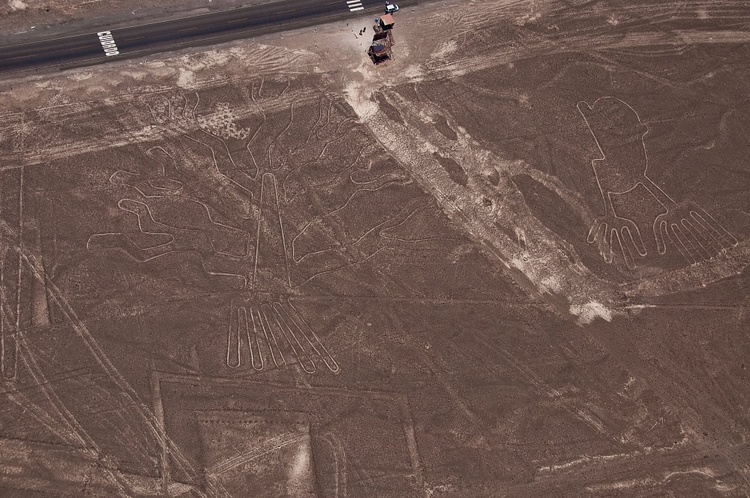
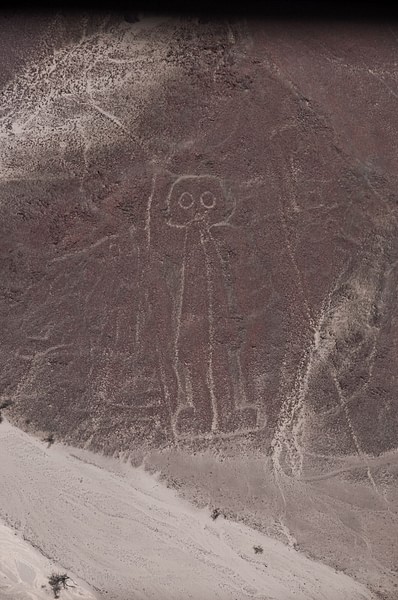
The lines were made remarkably easily and quickly by removing the oxidised darker surface rocks which lay closely scattered across the lighter coloured desert pampa floor. The aridity of the desert has preserved them well (although the sun can darken the exposed lighter sand over time) and many can still be clearly seen today. Most designs are only visible from the air but some were made on hillsides and so are visible from the ground.
Lines could be single - both straight and curved - or in groups and could cross each other in complicated networks. The width and length of lines could vary, one of the longest straight lines is 20 km long and the total combined length of Nazca lines has been estimated at over 1,300 km. Those lines used to describe a specific shape are generally composed of a single continuous line. Designs could be geometric shapes such as triangles, spirals, trapezoids, arrows and zig-zags. Examples of animal designs are a hummingbird, condor, monkey, llama, duck, lizard, spider and even a killer whale. Trees, plants and flowers such as the cactus were another subject, human figures were also drawn (especially on hillsides), as were objects such as tripods, looms and fans. There are also many forms as yet unidentified. The scale of the designs can be huge, many are at least the size of a sports field.
[  Nazca Lines Creation Amplitude Studios (Copyright) ](https://www.worldhistory.org/image/16508/nazca-lines-creation/ "Nazca Lines Creation")The creation of such large designs is made possible by carefully increasing the proportions taken from a small scale model. In total, more than 300 examples of geometric, animal and human figures have been identified which, along with purposely cleared areas, collectively cover over 640 square kilometres of desert.
[  Nazca Line Cactus Tobias Lange (CC BY-NC-SA) ](https://www.worldhistory.org/image/2367/nazca-line-cactus/ "Nazca Line Cactus")### Purpose
The exact purpose of the lines is much debated amongst scholars and the general public. Proposals range from astronomical maps relevant to the agricultural calendar to indicators of sacred routes between Nazca religious sites, a common device in other ancient South American cultures. Those on hillsides may have been intended as direction finders for travellers - which is almost certainly what they did become, intentionally or not. The lines which create shapes never cross each other and usually have a different starting and ending point indicating that they may have been paths walked during religious ceremonies as part of a repeated ritual. One such line actually leads directly from a small hut. More fanciful suggestions have the lines as the work of visitors from another world but these are usually dismissed for the complete lack of evidence and the ease with which the designs can be created - one experiment illustrated that a small team could clear 16,000 square metres of desert in a week.
Perhaps the most obvious purpose of the lines is that the Nazca wanted to display their reverence for the natural world and pay homage to their gods, especially those who controlled the weather, so vital to successful [agriculture](https://www.worldhistory.org/disambiguation/Agriculture/) in the arid plains of Peru. In support of this view is the fact that many of the designs also appear on Nazca textiles and [pottery](https://www.worldhistory.org/pottery/) decoration. In addition, many of the straight lines radiate from hills and mountains and other water sources (62 such points have been identified), trapezoid shapes often 'point' in the direction of a water source, and the two principal Nazca sites of Ventilla and [Cahuachi](https://www.worldhistory.org/Cahuachi/) were connected by such a line.
[  Nazca Line Human Figure Tobias Lange (CC BY-NC-SA) ](https://www.worldhistory.org/image/2368/nazca-line-human-figure/ "Nazca Line Human Figure")### Conclusion
Perhaps, the true purpose of the Nazca lines was a combination of some of the suggestions mentioned above. It is a fact that the lines appear in greater number closer to settlements and river courses and that they were made over several centuries. They can easily be made by a single individual in a few days and very often newer designs overlap and ignore older ones which would strongly suggest a lack of long-term and unified planning and, therefore, that they were made by different groups at different times and served more than a single purpose.
#### Editorial Review
This human-authored article has been reviewed by our editorial team before publication to ensure accuracy, reliability and adherence to academic standards in accordance with our [editorial policy](https://www.worldhistory.org/static/editorial-policy/).
## Bibliography
- [Alden Mason, J. *The Ancient Civilizations of Peru.* Penguin Books, 1988.](https://www.worldhistory.org/books/0140203958/)
- D'Altroy, T.N. *The Incas.* Blackwell, Oxford, 2012
- [Jones, D.M. *Mythology of the Incas.* Southwater, 2007.](https://www.worldhistory.org/books/1844763382/)
- [Jones, D.M. *The Complete Illustrated History of the Inca Empire.* Lorenz Books, 2012.](https://www.worldhistory.org/books/075482358X/)
- [Moseley, M.E. *The Incas and Their Ancestors.* Thames & Hudson, 2001.](https://www.worldhistory.org/books/0500282773/)
- [Stone, R.R. *Art of the AndesÃn to Inca.* Thames & Hudson, 2012.](https://www.worldhistory.org/books/0500204152/)
## About the Author
Mark is WHE’s Publishing Director and has an MA in Political Philosophy (University of York). He is a full-time researcher, writer, historian and editor. Special interests include art, architecture and discovering the ideas that all civilizations share.
## Questions & Answers
### Who built the Nazca lines and why?
The Nazca people of southern Peru (200 BCE - 600 CE) made the Nazca lines which are large drawings on the ground representing stylized animals, plants and humans or simple lines. Their purpose is not known for sure but most scholars think they were designed to be walked along in religious ceremonies.
### What is the mystery of the Nazca lines?
The Nazca lines were once thought mysterious because people could not understand how such large designs could be made without being seen from the air by their creators. Archaeologists have proven that it is actually quite easy to make the lines by removing stones and to create the stylized creatures they represent using a scale model. In short, there is no mystery.
### How are the Nazca lines still there?
The Nazca lines are still in Peru because the environment is very dry and they were created simply by removing stones to reveal the lighter coloured earth beneath. Actually, some have been erased over time and there is evidence many were made over older lines or that lines were regularly "repaired" to maintain their appearance.
### What are the designs of the Nazca lines?
While some Nazca lines are simply straight or curved lines, the more complex designs show stylized spiders, birds, reptiles, mammals, and humans. Trees, plants, and flowers are depicted, too. There are also many geometric designs such as triangles and spirals.
## External Links
- [Unlocking The Mystery Of Peru's Massive Nazca Lines](https://allthatsinteresting.com/nazca-lines)
- [Who were the Nasca? | British Museum](https://www.britishmuseum.org/blog/who-were-nasca)
- [AI Helps Discover Unknown Nazca Lines in Peru](https://mymodernmet.com/ai-discover-nazca-lines/)
- [Lines and Geoglyphs of Nasca and Palpa - UNESCO World Heritage Centre](https://whc.unesco.org/en/list/700/)
- [Researchers Uncovered 303 New Nazca Glyphs with the Help of AI](https://mymodernmet.com/new-nazca-geoglyphs-masato-sakai/)
## Cite This Work
### APA
Cartwright, M. (2014, March 10). Nazca Lines. *World History Encyclopedia*.
### Chicago
Cartwright, Mark. "Nazca Lines." *World History Encyclopedia*, March 10, 2014. .
### MLA
Cartwright, Mark. "Nazca Lines." *World History Encyclopedia*, 10 Mar 2014, .
## License & Copyright
Submitted by [Mark Cartwright](https://www.worldhistory.org/user/markzcartwright/ "User Page: Mark Cartwright"), published on 10 March 2014. The copyright holder has published this content under the following license: [Creative Commons Attribution-NonCommercial-ShareAlike](https://creativecommons.org/licenses/by-nc-sa/4.0/deed.en). This license lets others remix, tweak, and build upon this content non-commercially, as long as they credit the author and license their new creations under the identical terms. When republishing on the web a hyperlink back to the original content source URL must be included. Please note that content linked from this page may have different licensing terms.