---
title: The Mask of Xiuhtecuhtli
author: Mark Cartwright
source: https://www.worldhistory.org/article/641/the-mask-of-xiuhtecuhtli/
format: machine-readable-alternate
license: Creative Commons Attribution-NonCommercial-ShareAlike (https://creativecommons.org/licenses/by-nc-sa/4.0/)
updated: 1970-01-01
---
# The Mask of Xiuhtecuhtli
_Authored by [Mark Cartwright](https://www.worldhistory.org/user/markzcartwright/)_
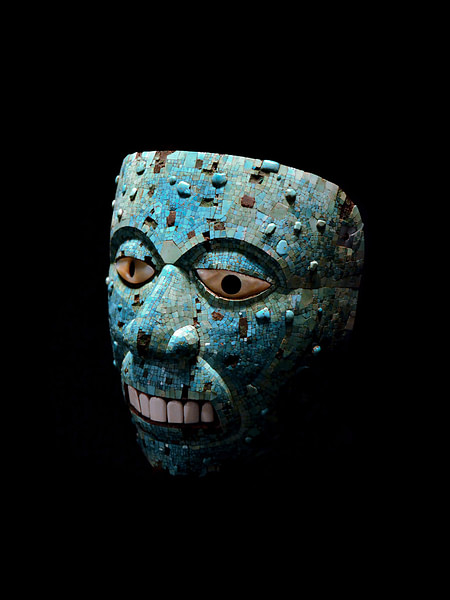
The striking turquoise mask now in the British Museum in London is thought to represent [Xiuhtecuhtli](https://www.worldhistory.org/Xiuhtecuhtli/), the [Aztec](https://www.worldhistory.org/Aztec_Civilization/) [god](https://www.worldhistory.org/God/) of fire, and dates to the final century of the [Aztec empire](https://www.worldhistory.org/Aztec_Civilization/), c. 1400-1521 CE. It is made from hundreds of small pieces of turquoise glued onto a cedar wood base and was meant to be either worn by a god impersonator in religious ceremonies or worn by an effigy of the god. The mask was almost certainly part of the treasure brought back from Mesoamerica by [Hernán Cortés](https://www.worldhistory.org/Hernan_Cortes/) and presented to Charles V.
[  Mask of Xiuhtecuhtli Trustees of the British Museum (Copyright) ](https://www.worldhistory.org/image/2234/mask-of-xiuhtecuhtli/ "Mask of Xiuhtecuhtli")### Properties
The mask measures 16.5 cm x 15.2 cm and is covered with hundreds of pieces (or tesserae) of turquoise which were cut and shaped by hand to create a contoured [mosaic](https://www.worldhistory.org/Mosaic/) to capture the three-dimensional features of the human face. The tesserae were attached to the carved cedar wood (*Cedrela* *odorata*) mask using pine resin as glue. To better represent the shape of a face the wooden base was also bent before the tesserae were added. The inner surface of the mask was painted with red hematite. The eyes, eyebrows, nose and mouth are rendered with tesserae cut with particular precision. The various shades of turquoise are also used to great effect - bluer tesserae around the cheeks, upper lip, chin and forehead - to further enhance the contrast between the flatter parts of the face with more prominent features such as the nose and eyes.
The eyes of the god are rendered using mother-of-pearl (*Pinctada* *mazatlantica*) whilst the eyelids were originally gilded with wafer-thin [gold](https://www.worldhistory.org/gold/) foil. The seven teeth are of conch shell (*Strombus gigas or S. Galeatus*), although two are modern synthetic replacements. Two holes, one at each [temple](https://www.worldhistory.org/temple/), were originally decorated with a border of mother-of-pearl and indicate the object was intended to be worn as a mask during certain Aztec religious ceremonies, either by an impersonator of the god dressed in full regalia and who would ultimately be sacrificed, or by an effigy of the god, commonly used during royal [burial](https://www.worldhistory.org/burial/) ceremonies.
[  Xiuhtecuhtli bathporeia (CC BY-NC-SA) ](https://www.worldhistory.org/image/1403/xiuhtecuhtli/ "Xiuhtecuhtli")### Xiuhtecuhtli or [Tonatiuh](https://www.worldhistory.org/Tonatiuh/)?
It is not absolutely certain just who the mask represents. The mask is not unique as several other examples of this [Aztec art](https://www.worldhistory.org/Aztec_Art/) form have survived for posterity, as have drawings of them in the Codex Borbonicus. Some scholars have taken the presence of the raised cabochon tesserae as representing the warts of the sun god Tonatiuh. In Aztec [mythology](https://www.worldhistory.org/mythology/) it was the old and wart-covered god Nanauatzin who sacrificed himself by jumping into the fire which created the sun of the 5th and present era. Emerging from the fire in [triumph](https://www.worldhistory.org/Roman_Triumph/), Nanauatzin had been transformed into Tonatiuh.
However, it is now thought that the most likely candidate for who the masks represents is Xiuhtecuhtli, the Aztec new god of fire, whose name translates as 'Turquoise Lord'. In Nahuatl the word for turquoise is *xihuitl*, which also means 'year'. One of Xiuhtecuhtli's most important roles was as overseer of the Toxiuhmolpilia festival or New Fire Ceremony. This was held once every 52 years on the completion of one full cycle of the [Aztec calendar](https://www.worldhistory.org/article/896/the-aztec-calendar/) (*xiuhmolpilli*). The purpose of the ceremony was to ensure the successful renewal (or re-occurrence) of the sun. Xiuhtecuhtli was often represented using turquoise and the mask, according to some scholars, has one other particular link to the god. The darker shades of the tesserae on the cheeks and bridge of the nose create a stylised butterfly, as do those on the forehead, a creature closely associated with Xiuhtecuhtli and a symbol of change and renewal.
#### Editorial Review
This human-authored article has been reviewed by our editorial team before publication to ensure accuracy, reliability and adherence to academic standards in accordance with our [editorial policy](https://www.worldhistory.org/static/editorial-policy/).
## Bibliography
- [British Museum Collections](http://www.britishmuseum.org/research/collection_online/collection_object_details.aspx?objectId=667486&partId=1&searchText=Turquoise+mask&page=1 "British Museum Collections"), accessed 1 Dec 2016.
- [Coe, M.D. *Mexico.* Thames & Hudson, 2013.](https://www.worldhistory.org/books/0500290768/)
- [McEwan, C. *Moctezuma.* British Museum Press, 2009.](https://www.worldhistory.org/books/0714125857/)
- [Miller, M.E. *The Art of Mesoamerica.* Thames & Hudson, 2012.](https://www.worldhistory.org/books/0500204144/)
## About the Author
Mark is WHE’s Publishing Director and has an MA in Political Philosophy (University of York). He is a full-time researcher, writer, historian and editor. Special interests include art, architecture and discovering the ideas that all civilizations share.
## Cite This Work
### APA
Cartwright, M. (2014, January 19). The Mask of Xiuhtecuhtli. *World History Encyclopedia*.
### Chicago
Cartwright, Mark. "The Mask of Xiuhtecuhtli." *World History Encyclopedia*, January 19, 2014. .
### MLA
Cartwright, Mark. "The Mask of Xiuhtecuhtli." *World History Encyclopedia*, 19 Jan 2014, .
## License & Copyright
Submitted by [Mark Cartwright](https://www.worldhistory.org/user/markzcartwright/ "User Page: Mark Cartwright"), published on 19 January 2014. The copyright holder has published this content under the following license: [Creative Commons Attribution-NonCommercial-ShareAlike](https://creativecommons.org/licenses/by-nc-sa/4.0/deed.en). This license lets others remix, tweak, and build upon this content non-commercially, as long as they credit the author and license their new creations under the identical terms. When republishing on the web a hyperlink back to the original content source URL must be included. Please note that content linked from this page may have different licensing terms.