---
title: Temple of Castor & Pollux
author: Mark Cartwright
source: https://www.worldhistory.org/article/632/temple-of-castor--pollux/
format: machine-readable-alternate
license: Creative Commons Attribution-NonCommercial-ShareAlike (https://creativecommons.org/licenses/by-nc-sa/4.0/)
updated: 1970-01-01
---
# Temple of Castor & Pollux
_Authored by [Mark Cartwright](https://www.worldhistory.org/user/markzcartwright/)_
The [Temple](https://www.worldhistory.org/temple/) of [Castor and Pollux](https://www.worldhistory.org/Castor_and_Pollux/) in the [Roman Forum](https://www.worldhistory.org/Roman_Forum/) of [Rome](https://www.worldhistory.org/Rome/) was erected in the final decade of the 1st century BCE, replacing the earlier temple to the twin sons of [Jupiter](https://www.worldhistory.org/jupiter/) which had stood on the site since 484 BCE. Today only the inner concrete core of the podium and three columns survive of this once massive structure.
[ 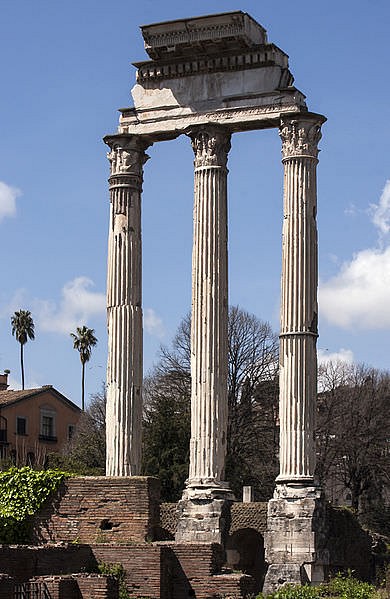 Temple of Castor & Pollux Dcastor (Public Domain) ](https://www.worldhistory.org/image/2158/temple-of-castor--pollux/ "Temple of Castor & Pollux")Castor and Pollux, in [Roman mythology](https://www.worldhistory.org/Roman_Mythology/), were the twin demi-[god](https://www.worldhistory.org/God/) offspring of Jupiter and [Leda](https://www.worldhistory.org/Leda/) and equivalent to the [Dioscuri](https://www.worldhistory.org/Castor_and_Pollux/) of [Greek mythology](https://www.worldhistory.org/Greek_Mythology/). They are also represented in the constellation Gemini. Pollux was considered immortal whilst his brother was mortal; both were particularly associated with cavalry and the cult of the twins went back to the mid-6th century BCE in [Italy](https://www.worldhistory.org/italy/). The original temple in Rome was dedicated by the [Roman](https://www.worldhistory.org/disambiguation/Roman/) general Aulus Postumius who won a great victory against the Latins in the [Battle](https://www.worldhistory.org/disambiguation/battle/) of Lake Regillus (499 or 496 BCE). During the battle two young men riding white horses were said to have appeared and guided the Romans to victory and then were seen again after the battle watering their horses at the Juturna Spring in Rome, hence the subsequent dedication to the famous cavalry twins and choice of location for the temple next to the fountain. Parts of the original temple's podium survive and hint at its great size.
Every 15th of July the temple was the focus of a cavalry parade - the *transvectio* - of 5,000 men led by two impersonators of the heroes who commemorated the victory at Regillus. Renovations to the temple, which came to be more associated with Castor following the hero's adoption by Roman knights (*equites*), were made in the first and last quarters of the 2nd century BCE, notably in 117 BCE by Lucius Caecilius Metellus Delmaticus following his victory over the Dalmatians.
Following the devastating fire of 14 or 9 BCE [Augustus](https://www.worldhistory.org/augustus/) rebuilt the temple, made the cult an official imperial one and initiated a new feast day for the pair on the 27th of January. The emperor also sought to associate his own two sons - Gaius and Lucius [Caesar](https://www.worldhistory.org/disambiguation/caesar/) - with the heroes and their temple. However, both children were to die before completion of the project and so were substituted by [Tiberius](https://www.worldhistory.org/Tiberius/) and his late brother Drusus in 6 CE, the former was also responsible for the final restorations.
Constructed in white marble and tufa, the new temple was a massive structure measuring 32 x 50 m and reached a height of almost 19 m. The facades had 8 Corinthian columns whilst the sides each had 11. The original front entrance was composed of twin staircases with a speaker's platform, changed in the 3rd century CE to a single staircase. The interior of the temple was quite complex and consisted of some 25 small chambers. The temple served as the office of weights and measures with an additional function as a bank. From the 4th century CE the temple gradually fell into decline with only three columns now standing silent testimony to the lost grandeur of this once magnificent building.
#### Editorial Review
This human-authored article has been reviewed by our editorial team before publication to ensure accuracy, reliability and adherence to academic standards in accordance with our [editorial policy](https://www.worldhistory.org/static/editorial-policy/).
## Bibliography
- [Claridge A. *Rome.* Oxford University Press, USA, 2010.](https://www.worldhistory.org/books/0199546835/)
- Costantino C. *Roman Forum Guide.* Electa, Milan, 2010
- Hope Moncrieff A.R. *Classical Mythology.* Senate, London, 1994
- [Hornblower S. *The Oxford Classical Dictionary.* Oxford University Press, USA, 2012.](https://www.worldhistory.org/books/0199545561/)
- Masi S. *Rome & The Vatican.* Bonechi, Florence, 2002
## About the Author
Mark is WHE’s Publishing Director and has an MA in Political Philosophy (University of York). He is a full-time researcher, writer, historian and editor. Special interests include art, architecture and discovering the ideas that all civilizations share.
## Cite This Work
### APA
Cartwright, M. (2013, November 16). Temple of Castor & Pollux. *World History Encyclopedia*.
### Chicago
Cartwright, Mark. "Temple of Castor & Pollux." *World History Encyclopedia*, November 16, 2013. .
### MLA
Cartwright, Mark. "Temple of Castor & Pollux." *World History Encyclopedia*, 16 Nov 2013, .
## License & Copyright
Submitted by [Mark Cartwright](https://www.worldhistory.org/user/markzcartwright/ "User Page: Mark Cartwright"), published on 16 November 2013. The copyright holder has published this content under the following license: [Creative Commons Attribution-NonCommercial-ShareAlike](https://creativecommons.org/licenses/by-nc-sa/4.0/deed.en). This license lets others remix, tweak, and build upon this content non-commercially, as long as they credit the author and license their new creations under the identical terms. When republishing on the web a hyperlink back to the original content source URL must be included. Please note that content linked from this page may have different licensing terms.