---
title: Temple of Vesta/Hercules, Rome
author: Mark Cartwright
source: https://www.worldhistory.org/article/625/temple-of-vestahercules-rome/
format: machine-readable-alternate
license: Creative Commons Attribution-NonCommercial-ShareAlike (https://creativecommons.org/licenses/by-nc-sa/4.0/)
updated: 2025-03-07
---
# Temple of Vesta/Hercules, Rome
_Authored by [Mark Cartwright](https://www.worldhistory.org/user/markzcartwright/)_
The [Temple](https://www.worldhistory.org/temple/) of [Vesta](https://www.worldhistory.org/Vesta/) is the popular name given to the round temple near the Tiber River in [Rome](https://www.worldhistory.org/Rome/) (now Piazza Bocca della Veritá). The association with Vesta is due to the shape of the building but in fact it is not known to which [god](https://www.worldhistory.org/God/) the temple was dedicated. It may have been dedicated to [Hercules](https://www.worldhistory.org/hercules/) Olivarius, patron of the Portus Tiberinus oil merchants, as three or four temples to the [Greek](https://www.worldhistory.org/disambiguation/greek/) hero are known to have stood in the area of the Forum Boarium where there was also a Great Altar to Hercules.
[ 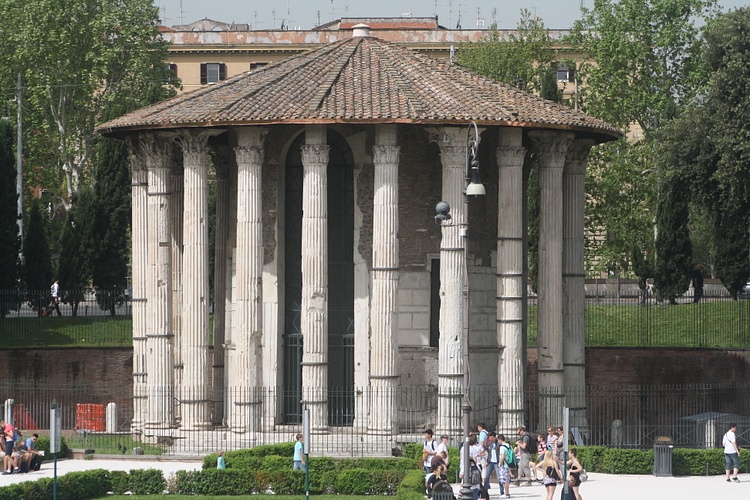 Temple of Vesta, Rome Mark Cartwright (CC BY-NC-SA) ](https://www.worldhistory.org/image/2046/temple-of-vesta-rome/ "Temple of Vesta, Rome")The temple is Greek in style and was probably the work of an eastern Greek architect. The building also uses that quintessential Greek building material, Pentelic marble, from near [Athens](https://www.worldhistory.org/Athens/). At the time of construction Pentelic marble was one of the more expensive building materials and so was rarely used for large projects. The columns, entablature and cella walls were constructed with this marble whilst the inner cella [wall](https://www.worldhistory.org/wall/) was lined with tufa and stucco.
The temple is 14.8 m in diameter (50 [Roman](https://www.worldhistory.org/disambiguation/Roman/) feet) and has 20 exterior Corinthian columns standing on a 360 degree, 5-stepped tufa podium. The unusually high columns are 10.65 m (36 Roman feet) tall and are topped by composite capitals, which have a combination of Ionic volutes with Corinthian acanthus leaves. All of the capitals are constructed from two separate pieces and the flat ends of the [column](https://www.worldhistory.org/column/) flutes, the single block used to carve the foot, base and plinth of the column, and the integration of the base into the first step of the podium are all typical features of 1st century CE architectural practice. The cella entrance was flanked by two tall rectangular windows, one on each side, and these remain visible today.
Some sort of disaster struck the temple in the 1st century CE as 10 columns on the north side were replaced using Luna marble and a capital, very similar to the originals but not an exact replica, was replaced on the south side.
The relatively good condition of the building is due to the fact that it was converted into a church and the oldest records (1132 CE) refer to the building as the church of S. Stefano alle Carozze ('of the carriages'). The building is today without its original roof and entablature. In addition, the top portion if the cella wall was replaced using brick-faced concrete and windows were added in the 12th century CE. In 1475 CE a [fresco](https://www.worldhistory.org/disambiguation/Fresco/) was added above the temple's altar. In the 17th century CE the church was re-dedicated to S. Maria del Sole ('of the sun') only to be then deconsecrated within two centuries. Finally, between 1809 and 1810 CE the podium of the building was excavated, the surrounding ground level was lowered, and the building was restored once again.
#### Editorial Review
This human-authored article has been reviewed by our editorial team before publication to ensure accuracy, reliability and adherence to academic standards in accordance with our [editorial policy](https://www.worldhistory.org/static/editorial-policy/).
## Bibliography
- [Claridge, A. *Rome.* Oxford University Press, USA, 2010.](https://www.worldhistory.org/books/0199546835/)
- Masi, S. *Rome & The Vatican.* Bonechi, Florence, 2010
- [Wheeler, M. *Roman Art and Architecture.* Thames & Hudson, 1985.](https://www.worldhistory.org/books/0500200211/)
## About the Author
Mark is WHE’s Publishing Director and has an MA in Political Philosophy (University of York). He is a full-time researcher, writer, historian and editor. Special interests include art, architecture and discovering the ideas that all civilizations share.
## Cite This Work
### APA
Cartwright, M. (2013, October 23). Temple of Vesta/Hercules, Rome. *World History Encyclopedia*.
### Chicago
Cartwright, Mark. "Temple of Vesta/Hercules, Rome." *World History Encyclopedia*, October 23, 2013. .
### MLA
Cartwright, Mark. "Temple of Vesta/Hercules, Rome." *World History Encyclopedia*, 23 Oct 2013, .
## License & Copyright
Submitted by [Mark Cartwright](https://www.worldhistory.org/user/markzcartwright/ "User Page: Mark Cartwright"), published on 23 October 2013. The copyright holder has published this content under the following license: [Creative Commons Attribution-NonCommercial-ShareAlike](https://creativecommons.org/licenses/by-nc-sa/4.0/deed.en). This license lets others remix, tweak, and build upon this content non-commercially, as long as they credit the author and license their new creations under the identical terms. When republishing on the web a hyperlink back to the original content source URL must be included. Please note that content linked from this page may have different licensing terms.