---
title: Temple of Mars Ultor, Rome
author: Mark Cartwright
source: https://www.worldhistory.org/article/617/temple-of-mars-ultor-rome/
format: machine-readable-alternate
license: Creative Commons Attribution-NonCommercial-ShareAlike (https://creativecommons.org/licenses/by-nc-sa/4.0/)
updated: 1970-01-01
---
# Temple of Mars Ultor, Rome
_Authored by [Mark Cartwright](https://www.worldhistory.org/user/markzcartwright/)_
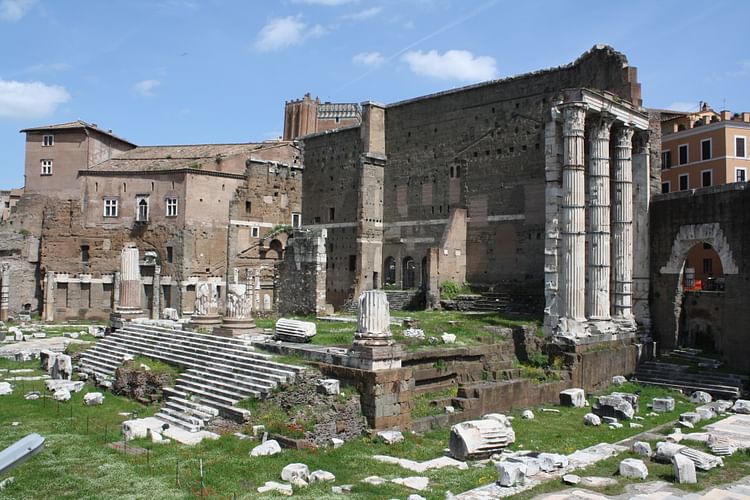
The [Temple](https://www.worldhistory.org/temple/) of [Mars](https://www.worldhistory.org/Mars/) Ultor stands in the Forum of [Augustus](https://www.worldhistory.org/augustus/) in [Rome](https://www.worldhistory.org/Rome/) and was built to commemorate Augustus' victory in 42 BCE at the [Battle](https://www.worldhistory.org/disambiguation/battle/) of [Philippi](https://www.worldhistory.org/Philippi/) over [the assassins](https://www.worldhistory.org/The_Assassins/) of [Julius Caesar](https://www.worldhistory.org/Julius_Caesar/). The building became the place where important military decisions were taken and a site of several state ceremonies with a military connotation.
[  Temple of Mars Ultor, Rome Mark Cartwright (CC BY-NC-SA) ](https://www.worldhistory.org/image/2065/temple-of-mars-ultor-rome/ "Temple of Mars Ultor, Rome")### The Forum of Augustus
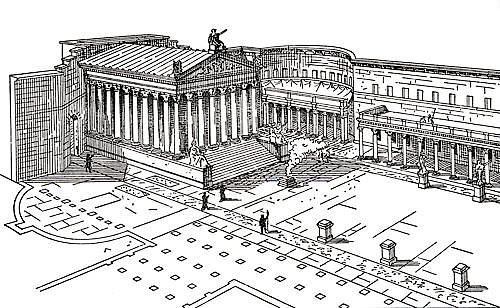
The Forum of Augustus originally covered some 8,000 square metres and was built next to [Caesar](https://www.worldhistory.org/disambiguation/caesar/)'s Forum. Later, it would be bordered on the left side by [Trajan](https://www.worldhistory.org/trajan/)'s Forum and on the right by [Nerva](https://www.worldhistory.org/Nerva/)'s Forum to create the complex known today as the Imperial Fora. Dominating this civil space created by Augustus was the temple dedicated to Mars, the [god](https://www.worldhistory.org/God/) of [war](https://www.worldhistory.org/disambiguation/War/) in his guise as 'the Avenger' (Ultor).
The temple was finally inaugurated (although still not quite finished) in 2 BCE and it came to function as the focal point of [Roman military](https://www.worldhistory.org/Roman_Army/) strategy. For example, Augustus decreed that it should be the meeting place for the Senate when decisions of war were taken. The temple was also the place where young [Roman](https://www.worldhistory.org/disambiguation/Roman/) males were ceremoniously given their adult toga, thus becoming eligible for military service, and it was the official departure point for commanders embarking on military service in the [empire](https://www.worldhistory.org/empire/).
The temple was designed to reflect the style of the nearby Temple of [Venus](https://www.worldhistory.org/venus/) in Caesar's Forum and so create an architectural harmony. There was one notable difference, though, in that the temple of Mars Ultor was made one and a half times bigger. The temple, typical of [Roman architecture](https://www.worldhistory.org/Roman_Architecture/), was built on a raised platform and entranced via steps which were originally flanked by fountains, once again, in imitation of the arrangement outside the Temple of Venus.
[  Forum of Augustus, Rome N8french (CC BY-SA) ](https://www.worldhistory.org/image/2103/forum-of-augustus-rome/ "Forum of Augustus, Rome")### Temple Exterior
The exterior of the temple was constructed using the Italian white Luna marble from Cararra. The Corinthian columns were 17.8 m high and arranged in a row of eight on the façade and eight down each side, three of which are still standing today. The flooring was laid with a mixture of coloured marble - yellow Numidian, purple Phrygian and Lucullun red and black. The interior cella had two sides of columns, probably also in purple marble, and in the [wall](https://www.worldhistory.org/wall/) behind these there were purple Phrygian pilasters on either side of niches which contained statues. The [column](https://www.worldhistory.org/column/) capitals and those of the pilasters were especially interesting as, instead of the usual volutes, they had representations of [Pegasus](https://www.worldhistory.org/Pegasus/) who was thought to carry the thunderbolts of [Zeus](https://www.worldhistory.org/zeus/), the god's traditional weapons. The interior ceiling was composed of coffered slabs embellished with gilded rosettes.
### Statue of Mars
The centre-piece of the whole temple was a huge marble statue of Mars who resided in the apse of the cella ahead of five [Egyptian](https://www.worldhistory.org/disambiguation/Egyptian/) alabaster covered steps and surrounded by the legionary standards which the Parthians had taken but which, following Roman victory, were recaptured and restored to Rome. The torso of this statue may well be the one now in the Capitoline Museums of Rome with the head, arms and legs having been restored.
### Later Additions & Re-Use
Behind the temple stands a 30 m high tufa wall which is topped with white travertine. It was constructed to separate the Forum from the hill residences behind it and to act as a firewall should a fire start in this densely-populated area of the [city](https://www.worldhistory.org/city/). In the 1st century CE [Tiberius](https://www.worldhistory.org/Tiberius/) added two arches to the temple sides in honour of his two sons Drusus the Younger and [Germanicus](https://www.worldhistory.org/Germanicus/) but these have now been lost except for the foundations of one. In the 2nd century CE [Hadrian](https://www.worldhistory.org/hadrian/) repaired parts of the building but from the 5th century CE the building went into decline and blocks began to be re-used in other building projects. From the 12th century CE soil was added to the site and the area used for [agriculture](https://www.worldhistory.org/disambiguation/Agriculture/), however, as the drains were then blocked, a marsh formed until the area was drained in the 16th century CE.
#### Editorial Review
This human-authored article has been reviewed by our editorial team before publication to ensure accuracy, reliability and adherence to academic standards in accordance with our [editorial policy](https://www.worldhistory.org/static/editorial-policy/).
## Bibliography
- [Claridge, A. *Rome.* Oxford University Press, USA, 2010.](https://www.worldhistory.org/books/0199546835/)
- Masi S. *Rome & The Vatican.* Bonechi, Florence, 2002
- [Wheeler, M. *Roman Art and Architecture.* Thames & Hudson, 1985.](https://www.worldhistory.org/books/0500200211/)
## About the Author
Mark is WHE’s Publishing Director and has an MA in Political Philosophy (University of York). He is a full-time researcher, writer, historian and editor. Special interests include art, architecture and discovering the ideas that all civilizations share.
## Cite This Work
### APA
Cartwright, M. (2013, October 11). Temple of Mars Ultor, Rome. *World History Encyclopedia*.
### Chicago
Cartwright, Mark. "Temple of Mars Ultor, Rome." *World History Encyclopedia*, October 11, 2013. .
### MLA
Cartwright, Mark. "Temple of Mars Ultor, Rome." *World History Encyclopedia*, 11 Oct 2013, .
## License & Copyright
Submitted by [Mark Cartwright](https://www.worldhistory.org/user/markzcartwright/ "User Page: Mark Cartwright"), published on 11 October 2013. The copyright holder has published this content under the following license: [Creative Commons Attribution-NonCommercial-ShareAlike](https://creativecommons.org/licenses/by-nc-sa/4.0/deed.en). This license lets others remix, tweak, and build upon this content non-commercially, as long as they credit the author and license their new creations under the identical terms. When republishing on the web a hyperlink back to the original content source URL must be included. Please note that content linked from this page may have different licensing terms.