---
title: Trajan's Market
author: Mark Cartwright
source: https://www.worldhistory.org/article/616/trajans-market/
format: machine-readable-alternate
license: Creative Commons Attribution-NonCommercial-ShareAlike (https://creativecommons.org/licenses/by-nc-sa/4.0/)
updated: 1970-01-01
---
# Trajan's Market
_Authored by [Mark Cartwright](https://www.worldhistory.org/user/markzcartwright/)_
[Trajan](https://www.worldhistory.org/trajan/)'s Market is the name given in the early 20th century CE to a complex of buildings in the imperial fora of [Rome](https://www.worldhistory.org/Rome/) constructed in 107-110 CE during the reign of Trajan. The complex included a covered market, small shop fronts and a residential apartment block.
[ 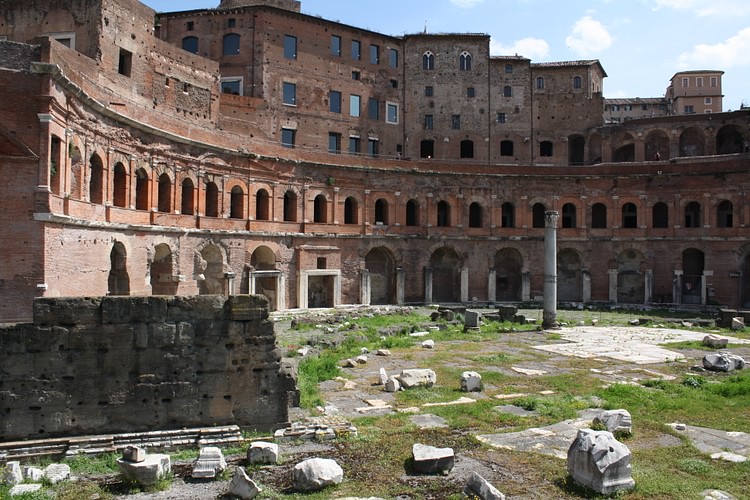 Trajans Market, Rome Mark Cartwright (CC BY-NC-SA) ](https://www.worldhistory.org/image/2064/trajans-market-rome/ "Trajans Market, Rome")The complex was built at one end of Trajan's Forum and includes buildings that had a number of different functions, predominantly commercial. Constructed on three different levels into the terraced hillside behind, access to the various parts was provided via connecting staircases. The ground level shallow alcoves opened onto a street and were used for small shops whilst there were more shops in the arcades above. The ground level alcoves are of uneven depth due to the fact that they were constructed following the bedrock of the hill. Originally, they would have all been framed with travertine, extending their capacity for displaying goods. One alcove (5th from the left) has been restored to illustrate the original look and also has the typical window above the lintel.
On the upper level, access staircases were built at each end of via Biberatica running above the semi-circular façade. The large uppermost central building was used as an apartment block, and the large structure further left functioned as a covered shopping arcade. In front of the whole complex, separated by a tufa [wall](https://www.worldhistory.org/wall/) but accessible through a large central gateway, was the Exhedra and Porticus of Trajan's Forum.
The buildings are largely constructed using concrete and faced with brick, and it is one of the finest examples of Imperial [Roman architecture](https://www.worldhistory.org/Roman_Architecture/) using these materials. The decorative semi-circular façade includes brick pilasters with travertine bases and capitals framing each archway on the second level. Decorative brick-work gives an added elegance, including entablatures of carved brick and alternate triangular and semi-circular pediments. White stucco would have once covered much of this brickwork and the pilasters, entablature, and pediments display evidence of having once been painted red.
[  Imperial Fora, Rome 3coma14 (CC BY-SA) ](https://www.worldhistory.org/image/2089/imperial-fora-rome/ "Imperial Fora, Rome")The name of the street on the upper level of the Market was via Biberatica, perhaps from the Latin *biber* - meaning drink - and hinting at the various drinking establishments which served the market shoppers. The principal products sold at the market would have come from across the [empire](https://www.worldhistory.org/empire/) and included fruit, vegetables, fish, wine, oil, and spices such as [pepper](https://www.worldhistory.org/Pepper/).
The whole complex became part of a medieval fortress in the 12th and 13th centuries CE with the notable addition of the huge tower, the Torre delle Milizie. First properly excavated in the 1920s and 1930s CE, the site quickly acquired the name Trajan's Market and it not only stands as one of the most imposing ruins of Imperial Rome but is also the current home of the Museum of the Imperial Forums.
#### Editorial Review
This human-authored article has been reviewed by our editorial team before publication to ensure accuracy, reliability and adherence to academic standards in accordance with our [editorial policy](https://www.worldhistory.org/static/editorial-policy/).
## Bibliography
- [Amanda Claridge. *Rome.* Oxford University Press, USA, 2010.](https://www.worldhistory.org/books/0199546835/)
- Masi S. *Rome & The Vatican.* Bonechi, Florence, 2002
- [Mortimer Wheeler. *Roman Art and Architecture.* Thames & Hudson, 1985.](https://www.worldhistory.org/books/0500200211/)
## About the Author
Mark is WHE’s Publishing Director and has an MA in Political Philosophy (University of York). He is a full-time researcher, writer, historian and editor. Special interests include art, architecture and discovering the ideas that all civilizations share.
## Cite This Work
### APA
Cartwright, M. (2013, October 08). Trajan's Market. *World History Encyclopedia*.
### Chicago
Cartwright, Mark. "Trajan's Market." *World History Encyclopedia*, October 08, 2013. .
### MLA
Cartwright, Mark. "Trajan's Market." *World History Encyclopedia*, 08 Oct 2013, .
## License & Copyright
Submitted by [Mark Cartwright](https://www.worldhistory.org/user/markzcartwright/ "User Page: Mark Cartwright"), published on 08 October 2013. The copyright holder has published this content under the following license: [Creative Commons Attribution-NonCommercial-ShareAlike](https://creativecommons.org/licenses/by-nc-sa/4.0/deed.en). This license lets others remix, tweak, and build upon this content non-commercially, as long as they credit the author and license their new creations under the identical terms. When republishing on the web a hyperlink back to the original content source URL must be included. Please note that content linked from this page may have different licensing terms.