---
title: Roman Glass
author: Mark Cartwright
source: https://www.worldhistory.org/article/592/roman-glass/
format: machine-readable-alternate
license: Creative Commons Attribution-NonCommercial-ShareAlike (https://creativecommons.org/licenses/by-nc-sa/4.0/)
updated: 1970-01-01
---
# Roman Glass
_Authored by [Mark Cartwright](https://www.worldhistory.org/user/markzcartwright/)_
[Roman](https://www.worldhistory.org/disambiguation/Roman/) glassware includes some of the finest pieces of art ever produced in antiquity and the very best were valued higher than wares made with precious metals. However, plain glass vessels such as cups, bowls, plates, and bottles were also used as everyday containers, in particular, for storing and serving food and drinks. Glass was also used by the Romans for its decorative qualities and could be incorporated in mosaics and decorative panels in both walls and furniture. The material was also used for windows, to create jewellery, mirrors, game pieces, magnifying glasses, [sculpture](https://www.worldhistory.org/disambiguation/Sculpture/) and, in the form of powder, even as a [medicine](https://www.worldhistory.org/disambiguation/medicine/) and toothpaste.
[  Roman Glass Kantharos Mark Cartwright (CC BY-NC-SA) ](https://www.worldhistory.org/image/4583/roman-glass-kantharos/ "Roman Glass Kantharos")### Materials
The use of the man-made material called glass - a mix of soda, silica, and lime - pre-dates the Romans by over 1,500 years, but even they seem not to have fully understood the complexity of the component mix and the necessity for lime to make the glass impervious to water and much more durable to the ravages of time and use. Lime can be found naturally, for example, as part of the silica component in the form of sand which contains a significant percentage of crushed sea shells. Indeed, two areas became noted for the high quality of their glass - along the Belarus River in [Phoenicia](https://www.worldhistory.org/phoenicia/) and the Volturnus River in Campania - not coincidentally, areas where the sand was particularly rich in lime. However, some Roman glassmakers, perhaps without knowing exactly why, did understand that the addition of small pebbles and shells could affect the final quality of the glass produced.
[ 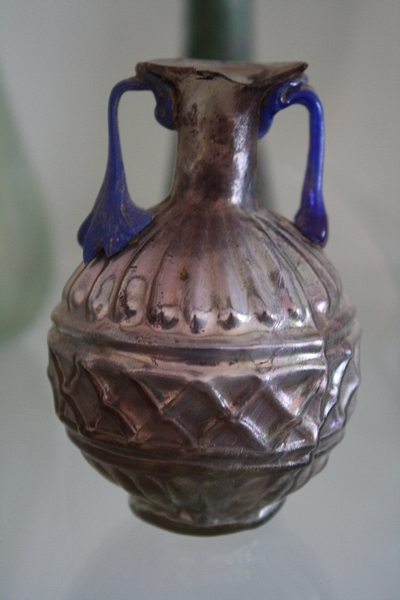 Roman Glass Vase Mark Cartwright (CC BY-NC-SA) ](https://www.worldhistory.org/image/1360/roman-glass-vase/ "Roman Glass Vase")### Techniques
The use of glass before Roman times was mainly restricted to small opaque bottles or large bowls, very often made in imitation of [metal](https://www.worldhistory.org/disambiguation/metal/)-wares. Early glass was usually opaque due to the high number of tiny air bubbles within the glass as a result of the firing process and usually had a pale green or yellow hue due to the presence of impurities. The colour tint of the glass could, though, be manipulated by increasing or decreasing the level of oxygen in the furnace. Colours could also be achieved by adding small amounts of metals to the mix; adding [copper](https://www.worldhistory.org/copper/) produced blue, green, and red, manganese produced pink and red, cobalt a deep blue, calcium white, and lead brought a yellow tint.
[ 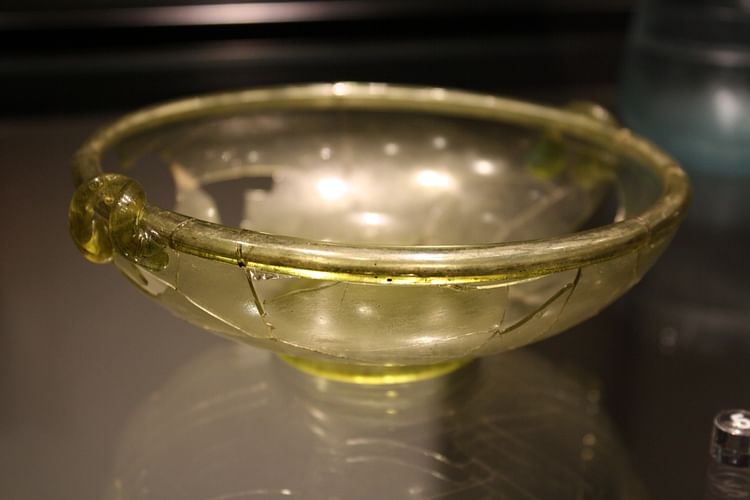 Roman Yellow Glass Bowl, Aosta Mark Cartwright (CC BY-NC-SA) ](https://www.worldhistory.org/image/2148/roman-yellow-glass-bowl-aosta/ "Roman Yellow Glass Bowl, Aosta")With the invention of glassblowing (blowing the glass whilst still hot through a hollow iron rod 1 to 1.5 m long) in the 1st century BCE, a better quality of glass was produced, and the production process became faster and cheaper with the consequence that vessels made from glass became much more common, everyday objects. This trend was increased further by the invention of the glassblowing furnace in the 1st century CE. As Strabo noted in his *Geography*, a glass vessel could be bought in the 1st century CE for only a copper [coin](https://www.worldhistory.org/coinage/). The exact location and time of the invention of this new production method is not known, but the earliest examples of blown glass date from the 1st century BCE in the areas of [Syria](https://www.worldhistory.org/syria/) and [Palestine](https://www.worldhistory.org/palestine/). This is also the time when the Latin word for glass - *vitrum* - is first recorded.
[ 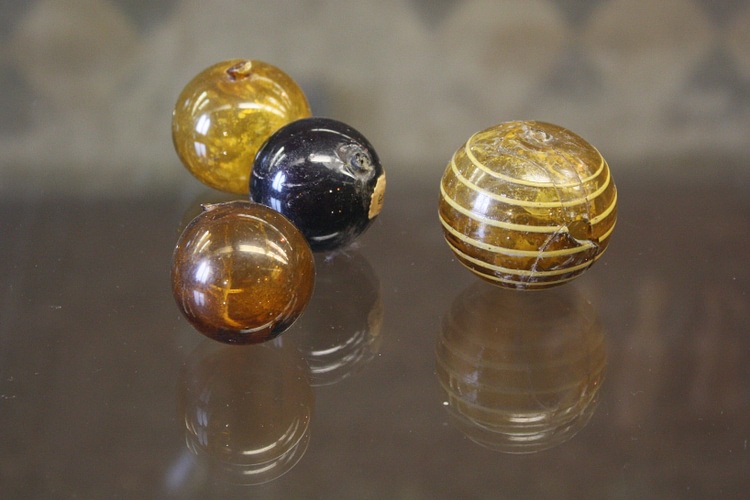 Roman Glass Perfume Containers Mark Cartwright (CC BY-NC-SA) ](https://www.worldhistory.org/image/4592/roman-glass-perfume-containers/ "Roman Glass Perfume Containers")The technique of blowing glass not only allowed vessels to be made with thinner walls and so the glass became more translucent, but it also allowed for a whole new range of shapes to be created. The older method of casting glass using moulds and creating decorative effects by joining together prefabricated component parts of white, brown, blue, red, and green did continue into the 1st century CE but was restricted mainly for the production of larger vessels such as bowls, plates, and jugs. With the revolutionary new method of glass-blowing the possibilities for design became limited only by the imagination of the craftsperson. As [Seneca](https://www.worldhistory.org/Seneca/) marvelled in his *Epistulae Morales*, the glassblower could, 'by his breath alone, fashion glass into numerous shapes which could scarcely be accomplished by the most skilful hand'.
[ 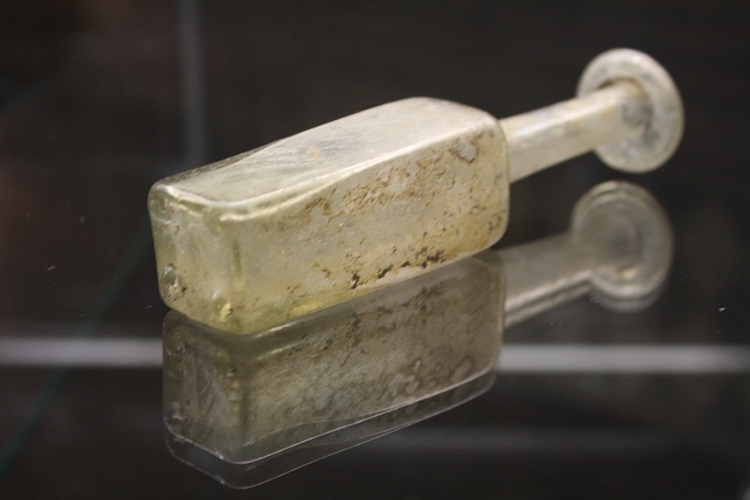 Roman Opaque Glass Perfume Bottle Mark Cartwright (CC BY-NC-SA) ](https://www.worldhistory.org/image/4599/roman-opaque-glass-perfume-bottle/ "Roman Opaque Glass Perfume Bottle")### Designs
Roman glass-makers (*vitriarii*) and glass-cutters (*diatretarii*) could employ a wide range of techniques to transform simple glass vessels into highly decorative pieces. Colourful glassware, as we have seen, was first created by putting together different pieces of pre-made glass. However, it was in the late 1st century CE that colourless glass first appeared in the glassmaker's repertoire and it became highly sought after by Roman households. One of the most popular shapes using clear glass was a large drinking cup with carved horizontal handles and sometimes with carved decorative incisions representing vine scrolls and laurel wreaths. Another decorative technique was to decorate the rims of plates with the 'egg and dart' motif so popular in architectural decorative sculpture.
[ 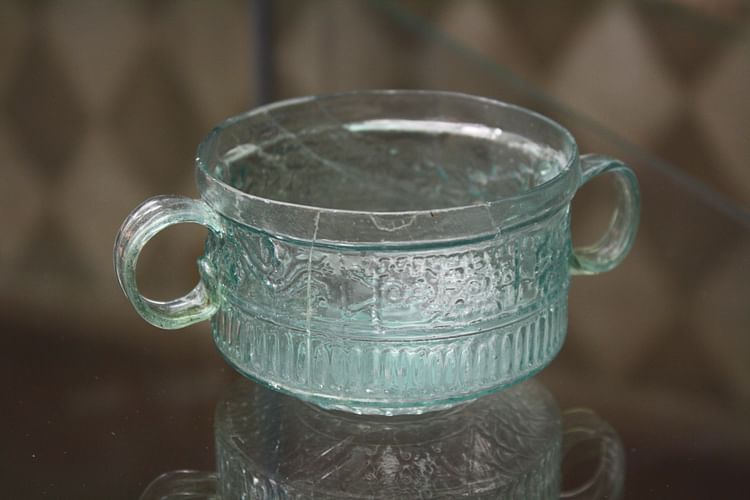 Roman Glass Two-handled Cup Mark Cartwright (CC BY-NC-SA) ](https://www.worldhistory.org/image/4596/roman-glass-two-handled-cup/ "Roman Glass Two-handled Cup")The production method of blowing glass into carved moulds permitted mass production and another range of designs which were often rendered using multi-coloured rods fused together in the mould and with patterns in high relief, decorative bosses being a particularly popular design in the 1st century CE. Decoration could also be added by placing small pieces or trails of hot glass onto the vessel and the shape of the vessel itself could be altered whilst still hot, for example by pinching the glass at the base of bottle necks. Handles were usually added to vessels separately and the lack of cutting shears amongst the glassworker's tools is evident in the folding over of handle ends so that the glass could be tapered and snapped off.
Glass could also receive pre-printed designs but surviving examples are rare. Abrasion was another technique to create decoration by creating areas of bright and dull contrast on the vessel. [Gold](https://www.worldhistory.org/gold/) leaf was also used; sandwiched between two layers of glass, the gold was used to create designs and even portraits and figure scenes and was used especially in the bases of cups and bowls. The technique was also commonly used in glass funerary medallions.
[  Thetis, Portland Vase Jastrow (CC BY-SA) ](https://www.worldhistory.org/image/1363/thetis-portland-vase/ "Thetis, Portland Vase")### Masterpieces
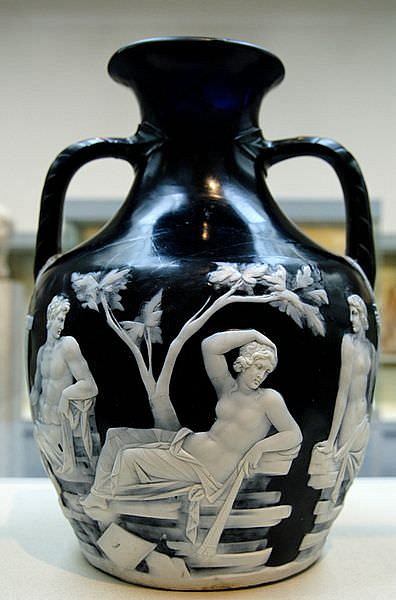
As glass-makers mastered their art, glassware became ever more intricate and ambitious in design and glass could now be transformed into dazzling works of art. Gem-cutting techniques were used to create effects such as those seen in cameos. Perhaps the most famous example of this technique is the '[Portland Vase](https://www.worldhistory.org/article/654/the-portland-vase/)' which was made sometime during the reign of [Augustus](https://www.worldhistory.org/augustus/) (27 BCE - 14 CE) and which depicts the marriage of Peleus and [Thetis](https://www.worldhistory.org/Thetis/) from [Greek mythology](https://www.worldhistory.org/Greek_Mythology/).
[ 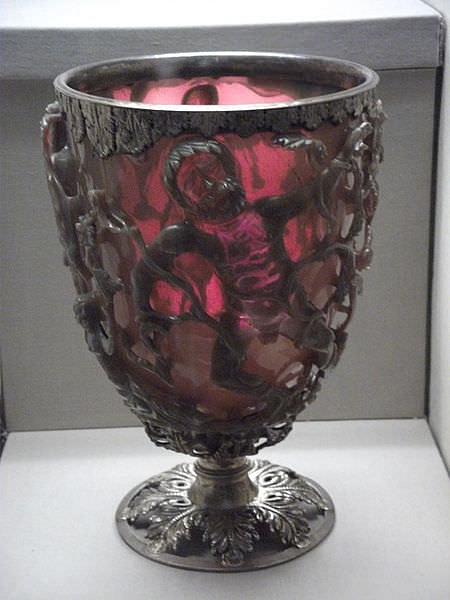 Lycurgus Cup Johnbod (CC BY-SA) ](https://www.worldhistory.org/image/1362/lycurgus-cup/ "Lycurgus Cup")Later vessels were cut even more dramatically and by the 4th century CE, the art form reached its zenith with the highly carved *diatreta* or cage-cups and perhaps the most famous Roman glass vessel of all, the [Lycurgus](https://www.worldhistory.org/Lycurgus/) Cup. These cups were created by carving away thick layers of the glass leaving a design or figure attached to the main body of the vessel only by a small hidden bridge of glass, creating a lattice work of decoration surrounding the entire vessel. The Lycurgus Cup, now currently in the British Museum in London, was carved in the 4th century CE from green and red glass and depicts the myth of Lycurgus and his fatal entrapment in a vine. The decorative figures in green are additionally carved out from behind to make them as thin as possible so that they become even more translucent.
Although the Roman glass industry never reached the scale of other mass production industries such as [pottery](https://www.worldhistory.org/pottery/) and [coinage](https://www.worldhistory.org/coinage/), glassware, nevertheless, became relatively common and remarkably uniform across the [Roman Empire](https://www.worldhistory.org/Roman_Empire/), and the sheer quantity of glassware produced would not be matched until the boom in Venetian glass in the 15th century CE.
#### Editorial Review
This human-authored article has been reviewed by our editorial team before publication to ensure accuracy, reliability and adherence to academic standards in accordance with our [editorial policy](https://www.worldhistory.org/static/editorial-policy/).
## Bibliography
- [Eric H. Cline. *The Oxford Handbook of the Bronze Age Aegean.* Oxford University Press, USA, 2012.](https://www.worldhistory.org/books/0199873607/)
- [Martin - Editor Henig. *A Handbook Of Roman Art - A Comprehensive Survey Of All The Arts Of The Roman World..* Cornell University Press, 1990.](https://www.worldhistory.org/books/B000LZDEXO/)
- [Mortimer Wheeler. *Roman Art and Architecture.* Thames & Hudson, 1985.](https://www.worldhistory.org/books/0500200211/)
- [Simon Hornblower. *The Oxford Classical Dictionary.* Oxford University Press, USA, 2012.](https://www.worldhistory.org/books/0199545561/)
## About the Author
Mark is WHE’s Publishing Director and has an MA in Political Philosophy (University of York). He is a full-time researcher, writer, historian and editor. Special interests include art, architecture and discovering the ideas that all civilizations share.
## Cite This Work
### APA
Cartwright, M. (2013, August 05). Roman Glass. *World History Encyclopedia*.
### Chicago
Cartwright, Mark. "Roman Glass." *World History Encyclopedia*, August 05, 2013. .
### MLA
Cartwright, Mark. "Roman Glass." *World History Encyclopedia*, 05 Aug 2013, .
## License & Copyright
Submitted by [Mark Cartwright](https://www.worldhistory.org/user/markzcartwright/ "User Page: Mark Cartwright"), published on 05 August 2013. The copyright holder has published this content under the following license: [Creative Commons Attribution-NonCommercial-ShareAlike](https://creativecommons.org/licenses/by-nc-sa/4.0/deed.en). This license lets others remix, tweak, and build upon this content non-commercially, as long as they credit the author and license their new creations under the identical terms. When republishing on the web a hyperlink back to the original content source URL must be included. Please note that content linked from this page may have different licensing terms.