---
title: The Arch of Septimius Severus, Rome
author: Mark Cartwright
source: https://www.worldhistory.org/article/502/the-arch-of-septimius-severus-rome/
format: machine-readable-alternate
license: Creative Commons Attribution-NonCommercial-ShareAlike (https://creativecommons.org/licenses/by-nc-sa/4.0/)
updated: 1970-01-01
---
# The Arch of Septimius Severus, Rome
_Authored by [Mark Cartwright](https://www.worldhistory.org/user/markzcartwright/)_
The Arch of [Septimius Severus](https://www.worldhistory.org/Septimius_Severus/), erected in 203 CE, stands in [Rome](https://www.worldhistory.org/Rome/) and commemorates the [Roman](https://www.worldhistory.org/disambiguation/Roman/) victories over the Parthians in the final decade of the 2nd century CE. The triple [triumphal arch](https://www.worldhistory.org/Triumphal_Arch/) was one of the most richly decorated of its type and even today, although badly damaged, it stands in the [Forum Romanum](https://www.worldhistory.org/Roman_Forum/) as a lasting and imposing monument to Roman vanity.
[ 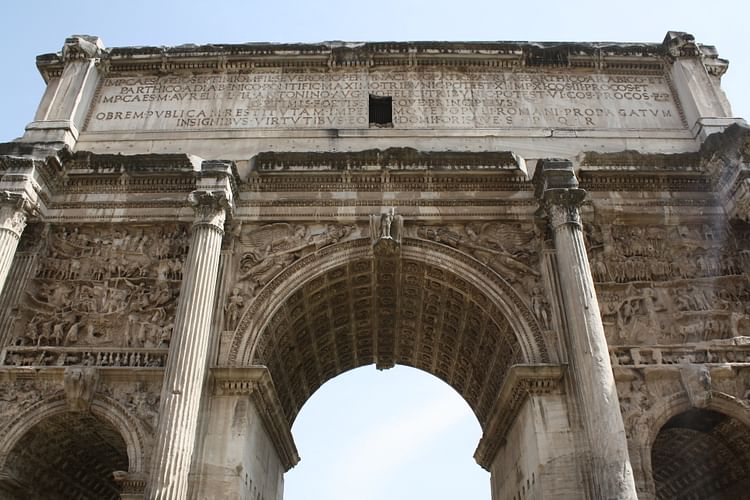 Triumphal Arch of Septimius Severus, Rome Mark Cartwright (CC BY-NC-SA) ](https://www.worldhistory.org/image/1339/triumphal-arch-of-septimius-severus-rome/ "Triumphal Arch of Septimius Severus, Rome")The arch stands on the Via Sacra in the Forum Romanum of Rome and has the three arches typical of later Roman triumphal arches. The larger central archway was used for traffic, whilst the two outer arches were closed off by steps. In terms of construction materials the core and foundations are of tavertine whilst, the whole is faced with Proconnesian marble, a feature of which is its grey and white bands. The eight composite columns, four on each façade, are of the same marble type.
It was possible to climb the arch via an inner staircase within the south pier, although the entrance was actually 5 m above ground level for security. There was both a walkway above the second cornice and access to the roof through the hollow attic.
[  Inscription, Arch of Septimius Severus, Rome Mark Cartwright (CC BY-NC-SA) ](https://www.worldhistory.org/image/1345/inscription-arch-of-septimius-severus-rome/ "Inscription, Arch of Septimius Severus, Rome")### Inscription
The inscription on the attic, originally with gilded [bronze](https://www.worldhistory.org/disambiguation/bronze/) lettering, is a dedication to Septimius Severus and his two sons [Caracalla](https://www.worldhistory.org/Caracalla/) and Geta who 'restored the Republic and expanded the dominion of the Roman people'. This refers to the successful campaigns against the Parthians in modern Iran when Septimius Severus took the [city](https://www.worldhistory.org/city/) of [Ctesiphon](https://www.worldhistory.org/ctesiphon/) (197 CE) and created the new Roman province of [Mesopotamia](https://www.worldhistory.org/Mesopotamia/) (199 CE). Interestingly, the inscription was changed following Geta's murder by his brother Caracalla in 212 CE. *P. Septimio L. fil. Getae nobiliss(imo) Caesari* or 'most noble [Caesar](https://www.worldhistory.org/disambiguation/caesar/) Geta' was removed and *optimis fortissimisque principibus* added (line four).
[  Detail, Arch of Septimius Severus, Rome Mark Cartwright (CC BY-NC-SA) ](https://www.worldhistory.org/image/1347/detail-arch-of-septimius-severus-rome/ "Detail, Arch of Septimius Severus, Rome")###
Decorative [Sculpture](https://www.worldhistory.org/disambiguation/Sculpture/)
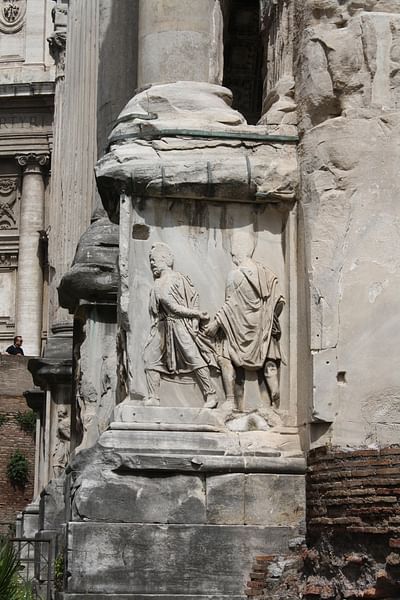
The arch was richly decorated with sculpture which depicted scenes from the military campaigns in [Parthia](https://www.worldhistory.org/disambiguation/Parthia/), the [seasons](https://www.worldhistory.org/Horae/), various deities, and victories. The style of the sculpture is similar to that on the [column of Marcus Aurelius](https://www.worldhistory.org/article/647/the-column-of-marcus-aurelius/) c. 180 CE but, unfortunately, it is in a poor state of preservation and many scenes are barely discernible today. Above the central arch on both façades are winged victories who each carry trophies. The arch has the typical central keystone of this genre of architectural monument which here represents [Mars](https://www.worldhistory.org/Mars/), the Roman [god](https://www.worldhistory.org/God/) of [war](https://www.worldhistory.org/disambiguation/War/). The smaller arches also have keystones which are carved to represent [Bacchus](https://www.worldhistory.org/Bacchus/) and [Hercules](https://www.worldhistory.org/hercules/) - gods which Septimius Severus held in particular esteem. The lower arches also carry figures, this time river gods. Above each of the small arches is a frieze which depicts a triumphal procession where booty and prisoners are being shown off. The [column](https://www.worldhistory.org/column/) plinths each have relief sculpture showing Roman soldiers with captured Parthians.
[ 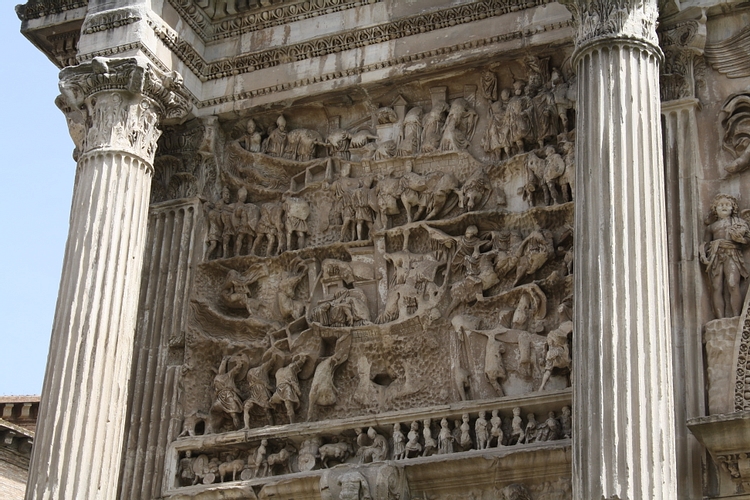 Relief Panel, Arch of Septimius Severus, Rome Mark Cartwright (CC BY-NC-SA) ](https://www.worldhistory.org/image/1346/relief-panel-arch-of-septimius-severus-rome/ "Relief Panel, Arch of Septimius Severus, Rome")The most impressive sculpture is found on four huge panels - two on each façade - which show scenes from the military campaigns in Parthia. The left panel on the Forum side shows the army leaving their camp, a [battle](https://www.worldhistory.org/disambiguation/battle/), Septimius Severus speaking before his troops, and the liberation of Nisibis. The right panel shows siege machines attacking the city of [Edessa](https://www.worldhistory.org/edessa/), a group of Parthians surrendering to Septimius Severus, a war council within a fortified camp, and the launch of a new campaign. On the Capitoline side the left panel depicts the city of Seleucia under attack, its eventual fall, and defeated Parthians. The right panel shows the siege of Ctesiphon with its ultimate defeat and Septimius Severus speaking in front of his victorious army.
On top of the structure, as indicated in coins of the period, there would once have been a six-horse [chariot](https://www.worldhistory.org/chariot/) in gilded bronze on which rode a statue of Septimius Severus. The emperor was also originally flanked by his two sons on horseback, possibly rendered in [silver](https://www.worldhistory.org/Silver/). Trophies and garlands in bronze would also once have adorned the plain surfaces around the inscription on the façades.
[ ![Arch of Septimius Severus, Rome [Side View]](https://www.worldhistory.org/img/r/p/500x600/1340.jpg?v=1619458202) Arch of Septimius Severus, Rome \[Side View\] Mark Cartwright (CC BY-NC-SA) ](https://www.worldhistory.org/image/1340/arch-of-septimius-severus-rome-side-view/ "Arch of Septimius Severus, Rome [Side View]")### Later History
The monument, like many other buildings from antiquity, suffered in later times, particularly in the Middle Ages when it was converted into a fortress, towers were added, and the structure was incorporated into surrounding buildings. Within the central passage a sculptor or stonemason even had a shop and the profiles he carved into the inner walls are still visible today. Likewise, the smaller archways were used for commerce right up until the 19th century CE. The worst damage to the structure, however, stems from the inferior quality of the original material and possibly also workmanship when it was originally built. Several deep cracks in the marble, vertical fissures in the columns, and the breaking off of pieces of sculpture can be attributed to the workmen not paying proper attention to the natural bedding of the marble. The sculptures have also suffered severe damage due to weathering and environmental pollution.
#### Editorial Review
This human-authored article has been reviewed by our editorial team before publication to ensure accuracy, reliability and adherence to academic standards in accordance with our [editorial policy](https://www.worldhistory.org/static/editorial-policy/).
## Bibliography
- [Amanda Claridge. *Rome.* Oxford University Press, USA, 2010.](https://www.worldhistory.org/books/0199546835/)
- Costantino C. *Roman Forum, Palatine & Colosseum.* Electa, Milan, 2010
- [Martin Henig. *A Handbook of Roman Art.* Cornell Univ Pr, 1983.](https://www.worldhistory.org/books/0801492424/)
- [Mortimer Wheeler. *Roman Art and Architecture.* Thames & Hudson, 1985.](https://www.worldhistory.org/books/0500200211/)
- [Simon Hornblower. *The Oxford Classical Dictionary.* Oxford University Press, USA, 2012.](https://www.worldhistory.org/books/0199545561/)
## About the Author
Mark is WHE’s Publishing Director and has an MA in Political Philosophy (University of York). He is a full-time researcher, writer, historian and editor. Special interests include art, architecture and discovering the ideas that all civilizations share.
## Cite This Work
### APA
Cartwright, M. (2013, June 29). The Arch of Septimius Severus, Rome. *World History Encyclopedia*.
### Chicago
Cartwright, Mark. "The Arch of Septimius Severus, Rome." *World History Encyclopedia*, June 29, 2013. .
### MLA
Cartwright, Mark. "The Arch of Septimius Severus, Rome." *World History Encyclopedia*, 29 Jun 2013, .
## License & Copyright
Submitted by [Mark Cartwright](https://www.worldhistory.org/user/markzcartwright/ "User Page: Mark Cartwright"), published on 29 June 2013. The copyright holder has published this content under the following license: [Creative Commons Attribution-NonCommercial-ShareAlike](https://creativecommons.org/licenses/by-nc-sa/4.0/deed.en). This license lets others remix, tweak, and build upon this content non-commercially, as long as they credit the author and license their new creations under the identical terms. When republishing on the web a hyperlink back to the original content source URL must be included. Please note that content linked from this page may have different licensing terms.