---
title: The Arch of Titus, Rome
author: Mark Cartwright
source: https://www.worldhistory.org/article/499/the-arch-of-titus-rome/
format: machine-readable-alternate
license: Creative Commons Attribution-NonCommercial-ShareAlike (https://creativecommons.org/licenses/by-nc-sa/4.0/)
updated: 1970-01-01
---
# The Arch of Titus, Rome
_Authored by [Mark Cartwright](https://www.worldhistory.org/user/markzcartwright/)_
The Arch of [Titus](https://www.worldhistory.org/disambiguation/Titus/) is a [Roman](https://www.worldhistory.org/disambiguation/Roman/) [Triumphal Arch](https://www.worldhistory.org/Triumphal_Arch/) which was erected by [Domitian](https://www.worldhistory.org/domitian/) in c. 81 CE at the foot of the Palatine hill on the Via Sacra in the [Forum Romanum](https://www.worldhistory.org/Roman_Forum/), [Rome](https://www.worldhistory.org/Rome/). It commemorates the victories of his father [Vespasian](https://www.worldhistory.org/Vespasian/) and brother Titus in the Jewish [War](https://www.worldhistory.org/disambiguation/War/) in [Judaea](https://www.worldhistory.org/disambiguation/judaea/) (70-71 CE) when the great [city](https://www.worldhistory.org/city/) of [Jerusalem](https://www.worldhistory.org/jerusalem/) was sacked and the vast riches of its [temple](https://www.worldhistory.org/temple/) plundered. The arch is also a political and religious statement expressing the divinity of the late emperor Titus.
[  Arch of Titus, Rome Mark Cartwright (CC BY-NC-SA) ](https://www.worldhistory.org/image/1284/arch-of-titus-rome/ "Arch of Titus, Rome")[ 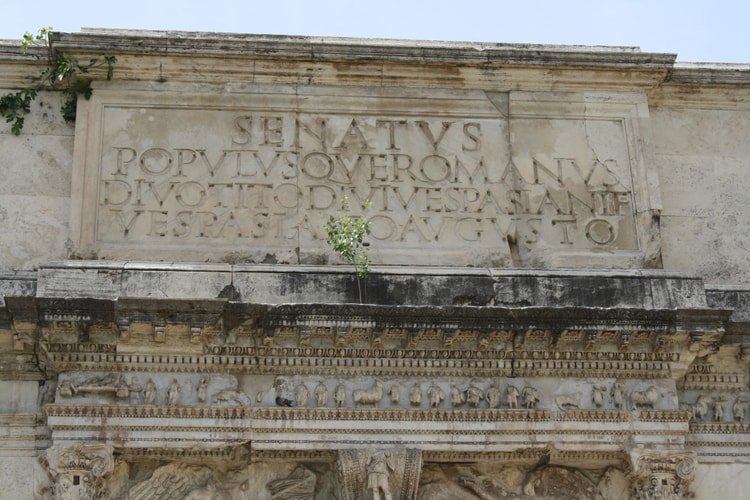 Inscription, Arch of Titus Mark Cartwright (CC BY-NC-SA) ](https://www.worldhistory.org/image/1289/inscription-arch-of-titus/ "Inscription, Arch of Titus")### Inscription
The arch was constructed using Pentelic marble, with the attic part in Luna marble. The original inscription on the east side of the arch is still *in situ,* although originally the letters would have been inlaid with gilded [bronze](https://www.worldhistory.org/disambiguation/bronze/). It reads:
> SENATUS
> POPOLUS QUE ROMANUS
> DIVO TITO DIVI VESPASIANI F
> VISPASIANO AUGUSTO
(The Senate and People of Rome, to Divus Titus, son of Divus Vespasian, Vespasian [Augustus](https://www.worldhistory.org/augustus/)). The use of 'Divo' for Titus indicates that the arch was erected after the [death](https://www.worldhistory.org/disambiguation/Death/) of the emperor in 81 CE. The inscription on the west side describes the refurbishment of the monument by Pope Pius VII in 1821 CE.
[  Temple of Solomon Treasure, Arch of Titus Mark Cartwright (CC BY-NC-SA) ](https://www.worldhistory.org/image/1287/temple-of-solomon-treasure-arch-of-titus/ "Temple of Solomon Treasure, Arch of Titus")### Decorative [Sculpture](https://www.worldhistory.org/disambiguation/Sculpture/)
With only a single opening the arch is smaller and more modest in its decoration than other surviving arches such as those of [Constantine](https://www.worldhistory.org/disambiguation/Constantine/) and [Septimius Severus](https://www.worldhistory.org/Septimius_Severus/). Also, the decorative sculpture has not survived the ravages of time very well. Nevertheless, one can still see the significance of some of the sculpture scenes, notably, the side panels. These marble reliefs are set either side of the inner arch and measure 2.04 m high by 3.85 m long. One panel shows the start of Titus' 71 CE victory [triumph](https://www.worldhistory.org/Roman_Triumph/) procession as it passes through the Porta Triumphalis to the Forum Boarium with the participants carrying booty from the Temple of Jerusalem after the sacking of the city. The booty includes a seven-branched candelabra (menorah), [silver](https://www.worldhistory.org/Silver/) trumpets, and perhaps even the [Ark of the Covenant](https://www.worldhistory.org/Ark_of_the_Covenant/). Some figures carry placards which would have probably indicated the names of the conquered [cities](https://www.worldhistory.org/city/) and peoples.
[  Chariot Panel, Arch of Titus Mark Cartwright (CC BY-NC-SA) ](https://www.worldhistory.org/image/1286/chariot-panel-arch-of-titus/ "Chariot Panel, Arch of Titus")The other relief panel is carved in three-quarter view and has Titus riding a four-horse [chariot](https://www.worldhistory.org/chariot/) (*quadriga*) and shows him being crowned by a personification of Victory. The goddess [Roma](https://www.worldhistory.org/disambiguation/Roma/) stands in front, holding the bridle of one of the horses. The two figures to the right of the chariot are personifications of the people of Rome (naked torso) and the Senate (wearing a toga).
The two relief panels are significant in the history and development of [Roman art](https://www.worldhistory.org/Roman_Art/), as they are the first full attempt by Roman sculptors to create the illusion of space. This is successfully achieved in several ways; the figures are portrayed in three-quarter view, the background figures are so rendered that they recede gradually into the distance, the central figures are carved in higher relief than those on the edges, and the whole panel is curved slightly inwards.
[ 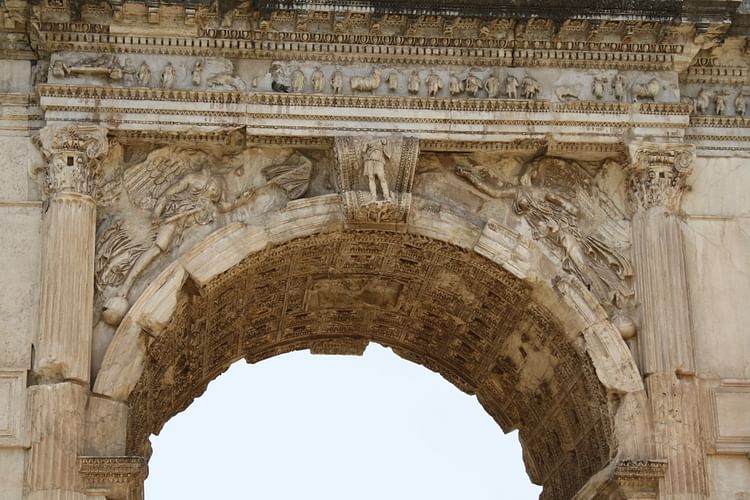 Victories, Arch of Titus Mark Cartwright (CC BY-NC-SA) ](https://www.worldhistory.org/image/1288/victories-arch-of-titus/ "Victories, Arch of Titus")Running around the whole arch is a small frieze which depicts the whole triumphal procession, and above the intrados winged victories each stand on a globe and hold banners, trophies, laurel wreaths, and palm fronds. Set in the centre of each side of the archway is a keystone representing Roma and the Genius of the Roman People. The interior vault is coffered with a central representation of the deified Titus (apotheosis) being carried to the heavens by an eagle. Originally, the whole arch was finished off in customary style with a huge bronze *quadriga* which would have stood on top of the arch.
[  Inner Archway, Arch of Titus Mark Cartwright (CC BY-NC-SA) ](https://www.worldhistory.org/image/1285/inner-archway-arch-of-titus/ "Inner Archway, Arch of Titus")### Later History
The arch was incorporated into fortifications built by the Frangipani family in medieval times and suffered as a consequence. The significant restoration of the monument was carried out in the 19th century CE, in particular, on parts of the piers and attic using Travertine limestone. In fact, the whole arch was dismantled and reassembled piece by piece. In the present day the foundation blocks of the arch are visible, as the original roadway would have been higher.
#### Editorial Review
This human-authored article has been reviewed by our editorial team before publication to ensure accuracy, reliability and adherence to academic standards in accordance with our [editorial policy](https://www.worldhistory.org/static/editorial-policy/).
## Bibliography
- [Claridge, A. *Rome.* Oxford University Press, USA, 2010.](https://www.worldhistory.org/books/0199546835/)
- Costantino, C. *Roman Forum, Palatine & Colosseum.* Electa, Milan, 2010
- [Henig, M. *A Handbook of Roman Art.* Cornell Univ Pr, 1983.](https://www.worldhistory.org/books/0801492424/)
- [Hornblower, S. *The Oxford Classical Dictionary.* Oxford University Press, USA, 2012.](https://www.worldhistory.org/books/0199545561/)
- Quenell, P. *The Colosseum.* Newsweek Book Division, New York, 1971
- [Wheeler, M. *Roman Art and Architecture.* Thames & Hudson, 1985.](https://www.worldhistory.org/books/0500200211/)
## About the Author
Mark is WHE’s Publishing Director and has an MA in Political Philosophy (University of York). He is a full-time researcher, writer, historian and editor. Special interests include art, architecture and discovering the ideas that all civilizations share.
## Cite This Work
### APA
Cartwright, M. (2013, June 16). The Arch of Titus, Rome. *World History Encyclopedia*.
### Chicago
Cartwright, Mark. "The Arch of Titus, Rome." *World History Encyclopedia*, June 16, 2013. .
### MLA
Cartwright, Mark. "The Arch of Titus, Rome." *World History Encyclopedia*, 16 Jun 2013, .
## License & Copyright
Submitted by [Mark Cartwright](https://www.worldhistory.org/user/markzcartwright/ "User Page: Mark Cartwright"), published on 16 June 2013. The copyright holder has published this content under the following license: [Creative Commons Attribution-NonCommercial-ShareAlike](https://creativecommons.org/licenses/by-nc-sa/4.0/deed.en). This license lets others remix, tweak, and build upon this content non-commercially, as long as they credit the author and license their new creations under the identical terms. When republishing on the web a hyperlink back to the original content source URL must be included. Please note that content linked from this page may have different licensing terms.