---
title: Roman Mosaics
author: Mark Cartwright
source: https://www.worldhistory.org/article/498/roman-mosaics/
format: machine-readable-alternate
license: Creative Commons Attribution-NonCommercial-ShareAlike (https://creativecommons.org/licenses/by-nc-sa/4.0/)
updated: 2024-11-08
---
# Roman Mosaics
_Authored by [Mark Cartwright](https://www.worldhistory.org/user/markzcartwright/)_
[Roman](https://www.worldhistory.org/disambiguation/Roman/) mosaics were a common feature of private homes and public buildings across the [empire](https://www.worldhistory.org/empire/) from [Africa](https://www.worldhistory.org/disambiguation/africa/) to [Antioch](https://www.worldhistory.org/Antiochia/). Not only are mosaics beautiful works of art in themselves but they are also an invaluable record of such everyday items as clothes, food, tools, weapons, flora and fauna. They also reveal much about Roman activities like [gladiator](https://www.worldhistory.org/gladiator/) contests, sports, [agriculture](https://www.worldhistory.org/disambiguation/Agriculture/), hunting and sometimes they even capture the Romans themselves in detailed and realistic portraits.
[  Fish, Roman Mosaic Mark Cartwright (CC BY-NC-SA) ](https://www.worldhistory.org/image/1279/fish-roman-mosaic/ "Fish, Roman Mosaic")### Technique
Mosaics, otherwise known as *opus tesellatum*, were made with small black, white and coloured squares typically measuring between 0.5 and 1.5 cm but fine details were often rendered using even smaller pieces as little as 1mm in size. These squares (*tesserae* or *tessellae*) were cut from materials such as marble, tile, glass, smalto (glass paste), [pottery](https://www.worldhistory.org/pottery/), stone and even shells. A base was first prepared with fresh mortar and the *tesserae* positioned as close together as possible with any gaps then filled with liquid mortar in a process known as grouting. The whole was then cleaned and polished.
### Origins & Influences
Flooring set with small pebbles was used in the [Bronze Age](https://www.worldhistory.org/disambiguation/Bronze_Age/) in both the [Minoan civilization](https://www.worldhistory.org/Minoan_Civilization/) based on [Crete](https://www.worldhistory.org/crete/) and the [Mycenaean civilization](https://www.worldhistory.org/Mycenaean_Civilization/) on mainland [Greece](https://www.worldhistory.org/greece/). The same idea but reproducing patterns was used in the [Near East](https://www.worldhistory.org/Near_East/) in the 8th century BCE. In Greece the first pebble flooring which attempted designs dates to the 5th century BCE with examples at [Corinth](https://www.worldhistory.org/corinth/) and Olynthus. These were usually in two shades with light geometric designs and simple figures on a dark background. By the end of the 4th century BCE colours were being used and many fine examples have been found at Pella in Macedonia. These mosaics were often reinforced by inlaying strips of terracotta or lead, often used to [mark](https://www.worldhistory.org/disambiguation/Mark/) outlines. Indeed, it was not until [Hellenistic](https://www.worldhistory.org/Hellenic_World/) times in the 3rd century BCE that mosaics really took off as an art form and detailed panels using *tesserae* rather than pebbles began to be incorporated into patterned floors. Many of these mosaics attempted to copy contemporary [wall](https://www.worldhistory.org/wall/) paintings.
[  Roman Bacchus Floor Mosaic Mark Cartwright (CC BY-NC-SA) ](https://www.worldhistory.org/image/1248/roman-bacchus-floor-mosaic/ "Roman Bacchus Floor Mosaic")As mosaics evolved in the 2nd century BCE smaller and more precisely cut *tesserae* were used, sometimes as small as 4 mm or less, and designs employed a wide spectrum of colours with coloured grouting to match surrounding *tesserae*. This particular type of [mosaic](https://www.worldhistory.org/Mosaic/) which used sophisticated colouring and shading to create an effect similar to a painting is know as *opus vermiculatum* and one of its greatest craftsmen was Sosus of [Pergamon](https://www.worldhistory.org/pergamon/) (150-100 BCE) whose work, especially his Drinking Doves mosaic, was much copied for centuries after. Besides Pergamon, outstanding examples of Hellenistic *opus vermiculatum* have been found at [Alexandria](https://www.worldhistory.org/alexandria/) and [Delos](https://www.worldhistory.org/delos/) in the [Cyclades](https://www.worldhistory.org/Cyclades/). Because of the labour involved in producing these pieces they were often small mosaics 40 x 40 cm laid on a marble tray or rimmed tray in a specialist workshop. These pieces were known as *emblemata* as they were often used as centre-pieces for pavements with more simple designs. So valuable were these works of art that they were often removed for re-use elsewhere and handed down from generation to generation within families. Several *emblemata* could make up a single mosaic and gradually, *emblemata* began to resemble more their surroundings when they are then known as panels.
### Evolution in Design
With a subject such as mosaics where there are difficulties of dating, tremendous variance in artistic quality, public taste and regional conventions, it is problematic to describe a strictly linear evolution of the art form. However, some major points of change and regional difference can be noted.
[  Alexander the Great & Bucephalus Mosaic Ruthven (Public Domain) ](https://www.worldhistory.org/image/132/alexander-the-great--bucephalus-mosaic/ "Alexander the Great & Bucephalus Mosaic")Initially, the Romans did not diverge from the fundamentals of the Hellenistic approach to mosaics and indeed they were heavily influenced in terms of subject matter - sea motifs and scenes from [Greek mythology](https://www.worldhistory.org/Greek_Mythology/) - and the artists themselves, as the many signed Roman mosaics often bear [Greek](https://www.worldhistory.org/disambiguation/greek/) names, evidencing that even in the Roman world mosaic design was still dominated by Greeks. One of the most famous is the [Alexander](https://www.worldhistory.org/disambiguation/Alexander/) mosaic which was a copy of a Hellenistic original painting by either Philoxenus or Aristeides of [Thebes](https://www.worldhistory.org/disambiguation/Thebes/). The mosaic is from the House of the Faun, [Pompeii](https://www.worldhistory.org/pompeii/) and depicts [Alexander the Great](https://www.worldhistory.org/Alexander_the_Great/) riding [Bucephalus](https://www.worldhistory.org/Bucephalus/) and facing [Darius](https://www.worldhistory.org/disambiguation/darius/) III on his [war](https://www.worldhistory.org/disambiguation/War/) [chariot](https://www.worldhistory.org/chariot/) at the [Battle of Issus](https://www.worldhistory.org/Battle_of_Issus/) (333 BCE).
[  Dionysos, Roman Mosaic Mark Cartwright (CC BY-NC-SA) ](https://www.worldhistory.org/image/1278/dionysos-roman-mosaic/ "Dionysos, Roman Mosaic")Roman mosaics often copied earlier coloured ones, however, the Romans did develop their own styles and production schools were developed across the empire which cultivated their own particular preferences - large scale hunting scenes and attempts at perspective in the African provinces, impressionistic vegetation and a foreground observer in the mosaics of Antioch or the European preference for figure panels, for example.
[  Season, Roman Mosaic Mark Cartwright (CC BY-NC-SA) ](https://www.worldhistory.org/image/1277/season-roman-mosaic/ "Season, Roman Mosaic")The dominant (but not exclusive) Roman style in [Italy](https://www.worldhistory.org/italy/) itself used only black and white *tesserae*, a taste which survived well into the 3rd century CE and was most often used to represent marine motifs, especially when used for [Roman baths](https://www.worldhistory.org/Roman_Baths/) (those from the first floor of the Baths of [Caracalla](https://www.worldhistory.org/Caracalla/) in [Rome](https://www.worldhistory.org/Rome/) are an excellent example). There was also a preference for more two-dimensional representations and an emphasis on geometric designs. In c. 115 CE at the Baths of Buticosus in [Ostia](https://www.worldhistory.org/Ostia/) there is the earliest example of a human figure in mosaic and in the 2nd century CE silhouetted figures became common. Over time the mosaics became ever more realistic in their portrayal of human figures and accurate and detailed portraits become more common. Meanwhile, in the Eastern part of the empire and especially at Antioch, the 4th century CE saw the spread of mosaics which used two-dimensional and repeated motifs to create a 'carpet' effect, a style which would heavily influence later Christian churches and Jewish synagogues.
[ 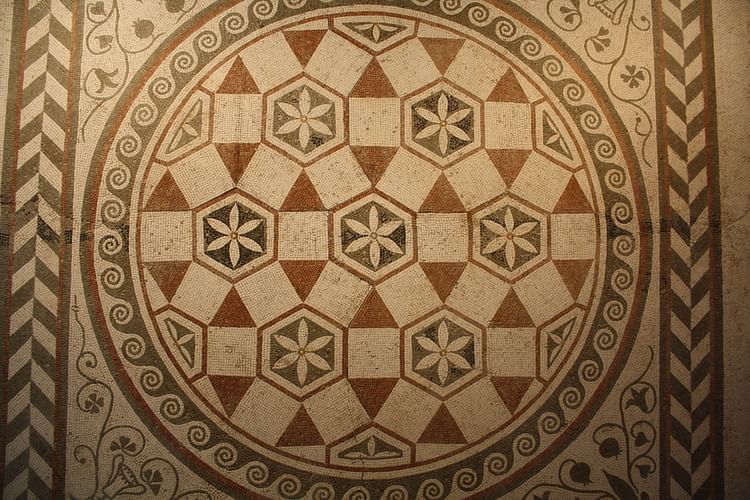 Roman Geometric Mosaic Mark Cartwright (CC BY-NC-SA) ](https://www.worldhistory.org/image/1283/roman-geometric-mosaic/ "Roman Geometric Mosaic")### Other Floor Designs
Floors could also be laid using larger pieces to create designs on a grander scale. *Opus signinum* flooring used coloured mortar-aggregate (usually red) with white *tesserae* placed to create broad patterns or even scattered randomly. Crosses using five red *tesserae* and a central *tesserae* in black were a very common motif in Italy in the 1st century BCE and continued into the 1st century CE but more typically using only black tiles.
*Opus sectile* was a second type of flooring which used large coloured stone or marble slabs cut into particular shapes. *Opus sectile* was another technique of Hellenistic origin but the Romans also expanded the technique to wall decoration. Used in many public buildings, it was not until the 4th century CE that it became more common in private villas and, under [Egyptian](https://www.worldhistory.org/disambiguation/Egyptian/) influence, began to use opaque glass as the primary material.
[ ![Opus Sectile Flooring [Hexagons]](https://www.worldhistory.org/img/r/p/750x750/5535.jpg?v=1667403423) Opus Sectile Flooring \[Hexagons\] Mark Cartwright (CC BY-NC-SA) ](https://www.worldhistory.org/image/5535/opus-sectile-flooring-hexagons/ "Opus Sectile Flooring [Hexagons]")### Other Uses of Mosaic
Mosaics were by no means limited to flooring. Vaults, columns and fountains were often decorated with mosaic (*opus musivum*), again, especially in baths. The earliest example of this use dates to the mid-1st century BCE in the nymphaeum of the 'Villa of [Cicero](https://www.worldhistory.org/Cicero/)' at Formiae where chips of marble, pumice and shells were used. In other locations pieces of marble and glass were also added the whole giving the effect of a natural grotto. By the 1st century CE more detailed mosaic panels were also used to embellish Nymphaea and fountains. In Pompeii and Herculanum the technique was also used to cover niches, walls and pediments and once again these murals often imitated original paintings. The walls and vaults of later Imperial Roman baths were also decorated in mosaic using glass which acted as a reflective of the sunlight hitting the pools and created a shimmering effect. The floors of the pools themselves were often set with mosaic as were the floors of mausolea, sometimes even incorporating a portrait of the deceased. Once again, the Roman use of mosaics to decorate wall space and vaults would go on to influence the interior decorators of Christian churches from the 4th century CE.
#### Editorial Review
This human-authored article has been reviewed by our editorial team before publication to ensure accuracy, reliability and adherence to academic standards in accordance with our [editorial policy](https://www.worldhistory.org/static/editorial-policy/).
## Bibliography
- [Amanda Claridge. *Rome.* Oxford University Press, USA, 2010.](https://www.worldhistory.org/books/0199546835/)
- [Martin Henig. *A Handbook of Roman Art.* Cornell Univ Pr, 1983.](https://www.worldhistory.org/books/0801492424/)
- [Mortimer Wheeler. *Roman Art and Architecture.* Thames & Hudson, 1985.](https://www.worldhistory.org/books/0500200211/)
- [Simon Hornblower. *The Oxford Classical Dictionary.* Oxford University Press, USA, 2012.](https://www.worldhistory.org/books/0199545561/)
## About the Author
Mark is WHE’s Publishing Director and has an MA in Political Philosophy (University of York). He is a full-time researcher, writer, historian and editor. Special interests include art, architecture and discovering the ideas that all civilizations share.
## Cite This Work
### APA
Cartwright, M. (2013, June 14). Roman Mosaics. *World History Encyclopedia*.
### Chicago
Cartwright, Mark. "Roman Mosaics." *World History Encyclopedia*, June 14, 2013. .
### MLA
Cartwright, Mark. "Roman Mosaics." *World History Encyclopedia*, 14 Jun 2013, .
## License & Copyright
Submitted by [Mark Cartwright](https://www.worldhistory.org/user/markzcartwright/ "User Page: Mark Cartwright"), published on 14 June 2013. The copyright holder has published this content under the following license: [Creative Commons Attribution-NonCommercial-ShareAlike](https://creativecommons.org/licenses/by-nc-sa/4.0/deed.en). This license lets others remix, tweak, and build upon this content non-commercially, as long as they credit the author and license their new creations under the identical terms. When republishing on the web a hyperlink back to the original content source URL must be included. Please note that content linked from this page may have different licensing terms.