---
title: The Arch of Constantine, Rome
author: Mark Cartwright
source: https://www.worldhistory.org/article/497/the-arch-of-constantine-rome/
format: machine-readable-alternate
license: Creative Commons Attribution-NonCommercial-ShareAlike (https://creativecommons.org/licenses/by-nc-sa/4.0/)
updated: 1970-01-01
---
# The Arch of Constantine, Rome
_Authored by [Mark Cartwright](https://www.worldhistory.org/user/markzcartwright/)_
The Arch of [Constantine I](https://www.worldhistory.org/Constantine_I/), erected in c. 315 CE, stands in [Rome](https://www.worldhistory.org/Rome/) and commemorates [Roman Emperor](https://www.worldhistory.org/Roman_Emperor/) [Constantine](https://www.worldhistory.org/disambiguation/Constantine/)'s victory over the [Roman](https://www.worldhistory.org/disambiguation/Roman/) tyrant Maxentius on 28th October 312 CE at the [battle](https://www.worldhistory.org/disambiguation/battle/) of Milvian Bridge in Rome. It is the largest surviving Roman [triumphal arch](https://www.worldhistory.org/Triumphal_Arch/) and the last great monument of Imperial Rome. The arch is also a *tour de force* of political propaganda, presenting Constantine as a living continuation of the most successful Roman emperors, renowned for their military victories and good government.
[  Arch of Constantine I Mark Cartwright (CC BY-NC-SA) ](https://www.worldhistory.org/image/1266/arch-of-constantine-i/ "Arch of Constantine I")### A Striking Monument
The arch was dedicated on 25th July 315 CE on the 10th anniversary of Constantine's reign (*Decennalia*) and stood on Rome's triumphal route. The monument is an imposing 21 metre high and 25.6 m wide rectangular block of grey and white Proconnesian marble consisting of three separate arches: one larger central arch with a shorter and narrower arch (*fornix*) on either side. All three arches express the same ratio of height and width. Dividing the arches are four detached Corinthian columns in Numidian yellow marble, each stood on a pedestal and topped with an entablature. Above the entablature, and as it were extending the columns, stand four pedestals, each carrying a statue representing a Dacian prisoner. Even more colour was provided through the use of purple-red porphry as a background for the sculpted Hadrianic Roundels, four on each façade, green porphry for the main entablature frieze, Carystian green for the statue pedestals and Phrygian purple for the statues themselves.
[  Inscription, Arch of Constantine I Mark Cartwright (CC BY-NC-SA) ](https://www.worldhistory.org/image/1267/inscription-arch-of-constantine-i/ "Inscription, Arch of Constantine I")### Inscription
The block or 'attic' storey above the monument's arches also presents sculpted panels and an inscription in Latin, a common feature of triumphal arches. The inscription, above the central arch, is a long one and is repeated on both sides of the arch. The letters would originally have been inlaid with gilded [bronze](https://www.worldhistory.org/disambiguation/bronze/). It reads:
IMP CAES FL CONSTANTINO MAXIMO
P F AUGUSTO SPQR
QUOD INSTINCTU DIVINITATIS MENTIS
MAGNITUDINE CUM EXERCITU SUO
TAM DE TYRANNO QUAM DE OMNI EIUS
FACTIONE UNO TEMPORE IUSTIS
REM PUBLICAM ULTUS EST ARMIS
ARCUM TRIUMPHIS INSIGNEM DICAVIT
To the emperor Flavius [Constantine the Great](https://www.worldhistory.org/Constantine_I/)
pious and fortunate, the Senate and People of Rome
because by divine inspiration and his own greatness of spirit
with his army
on both the tyrant and all his
faction at once in rightful
battle he avenged the State
dedicated this arch as a [mark](https://www.worldhistory.org/disambiguation/Mark/) of [triumph](https://www.worldhistory.org/Roman_Triumph/).
(Claridge, 308)
[  Dacian Prisoners, Arch of Constantine Mark Cartwright (CC BY-NC-SA) ](https://www.worldhistory.org/image/1269/dacian-prisoners-arch-of-constantine/ "Dacian Prisoners, Arch of Constantine")### [Sculpture](https://www.worldhistory.org/disambiguation/Sculpture/)
The Arch is a huge conglomerate of imperial [Roman sculpture](https://www.worldhistory.org/Roman_Sculpture/) as many parts of it were recycled from earlier 1st and 2nd century CE monuments, notably the Luna marble panels of the attic which were taken from the Arch of [Marcus Aurelius](https://www.worldhistory.org/Marcus_Aurelius/) (c. 176 CE). There are 8 (3x2 m) marble panels in total, four on each façade, showing scenes where the emperor, re-cut to resemble Constantine, is either at [war](https://www.worldhistory.org/disambiguation/War/) (south side) or conducting his civic duties (north side).
[ 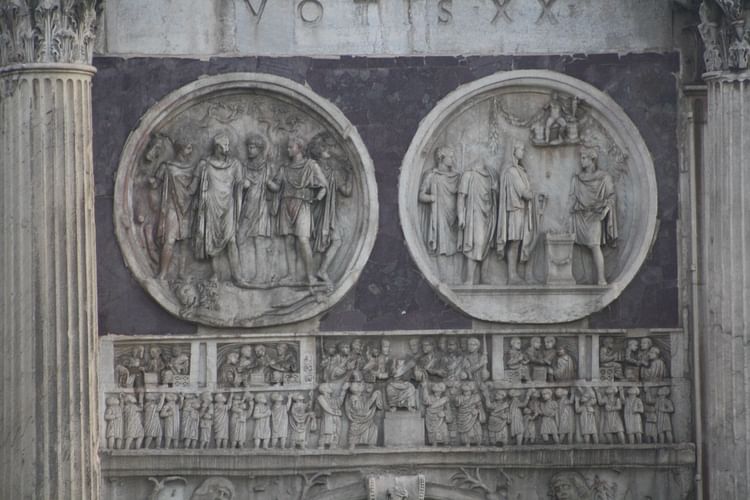 Detail, Arch of Constantine I Mark Cartwright (CC BY-NC-SA) ](https://www.worldhistory.org/image/1268/detail-arch-of-constantine-i/ "Detail, Arch of Constantine I")Eight white Luna marble medallions (*tondi*) on the north and south façades are from a now lost monument (130-138 CE) in honour of [Hadrian](https://www.worldhistory.org/hadrian/) and each is 236 cm in diameter. Set in pairs, scenes they depict include a successful lion hunt, a boar hunt, a bear hunt, and sacrificial ceremonies in honour of [Hercules](https://www.worldhistory.org/hercules/), [Apollo](https://www.worldhistory.org/apollo/), [Diana](https://www.worldhistory.org/diana/) and Silvanus; all are carved in high relief.
[  Arch of Constantine I (South Side) Mark Cartwright (CC BY-NC-SA) ](https://www.worldhistory.org/image/1270/arch-of-constantine-i-south-side/ "Arch of Constantine I (South Side)")The two inner central arch reliefs and the upper panel on each side of the arch are part of the Great Trajanic Frieze which was removed from the Basilica Ulpia in [Trajan](https://www.worldhistory.org/trajan/)'s Forum. These were also altered to suit the purposes of the new monument and use white Pentelic marble. The first of the two frieze panels within the central arch depicts Trajan or [Domitian](https://www.worldhistory.org/domitian/) on campaign riding a horse and charging barbarians but with the head once again re-worked to look more like Constantine. The second panel shows Constantine being crowned by Victory and flanked by two females possibly representing Honour (dressed as an [Amazon](https://www.worldhistory.org/amazon/)) and Virtue (in armour).
The eight Corinthian columns were taken from a 1st century CE Flavian monument (now lost) and the Dacian prisoners standing above each of them were probably part of an unknown monument to Trajan.
The arch does however have sculpture made specifically for the monument. The frieze scenes situated below each pair of medallions are 1 m high and commemorate Constantine's military victories showing the siege of [Verona](https://www.worldhistory.org/Verona/) (south façade, left side), the battle with Maxentius (south façade, right side), a scene addressing the public in the [Roman Forum](https://www.worldhistory.org/Roman_Forum/) (north façade, left side) and a gift-giving ceremony or *largito* (north façade, right side).
[ 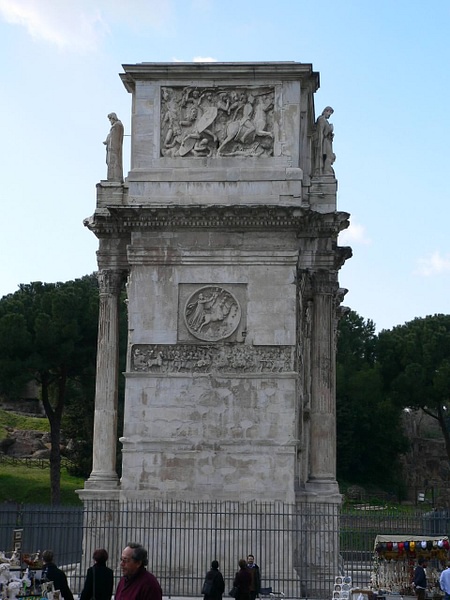 Side View, Arch of Constantine Mary Harrsch (CC BY-NC-SA) ](https://www.worldhistory.org/image/1003/side-view-arch-of-constantine/ "Side View, Arch of Constantine")Other original sculpture includes river gods above the two smaller arches and two victories over the larger arch on both façades. Each [column](https://www.worldhistory.org/column/) base also carries sculpture depicting winged victories holding palm fronds, [Roman legionaries](https://www.worldhistory.org/Roman_Legionary/) and captives. On each of the short sides of the monument there is a single round sculpture depicting the Sun (east side) and Moon (west side), both riding chariots. Below these is a frieze showing the entry into Rome (east) and departure from Milan (west).
### Later History
The monument suffered in later times, becoming a part of a fortress under the Frangipane in the Middle Ages before being restored in the 15th century CE. In c. 1597 CE Pope Clement VIII removed one of the yellow marble columns to use in a doorway of the St John Lateran church, replacing it with a purple one. However, extensive cleaning in the early 21st century CE has restored the monument to some of its former glory so that it now stands proud besides its illustrious neighbour the [Colosseum](https://www.worldhistory.org/Colosseum/) of Rome.
#### Editorial Review
This human-authored article has been reviewed by our editorial team before publication to ensure accuracy, reliability and adherence to academic standards in accordance with our [editorial policy](https://www.worldhistory.org/static/editorial-policy/).
## Bibliography
- [Claridge, A. *Rome.* Oxford University Press, USA, 2010.](https://www.worldhistory.org/books/0199546835/)
- Costantino, C. *Roman Forum, Palatine & Colosseum.* Electa, Milan, 2010
- [Henig, M. *A Handbook of Roman Art.* Cornell Univ Pr, 1983.](https://www.worldhistory.org/books/0801492424/)
- [Summerson, J. *The Classical Language of Architecture.* The MIT Press, 1966.](https://www.worldhistory.org/books/0262690128/)
- [Wheeler, M. *Roman Art and Architecture.* Thames & Hudson, 1985.](https://www.worldhistory.org/books/0500200211/)
## About the Author
Mark is WHE’s Publishing Director and has an MA in Political Philosophy (University of York). He is a full-time researcher, writer, historian and editor. Special interests include art, architecture and discovering the ideas that all civilizations share.
## Cite This Work
### APA
Cartwright, M. (2013, June 09). The Arch of Constantine, Rome. *World History Encyclopedia*.
### Chicago
Cartwright, Mark. "The Arch of Constantine, Rome." *World History Encyclopedia*, June 09, 2013. .
### MLA
Cartwright, Mark. "The Arch of Constantine, Rome." *World History Encyclopedia*, 09 Jun 2013, .
## License & Copyright
Submitted by [Mark Cartwright](https://www.worldhistory.org/user/markzcartwright/ "User Page: Mark Cartwright"), published on 09 June 2013. The copyright holder has published this content under the following license: [Creative Commons Attribution-NonCommercial-ShareAlike](https://creativecommons.org/licenses/by-nc-sa/4.0/deed.en). This license lets others remix, tweak, and build upon this content non-commercially, as long as they credit the author and license their new creations under the identical terms. When republishing on the web a hyperlink back to the original content source URL must be included. Please note that content linked from this page may have different licensing terms.