---
title: The Egyptian Amulet: Pious Symbols of Spiritual Life
author: P. DeMola
source: https://www.worldhistory.org/article/494/the-egyptian-amulet-pious-symbols-of-spiritual-lif/
format: machine-readable-alternate
license: Creative Commons Attribution-NonCommercial-ShareAlike (https://creativecommons.org/licenses/by-nc-sa/4.0/)
updated: 1970-01-01
---
# The Egyptian Amulet: Pious Symbols of Spiritual Life
_Authored by [P. DeMola](https://www.worldhistory.org/user/saintpaul/)_
**Material Objects & Cultures**
Material objects convey volumes about the people who possessed them. Cultures and societies in every generation are in part classified - either correctly or incorrectly - by the objects or symbols they select and how they are displayed. Typically, the formal study of society is the purview of anthropologists and social scientists who categorize 'people' into cultural assemblages which are extrapolated from commonly held 'features' (e.g. clothing, jewellery, and [music](https://www.worldhistory.org/disambiguation/Music/)) and their interpersonal behaviour (e.g. occupation, political activities, rand eligious practices) which socially defines them. Hence, any answer to the 'meaning of things' in society, generally speaking, is a structured hypothesis.
Amulets are an example of such culturally defining objects, and they satisfied a variety of roles in the society of Ancient [Egypt](https://www.worldhistory.org/egypt/). Specifically, they possessed complex socio-religious meanings which are reflected in their diverse designs and, therefore, may be analyzed within ontological/phenomenological and/or structural/poststructural dichotomies. In this article, I shall discuss [Egyptian](https://www.worldhistory.org/disambiguation/Egyptian/) amulets as objects of human expression; exploring their symbolism and utilization in socio-cultural functions.
[  Scarab Walters Art Museum (CC BY-SA) ](https://www.worldhistory.org/image/1216/scarab/ "Scarab")
**Life Before [Death](https://www.worldhistory.org/disambiguation/Death/)**
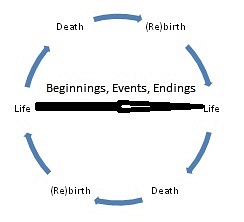
Culturally, amulets were intimately associated with the greater Egyptian religious system, which was a state system whose earliest cosmological views of nature contained a cyclical perception of life, death, and rebirth. Typically, amulets were worn as jewellery by both men and [women](https://www.worldhistory.org/disambiguation/women/) in social settings. However, they were not worn as a mere ornamental feature or simply as a sign of religious devotion. Rather, the amulet was regarded as a talisman. That is to say - metaphysically speaking - each amulet was understood to possess a precise supernatural attribute which could be imparted to those who wore them. The spiritual value of the amulet depended entirely on what specific enchantment was assigned to it and how it was employed. For example, to increase an amulet's potency, a sacrosanct 'inscription' may have been added to ascribe a certain spell. Unprovenanced specimens reveal wishes for a 'happy new year' or 'health and prosperity' and from this feature, we may deduce its owner's socio-economic needs or personal desire.
**[Ankh](https://www.worldhistory.org/Ankh/) - Symbol of Life**
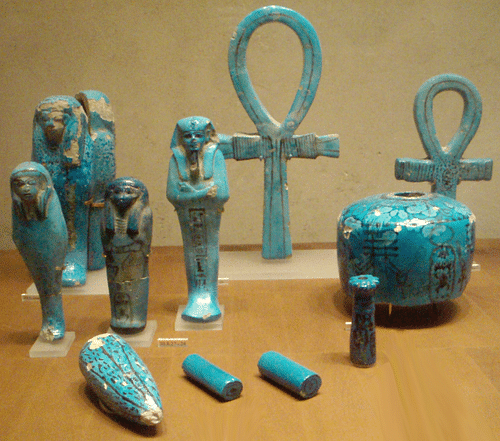
Inversely, while the selection of a particular amulet may indeed signify an aspect of an individual's identity, the amulet itself - symbolizing a commonly held concept - also denoted a larger social system of beliefs that were intra-culturally understood. Thus, one of the ways of establishing their meaning is through the 'reading' of amulets within their cultural setting. For example, amulets that were carved in the form of the **☥**, or *ankh*, were understood to impart the mystical properties of 'everlasting life'. In an abstract sense, this may be construed from the [hieroglyph](https://www.worldhistory.org/disambiguation/hieroglyph/) **☥** which is simply translated as 'life'.
While standalone amuletic ankhs are extremely rare, examples of the design can commonly be seen engraved on other amulets, such as the bull-bat cult specimen from Naga ed-Deir. Additionally, an ankh pendant has been found at el-[Amarna](https://www.worldhistory.org/Amarna/), the capital of [Akhenaten](https://www.worldhistory.org/Akhenaten/). Its discovery at Akhetaten - a [city](https://www.worldhistory.org/city/) dedicated to the dissemination of monotheism - is a small yet intriguing example of the durability of Old to [New Kingdom](https://www.worldhistory.org/disambiguation/New_Kingdom/) iconography during the turbulent [Amarna Period](https://www.worldhistory.org/Amarna_Period_of_Egypt/).
The story behind this particular design is unsettled amongst scholars. For example, it is known from [First Intermediate Period](https://www.worldhistory.org/disambiguation/First_Intermediate_Period/) (2160-2055 BCE) inhumations that some amulets had anatomical associations with the human body. Hypothetically, considering the ankh's known hieroglyphic meaning of 'life', one may infer a possible phallic origin for its lower cross-stem extension. In addition, the shape of the loop-handle has led some to propose a yonic interpretation. If this is true, a parallel with ancient Egyptian binary concepts regarding existence such as order/chaos, creation/destruction, and birth/death may be inferred. Furthermore, when considering the fact that the earliest ankhs have been contextually dated to the First Dynasty (3000-2890 BCE) - a time when according to Egyptian cosmology chaos and ruins were replaced by order and creation - an archaeological context that coincides with the historical 'birth' of ancient Egypt may be established.
Consequently, what we may be observing is a cognitive association between the Egyptian understanding of eternal life, their contemplations about creation, and their cosmological views regarding connubial relations. By extension, to the [ancient Egyptians](https://www.worldhistory.org/collection/162/the-ancient-egyptians/), the ankh may have been a microcosm of Egyptian history, beliefs, and interpersonal relations. Thus, a symbolic meaning - when found within an Egyptian household - could conceivably be interpreted as a desire for the magical impartation of a sound and happy marriage, prodigious fecundity, and/or a healthy and strong family. In each example, some aspect of biological or societal 'conception' is present (e.g. marriage, procreation). In any case, the ankh, being a unified or intersexual symbol, functions as a cultural sign for the reproductive or cyclical order of nature.
Contextually however, any definitive social interpretation would depend solely on the perception (or subjective experience) of the individual Egyptian living at the time. Thus, while we may seek to establish understandings *vis-à-vis* social conventions, we cannot conclusively interpret individual intention from the amulet alone, which should remind us of the importance of archaeological context. But even within context, meanings are occasionally murky. For example, it has been noted that the ankh is seldom found in non-royal burials. Deductively, one may infer a quality of 'restriction' or 'aristocratic exclusivity' regarding its use within Egyptian society. Conversely, perhaps natural or human made devastation to 'commoner' burials - in the form of erosion or looting - is the reason for their absence, presenting us with a much distorted picture. Nonetheless, this is only supposition and again shows us the great difficulty in establishing a precise 'meaning' which is here reflected in the incomplete, and ever evolving, archaeological record.
[  Objects from the Tomb of Thutmose IV Keith Schengili-Roberts (CC BY-SA) ](https://www.worldhistory.org/image/1217/objects-from-the-tomb-of-thutmose-iv/ "Objects from the Tomb of Thutmose IV")
**Afterlife: The Ankh Revisited**
The ritualistic burials of the ancient Egyptians represent some of the most researched areas of both [archaeology](https://www.worldhistory.org/Archaeology/) and the related field of Egyptology. Fascinatingly, the [Egyptian burial](https://www.worldhistory.org/Egyptian_Burial/) was associated with another interpretation of life. One that was linear yet just as associated with immortality: the afterlife. From an Egyptologist's point of view, the Egyptian social view of death would reflect their teleological perception of existence. However, during the [Middle Kingdom](https://www.worldhistory.org/disambiguation/Middle_Kingdom/) to Second Intermediate Periods (2055-1550 BCE) amulets are most frequently found in burials ranging from Kerma and Aniba in Lower Nubia, to Tell el-Dab'a in Lower Egypt.
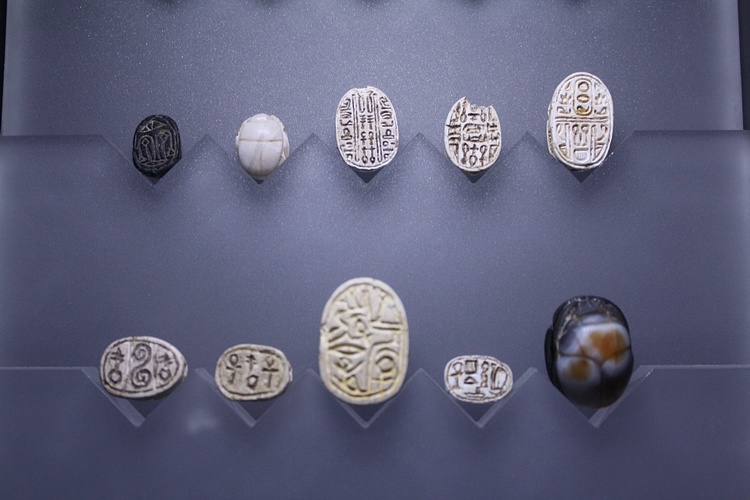
Additionally, some of the most prolific [burial](https://www.worldhistory.org/burial/) specimens are those modeled on the Scarabaeus sacer, or scarab, such as those found at el-Lisht and Tell el-Dab'a (Budge 1989: 231-34; Ben-Tor 2000: 48). While the scarab symbolizes life, its emphasis is more specifically the 'cyclicality of life' associated with the [god](https://www.worldhistory.org/God/) Kheper. Why introduce a symbol of rebirth after death? Surely this is paradoxical to the linearity of birth-life-death reflected in the burial itself? Budge suggested that this simply reflects the Egyptian belief in the daily 'revivification of the body'. However, I posit that there was a hidden meaning symbolized in the selection of these burial goods; moreover, that there was an understanding *vis-à-vis* life as experienced by the ancient Egyptians for which we are unable to offer a contemporary analogy.
[  Posited Cyclicality of Life for an Ancient Egyptian Paul Joseph De Mola after Mark Pluciennik (CC BY-SA) ](https://www.worldhistory.org/image/1193/posited-cyclicality-of-life-for-an-ancient-egyptia/ "Posited Cyclicality of Life for an Ancient Egyptian")
For example, in burial contexts, amulets are typically interpreted as a magical means of protection for the deceased's body in the afterlife. However, this implies that the laws governing the afterlife paralleled the laws of the physical or natural world. What can be said then? If considering the frequent use of the scarab in entombments, we may deduce that the spiritual afterlife may have been so closely related to natural (or physical) 'regeneration' that they were indistinguishable to the ancient Egyptian experience. Thus, it could be hypothesized that the cyclical concept of 'regeneration' - as was observed in days, [seasons](https://www.worldhistory.org/Horae/), festivals, rebirth, etc. - is inextricable from the linear narrative of birth, life, death and afterlife.
Accordingly, it may be argued that the ancient Egyptians possessed a unique metaphysical view of existence, one which amounted to a 'continuity of life' regarding reality itself. Cosmologically, death may have been viewed as a simple mechanism which allowed an individual to move to another 'place' in 'time or space', where 'life continued' unaltered and the 'nature of things' essentially remained unchanged, not unlike moving from one city to another. If this is true, then any analysis of artifacts deposited with the dead should be interpreted within the larger material [culture](https://www.worldhistory.org/disambiguation/culture/). For example, the necklace of Princess Kh-nu-met from the Lower Egyptian necropolis of Dahshur, may be a symbol of not just political authority in this life, but indicative of the hierarchal continuity regarding her 'place' in the next.
Additionally, the cultural democratization that was occurring by the Middle Kingdom suggests that these beliefs may have transcended various social strata. However, the scant burial evidence of ankhs makes thorough analysis rather difficult. Nevertheless, synthesizing the scarab's meaning as a sign of regenerating life with the somewhat inverted definition of eternal life for the ankh, a simultaneous linear/cyclical dichotomy for both signs is plainly visible. Moreover, when considered within a burial context, a dualistic contextualization of life that begins at physical birth and continues after the death of the body is evident in Egyptian society. Consequently, it may be argued that the ancient Egyptians viewed the physical death as the telos, or very purpose of existence, with the **☥** representing the promise of spiritual rebirth and of the life to come.
[  Egyptian Scarab Amulets Mark Cartwright (CC BY-NC-SA) ](https://www.worldhistory.org/image/1218/egyptian-scarab-amulets/ "Egyptian Scarab Amulets")
**Finale of Understandings**
There is no real way to 'make an end' to understanding material things. Objects, just as the people who created them, possess a reservoir of social, political, and economic depth to which the human mind cannot at any one time entirely comprehend. Nihilistic interpretations of society, such as Derrida's view that 'there is nothing outside the text', invites contradiction from ontological, epistemological, phenomenological, even theological scholars in an attempt to 'reconstruct the text', figuratively speaking. The impact such academic debate has on the meaning of material culture is difficult to measure, but for archaeologists who study [ancient societies](https://www.worldhistory.org/collection/62/ancient-societies/), it is even more pertinent to be as objective as possible when reconstructing culture from artifacts. For example, on the one hand, material culture contains a literal (or simple) meaning that is typified by its function within a society. On the other hand, the ideological and metaphysical reality of an object as it was 'known' or experienced by an individual within a culture needs to be explored.
In this essay, I have endeavoured to highlight these very points by synthesizing a wide battery of theoretical approaches to interpret material objects. To accomplish this, I have used an interdisciplinary framework focused on ancient Egyptian amulets to emphasize an archaeological approach to the understandings of objects. My goal was to show how no one interpretation is irrefutable, while no single interpretation is necessarily inaccurate. In conclusion, for archaeologists, the meanings of things are essential to our appreciation of past cultures. Wherefore, let us be flexible as we engage in the critical analysis of material remains.
#### Editorial Review
This human-authored article has been reviewed by our editorial team before publication to ensure accuracy, reliability and adherence to academic standards in accordance with our [editorial policy](https://www.worldhistory.org/static/editorial-policy/).
## Bibliography
- [The Mummy (1999) - Movie Clip: I've Got the Scarab Under My Skin!](http://www.youtube.com/watch?v=GJP8XTzpOCw "The Mummy (1999) - Movie Clip: I've Got the Scarab Under My Skin!"), accessed 1 Dec 2016.
- A.B. Knapp and W. Ashmore. *"Archaeological Landscapes: Constructed, Conceptualized, Ideational." In The Archaeology of Landscape, edited by W. Ashmore and A. B. Knapp,.* London: Routledge, 1999, 1-30.
- A.T. *Archaeological Theory.* Leicester: University of Leicester, 2011
- [Alejandro Jiménez-Serrano. *"Elephants Standing on Hills or the Oldest Name of Elephantine." In Egypt at its Origins: Studies in Memory of Barbara Adams, edited by Stan Hendrickx, R. F. Friedman, K. M. Cialowicz and M. Chlodnicki.* Leuven: Peeters Publishers, 2004, 847-858.](https://www.worldhistory.org/books/9042914696/)
- Anthony King. *"Structure and Agency." In Modern Social Theory: An Introduction. Edited by Austin Harrington.* Oxford: Oxford University Press, 2005, 215-232.
- Antonino Palumbo and Alan Scott. *"Classical Social Theory II: Karl Marx and Émile Durkheim." In Modern Social Theory: An Introduction. Edited by Austin Harrington.* Oxford: Oxford University Press, 2005, 40-62.
- [Carol Andrews. *Amulets of Ancient Egypt.* Austin: University of Texas Press, 1994.](https://www.worldhistory.org/books/029270464X/)
- [Daphna BenTor. *Scarabs, Chronology, and Interconnections.* Fribourg: Academic Press, 2007.](https://www.worldhistory.org/books/3525532040/)
- [David Harvey. *The Condition of Postmodernity.* Oxford: Wiley-Blackwell, 1989.](https://www.worldhistory.org/books/0631162941/)
- [Dimitri Meeks. *"The gods among themselves." In Daily Life of the Egyptian Gods, by Dimitri Meeks and Christine Favard-Meeks. Translated by G.M. Goshgarian.* Ithaca: Cornell University Press, 1996, 13-110.](https://www.worldhistory.org/books/0801482488/)
- [E. A. Wallis Budge. *Amulets and Superstitions.* Oxford: Oxford University Press, 1930.](https://www.worldhistory.org/books/0486235734/)
- [E.A. Wallis Budge. *The Mummy: A History of the Extraordinary Practices of Ancient Egypt.* New York: Random House, 1989.](https://www.worldhistory.org/books/0517675803/)
- Ethel Deane. *The Collector: Containing Articles and Illustrations. Reprinted From The Queen Newspaper, of Interest to the Great Body of Collectors on China, Engravings, Needlework, Pictures and Embroidery, Egyptian and Grecian Antiquities.* London: Horace Cox, 1903
- [Gae Callender. *"The Middle Kingdom Renaissance (c.2055-1650 BC)." In The Oxford History of Ancient Egypt. Edited by Ian Shaw.* Oxford: Oxford University Press, 2000, 148-183.](https://www.worldhistory.org/books/B006QU2PW4/)
- [Geraldine Pinch. *Egyptian Mythology.* Oxford: Oxford University Press, 2002.](https://www.worldhistory.org/books/0195170245/)
- [Ian Shaw. *The Oxford History of Ancient Egypt.* Oxford: Oxford University Press, 2000.](https://www.worldhistory.org/books/B006QU2PW4/)
- [Jacobus Van Djik. *"The Amarna Period and the Later New Kingdom." In The Oxford History of Ancient History. Edited by Ian Shaw.* Oxford: Oxford University Press, 2000, 272-313.](https://www.worldhistory.org/books/B008IU1UH6/)
- [James P. Allen. *Middle Egyptian.* Cambridge: Cambridge University Press, 2010.](https://www.worldhistory.org/books/0521741440/)
- [John H. Taylor. *Death and the Afterlife in Ancient Egypt.* Chicago: University Of Chicago Press, 2001.](https://www.worldhistory.org/books/0226791645/)
- [Kathryn A. Bard. *Encyclopedia of the Archaeology of Ancient Egypt.* London: Routledge, 1999.](https://www.worldhistory.org/books/0415185890/)
- Mark Pluciennik. "Is Narrative Necessary?." *Archäologe als Erzähler. Ethnographisch-Archäologische Zeitschrift,*, 51, pp. 1-15.
- [Matthew Johnson. *Archaeological Theory.* Hoboken: Wiley-Blackwell, 2010.](https://www.worldhistory.org/books/140510015X/)
- [Molefi K. Asante and A. Mazama. *Encyclopedia of African Religion.* Thousand Oaks: SAGE Publications, Inc, 2009.](https://www.worldhistory.org/books/1412936365/)
- Pat Remler. *Egyptian Mythology A to Z.* New York: Chelsea House, 2000
- [Paul Sheehy. *The Reality of Social Groups.* Farnham: Ashgate Pub Co., 2006.](https://www.worldhistory.org/books/075465348X/)
- [Robert A. Armour. *Gods and Myths of Ancient Egypt.* Cairo: The American University in Cairo Press, 1986.](https://www.worldhistory.org/books/9774246691/)
- Samantha Ashenden. *Structuralism and Post-Structuralism." In Modern Social Theory: An Introduction. Edited by Austin Harrington.* Oxford: Oxford University Press, 2005, 196-214.
- [Timothy Darvill. *Concise Oxford Dictionary of Archaeology.* Oxford: Oxford University Press, 2008.](https://www.worldhistory.org/books/0199534047/)
- [Toby A.H. Wilkinson. *Early Dynastic Egypt.* London: Routledge, 1999.](https://www.worldhistory.org/books/0415186331/)
## Cite This Work
### APA
DeMola, P. (2013, May 15). The Egyptian Amulet: Pious Symbols of Spiritual Life. *World History Encyclopedia*.
### Chicago
DeMola, P.. "The Egyptian Amulet: Pious Symbols of Spiritual Life." *World History Encyclopedia*, May 15, 2013. .
### MLA
DeMola, P.. "The Egyptian Amulet: Pious Symbols of Spiritual Life." *World History Encyclopedia*, 15 May 2013, .
## License & Copyright
Submitted by [P. DeMola](https://www.worldhistory.org/user/saintpaul/ "User Page: P. DeMola"), published on 15 May 2013. The copyright holder has published this content under the following license: [Creative Commons Attribution-NonCommercial-ShareAlike](https://creativecommons.org/licenses/by-nc-sa/4.0/deed.en). This license lets others remix, tweak, and build upon this content non-commercially, as long as they credit the author and license their new creations under the identical terms. When republishing on the web a hyperlink back to the original content source URL must be included. Please note that content linked from this page may have different licensing terms.