---
title: A Visual Glossary of Greek Pottery
author: Mark Cartwright
source: https://www.worldhistory.org/article/489/a-visual-glossary-of-greek-pottery/
format: machine-readable-alternate
license: Creative Commons Attribution-NonCommercial-ShareAlike (https://creativecommons.org/licenses/by-nc-sa/4.0/)
updated: 1970-01-01
---
# A Visual Glossary of Greek Pottery
_Authored by [Mark Cartwright](https://www.worldhistory.org/user/markzcartwright/)_
[  Corinthian Alabastron Vase Mary Harrsch (Photographed at the Getty Villa, Malibu) (CC BY-NC-SA) ](https://www.worldhistory.org/image/1205/corinthian-alabastron-vase/ "Corinthian Alabastron Vase")**Alabastron** (*pl.* alabastra) - a small jar for storing perfumes, named after the material (alabaster) the first examples were made from. They were often carried by a string looped around the neck of the vessel.
[  Greek Foot Race Mark Cartwright (CC BY-NC-SA) ](https://www.worldhistory.org/image/448/greek-foot-race/ "Greek Foot Race")**[Amphora](https://www.worldhistory.org/Amphora/)** (*pl.* [amphorae](https://www.worldhistory.org/Amphora/)) - one of the most common forms in [Greek pottery](https://www.worldhistory.org/Greek_Pottery/), various shapes, always with two vertical neck-handles and used for storing and transporting oil, wine and foodstuffs such as olives. Often with a lid but these have rarely survived.
[ 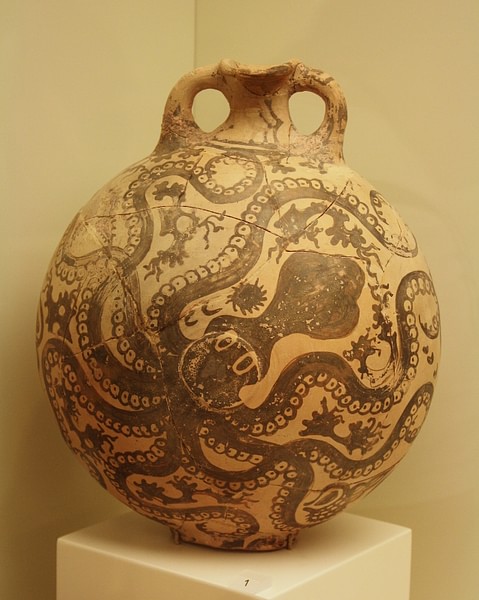 Minoan Vase in Marine Style Mark Cartwright (CC BY-NC-SA) ](https://www.worldhistory.org/image/367/minoan-vase-in-marine-style/ "Minoan Vase in Marine Style")**Askos** (*pl.* askoi) - named after the wineskin which it resembles in shape. The small neck implies they were used for pouring liquids in a small quantity, e.g.: fine oil, honey and vinegar.
**Astragalos** (*pl.* astragaloi) - a vessel shaped like a knucklebone from which it takes its name and which may have been used to store sheep knucklebones which were used as gaming pieces or dice.
**Barbotine Ware** - a style of [pottery](https://www.worldhistory.org/pottery/) with decorative excrescenses.
**Bell-Krater -** a particular form of the krater vessel with a body shaped like an upside down bell, the handles are placed high on the vessel and the foot is stepped.
[ 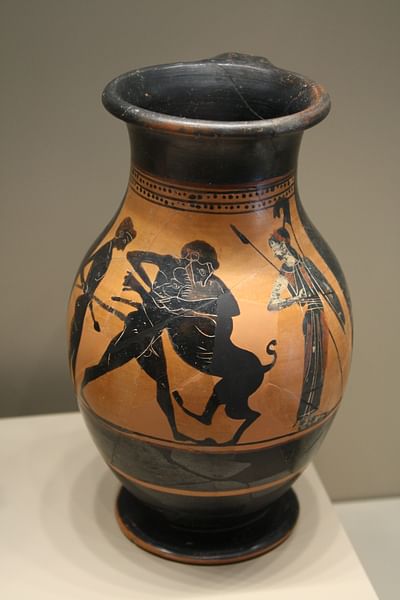 Hercules & The Nemean Lion Mark Cartwright (CC BY-NC-SA) ](https://www.worldhistory.org/image/622/hercules--the-nemean-lion/ "Hercules & The Nemean Lion")**Black-Figure Style Decoration** (c. 620 - c.530 BCE) Invented in [Corinth](https://www.worldhistory.org/corinth/), the style was adopted in Attica to become the dominant style in [Greek](https://www.worldhistory.org/disambiguation/greek/) pottery. Figures were painted in black silhouette with details such as muscles and hair incised using a sharp instrument.
[ 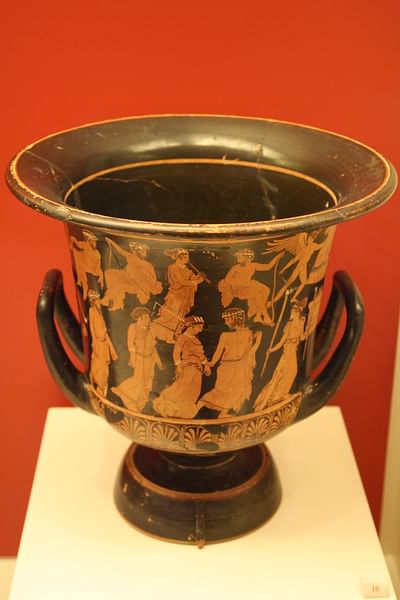 Calyx Krater Mark Cartwright (CC BY-NC-SA) ](https://www.worldhistory.org/image/3751/calyx-krater/ "Calyx Krater")**Calyx Krater** - a krater with a body shaped like a flower calyx, usually with a stepped foot.
[  Attic Column-Krater Peter Roan (CC BY-NC-SA) ](https://www.worldhistory.org/image/1207/attic-column-krater/ "Attic Column-Krater")**[Column](https://www.worldhistory.org/column/)-Krater** - a type of krater (wine and water mixer) popular in the black-figure style with each handle supported by a short vertical 'column'.
**Dinos** (*pl.* dinoi) - a large round-bottomed bowl with no handles and used for mixing wine with water. Usually placed on a ceramic stand or [metal](https://www.worldhistory.org/disambiguation/metal/) tripod.
[ 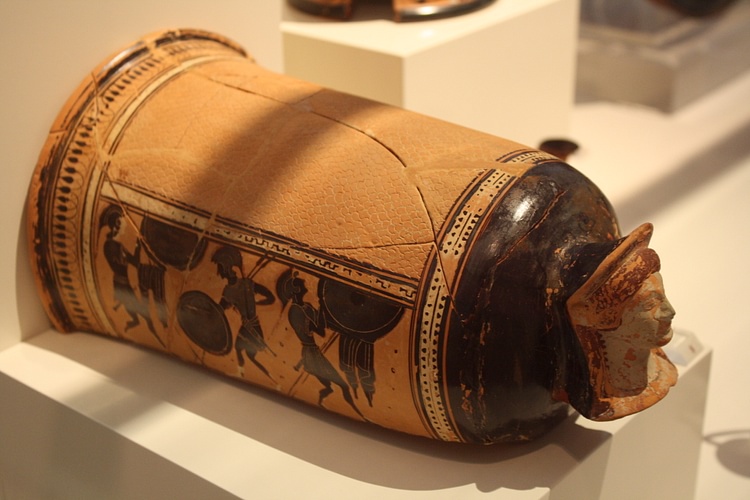 Epinetron Mark Cartwright (CC BY-NC-SA) ](https://www.worldhistory.org/image/3486/epinetron/ "Epinetron")**Epinetron** (*pl.* epinetra) - a half-cyclinder worn over the thigh with the closed end over the knee, used for preparing wool for weaving. The upper surface was often incised to make a rough surface against which the wool fibres could be rubbed. Often with a female head at the closed end.
[ 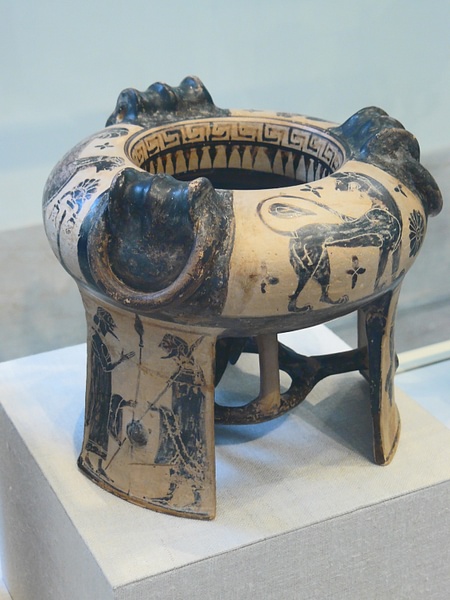 Boeotian Exaleiptron Mary Harrsch (Photographed at the Metropolitan Museum of Art) (CC BY-NC-SA) ](https://www.worldhistory.org/image/1227/boeotian-exaleiptron/ "Boeotian Exaleiptron")**Exaleiptron** (*pl.* exaleiptra) - a vessel used to store fine oil or perfume with an inverted lip to prevent spillage and usually lidded. Pottery decoration show them in a context of [women](https://www.worldhistory.org/disambiguation/women/) bathing or during funerary rites. Also known as a kothon.
[ 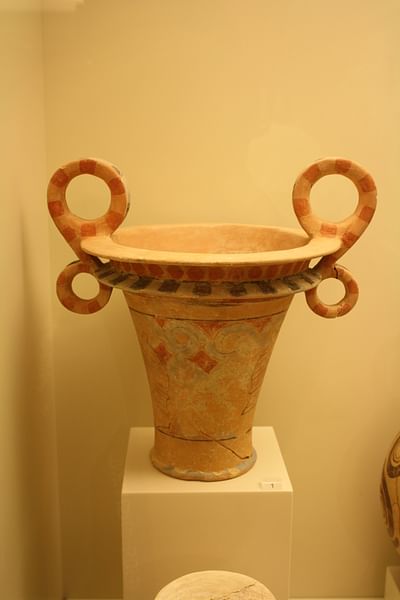 Minoan Vase Mark Cartwright (CC BY-NC-SA) ](https://www.worldhistory.org/image/682/minoan-vase/ "Minoan Vase")**Figure-of-eight Vase** - named after the distinctive handle shape, from the [Minoan civilization](https://www.worldhistory.org/Minoan_Civilization/).
**Fish Plate** - a flat dish with a short foot used for serving fish and seafood. A central depression collected excess oil. Produced from the 4th century BCE they were popular in Attica and [Magna Graecia](https://www.worldhistory.org/Magna_Graecia/). Usually decorated with fish and sealife, fish on Attic dishes were almost always painted with their undersides towards the outer edge whilst those from southern [Italy](https://www.worldhistory.org/italy/) had their undersides towards the centre of the plate.
[  Minoan Jug in Floral Style Mark Cartwright (CC BY-NC-SA) ](https://www.worldhistory.org/image/371/minoan-jug-in-floral-style/ "Minoan Jug in Floral Style")**Floral Style Decoration** - a decorative style from [Minoan](https://www.worldhistory.org/disambiguation/Minoan/) [Crete](https://www.worldhistory.org/crete/) using plant and flower motifs (c. 1600 - 1450 BCE).
[  Geometric Pottery Designs Mark Cartwright (CC BY-NC-SA) ](https://www.worldhistory.org/image/1370/geometric-pottery-designs/ "Geometric Pottery Designs")**Geometric Style Decoration** - the use of simple shapes and lines, later with stylized figures of animals and humans (900-600 BCE).
**Graffito** (*pl.* graffiti) - A [mark](https://www.worldhistory.org/disambiguation/Mark/) incised into the vase (usually under the foot), most commonly letters or numbers but sometimes also words and short phrases. They may indicate prices, trademarks or ownership. Similar marks, but painted, are called *dipinto*.
[  Red-figure Hydria Mark Cartwright (CC BY-NC-SA) ](https://www.worldhistory.org/image/3753/red-figure-hydria/ "Red-figure Hydria")**Hydria** (*pl.* hydriai) - used principally to store water and one of the commonest shapes in Greek pottery. Two horizontal handles were for carrying the vessel when full and one vertical handle used when pouring. They could also be used as a [burial](https://www.worldhistory.org/burial/) container for children. They were also often made in [bronze](https://www.worldhistory.org/disambiguation/bronze/) versions.
[ 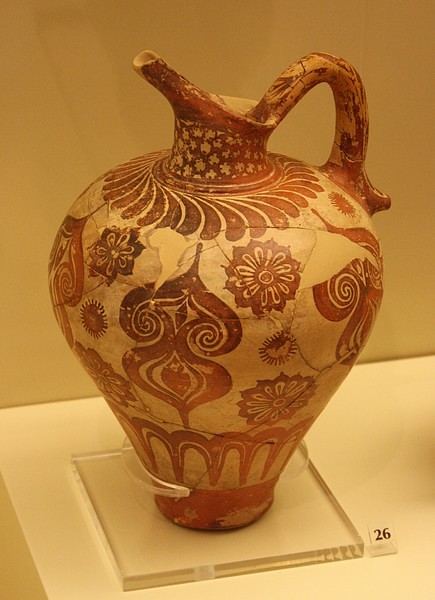 Mycenaean Jug Mark Cartwright (CC BY-NC-SA) ](https://www.worldhistory.org/image/459/mycenaean-jug/ "Mycenaean Jug")**Jug** - with a spout and single handle, used for pouring liquids.
[  Kamares Ware Pottery Ori Keren (CC BY-NC-SA) ](https://www.worldhistory.org/image/1357/kamares-ware-pottery/ "Kamares Ware Pottery")**Kamares Style** **Decoration** - a polychrome decorative style from the Minoan [civilization](https://www.worldhistory.org/civilization/) using bold designs in red or white on a black background (c. 2000 - c. 1700 BCE).
[  Black-figure Kantharos Egisto Sani (used with permission) (Copyright) ](https://www.worldhistory.org/image/1153/black-figure-kantharos/ "Black-figure Kantharos")**Kantharos** (*pl.* kantharoi) - a cup with two large vertical handles and a stemmed foot.
[ 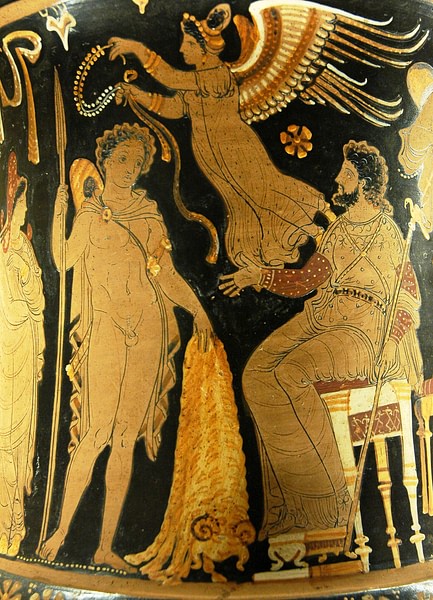 Jason Brings Pelias the Golden Fleece Marie-Lan Nguyen (CC BY-SA) ](https://www.worldhistory.org/image/780/jason-brings-pelias-the-golden-fleece/ "Jason Brings Pelias the Golden Fleece")**Kerch Style Decoration** - named after the palce where many examples have been found they are decorated with distinctive gilded details in low relief. Originally form [Athens](https://www.worldhistory.org/Athens/).
[ 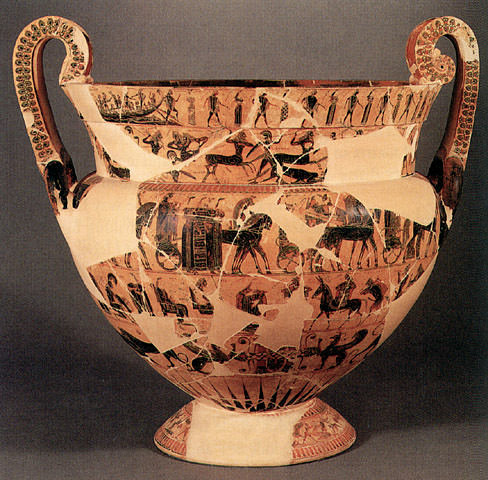 François Vase Fiona Willis (CC BY) ](https://www.worldhistory.org/image/995/francois-vase/ "François Vase")**Krater** (*pl.* krateres) - a large vessel with two handles, used to mix water and wine, usually to a ratio of 3:1 or 5:3.
[ 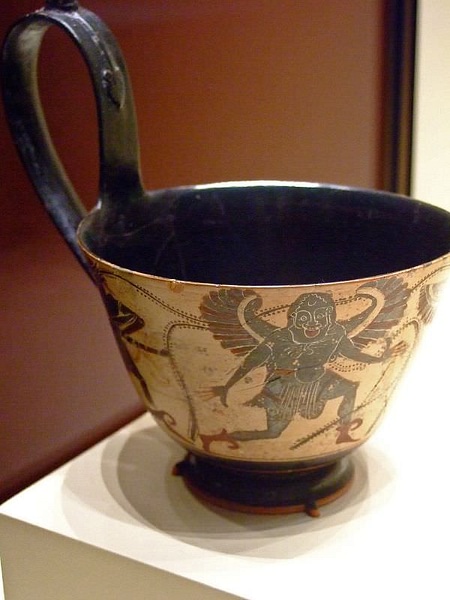 Attic Kyathos Mary Harrsch (Photographed at the Getty Villa, Malibu) (CC BY-NC-SA) ](https://www.worldhistory.org/image/1223/attic-kyathos/ "Attic Kyathos")**Kyathos** (*pl.* kyathoi) - a ladle-like cup used for serving wine.
[ 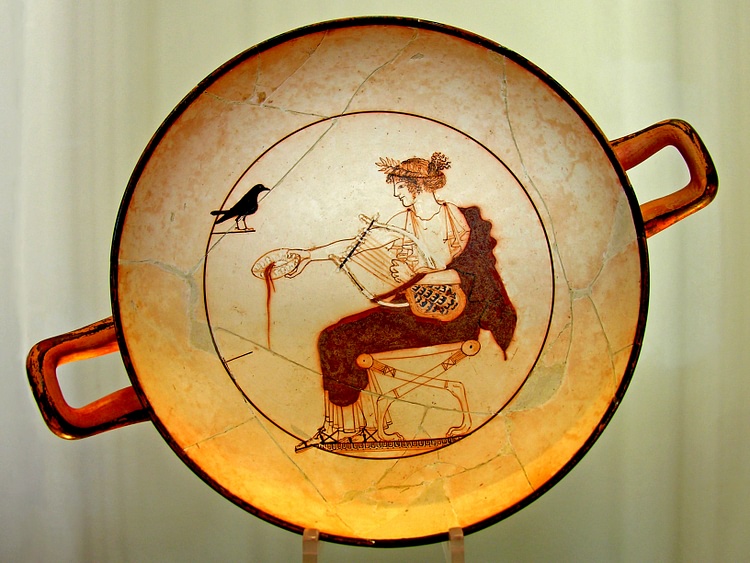 Apollo with Lyre Dennis Jarvis (CC BY-SA) ](https://www.worldhistory.org/image/986/apollo-with-lyre/ "Apollo with Lyre")**Kylix** (*pl.* kylikes)- a stemmed cup with two horizontal handles and a stemmed foot, used for drinking wine. One of the most common shapes in Greek pottery, over 30 varieties exist.
[ 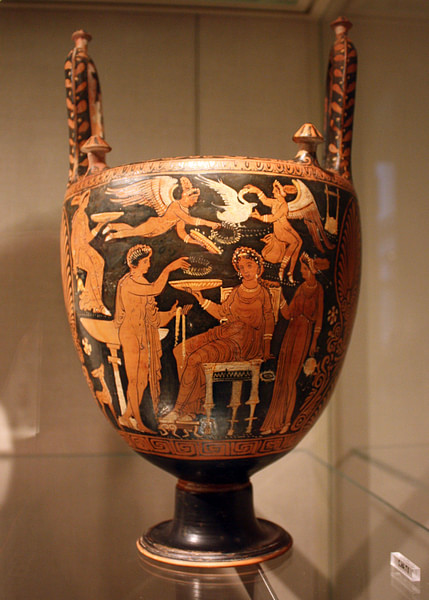 Lebes Gamikos Peter Roan (CC BY-NC-SA) ](https://www.worldhistory.org/image/1232/lebes-gamikos/ "Lebes Gamikos")**Lebes Gamikos** (*pl.* lebetes gamikoi) - a large vase with two upright handles often with a conical stand and lid. Used during marriage and burial ceremonies.
[ 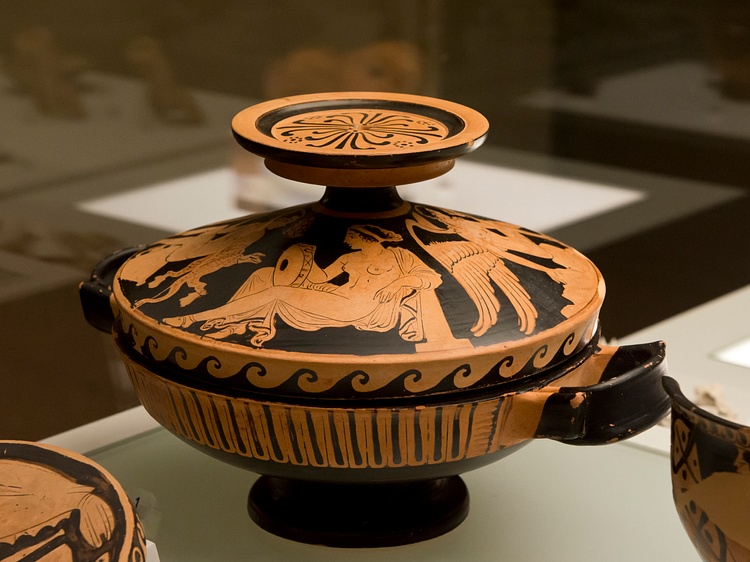 Attic Lekanis Egisto Sani (Copyright) ](https://www.worldhistory.org/image/1228/attic-lekanis/ "Attic Lekanis")**Lekanis** (*pl.* lekanides) - a shallow vessel with a foot and two horizontal handles and often with a single handled lid. The dish was used for storage of small articles (especially for women) and for serving food (when the lid, overturned, became a second serving dish).
[ 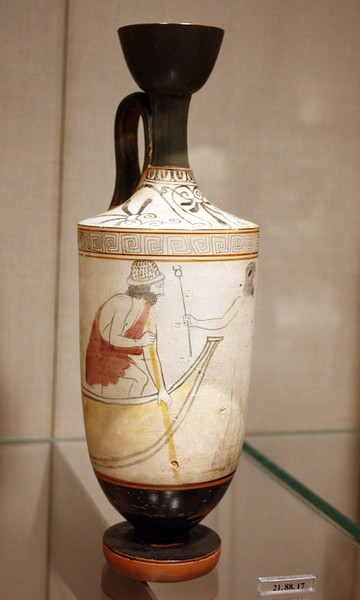 Attic Lekythos Peter Roan (CC BY-NC) ](https://www.worldhistory.org/image/1120/attic-lekythos/ "Attic Lekythos")**Lekythos** (*pl.* lekythoi)- used to store fine oils and perfumes, often dedicated in burials and decorated in reference to this function, often with a white background.
**Louterion** (*pl.* louteria) - a large basin vessel with two handles and sometimes a spouted lip. Used for holding water for washing or perhaps mixing wine and water. A third function may have been connected with funerary rites such as washing the body.
[ 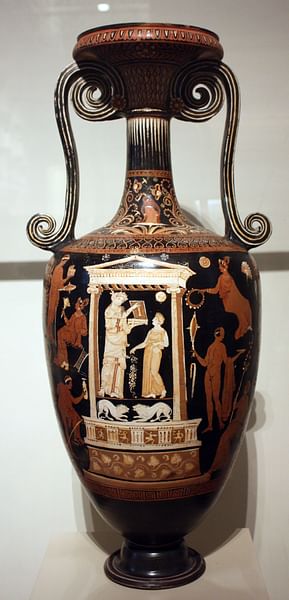 Apulian Loutrophoros Peter Roan (CC BY-NC-SA) ](https://www.worldhistory.org/image/1234/apulian-loutrophoros/ "Apulian Loutrophoros")**Loutrophoros** (*pl.* loutrophoroi) - a tall slim jar with elongated handles, used for holding water used in wedding and funeral rites and as a [grave](https://www.worldhistory.org/burial/) marker, especially when the deceased was unmarried.
**Marine Style Decoration** - found in Minoan and [Mycenaean pottery](https://www.worldhistory.org/article/455/mycenaean-pottery/) with the depiction of sea-life, particularly octupuses, argonauts and shellfish (from c. 1600 BCE) .
[ 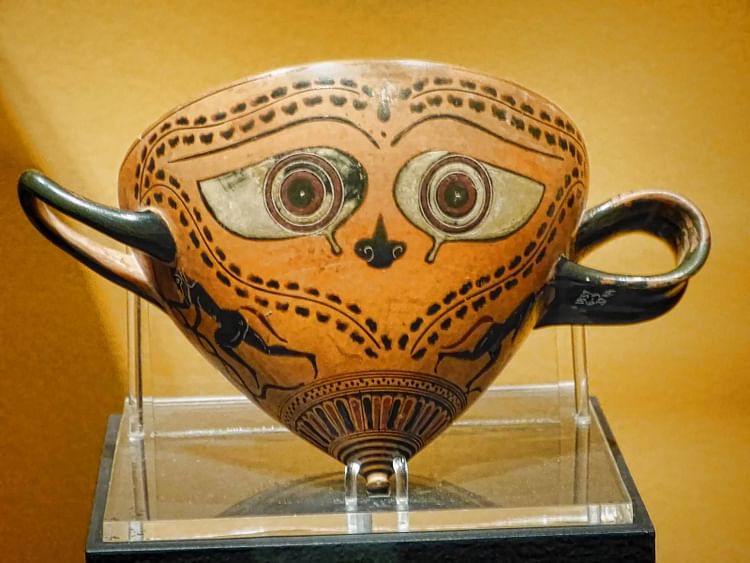 Etrurian Mastos Mary Harrsch (Photographed at the Portlan Art Museum) (CC BY-NC-SA) ](https://www.worldhistory.org/image/1222/etrurian-mastos/ "Etrurian Mastos")**Mastos** (*pl.* mastoi) - a wine cup shaped like a female breast with a nipple at the base instead of a foot.
**Neck-Amphora** - an amphora where the neck joins the shoulder of the vessel at a sharp angle.
**New [Palace](https://www.worldhistory.org/disambiguation/palace/) Style Decoration** - the late Minoan decorative style using more stylisitc representations of plants and marine life (from 1450 BCE).
[ 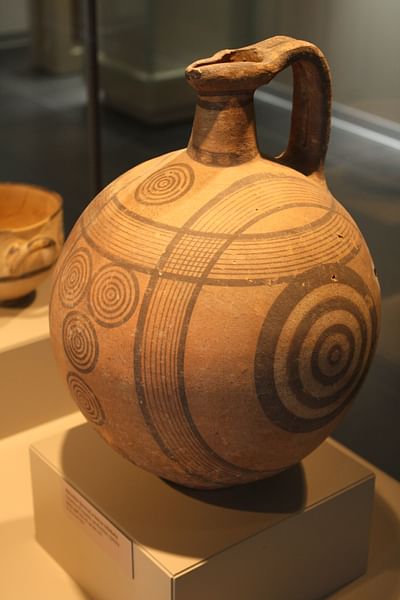 Cypriot Pitcher Mark Cartwright (CC BY-NC-SA) ](https://www.worldhistory.org/image/627/cypriot-pitcher/ "Cypriot Pitcher")**Oinochoe** (*pl.* oinochoai) - jug or pitcher for pouring liquids, principally wine.
[ 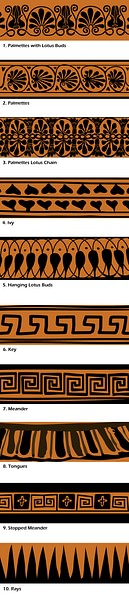 Greek Pottery Ornaments Ori Keren (CC BY-NC-SA) ](https://www.worldhistory.org/image/1348/greek-pottery-ornaments/ "Greek Pottery Ornaments")**Ornament** - decorative patterns and floral designs added to the foot, rim, handles and borders of vessels. Lotus, palmettes, ivy, meander, rays, tongues and rosettes were the most popular.
[ 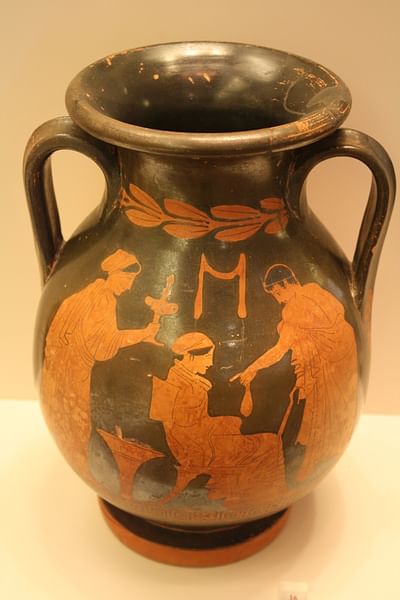 Red-figure Pelike Mark Cartwright (CC BY-NC-SA) ](https://www.worldhistory.org/image/3752/red-figure-pelike/ "Red-figure Pelike")**Pelike** (*pl.* pelikai) - a jar used for storing liquids such as oils and wines. Also used to contain ashes after cremation.
[  Nike Mark Cartwright (CC BY-NC-SA) ](https://www.worldhistory.org/image/639/nike/ "Nike")**Phiale** (*pl.* phialai) - a shallow bowl used for wine and pouring libations in religious ceremonies. Often with an upraised knob in the centre which gives the vessel its name - *omphalos* (naval).
**Pinax** (*pl.* pinakes) - a decorative plaque affixed to walls in tombs and temples.
[  Pithoi Mark Cartwright (CC BY-NC-SA) ](https://www.worldhistory.org/image/363/pithoi/ "Pithoi")**Pithos** (*pl.* pithoi) - from the Minoan civilization, a large jar for the storage of foodstuffs such as grain and olives. Large magazines of pithoi are a typical feature of Minoan palace complexes.
[ 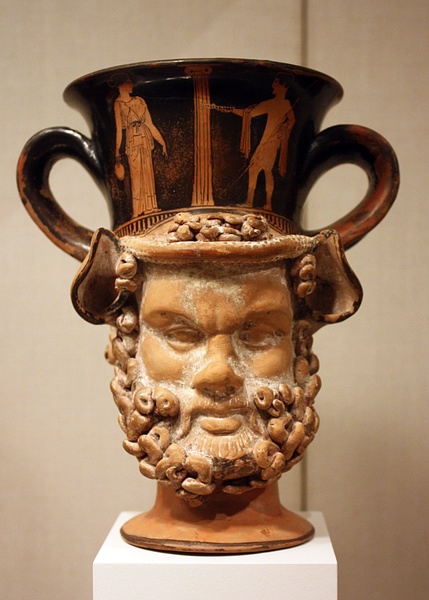 Satyr Kantharos Peter Roan (CC BY-NC-SA) ](https://www.worldhistory.org/image/1231/satyr-kantharos/ "Satyr Kantharos")**Plastic Vase** - A vase which incorporates a small [sculpture](https://www.worldhistory.org/disambiguation/Sculpture/) as part of the vessel.
[  Maenad, Red-Figure Cup Mark Cartwright (CC BY-NC-SA) ](https://www.worldhistory.org/image/642/maenad-red-figure-cup/ "Maenad, Red-Figure Cup")**Plate** - a circular flat dish with a raised rim.
**Proto-Geometric Style Decoration** - with simple shapes such as spirals and solid black lines, a pre-cursor of the more ambitious Geometric Style (c. 1000 - 900 BCE).
[  Corinthian Vessel with Protome Mary Harrsch (Photographed at the Getty Villa, Malibu) (CC BY-NC-SA) ](https://www.worldhistory.org/image/1229/corinthian-vessel-with-protome/ "Corinthian Vessel with Protome")**Protome** (*pl.* protomai or protomes) - three dimensional moulds added to vessels, especially handles. Often in the form of animals or the human upper body.
[ 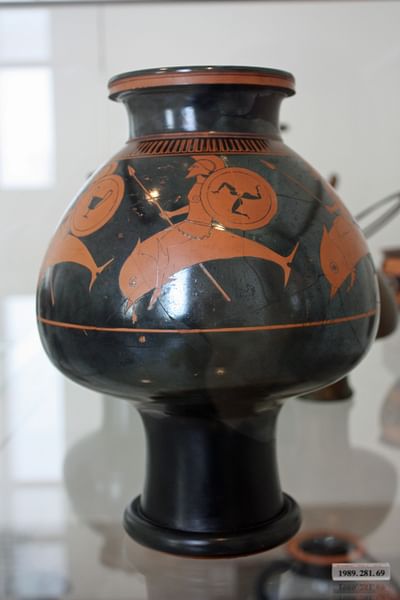 Attic Psykter Peter Roan (CC BY-NC-SA) ](https://www.worldhistory.org/image/1221/attic-psykter/ "Attic Psykter")**Psykter** (*pl.* psykters or psykteres) - a large vase shaped like a mushroom and used to cool wine. They could be placed within a krater or stand alone.
[  Attic Pyxis Peter Roan (CC BY-NC-SA) ](https://www.worldhistory.org/image/1230/attic-pyxis/ "Attic Pyxis")**Pyxis** (*pl.* pyxides) - a small circular box with a lid, often used for the storage of jewellery and toileteries.
[  Greek Erotic Scene Mark Cartwright (CC BY-NC-SA) ](https://www.worldhistory.org/image/640/greek-erotic-scene/ "Greek Erotic Scene")**Red-Figure Style Decoration** (from c. 530 BCE) Replacing the earlier black-figure style, vessels were painted black to leave unpainted figures the red colour of the original clay. Details were then added to the figures using a fine brush. Much greater attempts were made at realism and perspective in this style.
[ 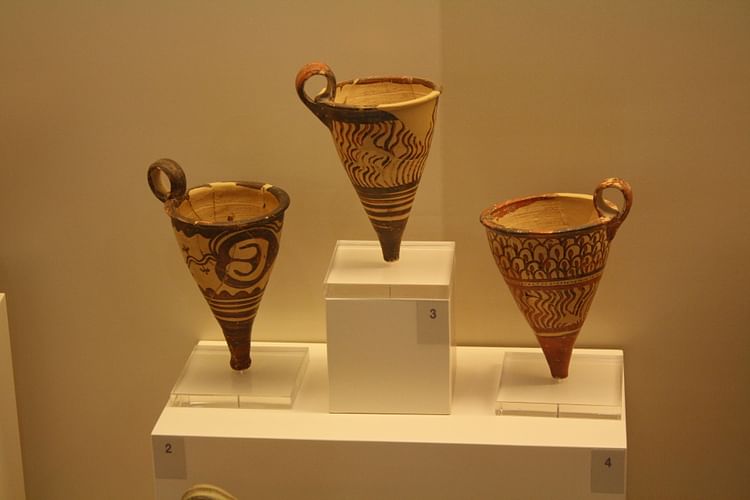 Mycenaean Rhyta Mark Cartwright (CC BY-NC-SA) ](https://www.worldhistory.org/image/480/mycenaean-rhyta/ "Mycenaean Rhyta")**Rhyton** (*pl.* rhyta) - used in relgious practices for the pouring of libations, they may also take the shape of animal heads, especially bulls.
[  Greek Athlete With Strigil Mark Cartwright (CC BY-NC-SA) ](https://www.worldhistory.org/image/641/greek-athlete-with-strigil/ "Greek Athlete With Strigil")**Skyphos** (*pl.* skyphoi) - deep cup or bowl with two handles near the rim.
[ 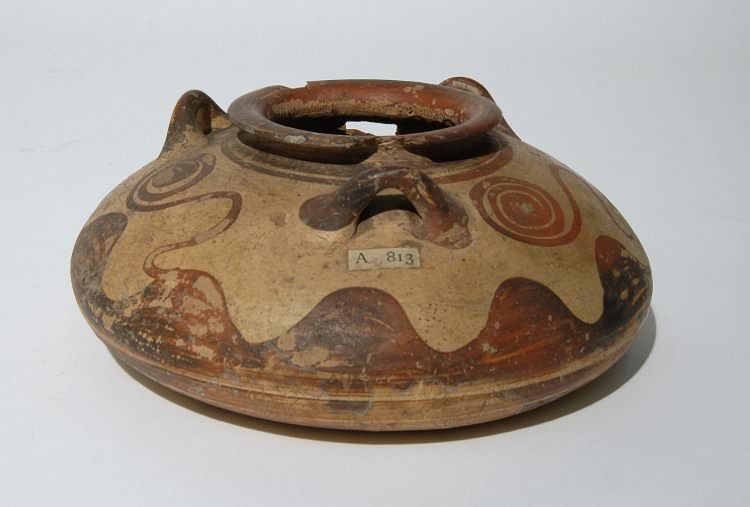 Squat Alabastron Jar Trustees of the British Museum (Copyright) ](https://www.worldhistory.org/image/1122/squat-alabastron-jar/ "Squat Alabastron Jar")**Squat Alabastron** - a flat jar for storing creams and ungents, first appearing in Minoan Crete and popular in the [Mycenaean period](https://www.worldhistory.org/Mycenaean_Civilization/). Early examples were made from alabaster, hence the name.
**Stamnos** (*pl.* stamnoi) - a jar with a wide mouth, often with a lid and two handles, used for mixing wine and water.
[ 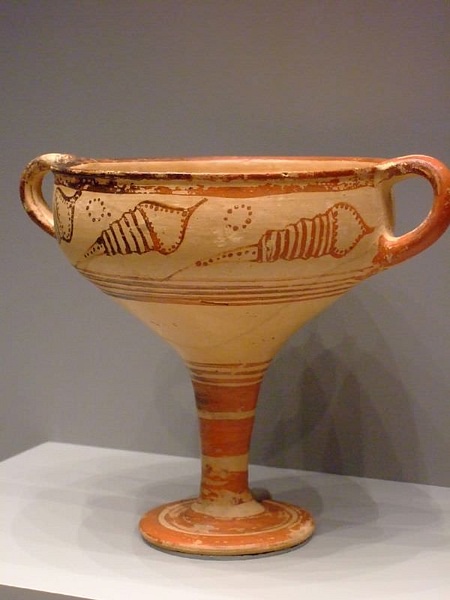 Mycenaean Stemmed Cup Mary Harrsch (Photographed at the Getty Villa, Malibu) (CC BY-NC-SA) ](https://www.worldhistory.org/image/910/mycenaean-stemmed-cup/ "Mycenaean Stemmed Cup")**Stemmed Cup -** a drinking cup with two handles, a stem and base. Popular in the [Mycenaean civilization](https://www.worldhistory.org/Mycenaean_Civilization/), they would later develop into the unbiquitous kylix.
[ 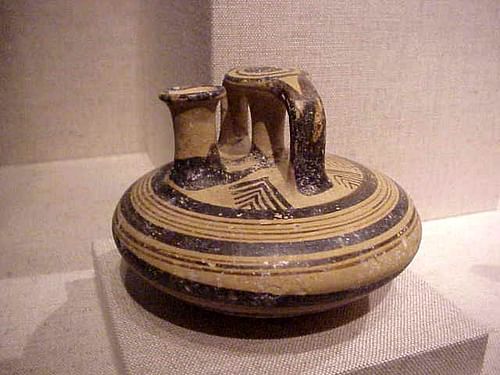 Mycenaean Stirrup Jar Mary Harrsch (Photographed at The Walters Art Museum, Baltimore) (CC BY-NC-SA) ](https://www.worldhistory.org/image/911/mycenaean-stirrup-jar/ "Mycenaean Stirrup Jar")**Stirrup Jar** - first appearing on Minoan Crete but the most common shape in [Mycenaean](https://www.worldhistory.org/Mycenaean_Civilization/) pottery, with a false central spout, used to store wine and oils.
[ 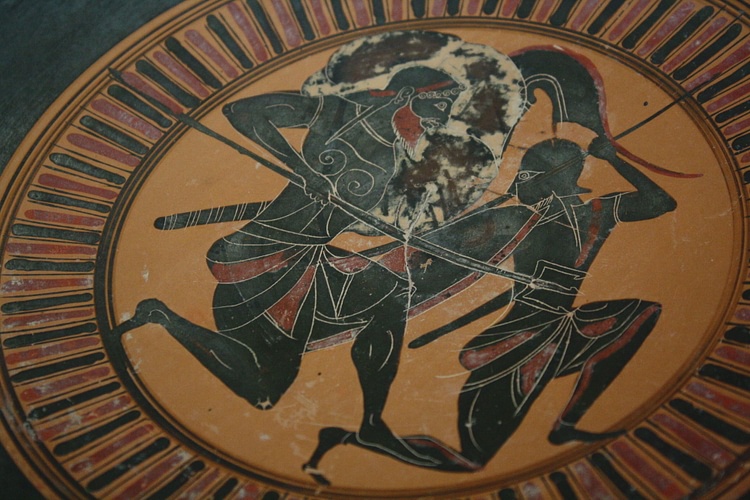 Black-Figure Tondo Mark Cartwright (CC BY-NC-SA) ](https://www.worldhistory.org/image/1356/black-figure-tondo/ "Black-Figure Tondo")**Tondo** (*pl.* tondi) - the picture enclosed in a circle found on the inside of a kylix or plate.
[ 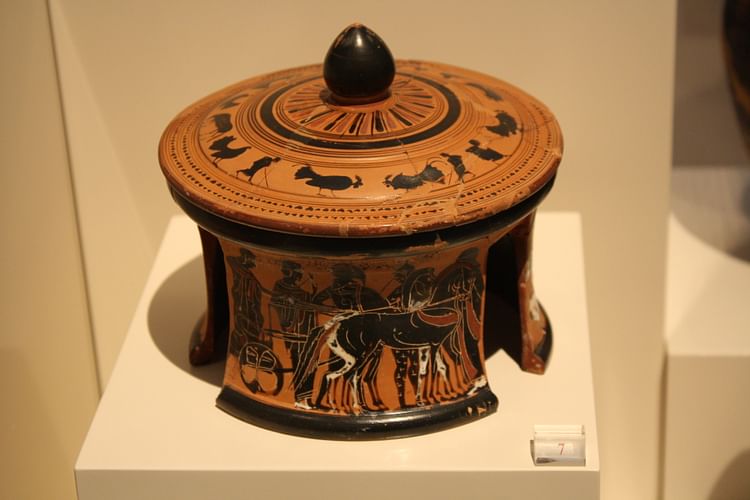 Tripod Pyxis Mark Cartwright (CC BY-NC-SA) ](https://www.worldhistory.org/image/3534/tripod-pyxis/ "Tripod Pyxis")**Tripod Pyxis** (*pl.* pyxides) - A pyxis with three concave legs, also called a *tripod-kothon*.
**Vasiliki Style Decoration** - the first distinctive Minoan style of pottery decoration using mottled red and black colours (c. 2600-2000 BCE). Named after the site where the first examples were excavated.
[ 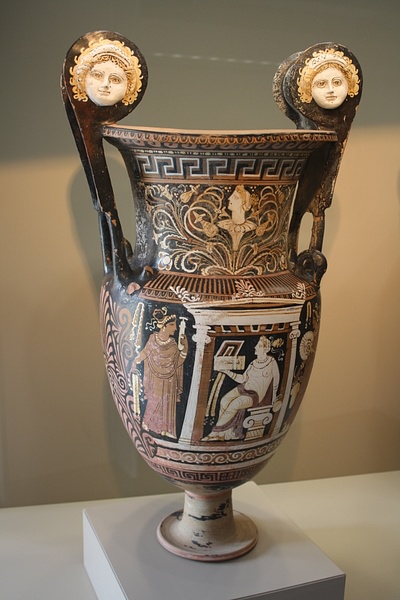 Greek Volute Krater Mark Cartwright (CC BY-NC-SA) ](https://www.worldhistory.org/image/626/greek-volute-krater/ "Greek Volute Krater")**Volute-Krater** - a krater where the tops of the handles have a volute or scroll. More commonly decorated in the red-figure style.
#### Editorial Review
This human-authored article has been reviewed by our editorial team before publication to ensure accuracy, reliability and adherence to academic standards in accordance with our [editorial policy](https://www.worldhistory.org/static/editorial-policy/).
## Bibliography
- [Boardman, J. *Athenian Black Figure Vases.* Thames & Hudson, 1985.](https://www.worldhistory.org/books/0500201382/)
- [Boardman, J. *Athenian Red Figure Vases.* Thames & Hudson, 1985.](https://www.worldhistory.org/books/0500201439/)
- [Boardman, J. *Early Greek Vase Painting, 11th-6th Centuries BC.* Thames & Hudson, 1998.](https://www.worldhistory.org/books/0500203091/)
- [Clark, A. *Understanding Greek Vases.* J. Paul Getty Museum, 2002.](https://www.worldhistory.org/books/0892365994/)
- [Higgins, R. *Minoan and Mycenaean Art.* Thames & Hudson, 1997.](https://www.worldhistory.org/books/0500203032/)
- Lane, A. *Greek Pottery.* Faber & Faber, London, 1956
## About the Author
Mark is WHE’s Publishing Director and has an MA in Political Philosophy (University of York). He is a full-time researcher, writer, historian and editor. Special interests include art, architecture and discovering the ideas that all civilizations share.
## Cite This Work
### APA
Cartwright, M. (2013, May 24). A Visual Glossary of Greek Pottery. *World History Encyclopedia*.
### Chicago
Cartwright, Mark. "A Visual Glossary of Greek Pottery." *World History Encyclopedia*, May 24, 2013. .
### MLA
Cartwright, Mark. "A Visual Glossary of Greek Pottery." *World History Encyclopedia*, 24 May 2013, .
## License & Copyright
Submitted by [Mark Cartwright](https://www.worldhistory.org/user/markzcartwright/ "User Page: Mark Cartwright"), published on 24 May 2013. The copyright holder has published this content under the following license: [Creative Commons Attribution-NonCommercial-ShareAlike](https://creativecommons.org/licenses/by-nc-sa/4.0/deed.en). This license lets others remix, tweak, and build upon this content non-commercially, as long as they credit the author and license their new creations under the identical terms. When republishing on the web a hyperlink back to the original content source URL must be included. Please note that content linked from this page may have different licensing terms.