---
title: A Visual Glossary of Classical Architecture
author: Mark Cartwright
source: https://www.worldhistory.org/article/486/a-visual-glossary-of-classical-architecture/
format: machine-readable-alternate
license: Creative Commons Attribution-NonCommercial-ShareAlike (https://creativecommons.org/licenses/by-nc-sa/4.0/)
updated: 1970-01-01
---
# A Visual Glossary of Classical Architecture
_Authored by [Mark Cartwright](https://www.worldhistory.org/user/markzcartwright/)_
[  Architectural Elements of the Parthenon F.Banister (Public Domain) ](https://www.worldhistory.org/image/945/architectural-elements-of-the-parthenon/ "Architectural Elements of the Parthenon")**Abacus** - a large slab placed above the [column](https://www.worldhistory.org/column/) capital to support the architrave or an arch placed above it.
[ 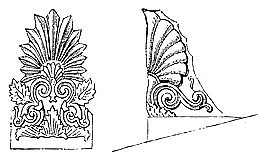 Akroterion ECeDee (CC BY-SA) ](https://www.worldhistory.org/image/1097/akroterion/ "Akroterion")**Akroterion** - a decorative piece added to the roof of a [temple](https://www.worldhistory.org/temple/) at the apex and corners, usually made of clay or [bronze](https://www.worldhistory.org/disambiguation/bronze/) and often in the form of a palm or statue, for example of [Nike](https://www.worldhistory.org/nike/).
[  Adyton Hazmat2 (CC BY-SA) ](https://www.worldhistory.org/image/1112/adyton/ "Adyton")**Adyton** - the most sacred inner part of a temple, usually at the end of the cella furthest from the entrance, often with restricted access to the initiated or priests.
[  Library of Celsus, Ephesus Mark Cartwright (CC BY-NC-SA) ](https://www.worldhistory.org/image/691/library-of-celsus-ephesus/ "Library of Celsus, Ephesus")**Aedicule** - a frame formed by two columns and an entablature with pediment.
[ 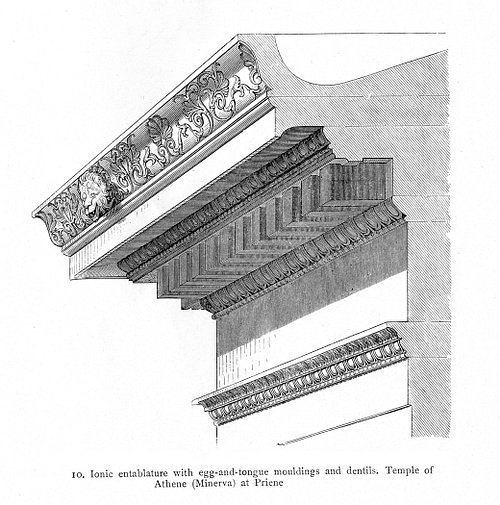 Cornice, Temple of Athena, Priene S. R. Koehler (Public Domain) ](https://www.worldhistory.org/image/1090/cornice-temple-of-athena-priene/ "Cornice, Temple of Athena, Priene")**Architrave** - the lowest part of the entablature, the part below the frieze.
[  Temple of Nike, Athens Mark Cartwright (CC BY-NC-SA) ](https://www.worldhistory.org/image/3292/temple-of-nike-athens/ "Temple of Nike, Athens")**Amphiprostyle Temple** - when both façades have columns, e.g.: the temple of Nike, [Athens](https://www.worldhistory.org/Athens/).
[  Phrygian Captive, Corinth Mark Cartwright (CC BY-NC-SA) ](https://www.worldhistory.org/image/517/phrygian-captive-corinth/ "Phrygian Captive, Corinth")**Atlantide** - a sculpted male figure acting as a column to support an entablature, named after [Atlas](https://www.worldhistory.org/Atlas/).
[  Arch of Constantine I (South Side) Mark Cartwright (CC BY-NC-SA) ](https://www.worldhistory.org/image/1270/arch-of-constantine-i-south-side/ "Arch of Constantine I (South Side)")**Attic Story** - the part placed above the entablature of a building, e.g.: often seen in triumphal arches.
[  Roman Buttress isawnyu (CC BY) ](https://www.worldhistory.org/image/1093/roman-buttress/ "Roman Buttress")**Buttress** - a mass placed to support a [wall](https://www.worldhistory.org/wall/), especially when the wall bears an arch or heavy weight. Flying buttresses support a weight over space and allow for walls to be weakened by the inclusion of niches and windows.
[  Corinthian Capital Mark Cartwright (CC BY-NC-SA) ](https://www.worldhistory.org/image/388/corinthian-capital/ "Corinthian Capital")**Capital** - the crown which joins the top of a column with the abacus and aids in distributing weight. Different types include the simple convex Doric and the highly decorative Corinthian with stylized acanthus leaves.
[  Caryatids of the Erechtheion Dennis Jarvis (CC BY-NC-SA) ](https://www.worldhistory.org/image/975/caryatids-of-the-erechtheion/ "Caryatids of the Erechtheion")**[Caryatid](https://www.worldhistory.org/Caryatid/)** - a sculpted female figure acting as a column to support an entablature, e.g.: in the [Erechtheion](https://www.worldhistory.org/Erechtheion/).
[  Theatre of Delphi Mark Cartwright (CC BY-NC-SA) ](https://www.worldhistory.org/image/415/theatre-of-delphi/ "Theatre of Delphi")**Cavea** - the seated area of a [theatre](https://www.worldhistory.org/disambiguation/theatre/), usually built into a natural slope.
[  Plan of the Parthenon S. R. Koehler (Public Domain) ](https://www.worldhistory.org/image/944/plan-of-the-parthenon/ "Plan of the Parthenon")**Cella** - the inner area of a temple, usually rectangular and without windows, sometimes columned. Often subdivided into smaller rooms, the largest of which often housed a large cult statue to a particular deity.
[  The Classical Orders of Architecture Simeon Netchev (CC BY-NC-ND) ](https://www.worldhistory.org/image/948/the-classical-orders-of-architecture/ "The Classical Orders of Architecture")**Column** - used to support the abacus and architrave without the necessity of a wall. There are several types including the simple and earliest the Doric. They may also be free-standing and often commemorate significant historical events such as [Trajan's Column](https://www.worldhistory.org/Trajans_Column/).
**Conch** - also known as an apse, a recess in a wall often highly decorated or containing a statue.
[  Cornice Mark Cartwright (CC BY-NC-SA) ](https://www.worldhistory.org/image/1312/cornice/ "Cornice")**Cornice** - the decorative projecting part at the top of the entablature which also aided in drainage of rainwater.
[  Crepidoma, Temple of Zeus, Olympia Joanbanjo (CC BY-SA) ](https://www.worldhistory.org/image/1098/crepidoma-temple-of-zeus-olympia/ "Crepidoma, Temple of Zeus, Olympia")**Crepidoma** - also crēpis, the three steps on which stand the columns of a temple. The final top step is known as the stylobate.
[  Aerial View of the Temple of Apollo, Miletus Carole Raddato (CC BY-SA) ](https://www.worldhistory.org/image/1099/aerial-view-of-the-temple-of-apollo-miletus/ "Aerial View of the Temple of Apollo, Miletus")**Decastyle Temple** - with ten columns at each façade, e.g.: the temple of [Apollo](https://www.worldhistory.org/apollo/) Didymaeus at Miletus.
[  Dentils Mark Cartwright (CC BY-NC-SA) ](https://www.worldhistory.org/image/1308/dentils/ "Dentils")**Dentils** - a regular series of squares or rectangles used to decorate cornices.
[ 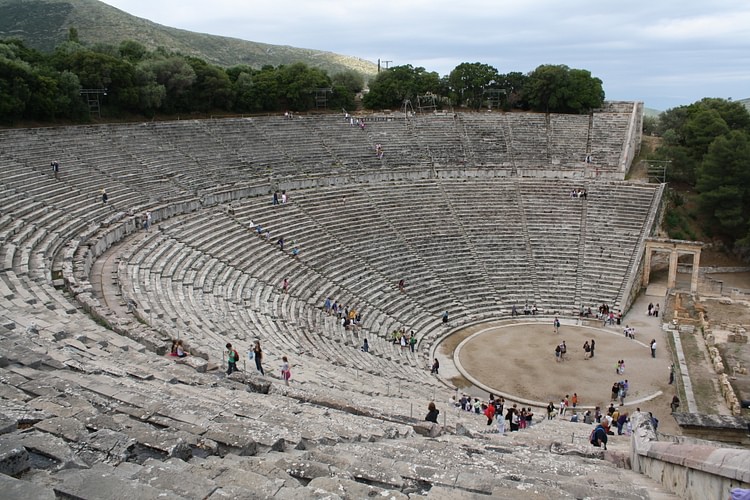 Seating of the Theatre of Epidaurus Mark Cartwright (CC BY-NC-SA) ](https://www.worldhistory.org/image/482/seating-of-the-theatre-of-epidaurus/ "Seating of the Theatre of Epidaurus")**Diazoma** - the walkway which horizontally divides the seats in a theatre.
**Dipteral Temple** - when there are a double row of columns on all sides, e.g.: the [Parthenon](https://www.worldhistory.org/parthenon/).
**Dodecastyle Temple** - with twelve columns at each façade.
[  Treasury of Atreus, Mycenae Mark Cartwright (CC BY-NC-SA) ](https://www.worldhistory.org/image/461/treasury-of-atreus-mycenae/ "Treasury of Atreus, Mycenae")**Dromos** - the monumental unroofed and walled entrance to a [tomb](https://www.worldhistory.org/tomb/), e.g. at [Mycenae](https://www.worldhistory.org/mycenae/).
[  Column Drums, Olympia Mark Cartwright (Copyright) ](https://www.worldhistory.org/image/1088/column-drums-olympia/ "Column Drums, Olympia")**Drum** - the individual circular pieces used to construct some types of columns.
[  Egg and Dart Ornamentation Mark Cartwright (CC BY-NC-SA) ](https://www.worldhistory.org/image/2091/egg-and-dart-ornamentation/ "Egg and Dart Ornamentation")**Egg and Dart Ornamentation** - a typical feature of decoration on cornices.
[  Temple of Portunus, Rome Mark Cartwright (CC BY-NC-SA) ](https://www.worldhistory.org/image/1310/temple-of-portunus-rome/ "Temple of Portunus, Rome")**Engaged Columns** - columns which are incorporated within a wall.
[  Architrave, Capitolium, Brixia Mark Cartwright (CC BY-NC-SA) ](https://www.worldhistory.org/image/381/architrave-capitolium-brixia/ "Architrave, Capitolium, Brixia")**Entablature** - the structure which lies horizontally above columns and which is composed of the architrave, frieze and cornice.
[  Doric Temple of Juno, Agrigento Chiara Marra (CC BY) ](https://www.worldhistory.org/image/1103/doric-temple-of-juno-agrigento/ "Doric Temple of Juno, Agrigento")**Entasis** - the swelling of a column at its base and centre to give the illusion of being perfectly straight.
[  Column Flutes, Parthenon Mark Cartwright (CC BY-NC-SA) ](https://www.worldhistory.org/image/3293/column-flutes-parthenon/ "Column Flutes, Parthenon")**Flute** - the curved vertical channel carved in a column.
[  Gigantomachy, Treasury of the Siphians, Delphi Mark Cartwright (CC BY-NC-SA) ](https://www.worldhistory.org/image/417/gigantomachy-treasury-of-the-siphians-delphi/ "Gigantomachy, Treasury of the Siphians, Delphi")**Frieze** - the widest and central part of the entablature often richly decorated with relief [sculpture](https://www.worldhistory.org/disambiguation/Sculpture/).
[  Roman Temple, Nimes, France Mark Cartwright (CC BY-NC-SA) ](https://www.worldhistory.org/image/402/roman-temple-nimes-france/ "Roman Temple, Nimes, France")**Hexastyle Temple** - with six columns at each façade, e.g. the Maison Carré at Nimes.
[  Treasury of The Athenians, Delphi Mark Cartwright (CC BY-NC-SA) ](https://www.worldhistory.org/image/436/treasury-of-the-athenians-delphi/ "Treasury of The Athenians, Delphi")**in antis** - when the walls of a portico extend in line with the façade columns.
[  Inner Archway, Arch of Titus Mark Cartwright (CC BY-NC-SA) ](https://www.worldhistory.org/image/1285/inner-archway-arch-of-titus/ "Inner Archway, Arch of Titus")**Intrados** - the inner surface of an arch.
[  Hercules & The Cretan Bull Mark Cartwright (CC BY-NC-SA) ](https://www.worldhistory.org/image/440/hercules--the-cretan-bull/ "Hercules & The Cretan Bull")**Metope** - a square space in the frieze between two triglyphs, often filled with relief sculpture or ornaments such as shields.
[  Monolithic Columns, Corinth Mark Cartwright (Copyright) ](https://www.worldhistory.org/image/1094/monolithic-columns-corinth/ "Monolithic Columns, Corinth")**Monolithic Column** - a column carved from a single piece of stone.
[  Temple of Baachus, Baalbek Jerzy Strzelecki (CC BY-SA) ](https://www.worldhistory.org/image/1318/temple-of-baachus-baalbek/ "Temple of Baachus, Baalbek")**Octastyle Temple** - with eight columns at each façade, e.g.: the temple of [Bacchus](https://www.worldhistory.org/Bacchus/) at [Baalbek](https://www.worldhistory.org/Baalbek/).
**Opisthodomos** - The small room at the rear of a temple commonly used as a treasury.
[  Theatre Parodoi, Epidaurus Mark Cartwright (Copyright) ](https://www.worldhistory.org/image/1087/theatre-parodoi-epidaurus/ "Theatre Parodoi, Epidaurus")**Parodoi** - the large arched gateways, either side of the skēnē, through which an audience entered a theatre.
[  The Zanes, Olympia Mark Cartwright (CC BY-NC-SA) ](https://www.worldhistory.org/image/427/the-zanes-olympia/ "The Zanes, Olympia")**Pedestal** - the block on which stands a column or statue, composed of the plinth, torus, dado and fascia.
[  Pediment, Pantheon Mark Cartwright (CC BY-NC-SA) ](https://www.worldhistory.org/image/1307/pediment-pantheon/ "Pediment, Pantheon")**Pediment** - the triangular space above the entablature at the short sides of a temple. Often richly decorated with sculpture in the round.
[  Parthenon, East Facade Mark Cartwright (CC BY-NC-SA) ](https://www.worldhistory.org/image/3372/parthenon-east-facade/ "Parthenon, East Facade")**Peripteral Temple** - when all four external sides have columns.
[  Peristyle Sailko (CC BY-SA) ](https://www.worldhistory.org/image/1314/peristyle/ "Peristyle")**Peristyle** - the rows of columns which surround a temple or courtyard.
[  Pilaster Columns Mark Cartwright (CC BY-NC-SA) ](https://www.worldhistory.org/image/1309/pilaster-columns/ "Pilaster Columns")**Pilaster** - an ornamental column carved in relief on a wall surface.
[  Portico, Pantheon Mark Cartwright (CC BY-NC-SA) ](https://www.worldhistory.org/image/1311/portico-pantheon/ "Portico, Pantheon")**Portico** - a space for walking, usually columned, e.g.: at the front of a temple.
[  Pronaos Benutzer:Ronaldo (Public Domain) ](https://www.worldhistory.org/image/1313/pronaos/ "Pronaos")**Pronaos** - the space between the outer columns and cella entrance in a temple.
[  Athenian Propylaea Reconstruction Immanuel Gial (Public Domain) ](https://www.worldhistory.org/image/1317/athenian-propylaea-reconstruction/ "Athenian Propylaea Reconstruction")**[Propylon](https://www.worldhistory.org/Propylaea/)** - the monumental gateway to a religious sanctuary or defined space. Often incorporating several separate entrances ([propylaia](https://www.worldhistory.org/Propylaea/)).
[  Treasury of The Athenians, Delphi Mark Cartwright (CC BY-NC-SA) ](https://www.worldhistory.org/image/436/treasury-of-the-athenians-delphi/ "Treasury of The Athenians, Delphi")**Prostyle** - a temple with columns only at the front façade.
[ 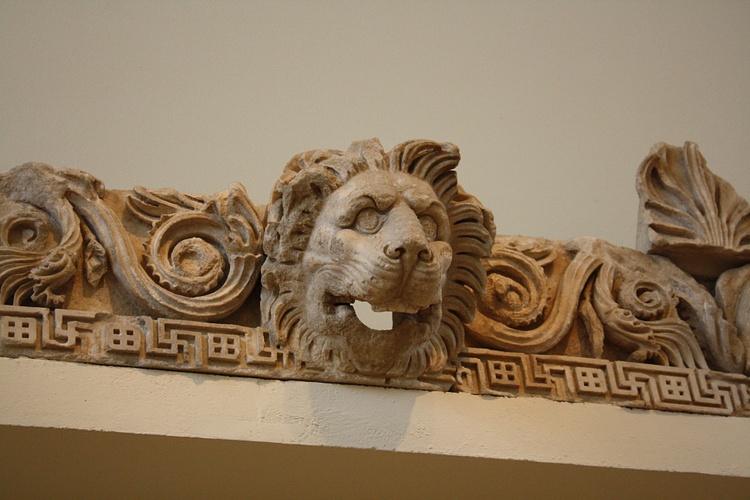 Lion-shaped Sima Mark Cartwright (CC BY-NC-SA) ](https://www.worldhistory.org/image/3295/lion-shaped-sima/ "Lion-shaped Sima")**Sima** - the gutter which collected rainwater from the roof of a temple, often containing decorative spouts at regular intervals.
[ 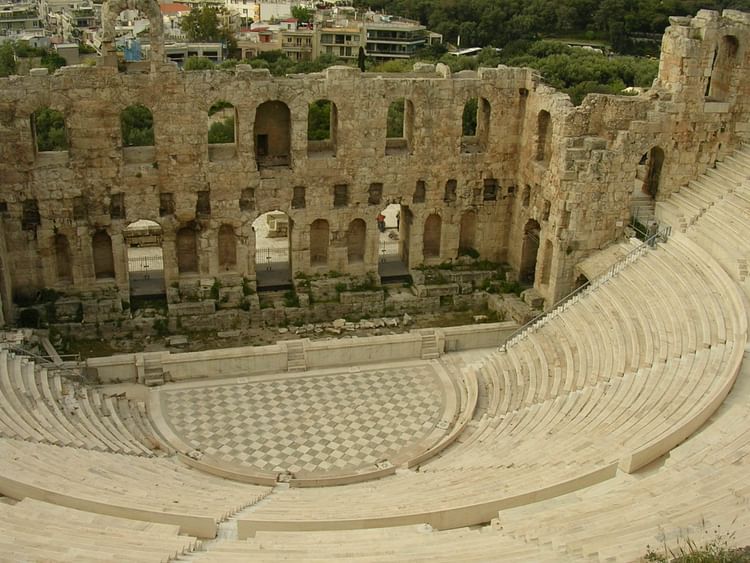 Odeon Of Herodes Atticus, Athens Mark Cartwright (CC BY-NC-SA) ](https://www.worldhistory.org/image/405/odeon-of--herodes-atticus-athens/ "Odeon Of Herodes Atticus, Athens")**Skēnē** - the background on a theatre stage, later examples were monumental in design.
[  Temple of Poseidon, Sounion, Greece Mark Cartwright (CC BY-NC-SA) ](https://www.worldhistory.org/image/362/temple-of-poseidon-sounion-greece/ "Temple of Poseidon, Sounion, Greece")**Stereobate** - the surface on which the stylobate stands.
**Stoa** - a long and narrow columned building often used to enclose a particular space at religious sites and public places such as markets and gymnasia. Used as a meeting place and shelter from the weather.
**Stylobate** - the foundation on which a row of columns stand. Often slightly curved to aid drainage.
**Tetrastyle Temple** - with four columns at each façade.
[ 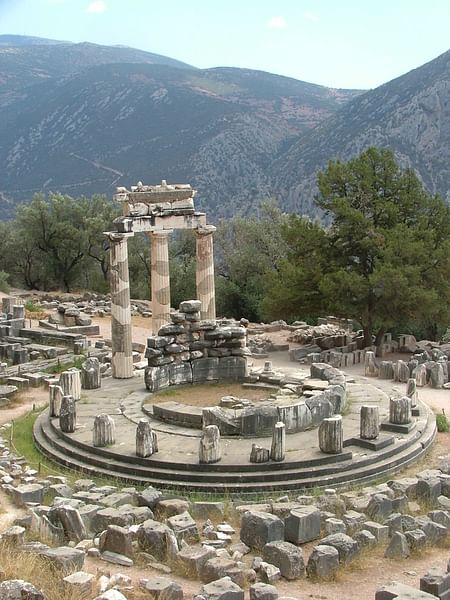 Tholos of Delphi Kufoleto (CC BY-SA) ](https://www.worldhistory.org/image/1315/tholos-of-delphi/ "Tholos of Delphi")**Tholos** - A circular-shaped temple, the most famous example being at [Delphi](https://www.worldhistory.org/delphi/).
[ 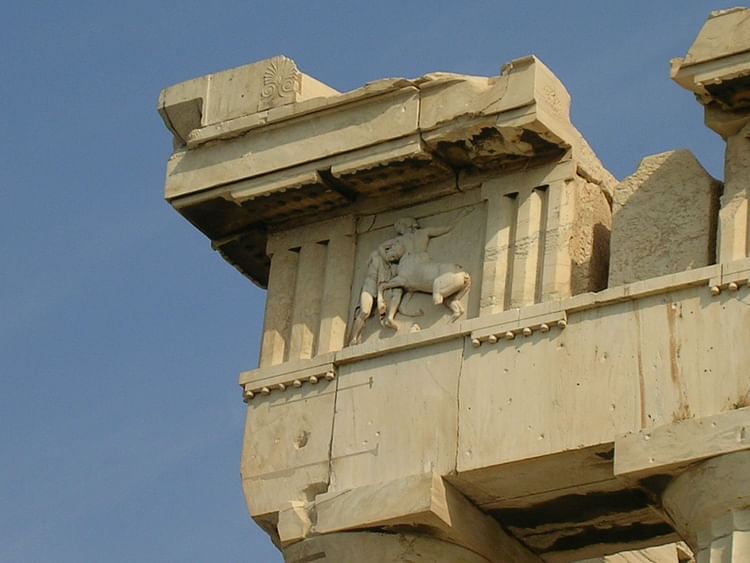 Entablature with Metope and Triglyphs Mark Cartwright (CC BY-NC-SA) ](https://www.worldhistory.org/image/385/entablature-with-metope-and-triglyphs/ "Entablature with Metope and Triglyphs")**Triglyph** - a decorative element of a frieze with two vertical grooves. Often used in alteration with metopes.
[  Arch of Constantine I Mark Cartwright (CC BY-NC-SA) ](https://www.worldhistory.org/image/1266/arch-of-constantine-i/ "Arch of Constantine I")**[Triumphal Arch](https://www.worldhistory.org/Triumphal_Arch/)** - a monumental archway to commemorate [Roman military](https://www.worldhistory.org/Roman_Army/) victories and other significant events.
[  Ionic Capital Mark Cartwright (CC BY-NC-SA) ](https://www.worldhistory.org/image/384/ionic-capital/ "Ionic Capital")**Volutes** - the scrolls of an Ionic capital.
#### Editorial Review
This human-authored article has been reviewed by our editorial team before publication to ensure accuracy, reliability and adherence to academic standards in accordance with our [editorial policy](https://www.worldhistory.org/static/editorial-policy/).
## Bibliography
- Ananiades D. *Ancient Greece: Temples & Sanctuaries.* Toubis, Athens, 2010
- [John Summerson. *The Classical Language of Architecture.* The MIT Press, 1992.](https://www.worldhistory.org/books/B006QETIZC/)
- [Mortimer Wheeler. *Roman Art and Architecture.* Thames & Hudson, 1985.](https://www.worldhistory.org/books/0500200211/)
- [Simon Hornblower. *The Oxford Classical Dictionary.* Oxford University Press, USA, 2012.](https://www.worldhistory.org/books/0199545561/)
- Vitruvius. *On Architecture.* Penguin, London, 2009
## About the Author
Mark is WHE’s Publishing Director and has an MA in Political Philosophy (University of York). He is a full-time researcher, writer, historian and editor. Special interests include art, architecture and discovering the ideas that all civilizations share.
## Cite This Work
### APA
Cartwright, M. (2013, March 10). A Visual Glossary of Classical Architecture. *World History Encyclopedia*.
### Chicago
Cartwright, Mark. "A Visual Glossary of Classical Architecture." *World History Encyclopedia*, March 10, 2013. .
### MLA
Cartwright, Mark. "A Visual Glossary of Classical Architecture." *World History Encyclopedia*, 10 Mar 2013, .
## License & Copyright
Submitted by [Mark Cartwright](https://www.worldhistory.org/user/markzcartwright/ "User Page: Mark Cartwright"), published on 10 March 2013. The copyright holder has published this content under the following license: [Creative Commons Attribution-NonCommercial-ShareAlike](https://creativecommons.org/licenses/by-nc-sa/4.0/deed.en). This license lets others remix, tweak, and build upon this content non-commercially, as long as they credit the author and license their new creations under the identical terms. When republishing on the web a hyperlink back to the original content source URL must be included. Please note that content linked from this page may have different licensing terms.